
AssemblyAI streaming costs $0.45 an hour for Universal-3.6 Pro Realtime and $0.15 for Universal-Streaming, so a five-minute call costs about 4 or 1 cents. It bills open session time, so idle time counts. Dograh, the open-source AI voice agent platform we build, runs AssemblyAI on your own key. You can self-host it or run it on Dograh Cloud.
Key Takeaways
- Universal-3.6 Pro Realtime costs $0.0075 a minute, Universal-Streaming $0.0025.
- AssemblyAI bills open session time, so silence and idle connections cost money.
- Add-ons like diarization apply to the whole session, not only speech.
AssemblyAI lists its speech-to-text prices per hour, but a voice agent pays per call. This guide turns the streaming and batch rates into cost per call minute, shows how add-ons and idle time change the bill, and ends with how AssemblyAI runs inside an open-source voice agent.
AssemblyAI's streaming and batch rates
AssemblyAI sells two kinds of speech-to-text, and only one can run a live call. AssemblyAI's pricing lists streaming models, which transcribe while the caller speaks, and batch models, which transcribe a finished recording.
| Model | Type | Price per hour | Price per minute |
|---|---|---|---|
| Universal-3.6 Pro Realtime | Streaming | $0.45 | $0.0075 |
| Universal-Streaming English | Streaming | $0.15 | $0.0025 |
| Universal-Streaming Multilingual | Streaming | $0.15 | $0.0025 |
| Universal-3.5 Pro | Batch | $0.21 | $0.0035 |
| Universal-2 | Batch | $0.15 | $0.0025 |
The "$0.15 an hour" figure that many pricing roundups lead with is real, but it is the rate for Universal-Streaming and for Universal-2 batch. A voice agent that runs on AssemblyAI's top streaming model, Universal-3.6 Pro Realtime, pays three times that.
Volume pricing below these list rates goes through AssemblyAI's sales team. The EU endpoint costs the same as the US one.
From hourly rates to cost per call minute
Divide the hourly rate by 60 and you have the cost of one minute of an open streaming session. That per-minute figure is what you multiply by your call length and call count, and it is the number to compare with every other line on a voice agent bill. Here are labelled examples built on a five-minute call:
| Example | Universal-3.6 Pro Realtime | Universal-Streaming |
|---|---|---|
| One five-minute call | 5 x $0.0075 = $0.0375 | 5 x $0.0025 = $0.0125 |
| 1,000 five-minute calls (5,000 minutes) | $37.50 | $12.50 |
| 10,000 five-minute calls (50,000 minutes) | $375 | $125 |
At these numbers, speech-to-text is a small line next to the language model, the voice and the phone minutes. That changes once add-ons and idle time come in, and both show up on every call rather than on some.
For a monthly view, take a clinic line that answers 200 calls a day, averaging four minutes, for 30 days. That is 24,000 minutes, or $180 a month on Universal-3.6 Pro Realtime and $60 on Universal-Streaming, before add-ons and idle time.
Pick the model by what it hears, then check the price. A lower-rate stream that mishears an account number costs more in failed calls than it saves on the meter.
Add-ons bill for the whole session
AssemblyAI prices features as per-hour add-ons, and they run for the whole session. The rate card says streaming add-ons "apply to the entire session", so an add-on bills through silence and hold time as well as speech. On a call with long pauses, that makes an add-on cost more per spoken minute than its hourly rate suggests.
| Add-on | Price per hour | Notes |
|---|---|---|
| Keyterms | Included on Universal-3.6 Pro, +$0.04 on Universal-Streaming English | Up to 100 terms on Universal-3.6 Pro |
| Diarization | +$0.12 | Tells speakers apart |
| Medical Mode | +$0.15 | Universal-3.6 Pro plus Medical comes to $0.60 an hour |
| Voice Focus | +$0.10 | Universal-3.6 Pro only |
Here is a labelled example. The same five-minute call on Universal-3.6 Pro with diarization costs ($0.45 + $0.12) / 60 x 5 = $0.0475. A thousand of those calls with Medical Mode instead come to $50.
A phone agent usually hears one caller on one channel, so diarization often adds cost without adding much. Medical Mode is worth testing for clinics where drug names matter, and keyterms are where brand names and product codes go.
How idle time gets billed
This is the rule most price comparisons skip. AssemblyAI's rate card says streaming is "billed on WebSocket session duration, open-to-close time, not audio sent." It adds: "Idle time counts. A WebSocket held open for 5 minutes between calls = 5 billable minutes."
The rate card gives a second example. A session open for 60 minutes with 30 minutes of audio sent is billed for 60 minutes. Speech, silence and hold music all cost the same per minute while the connection is open.
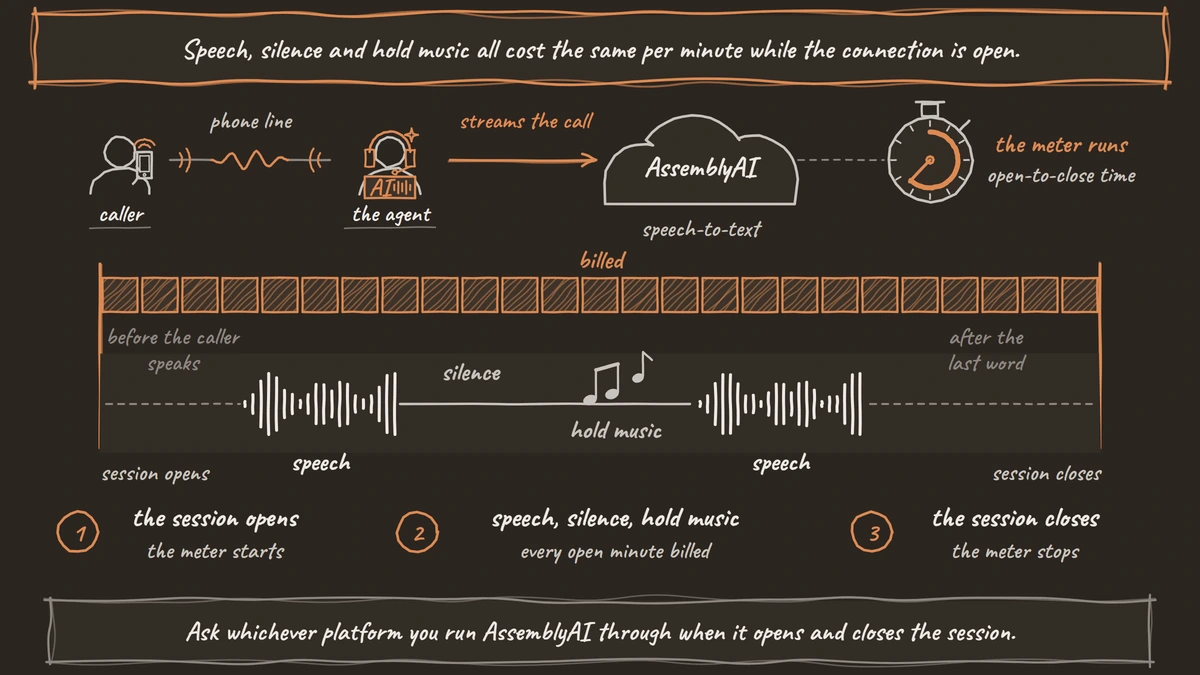
The examples below show what that means on real calls, as illustrations of AssemblyAI's stated rule.
- Before and after the call. If a session opens 10 seconds before the caller speaks and closes 20 seconds after the last word, those 30 seconds bill too. On Universal-3.6 Pro that adds $0.00375 to each call, or 500 extra minutes and $3.75 across 1,000 calls.
- Silence inside the call. A caller who goes to find a policy number for a minute costs the same minute as one who talks the whole time.
- Sessions left open between calls. A session held open for five minutes between calls adds five billable minutes, $0.0375 on Universal-3.6 Pro, with nobody on the line.
The last one is the expensive one, because it scales with mistakes rather than with calls. A platform that reuses one session across calls, or fails to close it when a caller leaves the call, pays for the gap every time. Ask whichever platform you run AssemblyAI through when it opens and closes the session.
You can check this on your own bill. Add up the call minutes in your phone provider's logs for a week, then compare them with the streaming hours on your AssemblyAI usage page for the same week. A small gap is the seconds around each call. A large gap means sessions are staying open when no call is running.

Open Source Alternative to Vapi / Retell
Self-hosted voice agent platform — no per-minute fees
dograh-hq/dograh
Star on GitHub
Streaming or batch for call transcripts
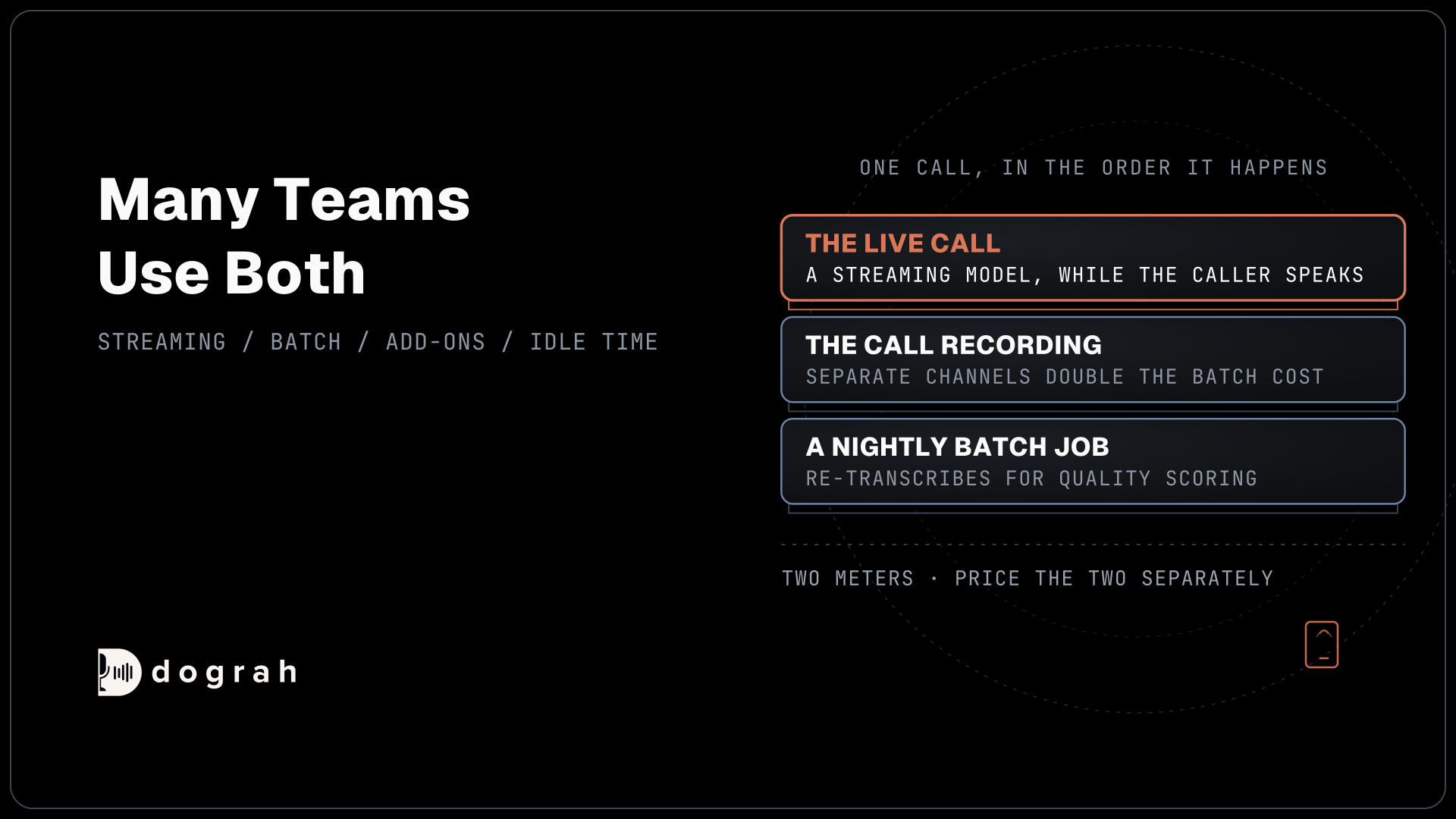
Batch is for recordings after the call, not for a live agent. A voice agent has to hear the caller while they speak, so it needs a streaming model.
Batch still has a place. If you transcribe recorded calls for quality review or analytics, Universal-3.5 Pro costs $0.21 an hour. Here is a labelled example: 5,000 minutes of recordings on Universal-3.5 Pro cost 5,000 / 60 x $0.21 = $17.50, against $37.50 for the same minutes streamed on Universal-3.6 Pro.
Batch has its own meter rule. Multichannel files bill per channel, so a one-hour stereo recording split into two channels bills as two hours. A call recording with the caller and the agent on separate channels doubles the batch cost.
Many teams use both. The live agent streams, and a nightly batch job re-transcribes the recordings on a model tuned for accuracy, for quality scoring or for training data. Price the two separately, because they run on different meters.
Free credit, limits and compliance
AssemblyAI is easy to start on. New accounts get $50 in free credit with no card, enough for about 111 hours of Universal-3.6 Pro Realtime or 333 hours of Universal-Streaming.
The limit to watch is how fast you open streams, not how many run at once. The free tier allows 5 new streams a minute, and pay as you go allows 100 new streams a minute with no spend commitment. An outbound campaign that starts many calls in the same minute should plan around that.
Compliance comes without a sales call. AssemblyAI says its HIPAA business associate agreement is signable in minutes, with no premium pricing, and lists ISO 27001, SOC 2 Type 2 and GDPR. Teams that need audio processed in Europe can use the EU endpoint at the same price as the US one.
AssemblyAI's meter next to Deepgram's
The two meters differ more than the rates. Deepgram's pricing lists $0.0077 a minute on pay as you go for Nova-3 monolingual and Flux English, billed per second of audio with no block rounding. AssemblyAI's Universal-3.6 Pro Realtime lists $0.0075 a minute, billed on open session time.
So on a call where the session closes the moment the caller leaves, the two cost almost the same. On a setup that leaves sessions open, AssemblyAI costs more than the rate suggests. Our head-to-head of Deepgram vs AssemblyAI compares them on turn detection, languages and accuracy too.
The volume limits differ in shape as well. Deepgram caps concurrent streams, at 150 on pay as you go. AssemblyAI caps how many new streams you can open each minute, at 100. An inbound line rarely hits either. A dialer that starts hundreds of calls at nine in the morning should check both.
Join the Dograh Community
Dograh is an OSS alternative to Vapi. Join our Slack community for queries, releases, best practices & community interactions.
Running AssemblyAI in Dograh
Dograh has AssemblyAI built in as a speech-to-text provider you use with your own key, set in model configurations. The AssemblyAI bill goes to your own AssemblyAI account.
The AssemblyAI option in Dograh is u3-rt-pro, AssemblyAI's Universal-3 Pro streaming model, in English, Spanish, German, French, Portuguese and Italian. The Universal-3.6 Pro Realtime rate above is for AssemblyAI's newer model, so check your own AssemblyAI usage page for what u3-rt-pro sessions cost on your account.
On the idle-time question, Dograh's AssemblyAI connection sends AssemblyAI's Terminate message when a call ends or is cancelled, so the session closes with the call rather than staying open until the next one. Each call's trace shows the speech-to-text time for every turn, which you can set against your AssemblyAI usage. Our guide to voice agent call traces shows how to read them.
Brand names go in the agent's Dictionary, which Dograh passes to AssemblyAI as its keyterms prompt. If AssemblyAI is not the right fit, switching to Deepgram, Speechmatics, Soniox, Gladia or a local open-source model is a settings change, explained in the transcriber settings. A local model running on your own servers has no per-hour speech bill at all, only the cost of the hardware.
Self-hosted Dograh has no per-minute platform fee, but servers, model keys and phone minutes still cost money. Dograh Cloud charges a 1¢-a-minute platform fee. Our roundup of speech-to-text APIs for voice agents compares AssemblyAI's rates with the other providers you can plug in.
Run AssemblyAI on 20 to 30 of your own recorded calls first, and compare its usage line with your trace totals before you scale.
Glossary
- Open session time
- How long a streaming connection stays open, from open to close, whatever audio is sent. AssemblyAI bills streaming on it, so silence and idle time between calls are billed at the same rate as speech.
- Streaming model
- A speech-to-text model that returns words while the caller is still speaking. A live voice agent needs one, because it has to reply within a second or two.
- Batch model
- A speech-to-text model that transcribes a finished recording after the call. It suits quality review and analytics, and AssemblyAI prices it separately from streaming.
- Diarization
- Labelling which speaker said each part of a transcript. On AssemblyAI streaming it is a $0.12-an-hour add-on billed for the whole session.