
Cartesia makes Sonic text-to-speech voices and Ink speech-to-text, and both are strong, fast choices for voice agents. Test them on a real phone line and plan the agent around them, since Cartesia sells the models. For teams that want to own the platform around Sonic and Ink, Dograh runs both, self-hosted or on Dograh Cloud.
Key Takeaways
- Sonic 3.6 was 4th on the Speech Arena on 19 November 2026.
- Ink 2 covers five languages, and ink-preview covers 44 as a preview.
- Test Sonic on a real phone call, since most lines carry 8 kHz audio.
This review looks at what Cartesia does well and where it needs help, from Sonic's voice quality and speed to Ink, phone lines, pricing questions and what buyers say. We end with who Cartesia fits, then we talk about how Dograh runs Sonic and Ink as a partner.
What Cartesia makes
Cartesia makes two kinds of speech model for real-time apps. Sonic turns text into speech, and Ink turns a caller's speech into text. Both are sold as APIs on monthly plans, and Cartesia also sells Managed Agents, a hosted way to run a full voice agent on its own platform.
This review judges the models, since that is what most teams buy Cartesia for. Our walk-through of Cartesia's features covers voice cloning, the model list and Managed Agents in more detail.
Sonic 3.6 voice quality and speed
Sonic 3.6 is Cartesia's current voice model, and one model covers 44 languages. It is backward compatible with Sonic 3.5, so moving up is mostly a change of model name. Cartesia says Sonic gives first audio in under 90 ms.
On voice quality there is an independent check. On Artificial Analysis's Speech Arena, where listeners vote on clips without seeing the model names, Sonic 3.6 was 4th, as measured on 19 November 2026. Sonic 3.5 was 21st on the same day.
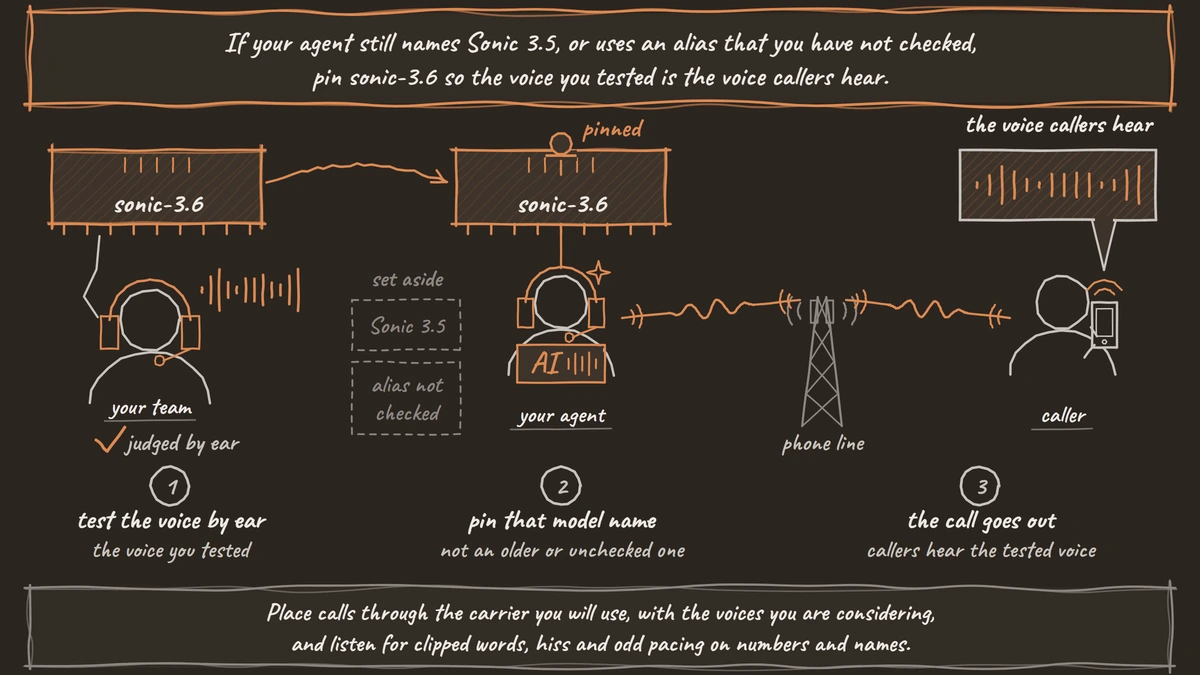
That gap is a practical point. If your agent still names Sonic 3.5, or uses an alias that you have not checked, pin sonic-3.6 so the voice you tested is the voice callers hear. Ranks move daily, so treat the board as a starting shortlist and judge the final pick by ear on your own calls.
Ink 2 and the new ink-preview
Ink 2 is Cartesia's stable speech-to-text model for English, French, Hindi, Japanese and Spanish. It sends turn events while the caller talks, so the agent can tell when a turn starts, pauses or ends without a separate voice activity detector.
Cartesia released ink-preview on 17 November 2026, and it covers 44 languages. Cartesia says the preview can change without notice and points production users to ink-2. For callers outside those five languages, plan on a different speech-to-text model for now and check back as the preview matures.

Open Source Alternative to Vapi / Retell
Self-hosted voice agent platform — no per-minute fees
dograh-hq/dograh
Star on GitHub
How Sonic holds up on a phone line
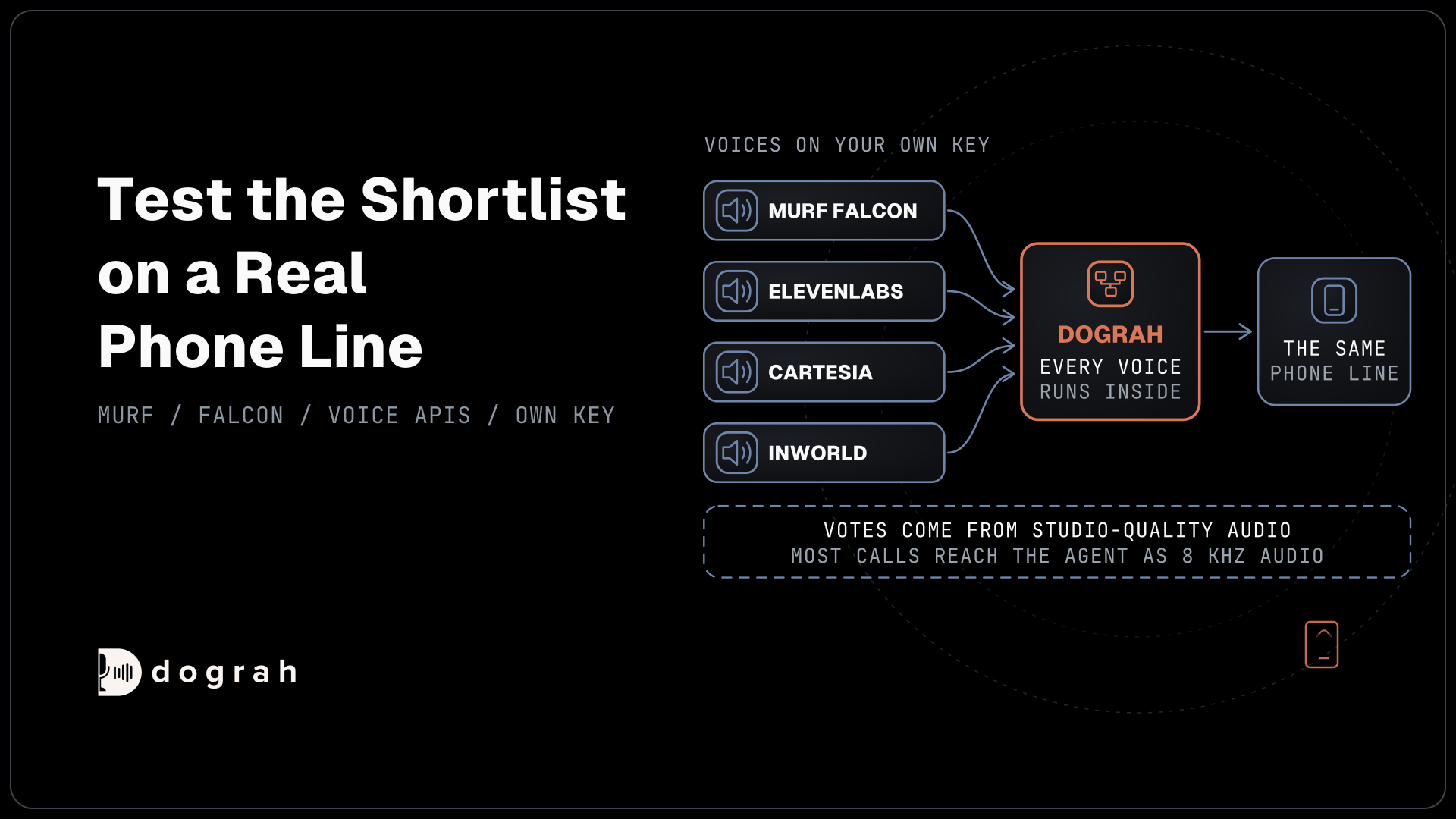
A browser demo plays at 16 kHz, but most phone calls still reach the agent as 8 kHz audio. Blind votes are cast on full-sound clips, so a voice that wins there loses some of its edge on a narrow phone line. How much depends on the voice and on the phone path, which is why a real call is the test that counts.
Place calls through the carrier you will use, with the voices you are considering, and listen for clipped words, hiss and odd pacing on numbers and names. Our comparison of Rime vs Cartesia goes deeper on phone audio formats and how each vendor handles 8 kHz.
Pricing and what to ask before you buy
Cartesia's plans run Free, Pro at $5, Startup at $49 and Scale at $299 a month, and our guide to Cartesia pricing works through the credits. What drives the bill is plain enough. Sonic spends about one credit per character spoken, Ink bills by the seconds of audio it hears, and each plan caps how many voice streams run at once, from 3 on Pro to 15 on Scale for text-to-speech.
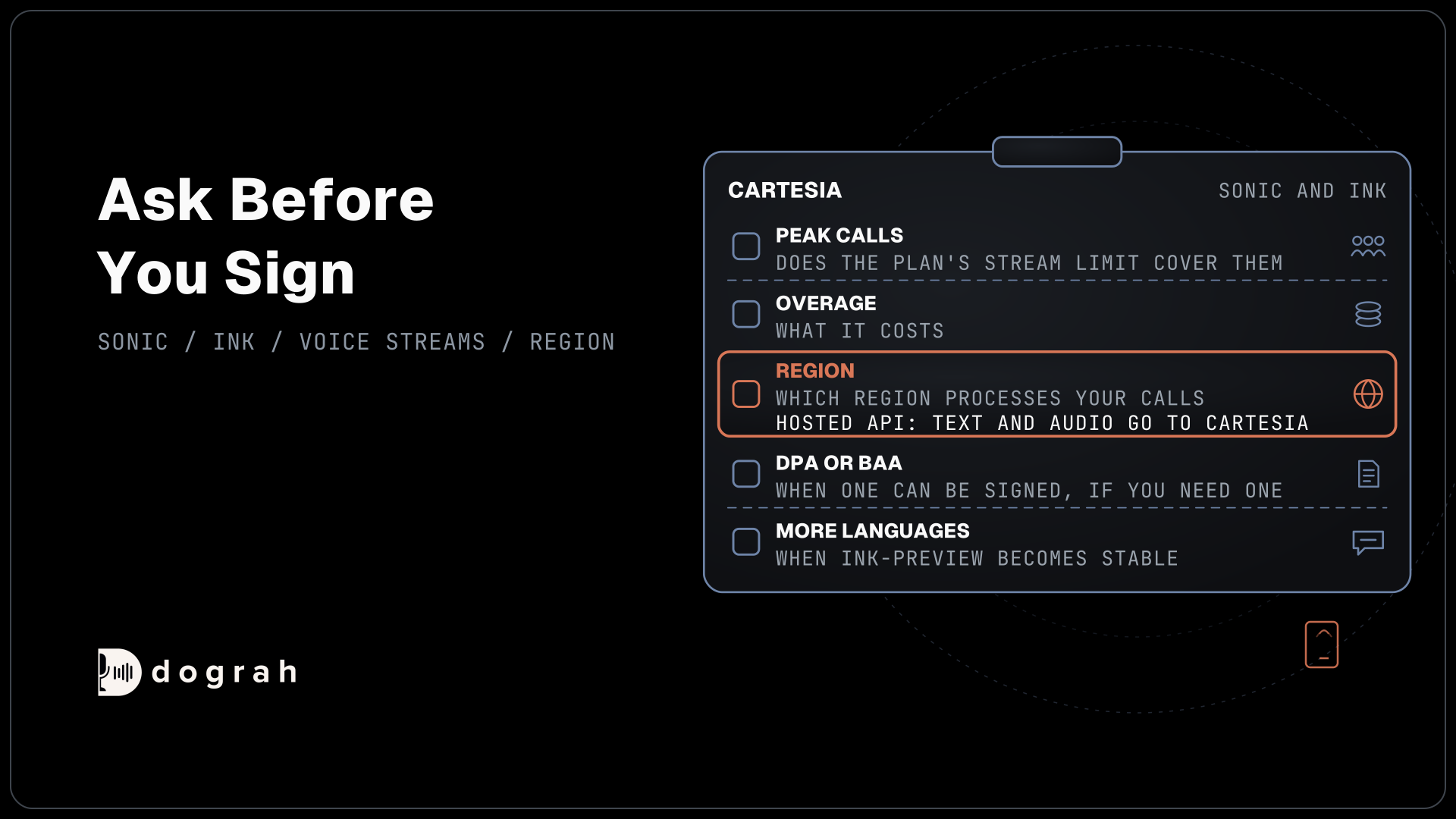
Before you sign, ask how many calls you will run at peak and whether the plan's stream limit covers them. Ask what overage costs, which region processes your calls, and when a DPA or BAA can be signed if you need one. If you are waiting on more languages, ask when ink-preview is expected to become stable.
Closed models and where your data goes
Sonic and Ink are closed models, so the weights are not public. On the hosted API, the text your agent speaks and the audio callers send go to Cartesia to be processed, which is normal for a speech API and worth a line in your data review.
For teams that need more control, Cartesia offers on-premise or private cloud deployment on Enterprise, along with DPAs, BAAs and SSO. Cartesia displays HIPAA, SOC 2 Type 2 and GDPR badges. Those terms go through Cartesia's sales team, so start the talk early if procurement needs them.
What buyers say, and one fair dissent
Buyer reviews are positive. On Product Hunt, Cartesia Sonic has 25 reviews with a 5.0 average, and the praise centers on fast responses, natural voices and how easy the API is to build on. It is a small sample, mostly from developers, and none of it covers phone-line results.
The fair dissent comes from eesel's Cartesia review. It calls Sonic "a developer API, not a business tool" and says it "doesn't handle the actual support workflow". Coming from a vendor that sells its own support product, the point still holds. Sonic is the voice, and someone has to build the agent around it.
Join the Dograh Community
Dograh is an OSS alternative to Vapi. Join our Slack community for queries, releases, best practices & community interactions.
Who Cartesia fits and who it does not
Cartesia fits teams that want a fast voice in many languages and are comfortable working with an API. It fits buyers who need the voice model itself on-premise or in a private cloud, and teams whose callers speak English, French, Hindi, Japanese or Spanish and want turn detection built into speech-to-text.
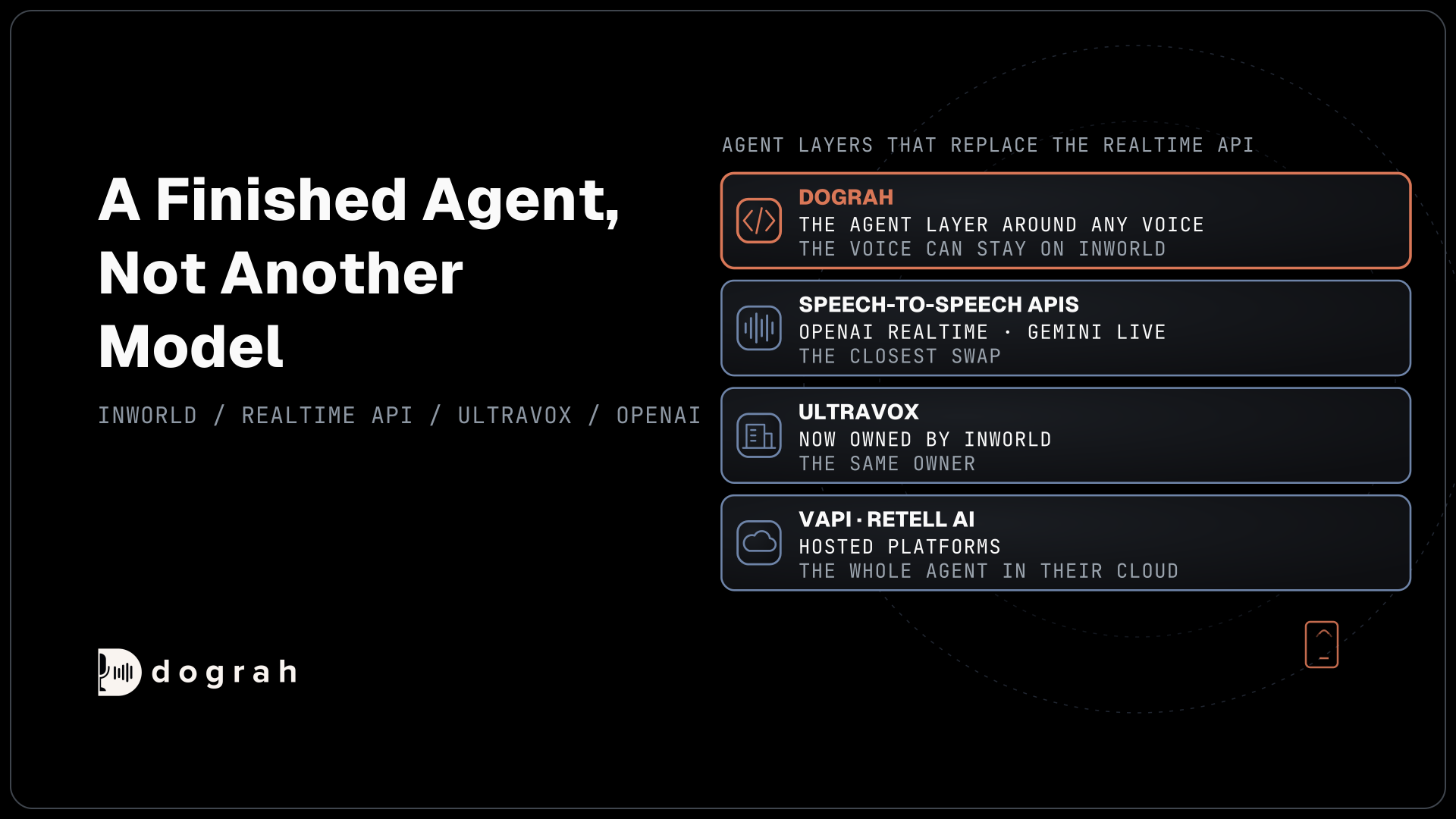
It fits less well when a team wants a finished agent without writing code, unless Managed Agents covers the job. It also fits less well for callers in languages Ink 2 does not cover yet, since ink-preview is still a preview. In both cases the models are rarely the problem. What is missing is the layer that runs the call.
Where Dograh fits
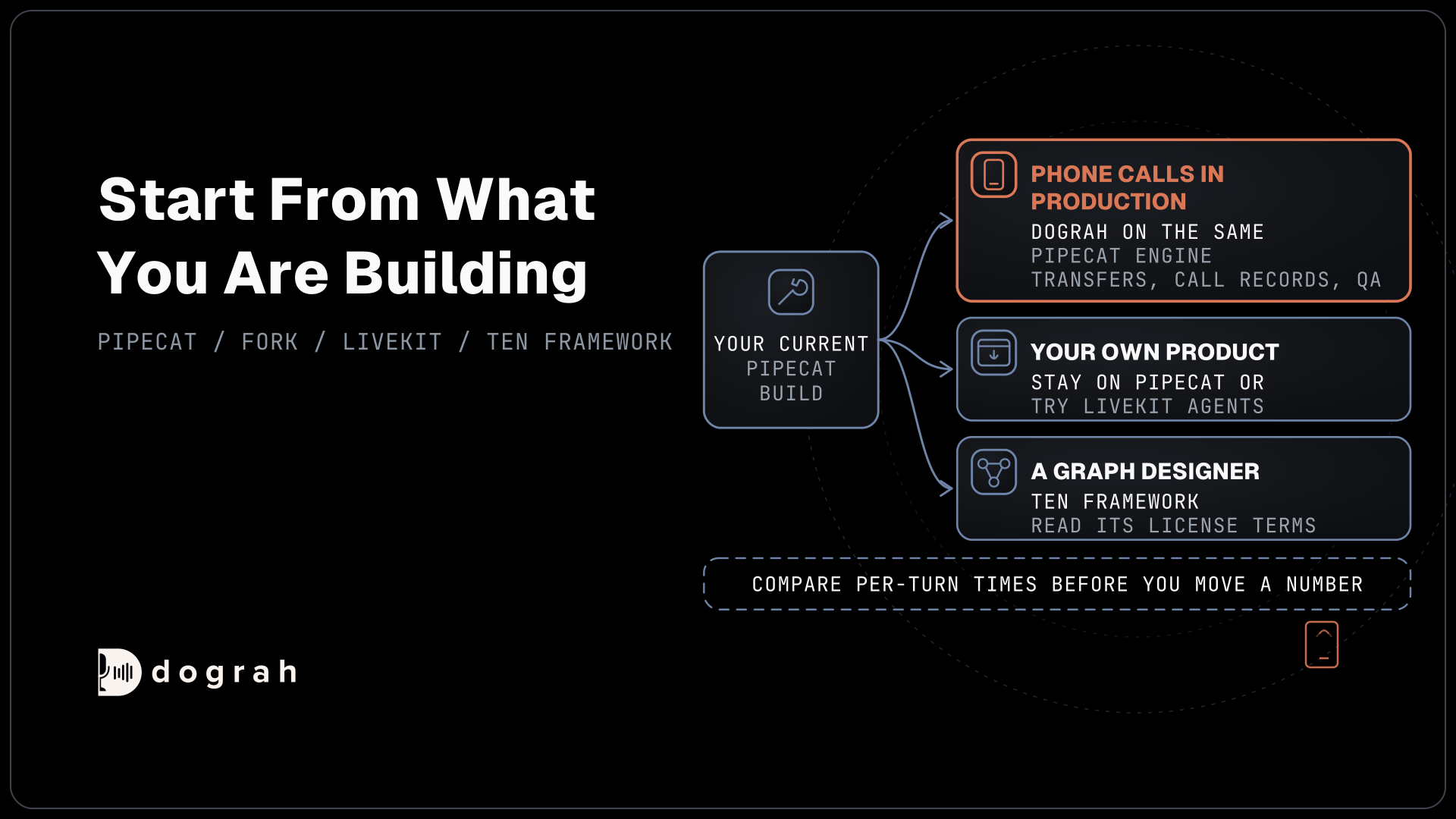
Dograh, the open-source AI voice agent platform, is that layer. Sonic is the voice and Ink the ears, and Dograh runs the call around them, with the call flow, tools, phone lines, Transfer Call and QA. Both are built-in voice and speech-to-text providers on your own Cartesia key. Sonic 3.6 is the default model, and each agent sets its voice, speed and volume in the Model tab.
For speech-to-text, Ink Whisper is the default and ink-2 runs in English in Dograh. Callers in other languages pair Sonic with Deepgram, Sarvam, Soniox or another speech-to-text provider. On Twilio, Telnyx, Plivo, Cloudonix and Asterisk ARI, Transfer Call dials the destination first and connects the caller only when someone answers. Our post on Dograh vs Cartesia walks through how the two work together.
A useful pattern is pre-recorded audio. Lines that never change play as recordings, and a Cartesia clone of the same speaker voices the rest, which saves characters and starts at once.
Cartesia bills Sonic and Ink on your own plan, and the platform is a separate line. A Dograh install you run with Docker Compose charges no per-minute platform fee. What you do pay for is servers, model keys and phone minutes, and your own engineers keep the database and upgrades current. Questions go to the open-source community, Enterprise adds custom SLAs, and Dograh Cloud runs the platform for a 1¢-a-minute platform fee with 10 calls at once.
Glossary
- Sonic 3.6
- Cartesia's current text-to-speech model, covering 44 languages from one model. It is backward compatible with Sonic 3.5 and is Dograh's default Cartesia voice model.
- ink-preview
- Cartesia's preview speech-to-text model, released 17 November 2026 with 44 languages. Cartesia says it can change without notice and points production use to ink-2.
- Speech Arena
- Artificial Analysis's blind-vote board for text-to-speech models. Listeners pick the better of two clips without seeing the model names, and ranks move daily.
- Turn events
- Signals a speech-to-text model sends as a caller starts, pauses or finishes speaking. Ink 2 sends them, so the agent knows when to reply.