
Brazilian Portuguese AI voice agents need speech-to-text that lists pt-BR and a pt-BR voice tested on Brazilian numbers, dates and accents. Calls also fall under the LGPD, Brazil's data protection law, and ANATEL's telemarketing rules. For teams that want to choose where call data lives, Dograh, the open-source AI voice agent platform, runs on their servers or Dograh Cloud.
Key Takeaways
- Pick providers that name pt-BR, since a plain pt code can mean European Portuguese.
- Have the prompt write reais, dates and CPF numbers out in words.
- The 0303 telemarketing prefix is optional now, but short-call blocking still applies.
A voice that sounds right in São Paulo can still misread R$ 1.250,00 or a CPF number. We cover pt-BR speech-to-text and voices, accent testing and number reading, then Brazil's calling and data rules. The last section shows how a Brazilian agent runs in Dograh on your own keys.
Speech-to-text that lists Brazilian Portuguese
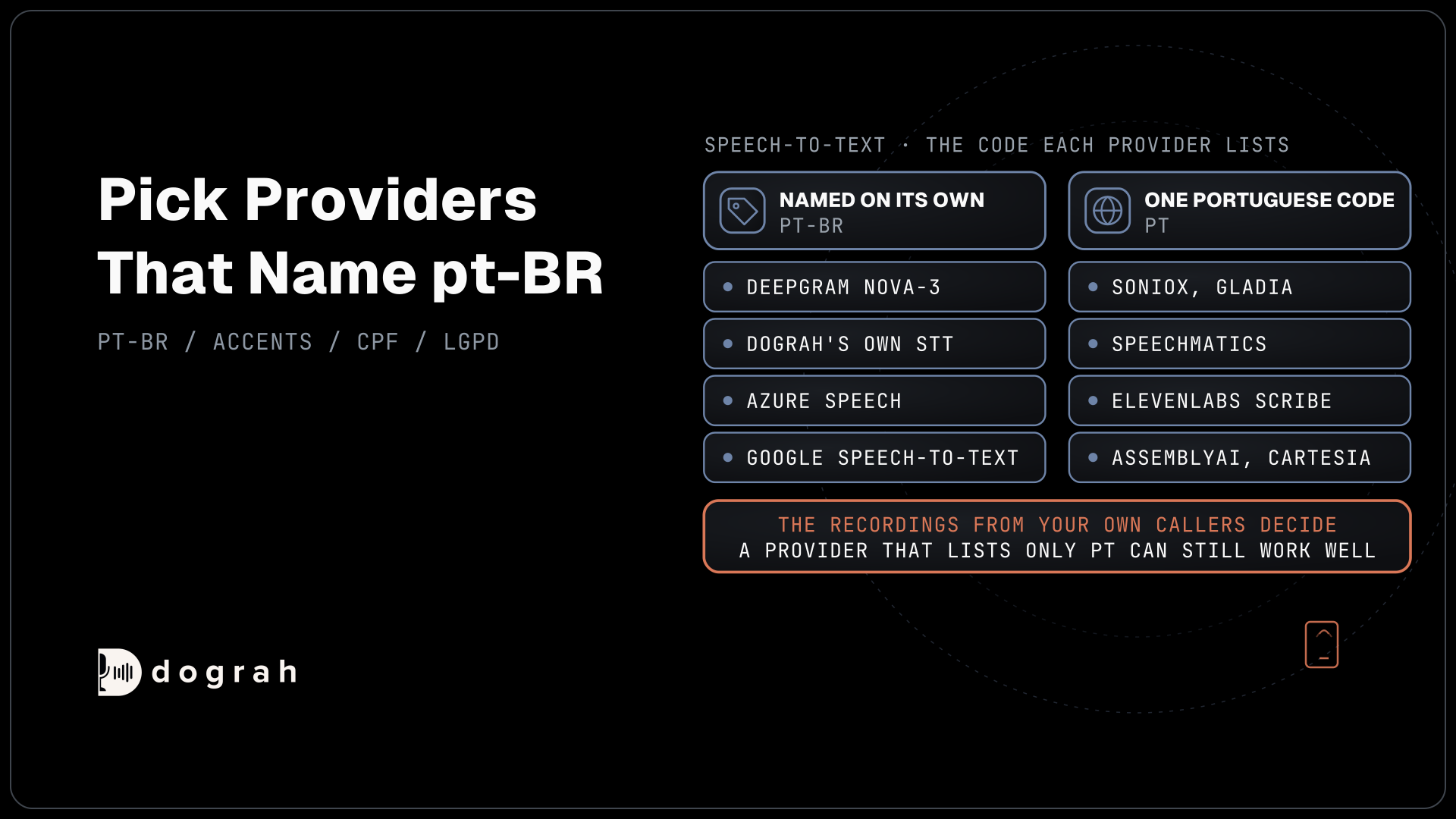
Most speech-to-text providers list Portuguese, but only some name Brazilian Portuguese on its own. That difference matters, because a model tuned mostly on European Portuguese hears Brazilian vowels and word endings differently. The table follows the language lists in Dograh's provider settings, and each provider lists the same code itself.
| Speech-to-text | Code listed | Brazilian Portuguese named? |
|---|---|---|
| Deepgram Nova-3 (also Dograh's own STT) | pt, pt-BR, pt-PT | Yes, as Portuguese (Brazil) |
| Deepgram Flux multilingual | Portuguese in flux-general-multi | One Portuguese code |
| Azure Speech | pt-BR, pt-PT | Yes |
| Google Speech-to-Text | pt-BR, pt-PT | Yes |
| Soniox, Speechmatics, ElevenLabs Scribe, Gladia, AssemblyAI, Cartesia ink-whisper | pt | Not split by country |
| OpenAI Realtime and Google Realtime | pt | Speech-to-speech, one model for the call |
A provider that lists only pt can still work well on Brazilian callers, so it belongs on the shortlist. The table tells you where to start testing, and the recordings from your own callers decide.
Voices that speak Brazilian Portuguese
Brazilian voices are easy to find. Azure Speech's language list names standard pt-BR Neural voices such as pt-BR-FranciscaNeural, pt-BR-AntonioNeural, pt-BR-BrendaNeural and pt-BR-ThalitaNeural, plus multilingual and HD voices. Google's Chirp 3 HD lists pt-BR as generally available, with names in the form pt-BR-Chirp3-HD followed by the voice, and it streams.
ElevenLabs lists "Portuguese (Brazil, Portugal)" for Multilingual v2, which Flash v2.5 also covers. Cartesia labels its Portuguese samples as Brazilian Portuguese (pt-BR) and advises a Portugal project to test a suitable voice separately. Speechify's simba-3.0 also lists pt-BR.
Test each voice on the phone path, not in a browser. Most phone calls still reach the agent as 8 kHz audio, and Brazilian lines use A-law audio, a different format from the mu-law used in North America. A voice that sounds bright in a demo can lose its nasal vowels and sound clipped on a handset, and that is the version your callers hear.
Testing Brazilian accents
Brazil is large, and its accents differ enough to change what a model hears. A paulistano, a carioca with a hissing s, a caller from the Nordeste and one from the Sul can read the same sentence and give a model four different recordings. A test from one office covers one of them.
The carrier matters too, since the route a call takes into Brazil adds delay with every extra hop. Test from Brazilian numbers over the carrier and number the agent will use, not from a laptop abroad.
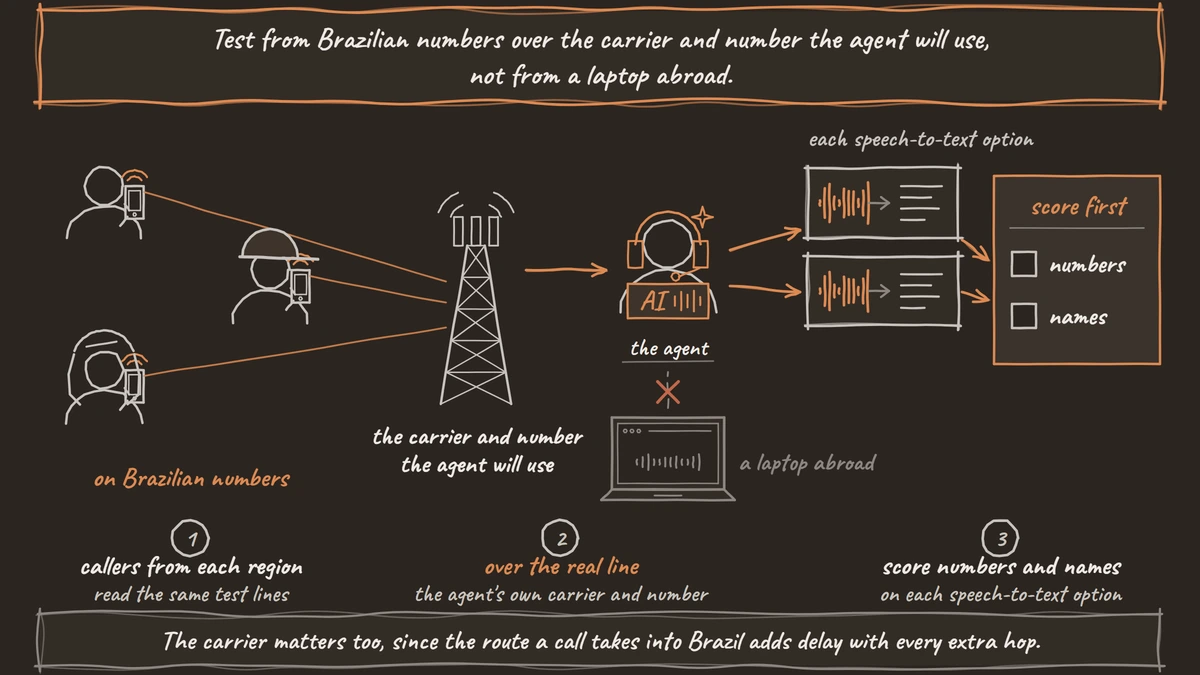
A test plan for this starts with 30 to 40 lines with prices, CPF and phone numbers, dates, street names and your product names. Have callers from each region you serve read them, run the recordings through each speech-to-text option on the shortlist, and score the numbers and names first. Our post on how voice agents handle accents and background noise covers the prompt rules for words the model mishears.

Open Source Alternative to Vapi / Retell
Self-hosted voice agent platform — no per-minute fees
dograh-hq/dograh
Star on GitHub
Reading reais, dates and CPF numbers
Brazilian formats are the second trap after accents. Brazil writes a comma where English writes a point, so R$ 1.250,00 is one thousand two hundred and fifty reais, and a voice reading English rules can say it wrong. Dates run day first, so 05/03 is 5 March, and callers say "cinco de março".
Documents have their own patterns. A CPF, the individual taxpayer number, has 11 digits and is usually read in groups of three with the last two apart. A CEP, the postal code, has eight digits. Phone numbers start with a two-digit area code, the DDD, and most mobile numbers then have nine digits. Callers read all of these in groups, and a transcript that drops one group sends the agent to the wrong record.
The fix for the speaking side is a prompt rule. Tell the language model to write amounts, dates and document numbers out in words in its reply, such as "mil duzentos e cinquenta reais" and "cinco de março", and to read a CPF back in groups before it acts. Azure Speech has markup for reading numbers and dates, but a voice agent works best when the reply text itself is already in the spoken form. Our post on Japanese AI voice agents uses the same rule for counters and era dates.
Brazil's calling and data rules in one place
Every call with a Brazilian caller falls under Brazil's General Data Protection Law (Lei Geral de Proteção de Dados, LGPD). Personal data may be processed only on one of ten legal bases, such as consent, a contract or legitimate interests. Biometric data linked to a person is sensitive personal data, so a voiceprint used to identify a caller needs extra care, as our post on why a voiceprint counts as biometric data explains. Callers can ask for access, correction and deletion, and can ask for a review of decisions made only by automated processing. Fines reach 2% of a company's revenue in Brazil, capped at R$50 million per infraction, and the ANPD, the national data protection authority, enforces the law.
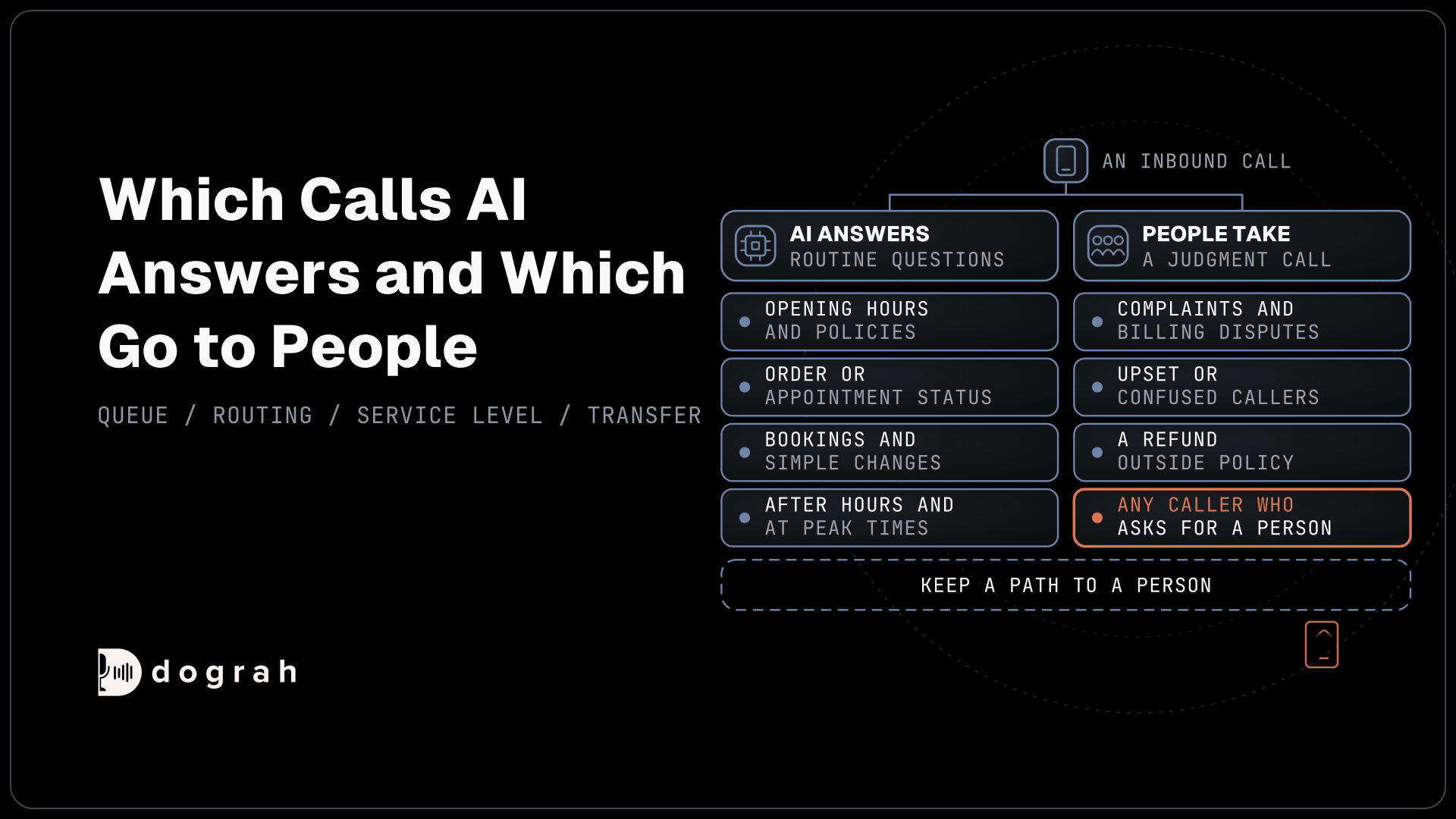
Decree 13.135 of 9 October 2026, in force since November 2026, sets customer service rules only for suppliers regulated by the federal government that meet their regulator's criteria and for digital financial, payment and credit providers supervised by the Central Bank, and sales calls are outside it. For those businesses, AI may handle triage, routing and resolution only if the consumer can reach a person in real time. Human phone service runs from 8:00 to 20:00 every day, urgent cases reach a person at any time, a dropped call with a person is returned within 300 seconds, and recordings are kept for at least 90 days.
Outbound calls follow ANATEL, the telecom regulator. Its 0303 page says the 0303 telemarketing prefix became optional in August 2025, and that callers placing more than 500,000 calls a month must use call authentication. Older ANATEL pages still call the 0303 prefix mandatory, so go by the current one.
ANATEL also targets dialling patterns. Under its rules on abusive calls, calls of 6 seconds or less count as short calls since 1 June 2024, and operators block users who place too many of them. An agent that drops answered calls fast, the way a predictive dialer does, is exactly that pattern. Consumers can also join Não Me Perturbe, which blocks telemarketing from telecom operators and payroll-loan lenders within about 30 days of signing up. This is our summary for a typical agent, so confirm your position with counsel in Brazil before you launch.
Join the Dograh Community
Dograh is an OSS alternative to Vapi. Join our Slack community for queries, releases, best practices & community interactions.
Running a Brazilian agent in Dograh
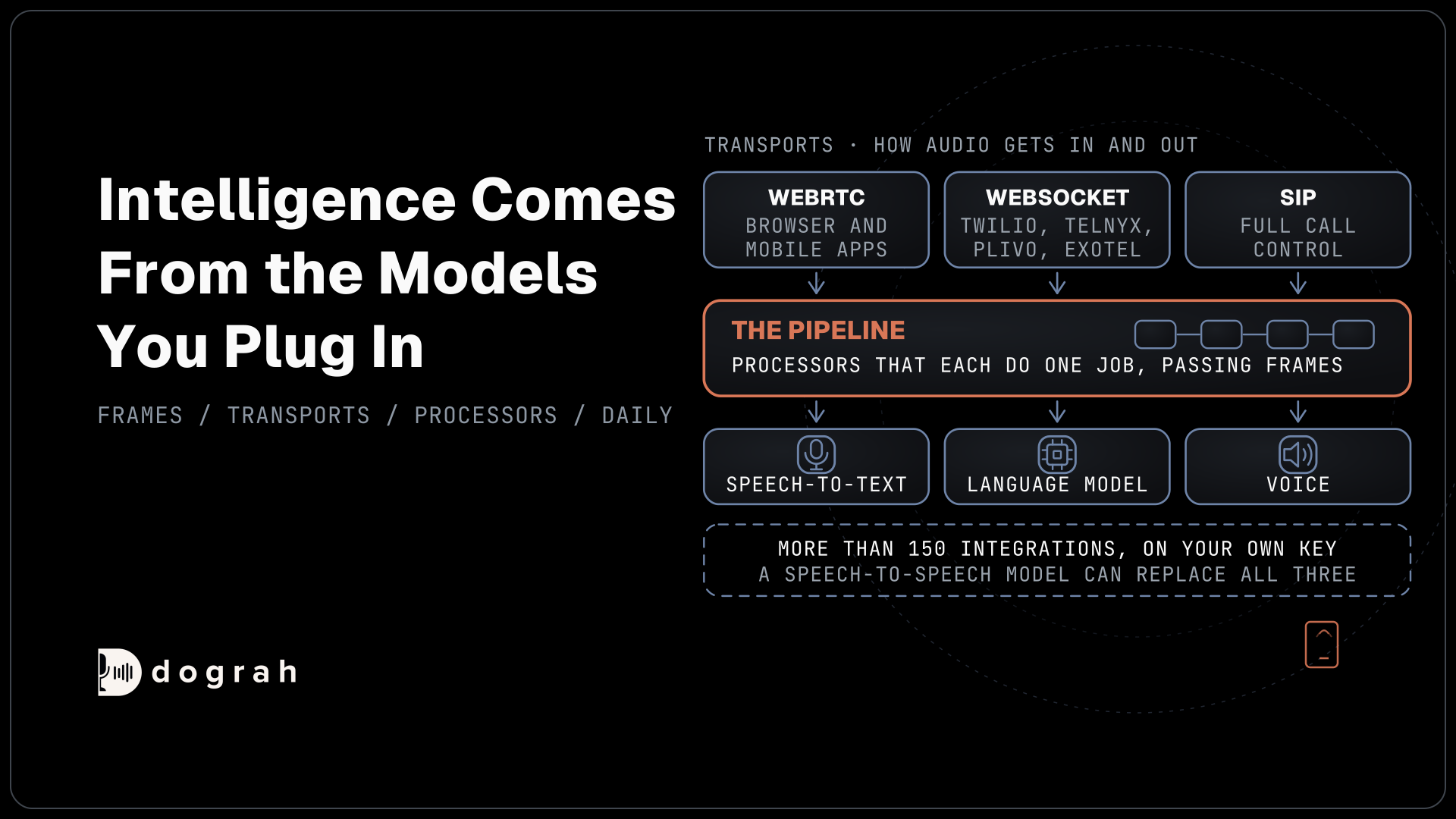
Models are chosen per agent, in the editor's Model tab, through a model configuration with LLM, STT and TTS tabs, each on your own provider key. Deepgram and Dograh's own speech-to-text offer "Portuguese (Brazil)" in the Language dropdown. For a line that takes Portuguese and English, set Language to "Multilingual (Auto-detect)" and tick both under Language hints on Dograh's speech-to-text or Deepgram Flux, and write the greeting in both, for example "Olá, hello". Our post on language switching mid-call covers the other designs.
On the voice side, both Azure Speech and Google list pt-BR in their voice settings. Set Language to pt-BR and type the voice name into Voice with Enter Custom Value, such as pt-BR-FranciscaNeural, since the preset list holds English voices. Brand and product names the speech-to-text keeps missing go in Dictionary in the agent's Settings, which Dograh passes as hints to its own speech-to-text, Deepgram, AssemblyAI, Soniox and Speechmatics. For outbound campaigns, split the list by time zone, since a campaign's calling hours run in one zone and Brazil spans several.
For a business inside the decree's scope, a person stays one step away through Transfer Call, which works on Twilio, Telnyx, Plivo, Cloudonix and Asterisk ARI. Dograh calls the destination first and connects the caller only when someone answers. A voicemail that picks up counts as answered, so turn voicemail off on that number or set it to pick up later than the Transfer Timeout. If nobody picks up within the 30-second default, the caller stays with the agent, and the prompt has it write a callback request to your system through an HTTP API tool.
Where call data sits is a hosting choice. Self-hosting Dograh in a Brazilian data center keeps the orchestration, recordings and transcripts there, and a business inside the decree's scope then sets the 90-day recording rule in its own storage policy. Any outside model provider on your keys still receives the call audio or transcript text, so full residency in Brazil needs open-weight models on the same servers. Self-hosting still leaves servers, model keys and phone minutes on your bill, and the database and upgrades stay with your team.
Glossary
- pt-BR
- The language code for Portuguese as spoken in Brazil. A provider that lists only pt may be tuned mostly on European Portuguese, so test it on Brazilian callers.
- CPF
- Brazil's individual taxpayer number, 11 digits, often used to find a customer record. Callers read it in groups, and the agent reads it back before acting.
- 0303 prefix
- The number prefix ANATEL created for active telemarketing calls. It became optional in August 2025, and very high-volume callers must use call authentication.
- Sensitive personal data
- Under the LGPD, a category that includes biometric data linked to a person, such as a voiceprint used to identify a caller.