
Bland AI vs Pipecat pits a hosted platform against an open framework. Bland runs calls on its own models and servers, from $0.14 a minute. Pipecat is free BSD-2-Clause code your engineers assemble and host. For teams that want Pipecat underneath with the product already built, Dograh is the open-source AI voice agent platform, self-hosted or on Dograh Cloud.
Key Takeaways
- Bland includes its own models in $0.14 a minute on Start.
- Pipecat's WebSocket phone routes carry no transfers, so hand-offs need SIP or Daily.
- At 5,000 minutes, Bland Start bills $700 and Pipecat Cloud hosting $50 before models.
Bland and Pipecat both put an AI agent on a phone line, but one sells the finished call and the other hands you the parts. We compare who builds, where calls run, what is left to build and the cost, then we talk about how Dograh runs on Pipecat.
Bland AI and Pipecat in one table
Bland is a product you configure, and Pipecat is a toolkit your engineers build with. Each row asks both the same question, using Bland's pricing page and Pipecat's own repository and pricing.
| Row | Bland AI | Pipecat |
|---|---|---|
| What it is | Hosted voice agent platform | Open-source Python framework for real-time voice |
| Code and license | Closed | Open source, BSD-2-Clause |
| Who builds the agent | Your team, in the Bland Agents builder | Your engineers, in Python, with Pipecat Flows for structured paths |
| Models | Bland's own transcription, language model and voices, in the rate | More than 100 speech, language and voice services on your keys |
| Phone lines | Bland's built-in Twilio, your Twilio account or SIP trunks | Twilio, Telnyx, Plivo, Exotel, Genesys and Vonage, plus Daily PSTN and SIP |
| Where the call runs | Bland's cloud and Bland's own SIP and media servers | Your servers, or Daily's Pipecat Cloud |
| Private hosting | Only on Enterprise, which Bland sells with isolated infrastructure and dedicated GPUs run by Bland. The code stays closed, and Start and Build run in Bland's cloud. | The same open code on any server, no contract |
| Price shape | Start $0.14 a minute, Build $299 a month plus $0.12 a minute | Framework free, Pipecat Cloud from $0.01 an active minute, models extra |
| Calls at once | 10 on Start, 50 on Build, custom on Enterprise | Set by your servers, unlimited on Pipecat Cloud |
| HIPAA | BAA on Enterprise | Depends on where you run it and each model provider |
Who builds the agent on each
On Bland, a team that does not write code can build the whole agent. Bland Agents is the current builder, where you write the prompt, lay out pathways, add tools and knowledge, set guardrails and run simulated test calls before you publish to staging and promote to production. On 15 November 2026 Bland moved its dashboard from pathways and personas to Bland Agents. API calls that send a pathway or persona ID keep working, and older pathways stay viewable in the new dashboard. Our Bland AI review covers the builder and its assistant in more depth.
On Pipecat, the agent is code. Pipecat is a Python framework from Daily under the BSD-2-Clause license, and each agent is a pipeline you write, with speech-to-text, a language model and a voice joined by frames that carry audio and text. Pipecat Flows is built in for calls that follow set steps, such as taking a booking or checking an order.
The framework moves fast, with new releases every few weeks and more than 100 ready integrations across speech, language, voice and speech-to-speech models. That freedom also means the team owns every choice, from which model ends a turn to how a tool result reaches the caller. A product manager can read a Bland pathway. A Pipecat agent needs an engineer to change it.
Where calls run and data sits
Bland keeps the whole call inside its own stack, and it argues that is the safer design. Bland says it runs its own SIP signaling and media servers, so every call is set up and processed on Bland infrastructure, with its own transcription, closed language model and voices. Enterprise adds isolated infrastructure and dedicated GPUs run by Bland, plus a business associate agreement (BAA) for HIPAA.
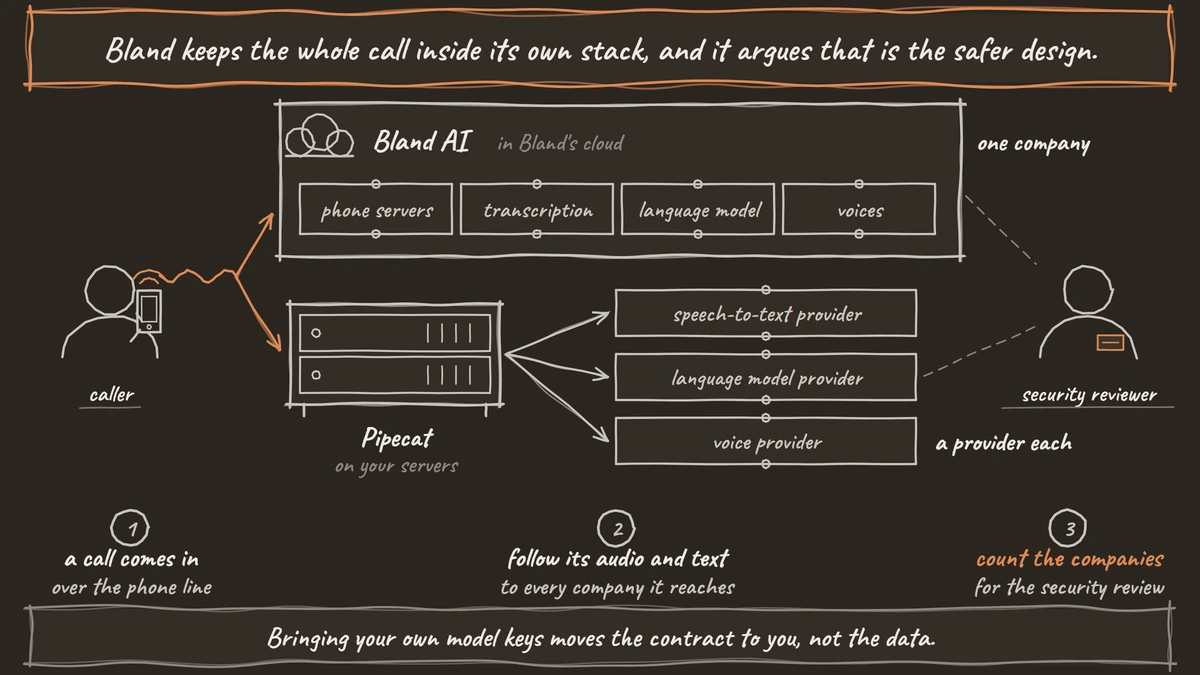
That means one company in the call path, which is easy to explain to a security reviewer. The trade is that you cannot read the code, swap the language model for one you prefer or run the platform on your own servers.
Pipecat runs wherever you deploy it. On your own servers, the platform and the call records stay with you, while the audio and text still reach whichever speech and language providers your pipeline calls. Bringing your own model keys moves the contract to you, not the data, so a team that needs audio to stay inside its network runs open models on its own hardware too. Pipecat Cloud, run by Daily, is the managed middle option for teams that want the open framework without running servers.

Open Source Alternative to Vapi / Retell
Self-hosted voice agent platform — no per-minute fees
dograh-hq/dograh
Star on GitHub
What you still build on each
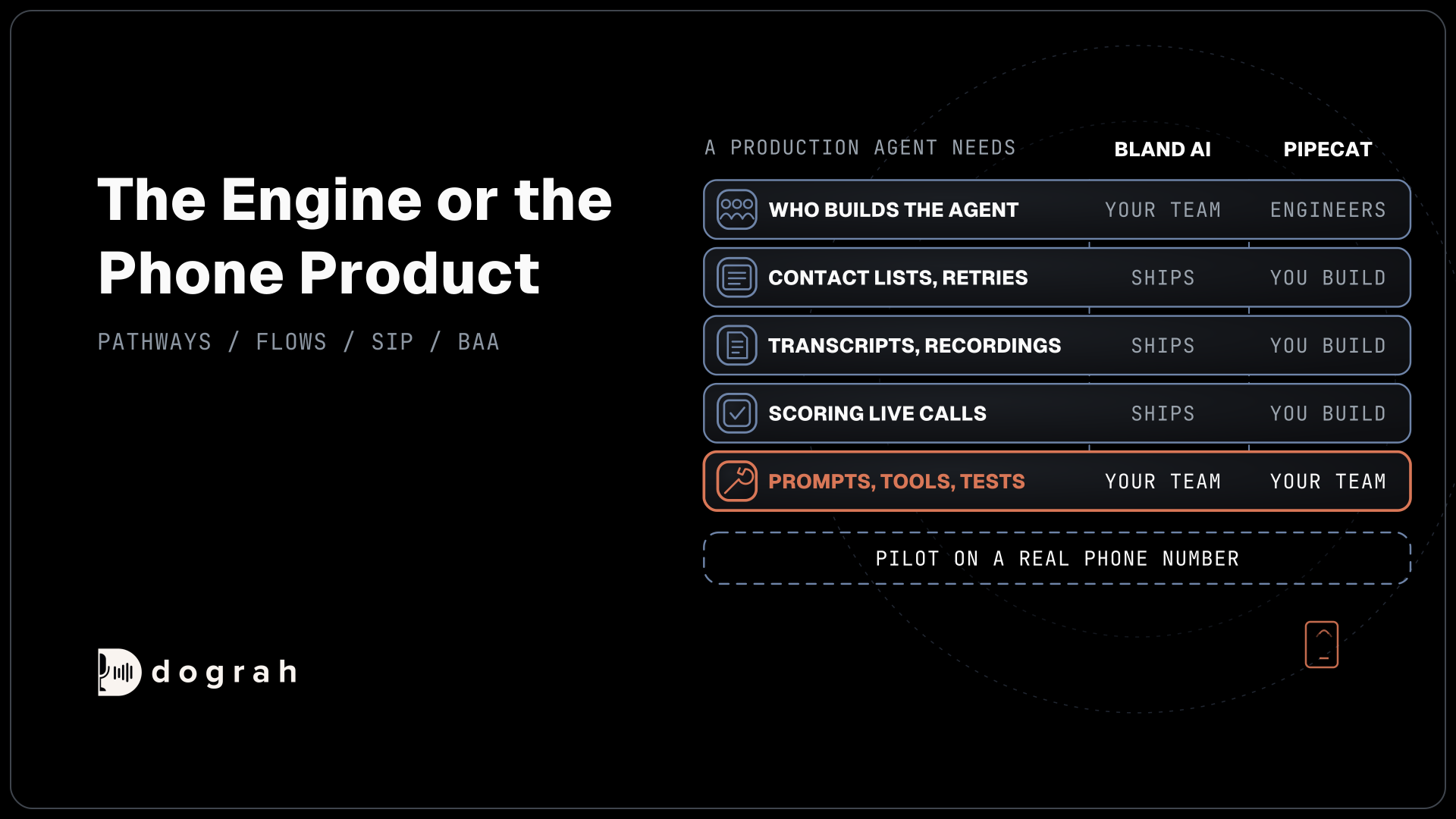
Pipecat gives you the engine, and the phone product around it is your team's job. The first gap shows up at the phone line. Pipecat's telephony guide says its WebSocket routes to Twilio, Telnyx, Plivo and Exotel have no advanced call center features like transfers or reconnects. To hand a caller to a person, you move the agent to Daily PSTN or a SIP route.
Past the phone line, a production agent needs more than a pipeline. Teams build contact lists with calling hours and retries, stored transcripts and recordings, a screen where non-developers can edit prompts, and a way to score live calls. Our post on Dograh vs Pipecat walks through that list item by item.
Bland ships those parts, so the work moves elsewhere. Your team still writes the prompts and pathways, connects the agent to your CRM or booking system through tools, and tests each version in the builder before it goes live. Bland's caps also shape the plan you buy. Start allows 10 calls at once and 100 calls a day, and Build allows 50 at once and 2,000 a day.
What 5,000 minutes a month costs
A worked example shows how differently the two bill. Take 5,000 call minutes in one month, about 55 three-minute calls a day, and count only the platform or hosting line plus what each line already covers.
| Option | Platform or hosting line for 5,000 minutes | Still to add |
|---|---|---|
| Bland Start | 5,000 x $0.14 = $700, models included | Phone minutes |
| Bland Build | $299 + 5,000 x $0.12 = $899, models included | Phone minutes |
| Pipecat, self-hosted | $0 for the framework | Servers, models, phone and the engineering time to build the product |
| Pipecat Cloud, agent-1x | 5,000 x $0.01 = $50 | Models, plus Daily PSTN at 5,000 x $0.018 = $90 if used, and the product you build |
The rows are not like for like. Bland's $700 already pays for transcription, the language model and the voice, while Pipecat Cloud charges only for hosting and leaves each model on its own provider's bill. At this volume Start costs less than Build, and Build only pays off above roughly 15,000 minutes a month. Our breakdowns of Bland AI pricing and Pipecat Cloud pricing cover the extra fees on each.
The framework is not automatically the smaller bill either. Softcery's cost model finds hosted options two to ten times cheaper below about 1M minutes a month once you hire a team to run your own stack. Engineering time is usually the largest cost in the Pipecat rows, and it does not show up on any invoice.
Join the Dograh Community
Dograh is an OSS alternative to Vapi. Join our Slack community for queries, releases, best practices & community interactions.
Where each one wins
Bland wins on speed to launch. An operations team with no voice engineers can have an agent taking calls in days, with models included, one bill, a rate it can forecast and no model keys to manage. Enterprise adds the compliance paperwork many buyers need, including a BAA, plus texts sent from the call.
Pipecat wins on control. You pick every model, change any part of the pipeline, run it on your own servers and keep call data where you put it. At high volume the platform line can shrink to the cost of your servers, though that saving pays for engineers who build and run the product.
So the choice turns on who you have. A team without Python engineers that needs a working phone agent this quarter fits Bland. A team whose voice agent is the product, and who wants the code, fits Pipecat. Whichever you lean toward, pilot on a real phone number, because most phone calls still reach the agent as 8 kHz audio while a browser demo runs at 16 kHz.
Where Dograh fits
Dograh, the open-source AI voice agent platform, runs on a fork of Pipecat that follows upstream releases. It ships the product layer a Pipecat team would otherwise build, from a chat-based Agent Builder and a visual canvas to campaigns with retries and calling hours, a QA node that scores each step of a call, and call traces. The code is BSD 2-Clause, so you can read and change all of it.
Callers reach it over Twilio, Telnyx, Plivo, Vonage, Exotel, Vobiz, Cloudonix or your own PBX through Asterisk ARI, and a custom telephony provider can be added as a package. Transfer Call works on Twilio, Telnyx, Plivo, Cloudonix and Asterisk ARI. Dograh calls the destination first and connects the caller only when someone answers, and a busy or unanswered transfer comes back to the agent so the call continues.
Models are chosen per agent, on your own keys for any provider or as open models on your own servers. The orchestration layer runs the call flow, tools and telephony, and the speech and language models are a separate layer you choose, which is how a team keeps audio inside its network when it needs to.
On cost and upkeep, running Dograh on your own hardware brings no per-minute platform fee. Servers, model keys and phone minutes remain real costs, and the database and every upgrade sit with your team. For support there is the open-source community, plus custom SLAs on Enterprise, and Dograh Cloud runs the platform for a 1¢-a-minute platform fee. To test the fit, install it with Docker, build one agent and place a real phone call before you compare it with your Bland or Pipecat setup.
Glossary
- Bland Agents
- Bland's current agent builder, where a team writes prompts, lays out pathways, adds tools and tests calls before promoting a version to production. It replaced the pathways dashboard on 15 November 2026.
- Pipecat Flows
- The part of Pipecat for calls that follow set steps, such as a booking. It tracks where the conversation is and which instructions apply at each step.
- WebSocket route
- A phone connection where the carrier streams call audio to a Pipecat pipeline over a WebSocket. Pipecat's guide says these routes have no transfers or reconnects.
- Active minute
- The unit Pipecat Cloud bills, a minute in which an agent instance is running, from $0.01 on the smallest size. Models and phone time are billed separately.