
The best voice AI testing and evaluation tools differ in what the judge reads and whether a test repeats into a pass rate. Testers such as Tuner simulate callers, while Vapi, Retell and ElevenLabs build tests in. For teams that want QA where the agent runs, Dograh is the open-source AI voice agent platform that scores calls in place.
Key Takeaways
- Retell's simulations run as text, so they never hear the caller's audio.
- Dograh's QA node scores each step of test and live calls at a sample rate.
- One study found significant quality gaps between commercial voice testing platforms.
A voice agent can say the right words and still fail the call, so how a tool judges matters more than its feature list. We set the criteria, rank the options with open-source Dograh first, then we talk about how to check the judge itself.
How to judge a voice agent testing tool
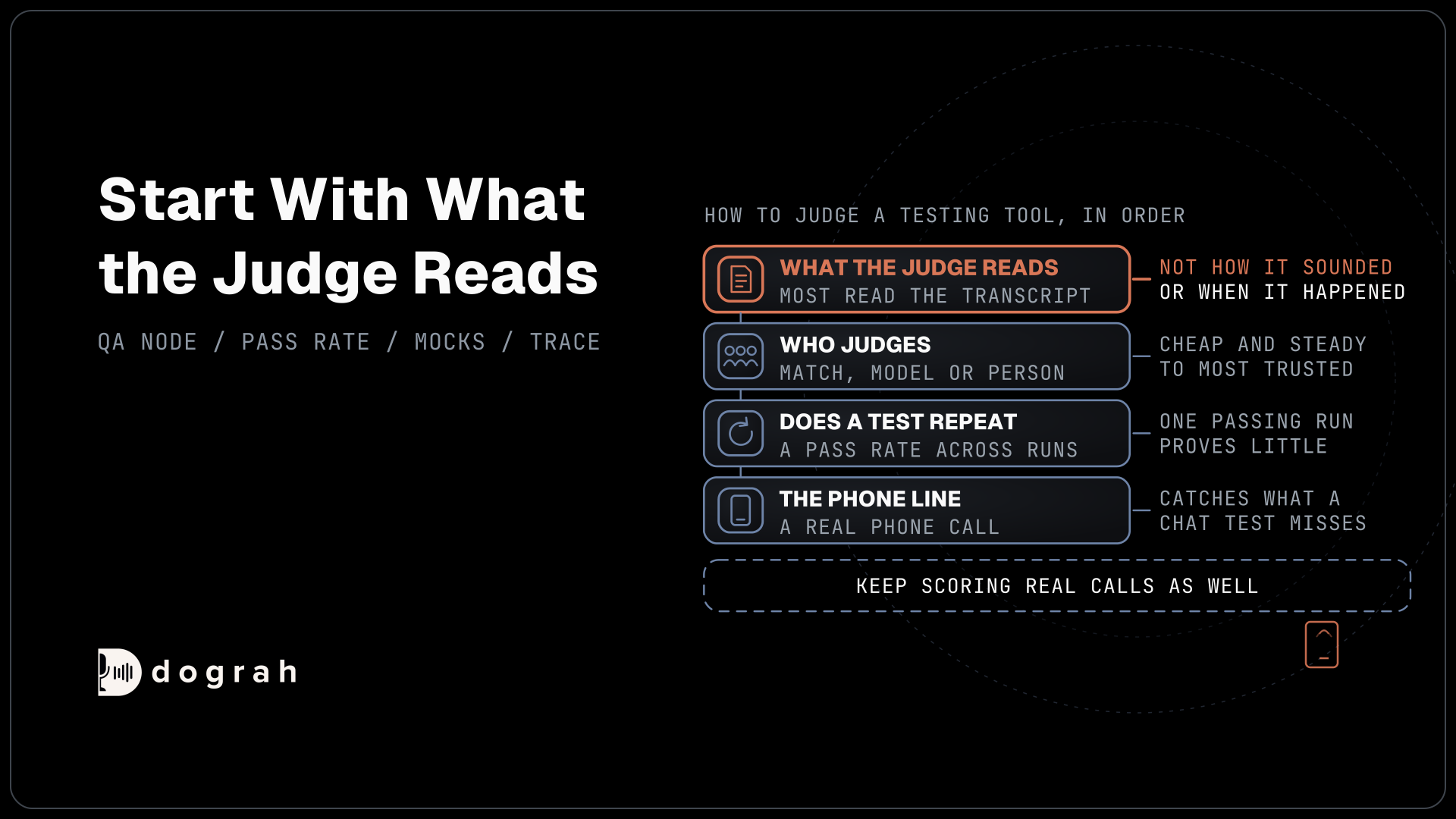
Start with what the judge reads. Most evaluation reads the transcript, which shows what was said but not how it sounded or when it happened. Confident AI, which sells an evaluation tool, argues that an agent can pass every transcript check and still frustrate callers with slow, overlapping or broken audio. That is the strongest case against text-only testing, and it holds.
Next, ask who judges. An exact match or a pattern is cheap and steady, a language model can judge open answers, and a person is the slowest and the most trusted. In LangChain's State of Agent Engineering, a survey of 1,340 people building AI agents, 53.3% used a language model as a judge and 59.8% used human review.
Then check whether a test repeats. Language models give different answers to the same input, so one passing run proves little, and a pass rate across several runs is the number to trust. Tool mocks matter too, so tests can call a fake booking system instead of your real one.
Last, look at the phone line and the data. Most phone calls still reach the agent as 8 kHz audio while a browser test runs at 16 kHz, so a tool that can test over a real phone call catches problems a chat test misses. Our list of voice AI observability and testing tools, sorted by stage, covers prices and where each tool fits in the build.
Voice AI testing tools compared
The table scores each option on the same questions, with Dograh first as the platform the agent runs on, then the built-in tests, the dedicated testers and Langfuse.
| Tool | What the judge reads | Who judges | Repeats and pass rate | Real phone line | Self-host |
|---|---|---|---|---|---|
| Dograh | Transcript per step, plus turn timing in View Trace | A language model with your QA prompt | QA on a random sample of calls | Yes, live and test calls, Tuner simulations over SIP | Yes, open source |
| Vapi | Text for evals, audio in voice simulations | Exact match, pattern or AI judge | Run critical scenarios several times | Voice simulations | No |
| Retell AI | Text only in simulations | A language model, each criterion pass or fail | Batch pass, fail and error counts | No, simulations are text | No |
| ElevenLabs Agents | The agent's replies and tool calls | LLM evaluator, exact or regex match for tools | Repeat 2 to 20 times, pass-rate badge | Not stated as voice | No |
| Tuner | Calls and traces, 30+ voice metrics | Built-in metrics and custom LLM evaluators | Simulation runs | Yes, simulated calls | On-premise on Enterprise |
| Langfuse | Traces and datasets | LLM-as-a-judge and human annotation | Experiments on datasets | No | Yes, open source |
Dograh, QA and traces where the agent runs
Dograh checks calls inside the platform the agent runs on, so every test and live call can be scored without exporting anything. The QA node sits on the agent's canvas and, once a call ends, a language model reads the transcript and scores each step of the call on its own, with tags such as dead air or a frustrated caller, a 1 to 10 score, a sentiment and a summary. You can replace its System Prompt with your own, for example a compliance check that asks whether identity was confirmed before account details were shared.
QA runs on test calls from the editor and on live calls of the published agent. Sample Rate (%) sets the share of calls it reviews, picked at random below 100, and Minimum Call Duration skips calls shorter than 15 seconds by default. Use Workflow's LLM is on, so the agent's own language model does the review unless you pick another. A random 5 to 10% of live calls is a sensible sample once an agent is stable.
QA reads text, so timing comes from the trace. Each call's View Trace button opens its trace in Langfuse, with the speech-to-text, AI and voice time for every turn, which is where a slow or overlapping turn shows up. Simulated callers come through the Tuner integration. Tuner places a call into the published agent over SIP, and a self-hosted install needs a backend Tuner can reach from the internet.
Running Dograh on your own servers means no per-minute platform fee. You still pay for those servers, the model keys and the phone minutes, and QA reviews add model usage for every sampled call. Your team keeps the database and upgrades in order, support comes from the open-source community with custom SLAs on Enterprise, and Dograh Cloud runs it all for a 1¢-a-minute platform fee.

Open Source Alternative to Vapi / Retell
Self-hosted voice agent platform — no per-minute fees
dograh-hq/dograh
Star on GitHub
Tests built into Vapi, Retell and ElevenLabs
The hosted platforms build tests into the product, and each judges in a different way. Vapi's testing docs split them in two. Evals check one decision at a known point in a conversation, by exact match, a pattern or an AI judge, and they run as text. Simulations give an AI tester a caller's goal and let it hold the whole call, in chat to refine prompts or in voice to test transcription, pacing and turn-taking. Vapi itself notes that synthetic callers do not fully represent real ones.
Retell's simulation testing runs as a text conversation. You write a simulated user and success criteria, and each criterion is graded pass or fail, with the run passing only if every one passes. Functions can be mocked, though MCP tools ignore mocks and call your server for real. Batch tests report pass, fail and error counts, and Retell advises rerunning a batch before you trust a single failure, since both the simulated user and the grader are language models.
ElevenLabs Agents offers three test types. Simulation runs a multi-turn conversation of 1 to 50 turns with a simulated user, Next Reply checks the agent's next message with an LLM evaluator, and Tool Call checks the parameters of a tool call by exact, regex or LLM match. Any test can repeat 2 to 20 times, with a green badge at 100% passed, amber at 80% or more and red below that.
Dedicated voice testers
Dedicated testers sit outside the platform and usually go further on simulated callers and audio metrics. Tuner runs simulations and testing, alerts, latency and hallucination checks and full call traces on every plan, with more than 30 voice AI metrics, unlimited custom evaluators and on-premise deployment on Enterprise. It connects to Dograh as a Tuner node, as above.
Coval, Roark, Cekura and Hamming also simulate callers and monitor live calls. Our post on Cekura alternatives compares these testers and their prices.
A tester's verdict is still a model's verdict on a simulated call. Use one to cover scenarios you cannot wait for in production, and keep scoring real calls as well.
Join the Dograh Community
Dograh is an OSS alternative to Vapi. Join our Slack community for queries, releases, best practices & community interactions.
Langfuse for open evaluation
Langfuse is the open option for teams that want evaluation on their own servers. Langfuse is open source and free to self-host, and every cloud plan includes datasets, experiments, LLM-as-a-judge evaluators and human annotation.
It works on traces and text, not audio, so it fits checks of the language model and tools rather than the voice. Teams use datasets of past turns to replay a prompt change across many cases, then score the results with a judge or a reviewer. Because Dograh sends its traces to Langfuse, the same traces that show turn timing can feed those datasets.
Check the judge before you trust it
Every automated verdict comes from a judge that can be wrong, and testers differ more than their pages suggest. In Testing the Testers, researchers from Evalion, one of the platforms they tested, gathered 21,600 human judgments across 45 simulations of three commercial voice testing platforms and found statistically significant gaps in both evaluation quality and simulation quality. A tool's score is only as good as its judge.
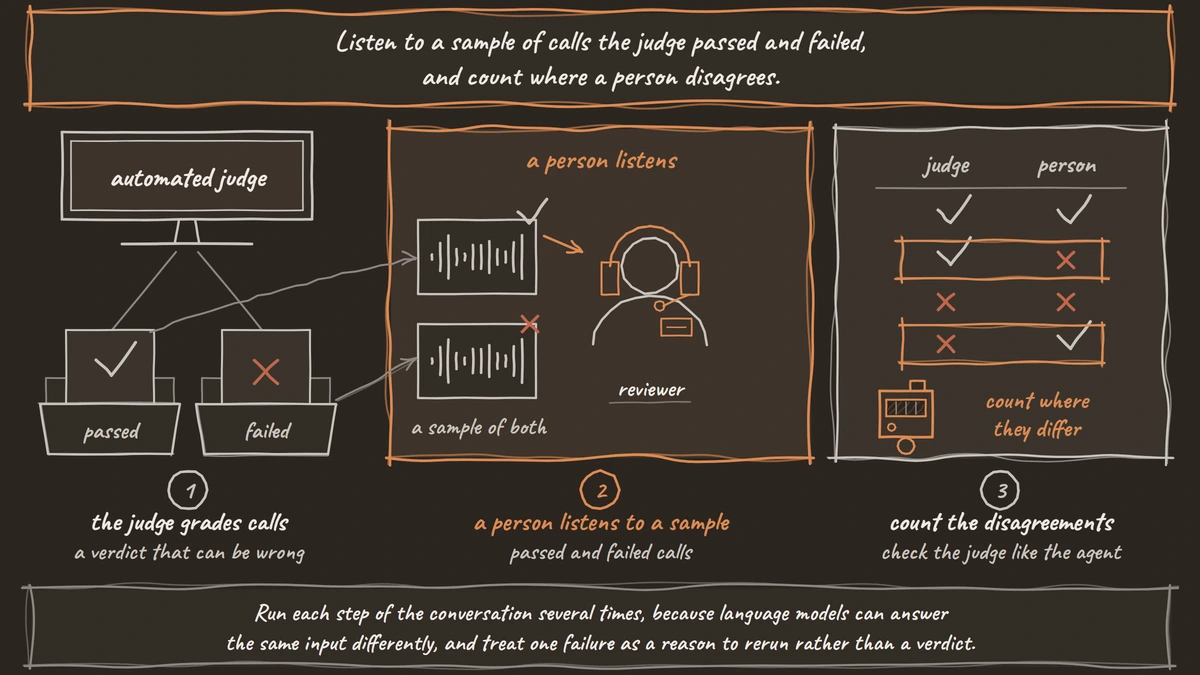
So check the judge the way you check the agent. Listen to a sample of calls the judge passed and failed, and count where a person disagrees. Run each step of the conversation several times, because language models can answer the same input differently, and treat one failure as a reason to rerun rather than a verdict.
Then test over a real phone line before launch, since phone audio changes what speech-to-text hears. Our guide to voice agent testing and evaluation covers scenario sets and pass counts per step, and re-running them on every new version of the agent.
Glossary
- LLM-as-a-judge
- Using a language model to grade an agent's reply against written criteria. It handles open answers well, but its verdicts need checking against human review.
- Pass rate
- The share of repeated runs of the same test that pass. Because models vary between runs, it is a steadier signal than one result.
- Tool mock
- A fake response a test returns in place of a real tool call, so tests never book real appointments or change real records.
- Sample rate (QA)
- The percentage of calls an automated QA review scores. In Dograh, values below 100 pick calls at random.