
Cekura alternatives are divided into voice agent testers, contact-center journey testers, DIY load tools and LLM tracing tools. For self-hosting teams, Dograh, the open-source AI voice agent platform we build, has QA, traces and test calls built in, self-hosted or on Dograh Cloud. Hamming, Coval, Roark and Tuner simulate callers, and SIPp and Langfuse cover load and tracing.
Key Takeaways
- Cekura bills $0.25 per voice testing minute and $0.05 per monitored call.
- Caller simulators score the agent, while load and tracing tools check other layers.
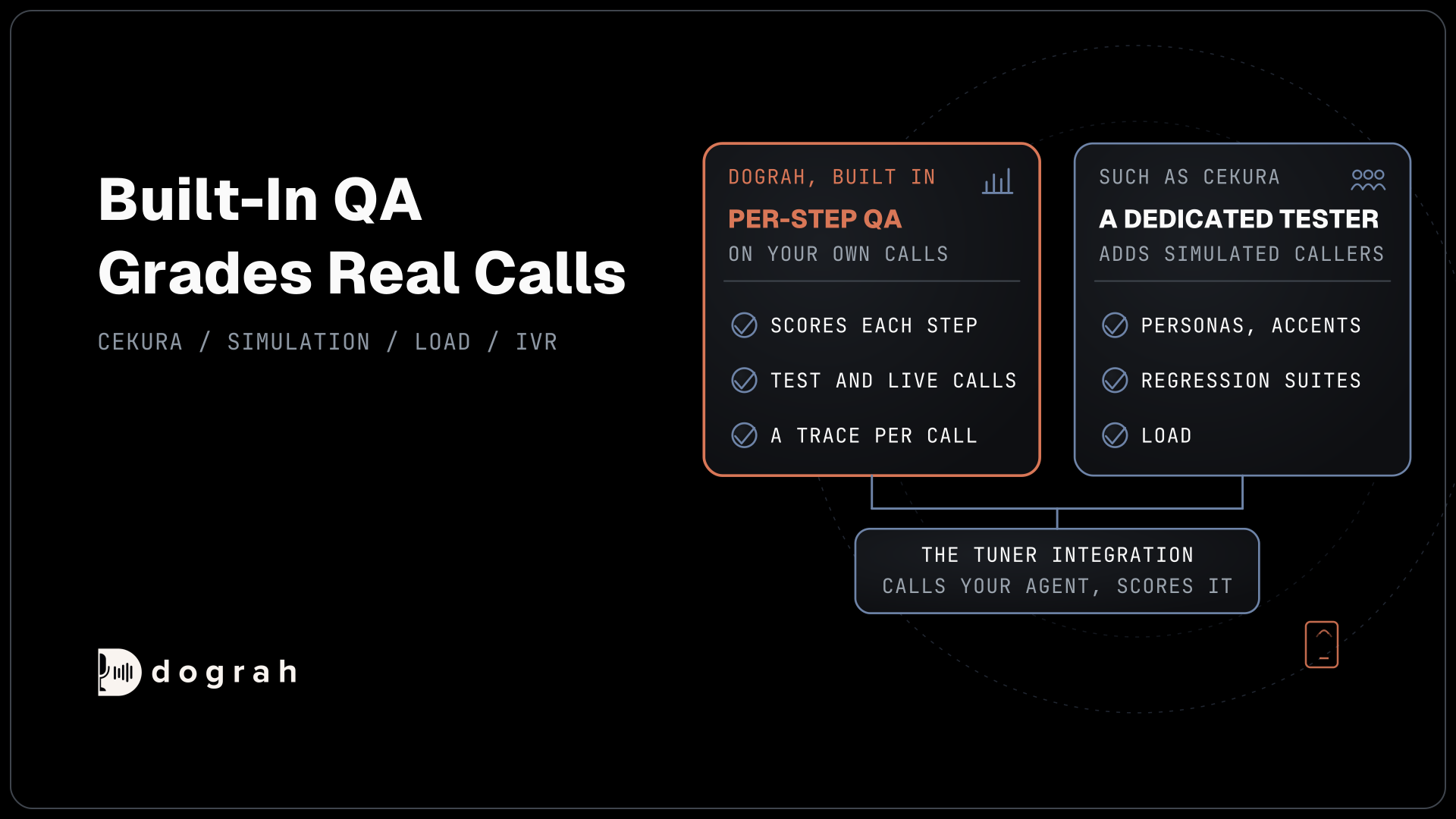
- Built-in QA grades real calls, and a dedicated tester adds simulated callers.
Testing tools do different jobs, so this guide sorts Cekura's rivals by the job each one does. We compare them in one table, show what Dograh's built-in checks cover, then walk through testers, journey tools, load tools and tracing. We end with when to stay and what moving takes.
Why teams look past Cekura
Cekura is a hosted tester for voice and chat agents, and it bills by use. Cekura charges $0.25 per voice testing minute and $0.05 per monitored call on pay as you go, with the first user free and $30 a month for each extra seat. The Startup plan is $500 a month for about 2,000 minutes of voice testing, and Enterprise adds VPC or on-prem deployment on an annual contract.
Teams look elsewhere for a few reasons. A large regression suite run before every release adds up at a per-minute rate. Some want a different job done, such as load on their phone path or traces of the model's steps, which a caller simulator does not give them. Others run their agent on a platform outside Cekura's ready integrations for Retell, Vapi, ElevenLabs, LiveKit and Pipecat, so their tests go over a SIP call or Cekura's custom route instead.
Before switching, decide which job you are hiring for. The answer narrows the list fast.
Cekura alternatives compared
The table sets each option against Cekura by job, code, hosting and price. Prices are each vendor's list price.
| Tool | Job it does | Open source | Where it runs | Price |
|---|---|---|---|---|
| Cekura (baseline) | Simulated calls, live monitoring, IVR, DTMF and load tests | No | Hosted. VPC or on-prem on Enterprise | $0.25 per voice testing minute, $0.05 per monitored call. Startup $500/mo |
| Dograh (built in) | Per-step QA, call traces and test calls on your own agent | Yes, BSD-2-Clause | Self-host, Dograh Cloud, or on-prem on Enterprise | Part of the platform. Self-hosted, no per-minute platform fee. Dograh Cloud, 1¢/min |
| Hamming | Simulated callers, IVR trees, every live call scored | No | Hosted. Single-tenant on Enterprise | Quoted per deployment |
| Coval | Simulation with CI regression runs | No | Hosted. Private or VPC on Enterprise | $100/mo for 100 minutes, $500/mo for 1,000. Enterprise from $4,500/mo |
| Roark | Simulation over phone and web, monitoring, call replay | No | Hosted | $0.15/min plus provider costs. Team $500/mo |
| Tuner | Simulations, call traces, voice metrics | No | Hosted. On-prem on Enterprise | Free start. Builder $39/mo, Growth $399/mo |
| Cyara | Contact-center journey, load and carrier testing | No | Hosted | Priced through a sales demo |
| SIPp | SIP call load on your phone path | Yes, GPL-2.0 or later | Your own machines | Free |
| Langfuse | Traces and evals of model steps, in text | Yes, MIT core | Self-host or Langfuse Cloud | Self-host free. Cloud from free to $199/mo and up |
The rows split by job more than by vendor. Five hosted testers compete with Cekura on simulated callers, Cyara and SIPp test the paths and volume around the agent, and Langfuse watches the model. Dograh sits in a different row, as the platform the agent runs on, with its own checks built in.
What Dograh's built-in QA and traces cover
Dograh is the voice agent platform rather than a tester, and it ships the checks a team needs on its own calls. Its code is open under BSD-2-Clause, so you can run it on your own servers or on Dograh Cloud, with on-prem deployment on Enterprise.
The QA node reviews each call's transcript after it ends and scores each step of the conversation on its own. Every step gets tags such as DEAD_AIR or USER_FRUSTRATED, a score from 1 to 10, a sentiment and a short summary, and all tags are also listed together for the call. It runs on test calls from the editor and on live calls, and its Sample Rate setting picks a random share once you are live. Our guide to automated QA for voice agents sets out why 5-10% of live calls is enough once an agent is stable.
When a score looks wrong, each call's View Trace opens the run in Langfuse tracing, with the speech-to-text, AI and voice time for every turn. Test calls start in the editor's Test Audio and Test Chat tabs, and a phone call from the editor checks the real phone path, which matters because a browser call cannot test a transfer.
A dedicated tester adds what a platform does not generate, simulated callers at volume, scripted personas and accents, regression suites across versions and load. The Tuner integration brings that in. Tuner can call your agent with generated caller scenarios and score them, and the node sends each finished call back to Tuner.
For analysis across many calls, the Noveum integration exports every call after it ends as a trace with per-turn speech-to-text, model and voice spans, and the call audio if you choose.
Test calls are ordinary calls, so they cost what a call costs. On your own servers there is no per-minute platform fee, though the servers themselves, model keys and phone minutes still have to be paid for. The managed Dograh Cloud takes a platform fee of 1¢ per minute.
Self-hosting means your team runs the server and the database and applies the upgrades. Support for the open-source edition comes from the community on Slack, and Enterprise adds custom SLAs.

Open Source Alternative to Vapi / Retell
Self-hosted voice agent platform — no per-minute fees
dograh-hq/dograh
Star on GitHub
Testers that simulate callers
These tools do Cekura's core job, calling your agent as scripted callers and scoring the result. Hamming quotes per deployment and covers accents, interruptions, keypad input and IVR trees, runs 50 parallel calls by default in CI, and scores every live call with alerts to Slack or PagerDuty.
Coval is built around simulation and CI regression runs. Coval starts at $100 a month for 100 simulation minutes, then $0.40 a minute, and Growth is $500 a month for 1,000, then $0.25. Enterprise starts at $4,500 a month with private or VPC deployment. Roark simulates calls over real phone lines and the web in 45 languages at $0.15 a minute on pay as you go, plus the voice and model provider costs, and adds production monitoring with call replay.
Tuner starts free and runs from $39 a month on Builder, about 1,000 calls, to $399 on Growth. It is the one tester here with a ready Dograh integration.
An example makes the per-minute rates concrete. Take 500 test calls of three minutes each before a launch, 1,500 minutes.
| Tester | 1,500 test minutes | Notes |
|---|---|---|
| Cekura pay as you go | 1,500 x $0.25 = $375 | Monitoring billed per call after launch |
| Coval Growth | $500 + 500 x $0.25 = $625 | 1,000 minutes included |
| Roark pay as you go | 1,500 x $0.15 = $225 | Plus provider costs and any metrics |
| Hamming | Quoted | Per deployment |
Price is not the only gap between testers. In Testing the Testers, researchers compared three commercial voice-agent testing platforms against 21,600 human judgments. The best scored an F1 of 0.92 and the other two 0.73, so read a sample of the tester's verdicts yourself before you trust its pass rate.
Journey testers and DIY load tools
Some teams need to test the path around the agent more than the agent itself. Cyara tests contact-center journeys across channels, carrier paths and handoffs, runs load and performance tests, and monitors call quality and caller ID, sold through a sales demo. Cekura and Hamming also test IVR paths and keypad input inside their simulations.
For load alone, SIPp is a free SIP traffic generator under GPL-2.0 or later. It fires many calls at once at your phone path, so you see whether the carrier, the server and the platform keep up. It tests capacity, and what the agent says on those calls is for QA or a tester to judge.
Start load small and climb in steps. Run a few dozen calls, check turn times on a sample, then double, which catches a slow provider before your callers find it.
LLM tracing sees text, not audio
LLM tracing tools record what the model received and returned, step by step. Langfuse is open source with an MIT core and free to self-host, and Langfuse Cloud runs from a free Hobby plan to $199 a month on Pro. LangWatch is another open option, under Apache-2.0.
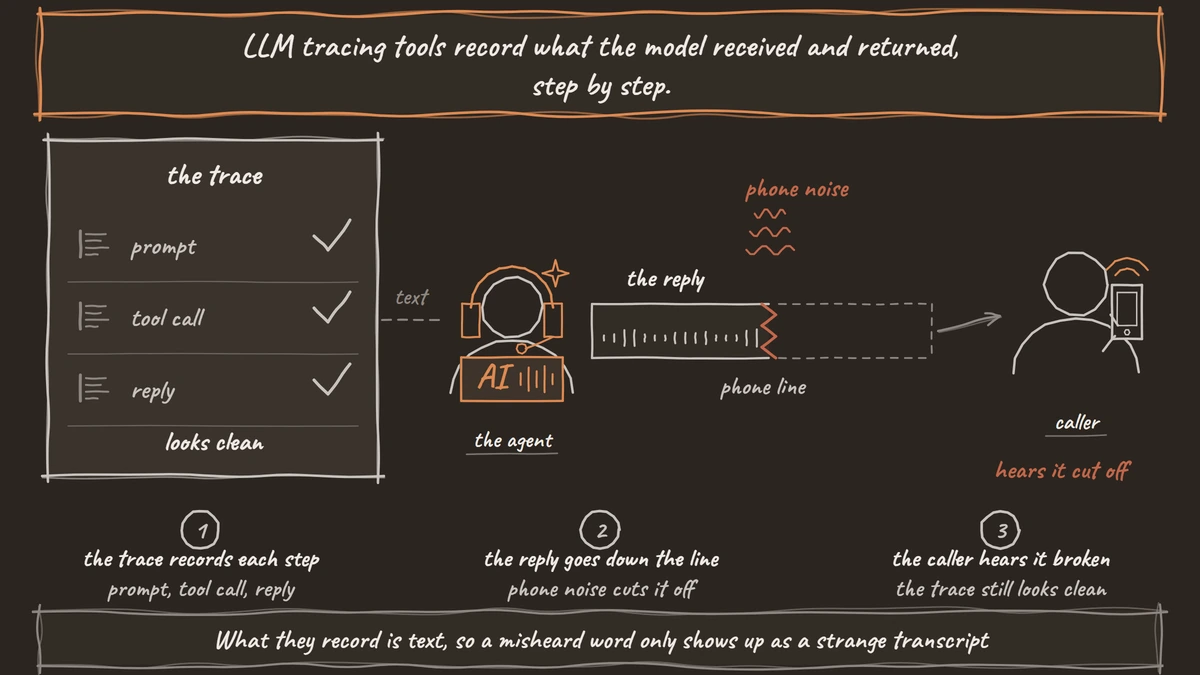
They are strong at the model layer. You see the exact prompt, the tool calls and the reply, and you can replay a step to count how often it fails. What they record is text, so a misheard word only shows up as a strange transcript, and a reply cut off by phone noise looks clean in the trace. A speech vendor's own dashboard has the opposite limit, since it covers its own layer of the call and leaves the agent's choices out.
Use tracing to debug a step once QA or a tester has flagged the call. Our walkthrough on reading call traces shows how to find the failing layer.
Join the Dograh Community
Dograh is an OSS alternative to Vapi. Join our Slack community for queries, releases, best practices & community interactions.
When staying on Cekura makes sense
Cekura covers a lot in one place, simulated calls, live monitoring, IVR and keypad tests, load and red teaming, and that breadth is a reason to stay. If your agent runs on one of its ready integrations and your test volume fits the Startup plan's 2,000 minutes, switching saves little.
Stay too if you need a signed BAA without an enterprise contract, since the Startup plan includes one, or if your team values one dashboard over several specialist tools.
What moving off Cekura takes
Moving a test suite is mostly moving scenarios. Export or write down each scenario's caller goal, persona and pass rule before you leave, because those are the real asset, and rebuild them in the new tester.
Then point the new tool at your agent, through its platform integration or a SIP number, and run both testers on the same release for a week. Where they disagree on a call, read the transcript yourself, which also tells you how far to trust the new one.
Keep at least one test on a real phone line throughout. Our guide to Testing Voice Agents Before You Go Live puts the phone test, the simulation run and the small load test in order.
Picking your Cekura alternative
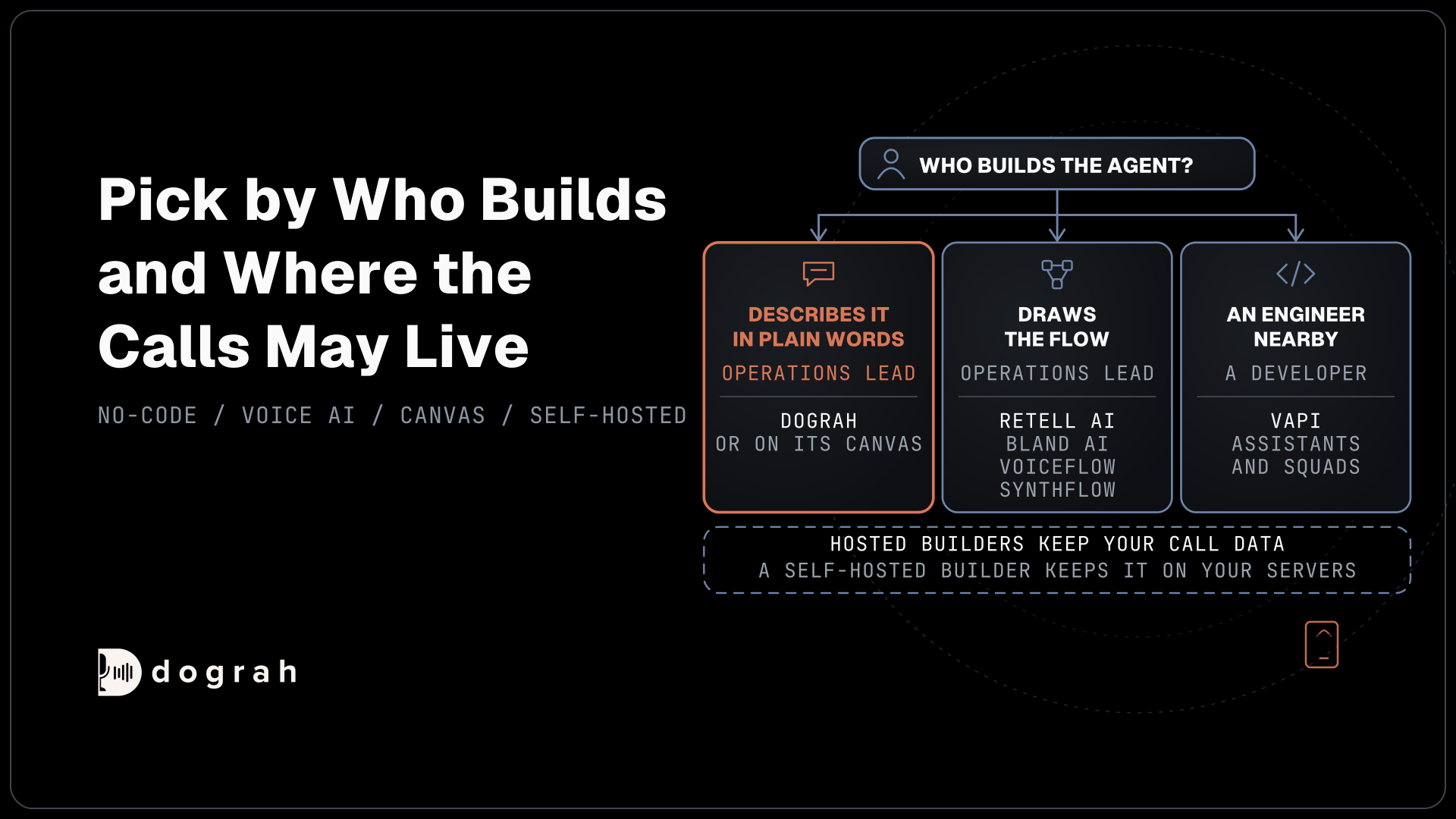
Pick by the job you need done. If you want to own the agent platform itself and keep calls on your own servers or on-prem, Dograh gives you per-step QA, traces and test calls built in, and adds simulated callers through its Tuner integration.
If you need simulated callers at volume, compare Hamming, Coval, Roark and Tuner on your own test minutes. If your risk sits in the contact-center path, look at Cyara, and for raw load use SIPp. For debugging model steps, add Langfuse. Our list of the best voice AI observability and testing tools sorts the same field by stage instead of job.
Glossary
- Voice testing minute
- One minute of a simulated call between a tester and your agent, the unit many testers bill by. Cekura charges $0.25 for one on pay as you go.
- Simulated caller
- A scripted test caller, with a goal, a persona and sometimes an accent, that a testing tool uses to call your agent and score how it handles the conversation.
- Load test
- Many calls placed at once to see whether the phone path, servers and providers keep up. SIPp generates this load over SIP.
- Per-step QA
- A review that scores each step of a call separately, with its own tags, score and summary, so a bad call points at the step that failed. Dograh's QA node works this way.