
The best voice AI for regulated industries meets the contract each rule needs, a business associate agreement (BAA) in healthcare, card-data and vendor-oversight terms in finance, and an authorized cloud or on-prem install in government. Dograh fits teams that need calls on their own servers, self-hosted or on-prem on Enterprise. Bland holds a FedRAMP listing, and Kore.ai still offers on-prem.
Key Takeaways
- Self-hosted Dograh keeps calls on your servers with no BAA to sign with Dograh.
- Bland is FedRAMP 20x Class A certified, with no agency authorization listed yet.
- Vapi, Retell, PolyAI, Bland and Synthflow all sign a BAA, on different plans.
Certification badges tell a regulated buyer little about the contract they need. We sort the platforms by what healthcare, finance and government rules each ask of a vendor, rank them led by open-source Dograh, then go industry by industry through the platforms that meet each test and how to choose.
What each regulated industry asks of a voice platform
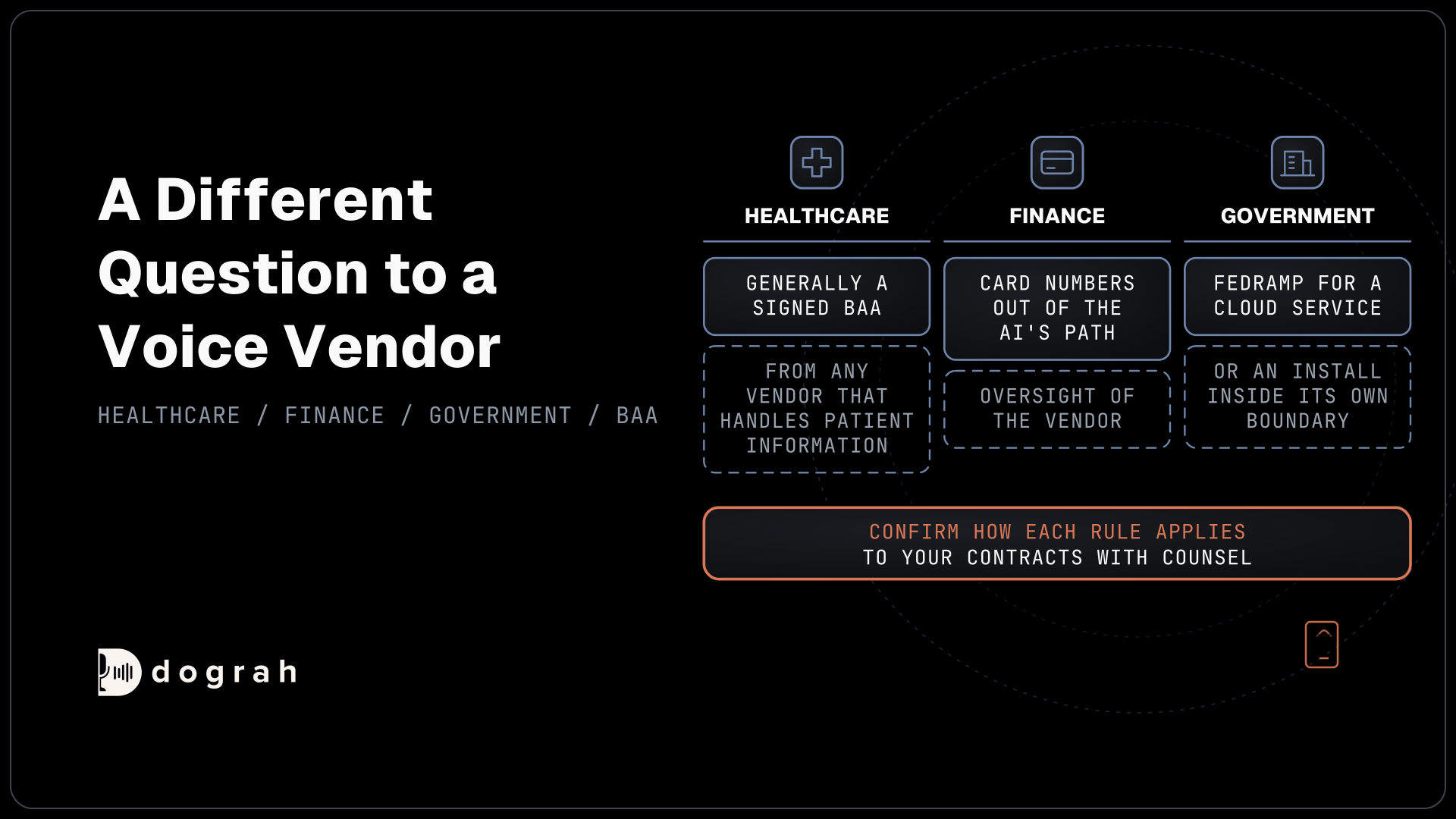
Each industry's rules put a different question to a voice vendor, and the useful test is whether the duty can be handed to that vendor by contract. In healthcare it can, because a business associate agreement (BAA) under the Health Insurance Portability and Accountability Act (HIPAA) passes the safeguard duties to the vendor, though the hospital still answers for the choice. In finance, card data falls under the Payment Card Industry Data Security Standard (PCI DSS), and the lender keeps a duty to oversee every service provider it picks.
Government is stricter still. A cloud service sold to a US federal agency needs its own authorization under the Federal Risk and Authorization Management Program (FedRAMP), so a vendor's paperwork matters less than where the platform runs. The further a duty sits from what a contract can hand off, the more it pays to run the platform on your own servers.
This post is a buyer's list by industry. The full map of consent, recording and disclosure rules for voice agents sits in our compliance guide for AI voice agents, which this list builds on.
Voice AI platforms for regulated industries compared
The table puts each platform against the three industry tests, with self-hosting first and the hosted platforms after it. Every row except the first is closed code.
| Platform | Healthcare (BAA) | Finance (PCI DSS, SOC 2) | Government (FedRAMP, on-prem) | Code |
|---|---|---|---|---|
| Dograh | Self-hosted, no BAA with Dograh | Card payments go to your own payment provider | Self-hosted inside your boundary, on-prem on Enterprise | Open source, BSD 2-Clause |
| Bland | BAA on Enterprise | PCI DSS self-attested, SOC 2 Type I and II | FedRAMP 20x Class A, on-prem or VPC on Enterprise | Closed |
| Kore.ai | Ask about a BAA | PCI DSS, SOC 2 Type 1 and 2 | On-premises or a private cloud VPC | Closed |
| PolyAI | BAA on Enterprise | PCI card capture on Enterprise, SOC 2 Type II | Ask during review | Closed |
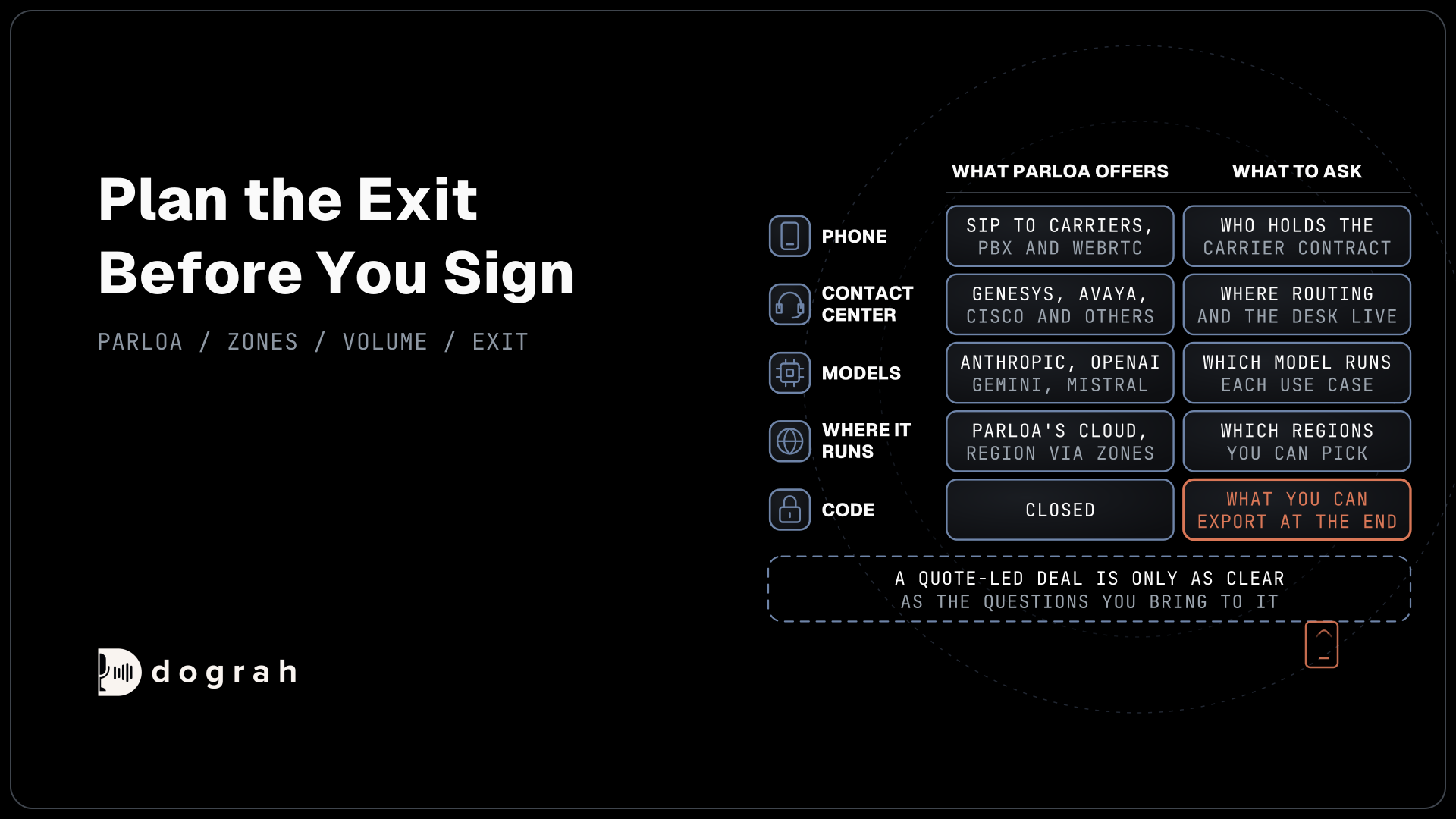
| Parloa | HIPAA compliance listed | PCI DSS, SOC 2 Type 1 and 2 | Parloa's cloud, in a region you choose | Closed |
| Synthflow | BAA with its HIPAA Setting | PCI DSS v4.0.1, SOC 2 Type 2 | Synthflow's cloud, EU or US | Closed |
| Vapi | BAA in a $2,000-a-month add-on | SOC 2 Type II | Vapi's cloud, no on-prem | Closed |
| Retell AI | Self-signed BAA, no fee | SOC 2 Type 1 and 2 | Retell's cloud, on-prem through sales | Closed |
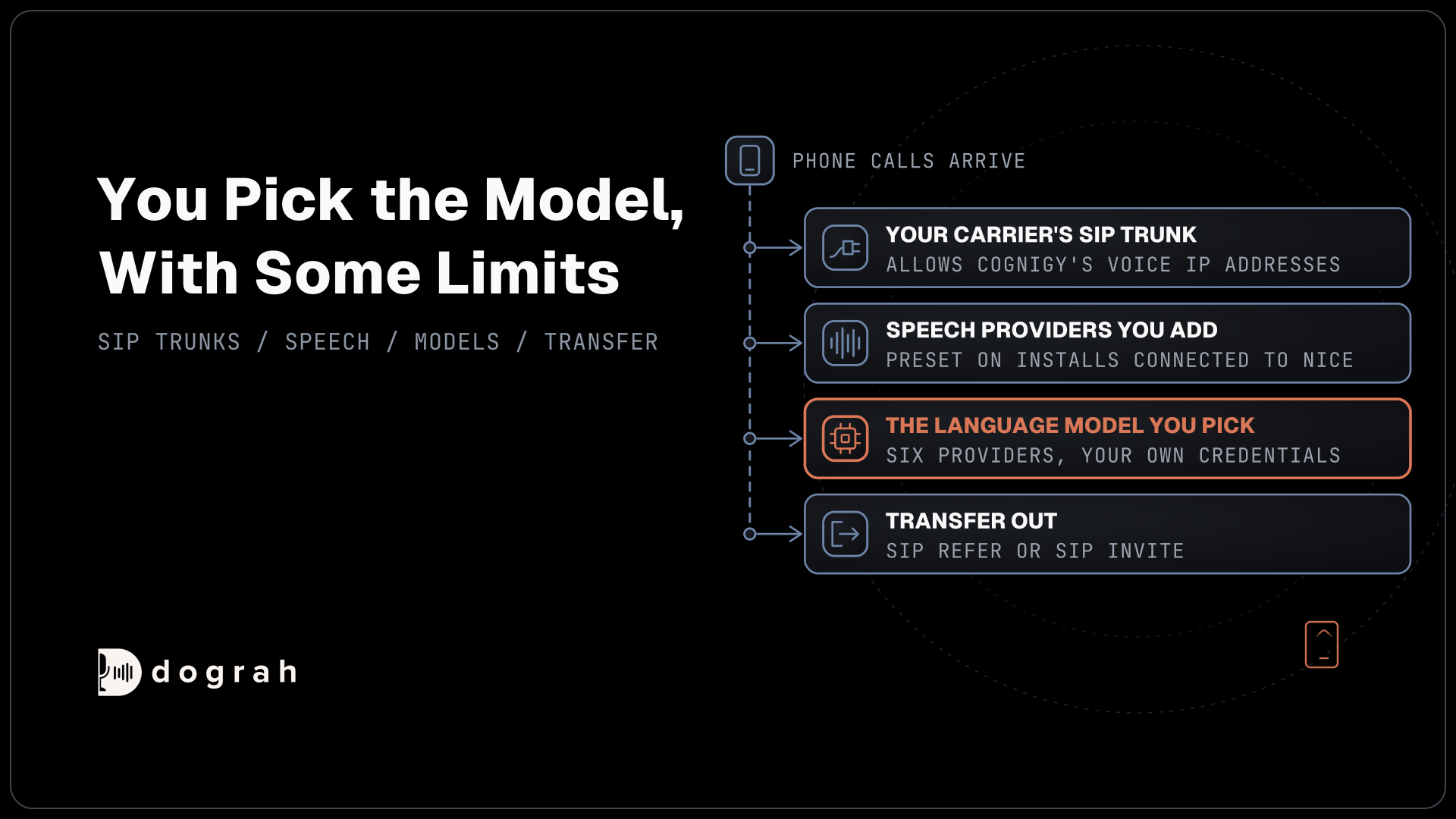
| Cognigy (NiCE) | Ask during review | Ask during review | SaaS for new customers, on-prem only for existing installs | Closed |
Dograh: calls on servers your organization runs
Dograh comes first for teams whose rules push calls onto their own servers, because the whole platform runs there. You self-host it with Docker Compose or with Helm on Kubernetes, and the Enterprise plan adds on-prem or private-cloud deployment with data residency. The code is open under BSD 2-Clause, so your security team can read what happens to a call before it goes live.
Self-hosted, there is no BAA to sign with Dograh and no hosted platform to list as a provider. Your model providers still receive call audio unless you run local open-weight models, which Dograh supports through a Speaches server, and your phone carrier still carries the call. One server-wide switch stops recording uploads while transcripts are still saved, and usage telemetry can be switched off with the ENABLE_TELEMETRY setting.
Card numbers stay out of the agent's transcript by design. An HTTP API tool asks your own payment provider to send its secure payment link by text or email, or Transfer Call hands the caller to a payment line, and Dograh calls the destination first and connects the caller only when someone answers. Every saved agent change creates a version kept for auditing, and the Enterprise plan adds audit logs and SSO / SAML.
Self-hosting also hands your team the server, the database and every upgrade, with community support on the open-source edition and custom SLAs on Enterprise. Self-hosted Dograh has no per-minute platform fee, but servers, model keys and phone minutes still cost money. Dograh Cloud charges a 1¢-a-minute platform fee. Our page on self-hosted voice AI for regulated industries shows that setup for each sector.

Open Source Alternative to Vapi / Retell
Self-hosted voice agent platform — no per-minute fees
dograh-hq/dograh
Star on GitHub
Healthcare platforms that sign a BAA
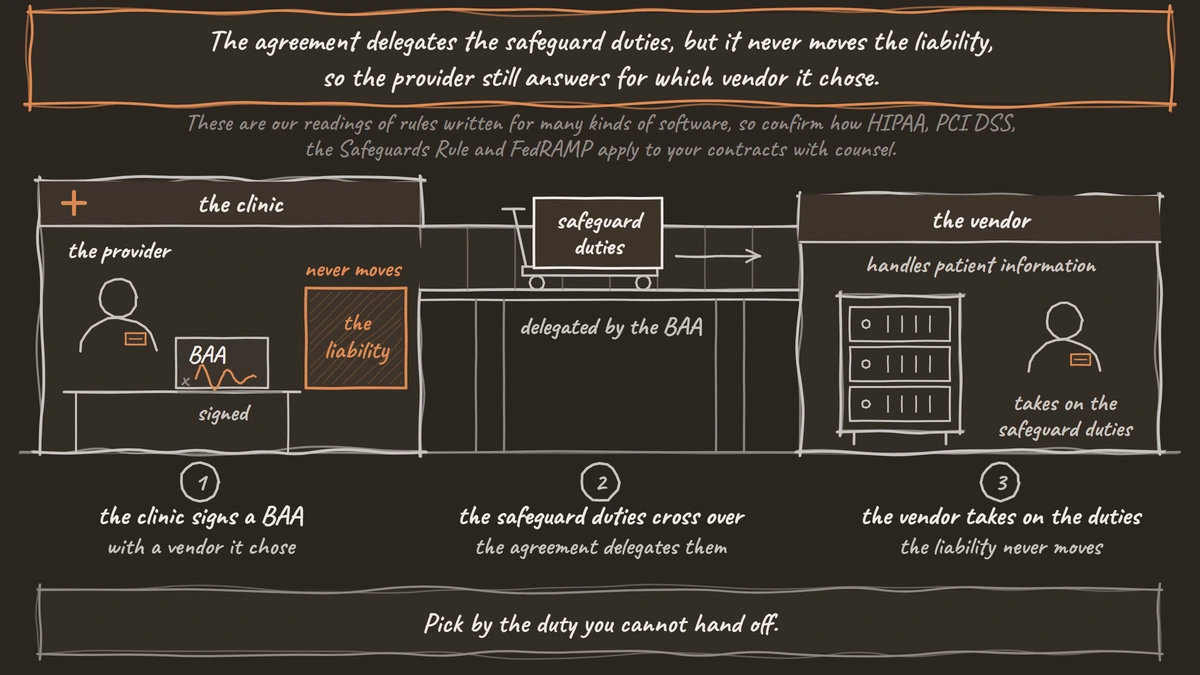
Hospitals and clinics need a signed BAA from any vendor that handles patient information, under the HIPAA business associate contract rules. The agreement delegates the safeguard duties, but it never moves the liability, so the provider still answers for which vendor it chose. With self-hosted Dograh, model providers that receive call audio may need their own BAA, the carrier may need one depending on what it stores, and a cloud host needs one if health data sits on its servers.
Among hosted platforms, the BAA comes on different plans. Retell AI's is self-signed with no fee, Vapi's comes with a HIPAA add-on at $2,000 a month, and Synthflow signs one once its HIPAA Setting is switched on. Bland and PolyAI sign one on Enterprise, and Parloa lists HIPAA compliance. Our list of HIPAA-compliant voice AI platforms compares each BAA's terms in full.
Finance platforms for PCI DSS and vendor oversight
Finance adds two tests, card data and oversight of the vendor. Under the FTC Safeguards Rule, which implements the Gramm-Leach-Bliley Act for lenders and other FTC-covered financial firms, a firm must pick providers able to protect customer data, require that protection by contract and check them over time. A hosted voice platform becomes one more provider to review every year.
Card numbers are the other test, since a number spoken on a call reaches recordings and transcripts. Parloa routes card data to a separate process outside its AI model, PolyAI offers card capture on Enterprise, Synthflow lists PCI DSS v4.0.1 and Bland lists PCI DSS as self-attested. Our guide to taking card payments on voice agent calls shows how to keep the card number off the AI path entirely.
EU banks also answer to the Digital Operational Resilience Act (DORA), where every outside service on the call becomes an entry in the bank's register of technology providers. The carrier stays on that register, while self-hosting generally takes the voice platform off it as a hosted service. Our list of AI voice agents for banking ranks the banking-specific vendors.
Government platforms with FedRAMP or on-prem
Federal agencies check a cloud vendor on the FedRAMP Marketplace, which shows each listing's status and the agencies that have authorized it. Bland's listing shows it FedRAMP 20x Class A certified, with no agency authorization listed yet, and Bland also offers on-prem or VPC deployment on Enterprise. Kore.ai still offers on-premises and private-cloud installs, while Cognigy now sells new customers SaaS only.
For agencies that want the platform on their own infrastructure, a self-hosted install runs inside the agency's own authorization boundary, so ask your authorizing official how it is assessed. These are our readings of rules written for many kinds of software, so confirm how HIPAA, PCI DSS, the Safeguards Rule and FedRAMP apply to your contracts with counsel. State and local agencies, and those outside the US, buy under their own rules, which our post on AI voice agents for public services covers.
Join the Dograh Community
Dograh is an OSS alternative to Vapi. Join our Slack community for queries, releases, best practices & community interactions.
Picking a voice AI platform for a regulated industry
Pick by the duty you cannot hand off. If calls must stay on servers your organization runs, start with Dograh, self-hosted or on-prem on Enterprise, and plan for the server, upgrades and model keys your team will own. If a hosted vendor is allowed, take the one whose BAA, PCI DSS scope or FedRAMP listing matches your industry.
For healthcare, Retell's self-signed BAA is the quickest to put in place, while PolyAI and Bland put theirs on Enterprise. For finance, pick a vendor that keeps card numbers out of the AI's path. For federal work, Bland is the hosted platform with a FedRAMP listing, and Kore.ai is the suite that still installs on-prem.
Glossary
- Business associate agreement (BAA)
- A HIPAA contract in which a vendor handling patient information takes on safeguard duties. It delegates the duties, but the healthcare provider still answers for choosing that vendor.
- FedRAMP 20x
- A newer FedRAMP route that certifies cloud services through automated checks. A certified listing is not the same as an agency authorization, which the Marketplace shows separately.
- PCI DSS scope
- The systems that store, process or carry card numbers and so must meet PCI DSS. Keeping card numbers off the voice agent keeps the agent out of that scope.
- Authorization boundary
- The set of systems an agency's security authorization covers. A self-hosted platform installed on agency servers sits inside it and is assessed with them.