
The best telephony providers for voice AI stream audio to your agent, sell the numbers you need and show the streaming charge. Twilio and Telnyx lead on API coverage, Plivo includes streaming, and Vonage sends 16 kHz audio. Dograh, the open-source AI voice agent platform, runs your agent on any of them through your own carrier account.
Key Takeaways
- Streaming adds $0.0044 a minute on Twilio and $0.0035 on Telnyx, but not on Plivo.
- Dograh connects to each of these carriers with your own account and keys.
- Vonage can stream 16 kHz audio, while most phone routes carry 8 kHz.
A phone provider for an AI agent does more than carry the call, since it also streams audio both ways. We set the tests an AI call adds, rank the main API carriers and own-trunk routes, then we talk about phone audio and how Dograh runs on each one.
What an AI call needs from a phone provider
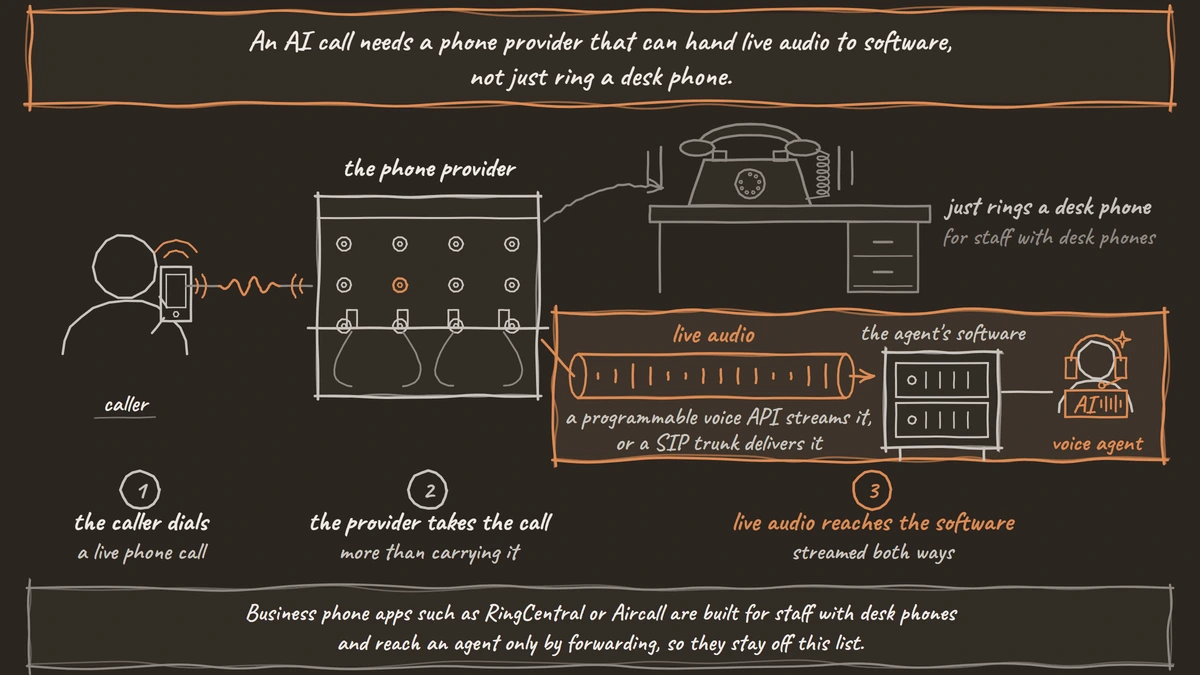
An AI call needs a phone provider that can hand live audio to software, not just ring a desk phone. There are two ways in. A programmable voice API streams the call to your agent over a WebSocket, while a SIP trunk delivers it to a system that handles the audio for you. Our list of the best SIP trunk providers for AI voice agents ranks trunks and their rates, and this list ranks the API accounts most teams start on.
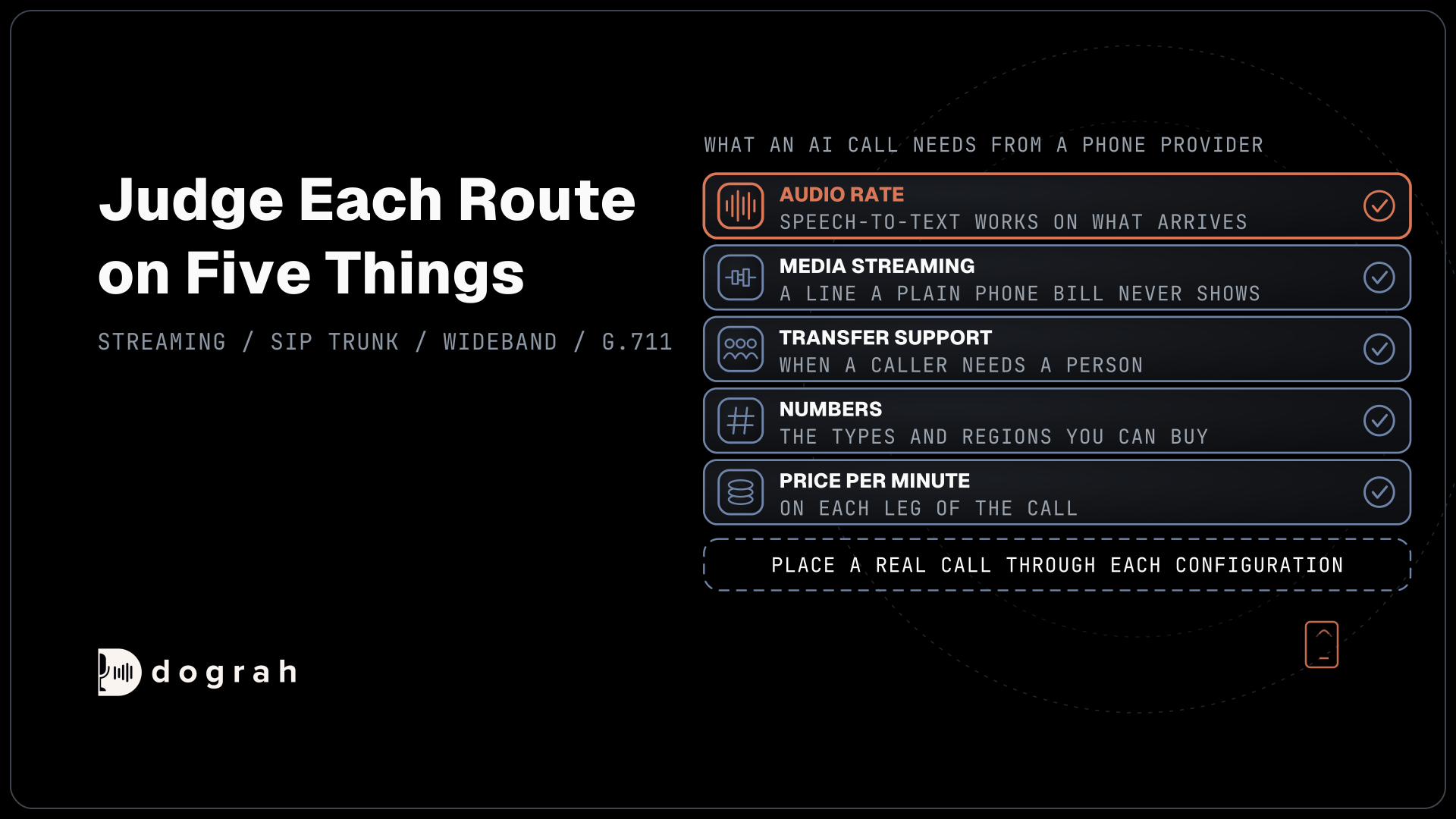
We judge each route on five things. The first is the audio rate the agent hears, because speech-to-text works on what arrives. The second is the media streaming charge, a per-minute line that a plain phone bill never shows. Then come transfer support when a caller needs a person, the number types and regions you can buy, and the price per minute on each leg of the call.
Business phone apps such as RingCentral or Aircall are built for staff with desk phones and reach an agent only by forwarding, so they stay off this list. Everything below can hand the call's audio straight to an agent.
Telephony providers for voice AI compared
The table ranks each route on those tests, in the order we would try them for a new US agent. Rates are US pay-as-you-go list prices before taxes and carrier fees, and the Transfer Call column shows what each route supports in Dograh.
| Provider | Best for | Audio into the agent | Transfer Call in Dograh | US per minute, in / out | Media streaming | US local number a month |
|---|---|---|---|---|---|---|
| Twilio | The most documented API route | 8 kHz mu-law | Yes, with an optional spoken introduction | $0.0085 / $0.0140 | $0.0044 a minute | $1.15 |
| Telnyx | A carrier with its own network | 8 kHz PCMU | Yes | $0.0052 / $0.0070 (Voice API plus SIP) | $0.0035 a minute | $1.00 |
| Plivo | Streaming inside the call rate | 8 kHz | Yes | $0.0055 / $0.0115 | Included | $0.50 |
| Vonage | Wideband audio | 16 kHz linear PCM | Callback request through an HTTP API tool | Not confirmed | Not confirmed | Not confirmed |
| Vobiz | Indian and US numbers | 8 kHz | Callback request through an HTTP API tool | $0.0055 / $0.0046 | Not confirmed | $1.00 |
| Exotel | Indian numbers | 8 kHz | Callback request through an HTTP API tool | By quote | By quote | By quote |
| Cloudonix | Your own carrier behind one platform | 8 kHz | Yes | Your carrier's rate | Plans from $69 a month | From your carrier |
| Asterisk | Your own PBX and trunks | 8 kHz ulaw | Yes | Your trunk's rate | None, it runs on your server | From your trunk |
Twilio, the most documented API route
Twilio is where most teams put their first AI agent on a phone line, because every step has docs and numbers are bought in its console in minutes. Twilio's US voice pricing lists inbound local calls at $0.0085 a minute, outbound calls at $0.0140 and Media Streams at $0.0044. An inbound AI call on a local number therefore runs about $0.0129 a minute before any model costs. Local numbers cost $1.15 a month and toll-free numbers $2.15.
Audio arrives as G.711 mu-law at 8,000 samples a second, and Twilio allows one two-way stream per call. Twilio also sells ConversationRelay, where Twilio runs speech-to-text and the voice while you host the language model logic. That suits a team that wants Twilio to own the speech layer.
Transfer Call works on Twilio, and it is the one route where Dograh can play a short spoken introduction both people hear before they are connected. To set it up from the first number to a transferred test call, see how to build a voice agent with Twilio.

Open Source Alternative to Vapi / Retell
Self-hosted voice agent platform — no per-minute fees
dograh-hq/dograh
Star on GitHub
Telnyx, a carrier with its own network
Telnyx runs its own carrier network and says it holds carrier licenses in more than 30 countries. That matters when you want one company answering for call quality from the handset to the stream.
Telnyx's Call Control pricing bills the Voice API at $0.002 a minute plus a SIP fee of $0.0032 inbound and $0.005 outbound. Media streaming adds $0.0035 a minute, numbers cost $1.00 a month and a call transfer costs $0.10 each time. Telnyx notes that rates may vary by destination and volume tier. An inbound AI minute lands near $0.0087 before models.
Telnyx streams can carry 16 kHz codecs such as L16, while Dograh asks Telnyx for PCMU, the 8 kHz default, so the agent hears the same narrowband audio as most phone calls. One setup detail catches people. Outbound calls need an Outbound Voice Profile attached to the app, and the steps to build a voice agent with Telnyx cover it along with the test call.
Plivo, with streaming in the call rate
Plivo folds audio streaming into its call rates, so an AI minute costs the same as a plain one. Plivo's US voice pricing lists local inbound calls at $0.0055 a minute, local outbound at $0.0115 and toll-free inbound at $0.0180. A local number costs $0.50 a month and a toll-free number $1.00, the lowest number fees in this list.
There are two limits to plan around. Plivo's Professional plan carries a usage limit of $2,500 a month in the US region, and going above it means moving to Enterprise. In its India data region, calling is restricted to India. Transfer Call works on Plivo, and the agent hears 8 kHz audio as on the other API carriers.
Vonage, Exotel and Vobiz for wideband and India
Vonage stands out for audio quality. Its WebSocket connection carries 16 kHz linear PCM into Dograh, twice the sample rate of the other carriers here, which gives speech-to-text more of the caller's voice to work with. We could not confirm Vonage's per-minute and streaming rates, so get a quote before you plan a budget.
Exotel and Vobiz suit teams calling Indian numbers. Exotel quotes its rates through sales. Vobiz's pricing lists US local calls at $0.0055 a minute inbound and $0.0046 outbound, with local numbers at $1.00 a month, toll-free numbers at $1.50 and the first month's rental charged as a setup fee. For India, its Build plan lists voice from ₹0.42 a minute.
On these three routes, a caller who needs a person gets a callback request. The agent writes it to your system through an HTTP API tool, and your team calls back from its usual line.
Join the Dograh Community
Dograh is an OSS alternative to Vapi. Join our Slack community for queries, releases, best practices & community interactions.
Cloudonix and Asterisk for your own trunk
Some teams already pay a carrier and want to keep it. Cloudonix sits between that carrier and the agent, and says plainly that it does not provide phone numbers or call minutes. You bring a SIP trunk, and Cloudonix bills by sessions and concurrent calls, from a free plan with 500 sessions and two active calls to Starter at $69 a month.
Asterisk is the open-source route. You run your own PBX and trunks, and the agent connects to it over the Asterisk REST Interface (ARI), with call audio as ulaw. Use Asterisk 22.8 or later, and check the options table on Asterisk's WebSocket page for your version. The steps to build a voice agent with Asterisk show the setup on a server you control. Transfer Call works on both Cloudonix and Asterisk.
What phone audio does to speech-to-text
Most phone calls still reach the agent as 8 kHz audio, while a browser demo runs at 16 kHz. Every route above except Vonage delivers narrowband audio, so the speech-to-text model you pick matters as much as the carrier.
The gap depends on the model. The independent WildASR benchmark simulated G.711 phone audio on English speech and found six of seven models moved by 0.6 points of word error rate or less. Whisper Large V3 went from 4.2% to 4.8%, while Qwen2-Audio jumped from 5.8% to 48.3%. A simulation leaves out real networks, handsets and background noise, so test your pick on a real call.
For production, a SIP trunk is still the most reliable route, and the browser is for demos. Our post on why your voice agent mishears callers covers codecs, noise and fixes in more depth.
Dograh, the agent layer on any of these carriers
Dograh runs the agent and leaves the phone account with you. It connects to Twilio, Telnyx, Plivo, Vonage, Exotel, Vobiz, Cloudonix and Asterisk ARI, and the telephony setup is the same shape on each. You open Telephony in the sidebar, choose Add configuration, pick the provider, paste its keys and select Create. Then Add phone number links a number to the agent through its Inbound workflow field.
The agent stays the same when the carrier changes. You can hold several configurations, mark one as the default for outbound calls, and move a number by pointing it at the same agent. Transfer Call works on Twilio, Telnyx, Plivo, Cloudonix and Asterisk ARI, and Dograh calls the destination first and connects the caller only when someone answers.
Your carrier bills minutes, numbers and streaming to your own account. Running Dograh yourself puts no per-minute platform fee on top of that bill. You still pay for the server it runs on, your model keys and those phone minutes, and your team keeps the database healthy and applies upgrades. The open-source community answers support questions, and Enterprise adds custom SLAs. Dograh Cloud hosts it instead for a 1¢-a-minute platform fee, with 10 concurrent calls included on pay as you go, while a self-hosted install runs 10 by default, a limit you can raise.
To compare carriers, build one agent and place a real call through each configuration with the Phone Call button in the agent editor. Then open View Trace on each run and compare the speech-to-text time per turn, since that is where audio quality shows first.
Glossary
- Programmable voice API
- A carrier's API that lets software answer, place and control calls. For an AI agent it also streams the live call audio to your server.
- Media streaming
- The live copy of a call's audio sent to the agent over a WebSocket and back. Twilio and Telnyx bill it per minute, while Plivo includes it.
- G.711 mu-law
- The standard narrowband phone codec, sampled at 8,000 times a second. Most AI calls reach the agent in this format.
- Wideband audio
- Audio sampled at 16 kHz, which keeps more of the voice than an 8 kHz line. Vonage streams it into the agent.