
AI voice agents can handle claims intake, policy questions, payment reminders and renewal calls for Australian insurers. ASIC's hawking ban covers AI, so an agent never offers a new policy on a call the customer didn't ask for. Dograh, the open-source AI voice agent platform, can be self-hosted in Australia or run on Dograh Cloud.
Key Takeaways
- The hawking ban covers AI calls, so offers go to a licensed person.
- Reminders and payment calls aren't telemarketing. Offer calls need consent and a washed list.
- Call audio stays onshore only when the speech and language models do too.
This post is part of our guide to AI voice agents for insurance, from first lead to renewal. Below, we sort the calls, then cover the hawking ban, calling rules and call data. Then we set up the calls in Dograh, the open-source AI voice agent platform we build.
Sort each call: service, renewal or offer
Most insurance calls an agent handles are service calls, and the rules change only when a call starts to sell. Two questions sort every call. Is it telemarketing under the Do Not Call rules, and does it offer a financial product under the hawking ban?
| Call | Telemarketing? | Hawking risk | What the agent does |
|---|---|---|---|
| Claims intake, inbound | No, the customer called | Low | Takes the claim, sends an upload link |
| Policy questions, inbound | No, the customer called | Low, until a new policy comes up | Reads the policy, hands buying questions over |
| Payment reminders, outbound | No, payment calls are exempt | Low, if nothing new is offered | States the amount due after verification |
| Renewal calls, outbound | Depends on the offer | Allowed for a similar policy held in the last 30 days | Reads a fixed renewal line, hands anything new over |
The last row is where an AI agent can cross a line by being helpful. "While I have you, would you like home cover too?" turns a renewal into a sales call.
The hawking ban covers AI calls
Australian law bans hawking insurance. ASIC's guide to the hawking prohibition, Regulatory Guide 38 under the Corporations Act 2001, says no one may offer a financial product, or ask or invite someone to apply for one, during or because of contact the person did not ask for. Insurance is a financial product. The guide calls the ban technology neutral and says it reaches media that use artificial intelligence, so an AI voice agent is covered exactly like a person.
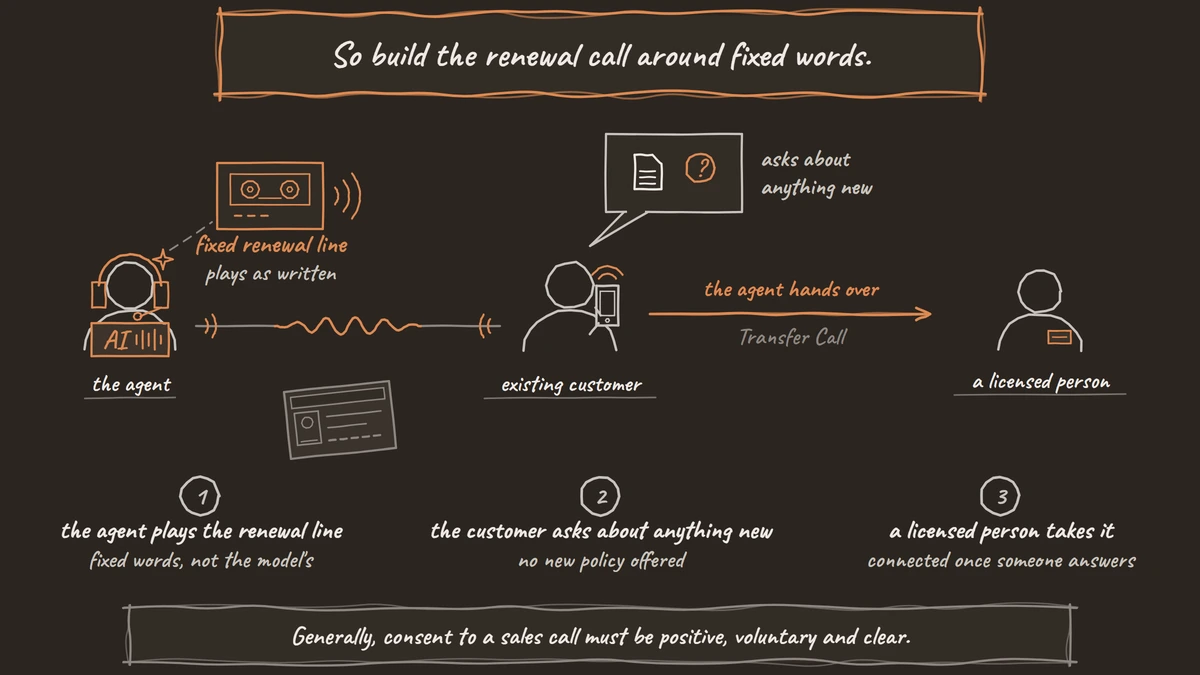
Consent to a sales call must be positive, voluntary and clear. It cannot come from a leading question, and it can cover a period of up to six weeks. A customer who rings the insurer has agreed to that contact. Two carve-outs matter most. An existing customer can be called about a policy they hold, as long as nothing new is offered, and a renewal of a substantially similar policy is allowed if they held it in the last 30 days. Breaking the ban is a strict liability offence, and the customer can hand the policy back.
So build the renewal call around fixed words. Put the renewal line in Transition Speech or a recording, which plays as written, rather than letting the model phrase it. When the caller asks about anything new, the agent hands them to a licensed person with Transfer Call. Dograh dials your team while the caller hears hold music and connects them once someone answers. When the transfer gets no answer, a busy line, a failure or a timeout, the agent receives transfer_failed and the call continues, so it books a callback from a licensed adviser instead.
Register, consent and calling hours
The Do Not Call Register Act 2006 bars unsolicited telemarketing calls to registered numbers. The Do Not Call Register rules for businesses say calls for reminders, rescheduling, payments, product recalls and replies to a customer's own enquiry are not telemarketing. Consent can be express. Inferred consent, drawn from an existing relationship, counts too. Express consent with no stated end lapses after three months, and any consent ends the moment the person says no. A washed list, checked against the register in the last 30 days, covers numbers not on it.
The telemarketing and research calls standard sets the hours: 9am to 8pm on weekdays and 9am to 5pm on Saturday, with no calls on Sunday or national public holidays. Each call must say who the caller works for, why they are calling and who arranged the call, keep caller ID on and end as soon as the person asks. Our post on Do Not Call basics for Australian small businesses covers the register from a tradie's side. How these rules, the hawking ban and your state's call recording law apply to your calls depends on your business, so confirm the details with counsel before the first campaign.
In Dograh, a campaign runs its calling hours in one time zone, so split the list by local time zone, such as Perth, Darwin, Adelaide, Brisbane and Sydney, and plan national public holidays out of the schedule. Put the business name, the reason for the call and who arranged it in the Greeting Text, and switch off Allow Greeting Interruption on the Start Call node so it plays in full. You set the retries, from 0 to 10, and the wait between them. Our post on outbound calling rules for voice agents covers those settings in depth.

Open Source Alternative to Vapi / Retell
Self-hosted voice agent platform — no per-minute fees
dograh-hq/dograh
Star on GitHub
Claims, questions and payment calls
A claims intake call carries more personal detail than any other insurance call. Health, damage and money can all come up in a few minutes from a caller who may be shaken, so the agent keeps its questions short and its tone calm. It never collects documents on the call. An HTTP API tool asks your own system to send a secure upload link to the contact details on file.
Policy questions follow greet, verify, disclose. The agent finds the record by phone number, confirms identity with an approved check and only then reads cover details from the policy system. Anything that sounds like advice, such as "should I add flood cover?", goes to a licensed person.
Payment reminders state the amount due after verification and never take card numbers by voice. Your own system sends its secure payment link instead. A reminder that slips in an offer stops being a payment call, so keep the reminder script fixed and short.
Join the Dograh Community
Dograh is an OSS alternative to Vapi. Join our Slack community for queries, releases, best practices & community interactions.
Keeping call data in Australia
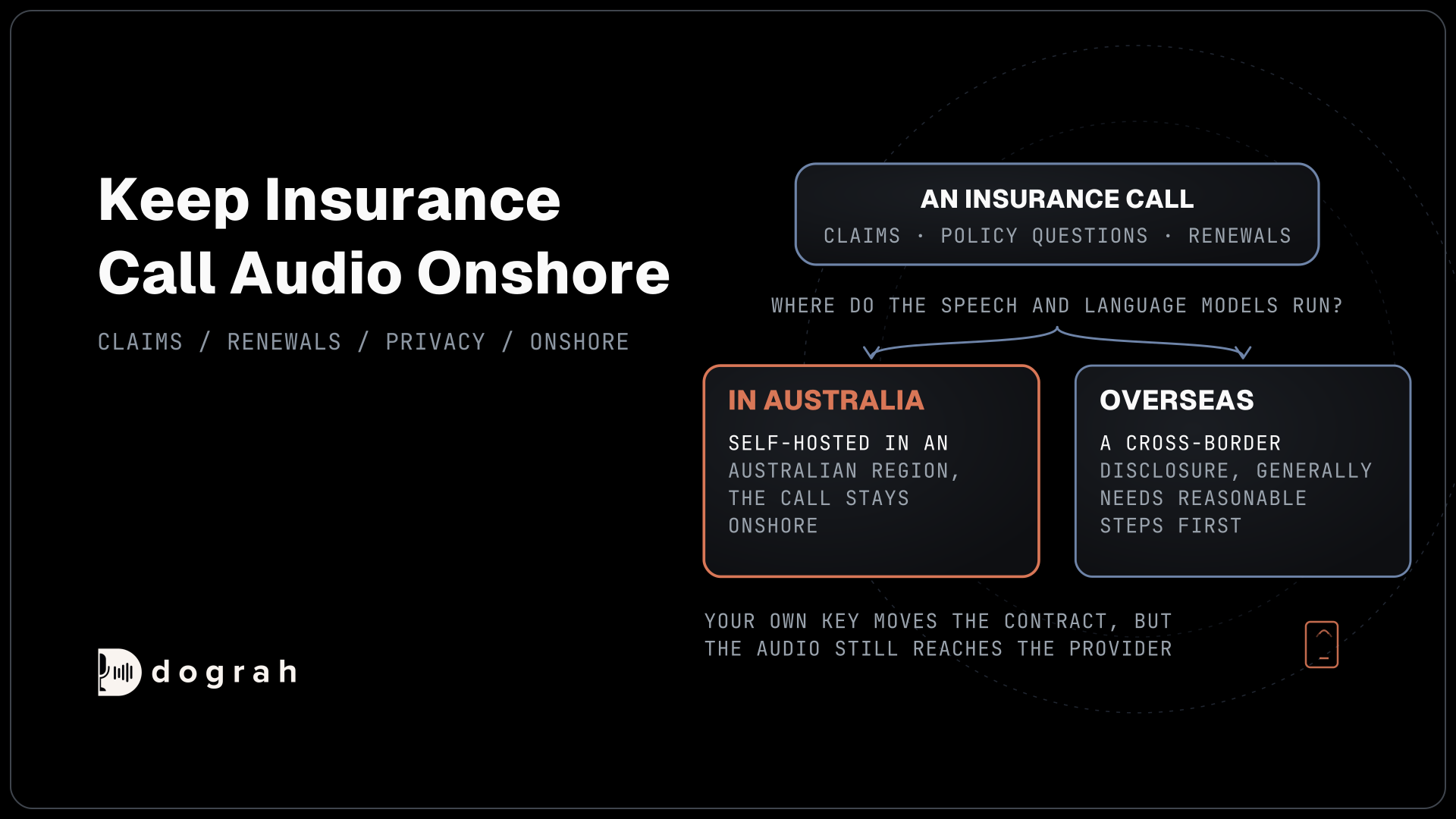
The Privacy Act 1988 sets the rules through the Australian Privacy Principles. A cross-border disclosure, sending personal information to an overseas recipient, needs reasonable steps first, data must be kept secure and destroyed or de-identified when no longer needed, and direct marketing must offer an opt-out. Our post on the Privacy Principles a phone agent touches works through them for a practice line.
A newer duty starts on 10 December 2026. Under the Privacy and Other Legislation Amendment Act 2024, a privacy policy must describe decisions that computer programs make when they could significantly affect a person. An agent that only records a claim is generally outside that, while one that decides how a claim is triaged could be inside it.
Self-hosting is the way to keep the call onshore. Run Dograh in an Australian cloud region or data centre, with the speech and language models running there too. On the Models page, set the Organization default to your own providers or local models, and check that no agent has its own override. Bringing your own key moves the contract, but the audio still reaches the provider, wherever it runs. Our post on every place call data is stored lists the copies your retention schedule must cover.
Self-hosted Dograh has no per-minute platform fee, but servers, model keys and phone minutes still cost money. Dograh Cloud charges a 1¢-a-minute platform fee. For call data that stays onshore, those servers and models are the ones you run in Australia.
Start with inbound claims intake, which needs no consent and no wash, and add renewal calls once the fixed lines and the licensed handover are tested on real phone calls.
Glossary
- Hawking prohibition
- The Corporations Act ban on offering a financial product, insurance included, during or because of contact the person did not ask for. ASIC says it covers AI, with carve-outs for existing products and similar renewals held in the last 30 days.
- Washed list
- An outbound list checked against the Do Not Call Register before a telemarketing campaign. A wash within the last 30 days covers numbers that are not on the register.
- Inferred consent
- Consent drawn from an existing relationship or the person's conduct, such as a current policyholder. It ends the moment the person says no.
- Cross-border disclosure
- Sending personal information to a recipient outside Australia, which needs reasonable steps first. Live call audio sent to an overseas model counts.