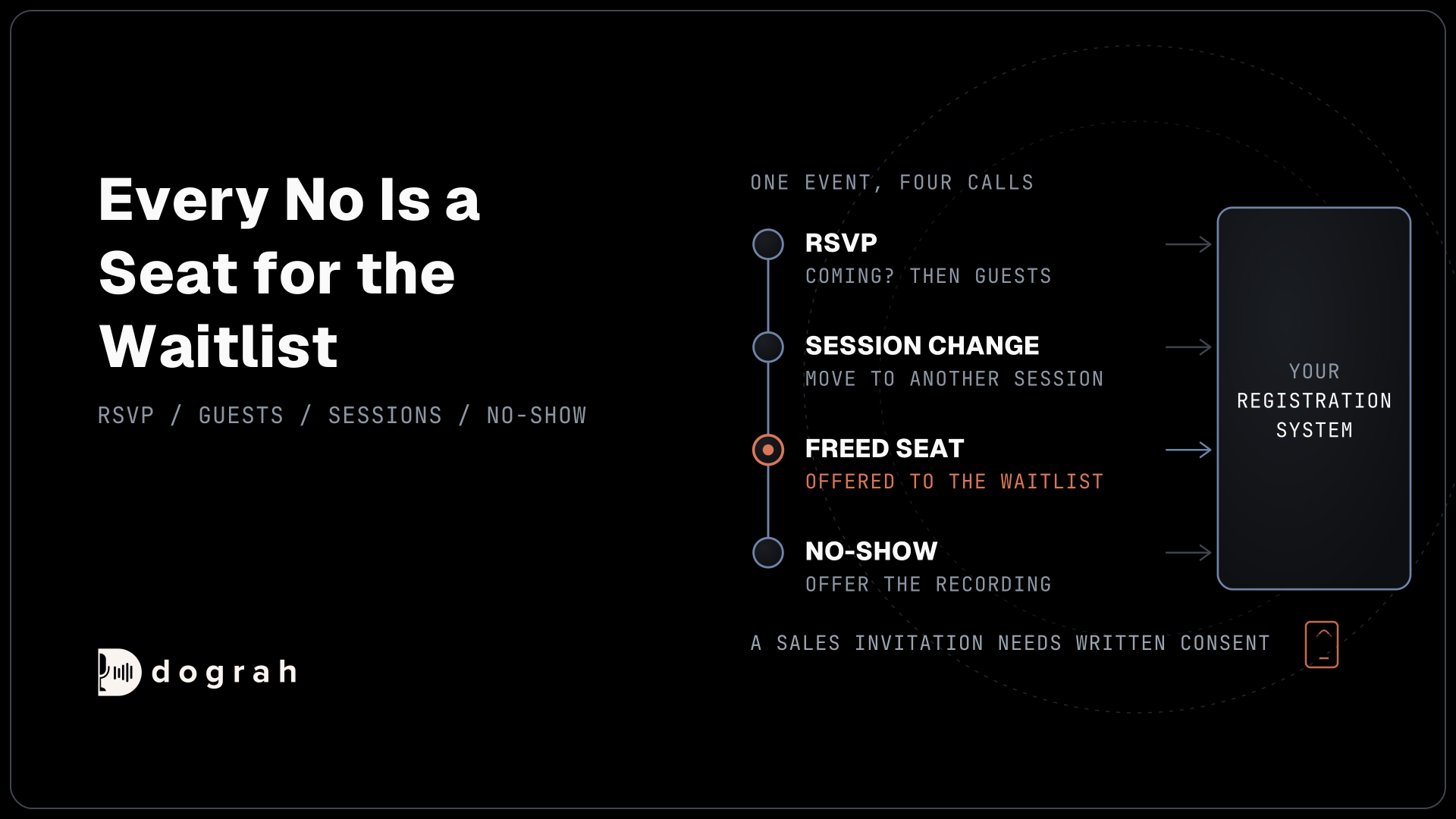

AI voice agents for event and webinar RSVP and reminders call registrants when there is a decision to make, such as whether they're coming. They write each answer to the registration system and offer any freed seat to the waitlist. Calls to registrants are service calls, while sales invitations need written consent.
Key Takeaways
- Call registrants for a decision, and send confirmations and links by email.
- A sales invitation with an AI voice needs prior express written consent.
- Every answer goes straight back to the registration system, including guest counts.
Registration alone doesn't fill the room, and a wrong headcount changes catering and seating. We cover when a call earns its place, consent, the RSVP call, reminders, waitlists, no-show follow-up, day-of changes, handovers, campus events and running the campaign in Dograh. You can self-host Dograh or run it on Dograh Cloud.
Call when there is a decision to capture
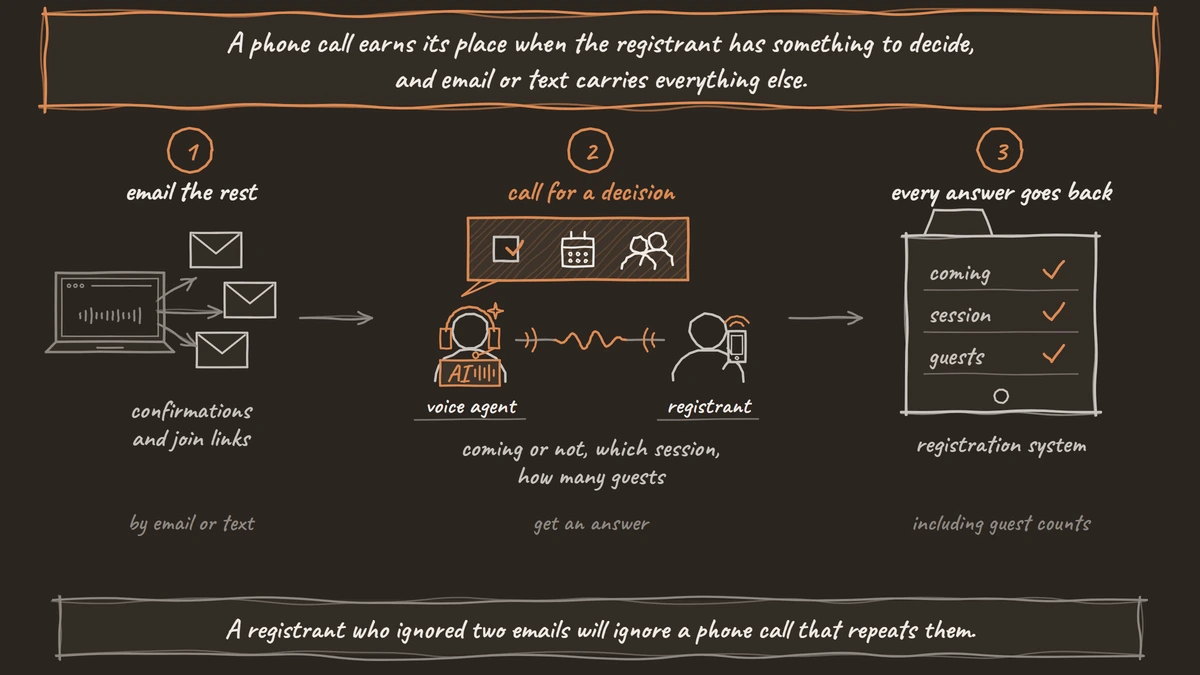
A phone call earns its place when the registrant has something to decide, and email or text carries everything else. Registration alone doesn't fill the room. Across 33,786 webinar sessions in Livestorm's 2026 webinar benchmark, 47.7% of registrants attended live in 2025, down from 48.9% in 2024. Livestorm reports replay views separately, so that is live attendance only.
More reminders won't fix that on their own. A registrant who ignored two emails will ignore a phone call that repeats them. What a call can do that an email can't is get an answer, such as coming or not, which session, how many guests, or whether to take a seat that just opened.
So keep confirmations and join links on the channels your registration system already uses. Use the voice agent for the calls that end in a decision, and for registrants who haven't answered anything else.
One-to-one bookings, such as a clinic visit or a service call, follow a different pattern, because there is one slot and one person. AI voice agents for appointment reminders and confirmations covers those. This guide stays with one-to-many events, where seats, sessions and headcounts matter.
Registrants, invitations and consent
The purpose of the call decides the consent rule, so sort your call lists by purpose before anything else. The FCC's 2024 ruling on AI-generated voices brought AI voices under the artificial-voice rules of the Telephone Consumer Protection Act (TCPA), so an AI call to a registrant's mobile needs prior consent.
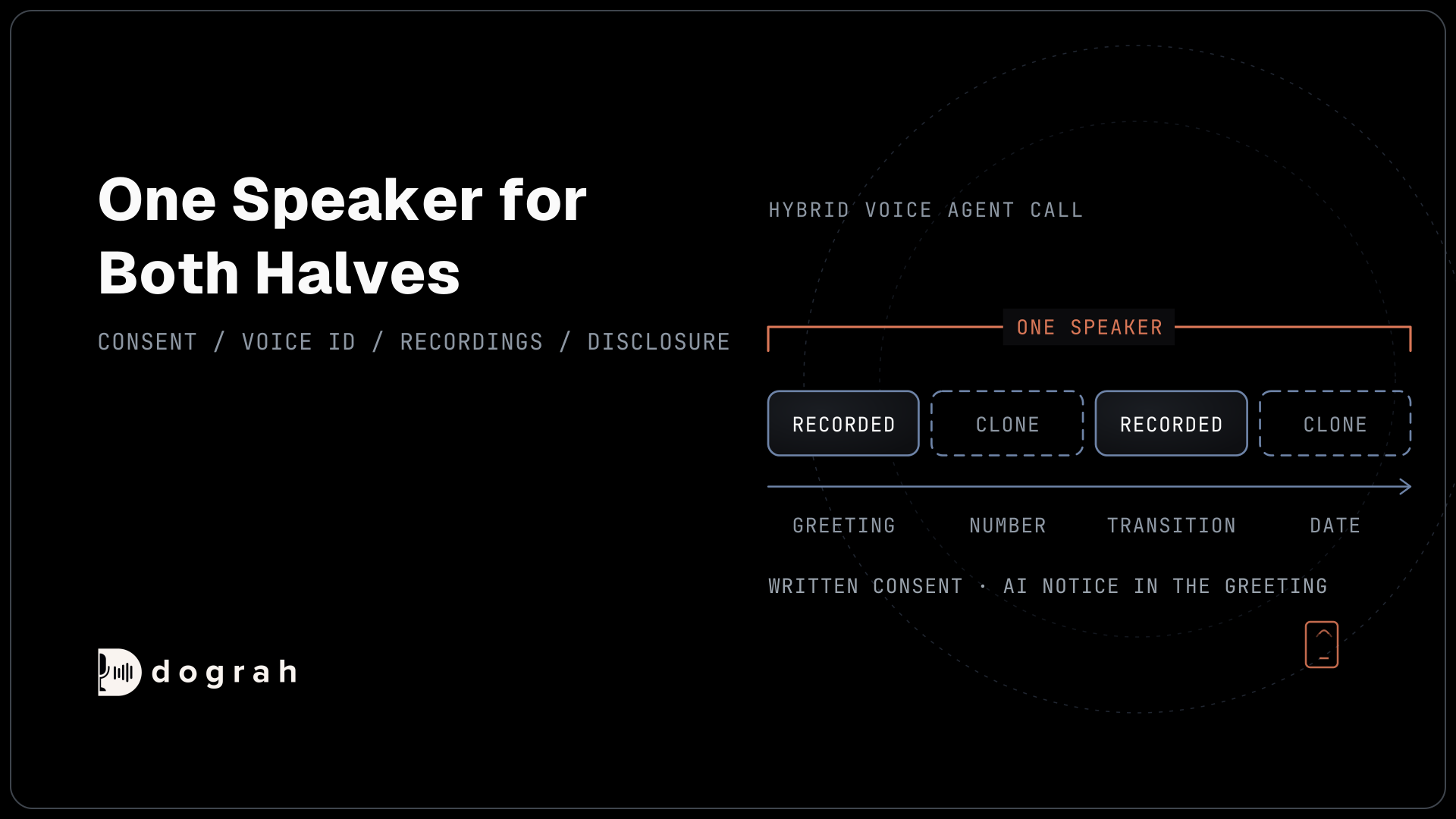
A registrant who gave their number for the event and gets a call about that event is generally receiving a service call, which needs prior express consent. An invitation to someone who never registered is different. So is a call that sells tickets, an upgrade, a paid conference or a product demo. The Telemarketing Sales Rule's definition covers calls made to induce a purchase, and an AI-voice call of that kind needs prior express written consent.
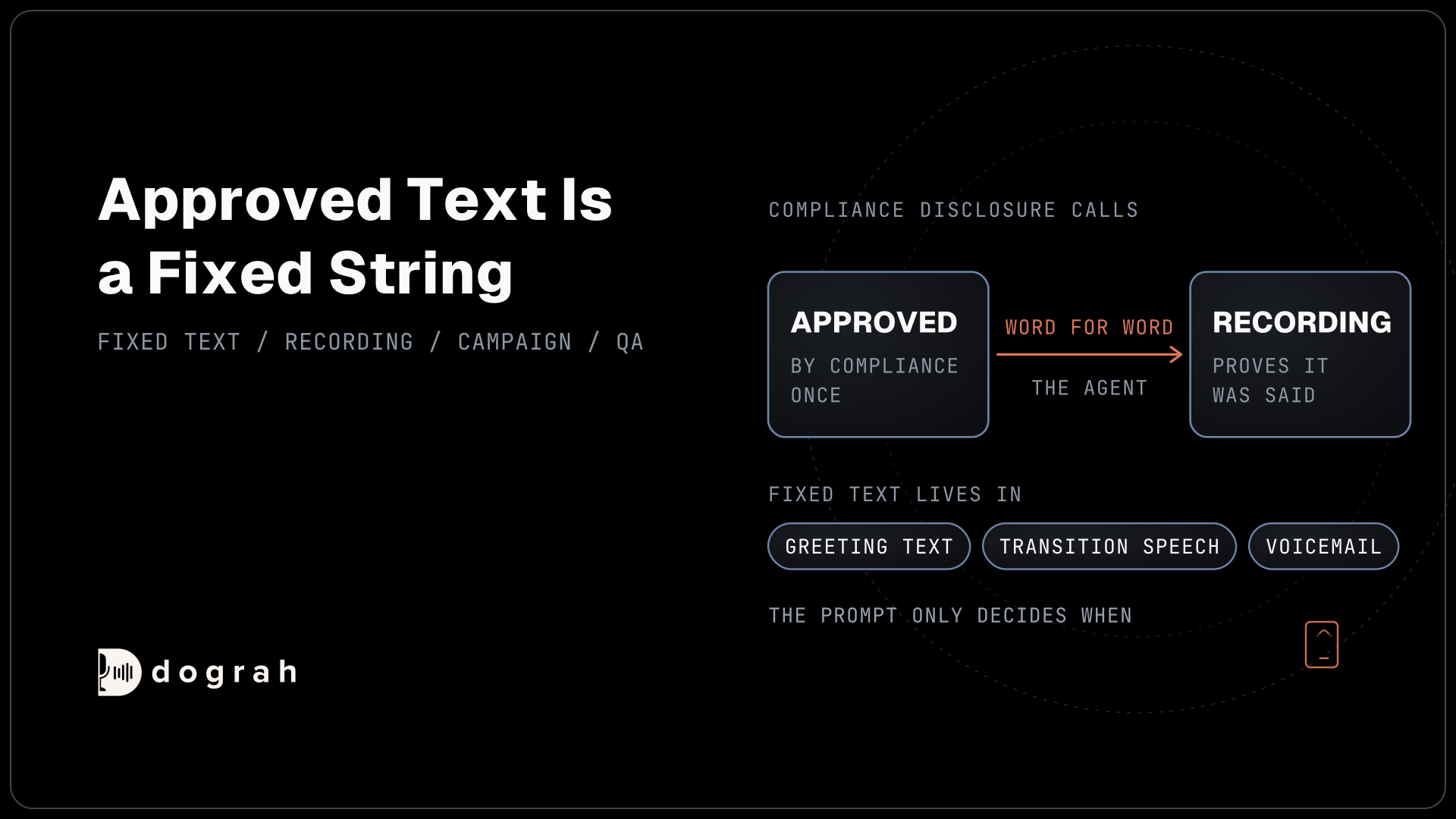
The FCC's calling rules also require an artificial-voice call to identify the business at the start and give a number to reach it. Put the organiser's name in the Greeting Text, which plays word for word. Add a line saying an automated assistant is calling if you want registrants to know, or if local law requires it. Allow Greeting Interruption is on by default on the Start Call node, so switch it off for a greeting that must play in full.
When a registrant says "stop calling", the agent logs that opt-out in your registration system during the call, and the number stays off every list after it. Registrants in the UK and EU fall under different rules, covered in GDPR and voice AI. Confirm your call lists and scripts with counsel before the first campaign.
The RSVP call, one question at a time
An RSVP call asks one thing at a time and writes each answer back. The call list comes from your registration system as a campaign file, and extra columns such as the event name, the session time and the venue become variables the agent can use.
The agent names the organiser and the event, then asks whether the person is still coming. Only after a yes does it ask how many guests they're bringing, because a headcount question to someone who isn't sure yet gets a guess. A "maybe" is a valid answer too. Record it, and let your system decide whether a later call is worth it. That same question order runs in our open-source event RSVP voice agent, which writes each answer and guest count to your registration system.
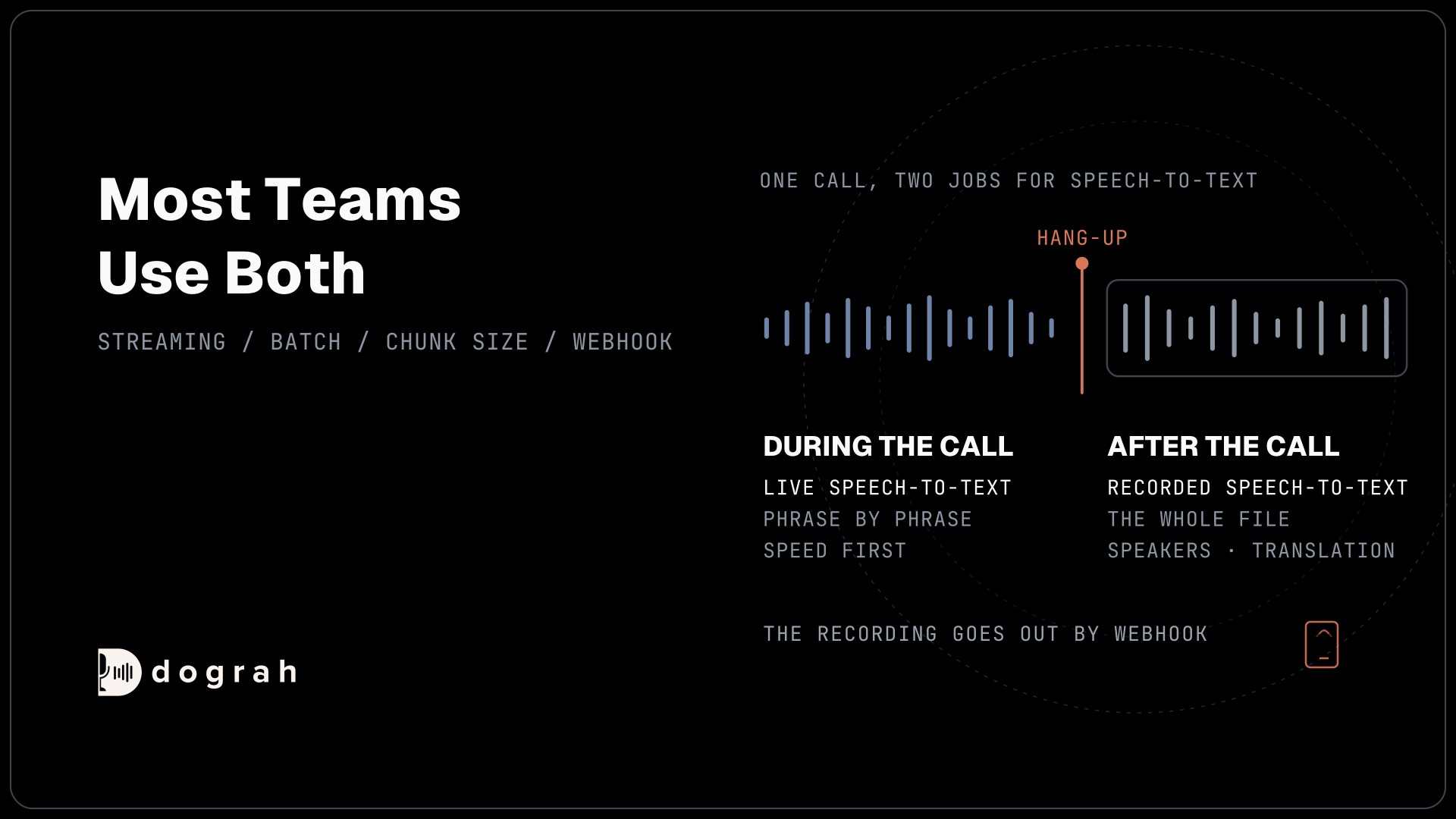
Variable extraction records the answer and the guest count as the caller stated them, with the transcript and recording as the exact record. A Webhook node at the end of the call sends them to your registration system. A temporary failure, such as a timeout, is tried up to five times in all, so a brief outage on your side doesn't lose an RSVP. Webhook-driven voice agents covers the payload and the retries.
Keep the call short. A registrant who says they're busy gets a callback at a time they choose, recorded as a request for your system to schedule, and never an immediate redial.

Open Source Alternative to Vapi / Retell
Self-hosted voice agent platform — no per-minute fees
dograh-hq/dograh
Star on GitHub
Reminders and session changes
A reminder call is worth making when something changed or a choice is open, and it should carry the details as they stand at call time. Room changes and new start times happen after a campaign list is built. Pre-Call Data Fetch asks your event system for the current details as the call connects, and the greeting waits for it, so the agent never reads out last week's room.
A registrant who can't make the Tuesday session can move to Thursday on the same call. An HTTP API tool asks the registration system which sessions have seats and moves the registration. While the request runs, the registrant hears the line on the tool's Messages card, such as "Let me check Thursday for you". Add a Preset Parameter named workflow_run_id with the value {{initial_context.workflow_run_id}}, so a repeated request never moves anyone twice.
The join link stays off the call, because a spoken web address is hard to catch. If the registrant asks for it again, an HTTP API tool asks your own email or messaging provider to send it during the call.
Questions about parking or the agenda are answered from the organiser's own files. Upload them to the agent's Knowledge Base, and the agent answers from them instead of guessing.
Waitlists: free the seat, then offer it
Every "no" on an RSVP call is a seat someone on the waitlist wants. When the registration system marks the seat open, it can start a call to the next person on the waitlist through the API Trigger, with the session details as context.
The agent offers the seat and asks for a yes or a no. Two waitlisted people can be called for the same seat at once, so the registration system, never the agent, decides who gets it. The agent's booking request either succeeds or comes back taken, and the agent says so and offers to keep the person on the list.
A waitlist call goes to someone who asked for a seat, so it is a service call like the RSVP. AI voice agents for class booking and reminder calls runs the same free-the-spot pattern for gym classes.
No-show follow-up after the event
A registrant who missed the live session gets one short call, and it carries the recording. The agent says it is calling about the session they registered for and asks whether they'd like the recording. On a yes, an HTTP API tool asks the organiser's own email or messaging provider to send the link during the call.
Then the agent asks one question, such as whether they want a seat at the next session, and records the answer. Keep the follow-up to that. A no-show follow-up that pitches a paid product or a sales demo is a sales call, so it needs prior express written consent, and most organisers are better off sending that offer by email.
Day-of changes and cancellations
A venue change or a cancelled session on short notice is the one time every registrant should get a call. An email sent the night before is easy to miss, and a registrant who travels to the wrong building has a bad day that no apology fixes.
Build the list from the registration system, and keep the new details out of the campaign file. Pre-Call Data Fetch reads them as each call connects, so a second change during the campaign still reaches the people called later. The agent gives the new detail first, then asks whether the person can still come, and records the answer like any RSVP.
A call like this is about the registrant's own booking, so it is a service call. Keep it to the change. If the session moved to a date the person can't make, the agent offers another session through the same HTTP API tool as any other move, or records that they want a refund, which your team handles.
Questions that need a person
Some registrants need a person, such as a refund request or a group booking. Transfer Call works on Twilio, Telnyx, Plivo, Cloudonix and Asterisk ARI. The events team's line rings first, and the registrant joins only after someone there picks up.
No summary travels with the call by default, so the agent writes the request to your system before the transfer. If nobody answers within the 30-second default, the caller stays with the agent, which records a callback request. Test transfers on a real phone line, since browser test calls can't run them.
Campus events and orientation
Universities run the same calls for orientation and open days, with student privacy added. The orientation call is about logistics, such as the date, the session, how many family members are coming and what to bring. Anything about the student's record goes through the school's verify-then-answer process.
An RSVP of "no", or no answer at all, is an early sign that an admitted student may not arrive in the fall. The agent passes that to an admissions counsellor's list. AI voice agents for event and orientation RSVP covers the orientation call and its privacy rules.
Running the campaign
A campaign's calling hours run in one time zone, set per campaign, so split a national or global registrant list by time zone and run one campaign each. Retries are set per campaign, from 0 to 10 with a default of 2, and you choose which outcomes, such as busy or no answer, are retried.
International events need the right language. Set speech-to-text to "Multilingual (Auto-detect)" in the agent's Model tab, and write the Greeting Text in both languages, since it plays before the agent can hear the caller's language. A campaign file can also carry a different greeting for each registrant, through the greeting_override_type and greeting_override_text columns.
Voicemail handling is off by default. Once you turn it on, "When voicemail is detected" starts at Disconnect the call, and a message plays only when you set it to Leave a message. Keep the message to the organiser's name, the event and a number to call back, and nothing that needs an answer.
A self-hosted install runs 10 concurrent calls by default, adjustable on your own servers, and Dograh Cloud Pay as you go includes 10 concurrent calls. Hosting it yourself means no per-minute platform fee, though servers, model keys and phone minutes for each registrant call still cost money, while Cloud usage carries a 1¢-a-minute platform fee.
Join the Dograh Community
Dograh is an OSS alternative to Vapi. Join our Slack community for queries, releases, best practices & community interactions.
Which event call to automate first
Start with RSVP calls for in-person events, because a headcount changes catering and seating, and registrants expect the call. Add waitlist offers once RSVPs flow into your system, then no-show follow-up after your first webinar with a recording.
Test on a real phone number before launch. Most phone calls reach the agent as 8 kHz audio, while a browser test runs at 16 kHz, so event names and venue names can sound different to the speech model. Campus events have their own deep dive:
Glossary
- Show-up rate
- The share of registrants who attend an event live. Replay views are reported separately, so a webinar's show-up rate is lower than its total views.
- Telemarketing
- Under the Telemarketing Sales Rule, calls made to get someone to buy goods or services. An event call that sells tickets or a demo counts, and with an AI voice it needs prior express written consent.
- Prior express consent
- Permission to call a number about a specific matter, often given by providing the number for it. A registrant who gave a number for the event has generally given it for calls about that event.
- Waitlist offer
- A call to the next person on an event's waitlist when a seat opens. The registration system decides who gets the seat, so two calls at once never give it away twice.