
AI voice agents for DME suppliers take the calls that eat staff time beyond resupply. They answer order-status calls after checking the patient's identity, call prescriber offices about missing written orders and prior authorization, and book deliveries. The agent reads from and writes to your own systems, while your team keeps every coverage decision.
Key Takeaways
- Verify the patient before the agent reads any order or delivery status.
- Point prescriber-office campaigns at each office's direct records or referral line.
- The agent reports order and authorization status, and people decide coverage.
This post is part of our guide to AI voice agents for hospitals and health systems, where DME resupply eligibility is read from the supplier's own system, never decided by the agent. We cover order status, paperwork chasing and deliveries in Dograh, the open-source AI voice agent platform we build.
Where a DME supplier's phone time goes
A durable medical equipment (DME) supplier's phones ring for a handful of reasons. Patients call to ask where their order is. Staff call prescriber offices to chase missing paperwork, and call payers about authorizations. Then someone calls the patient to book the delivery.
Resupply is one more call: reaching patients when their CPAP masks or diabetic supplies are due. It has its own Medicare rules on when the supplier may call, and our post on AI voice agents for DME order and resupply reminders covers them, from the eligibility read to the refill record.
The rest of this post covers the other calls. Each one follows a script your team already knows, which is what makes it a good fit for an agent.
An order-status line that checks first
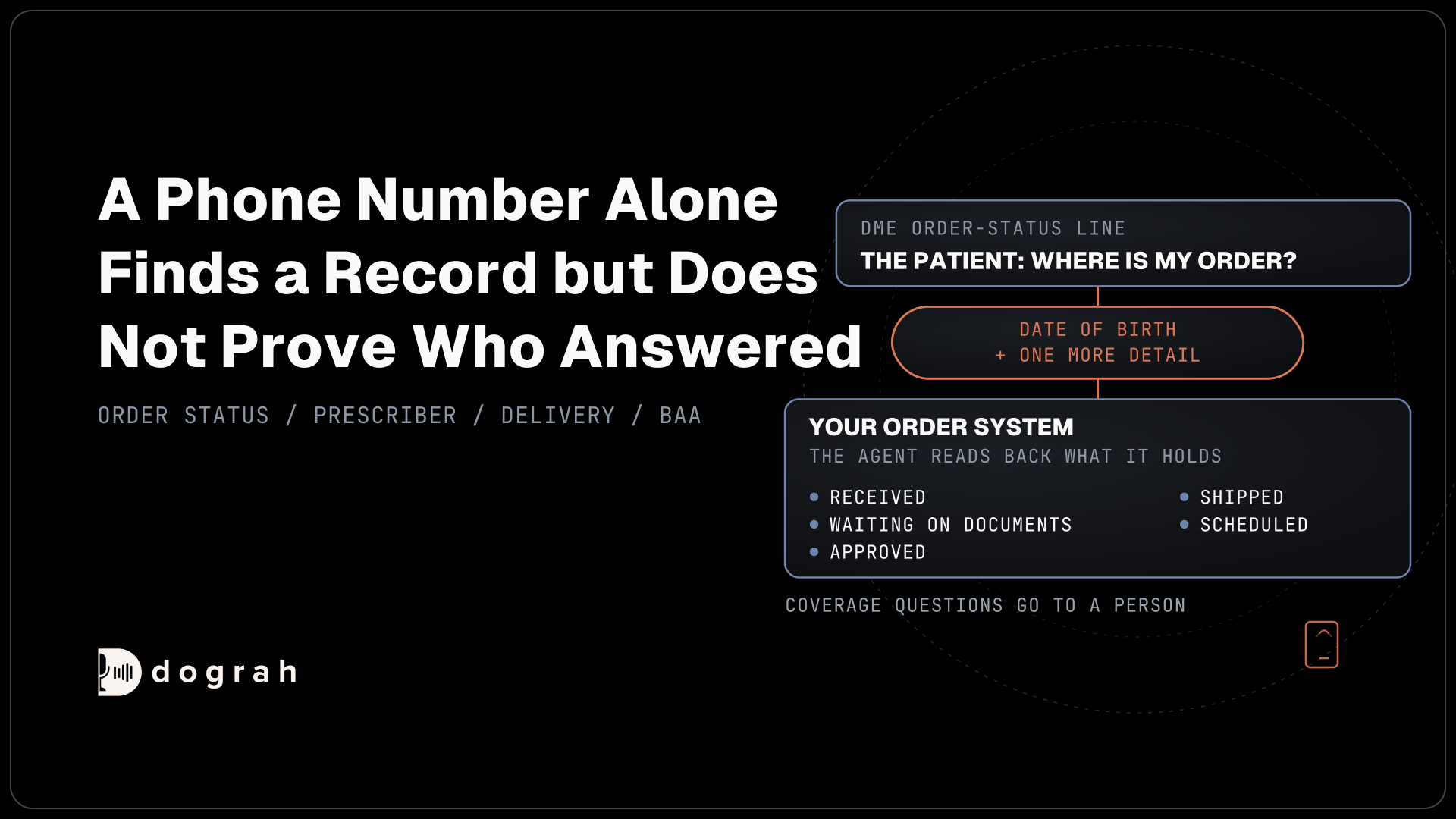
Order-status calls are the most frequent and the easiest to hand over. The agent greets the patient, asks for the date of birth plus one more detail your team already uses, such as the first line of the address, and compares them with your records. A phone number alone finds a record but does not prove who answered.
After a match, an HTTP API tool asks your billing or order system for the status. The agent reads back what the system holds: received, waiting on documents from the doctor's office, approved, shipped or scheduled. It never guesses a date the system does not return.
When the patient needs more, such as a billing dispute or a question about coverage, the agent hands over. The Transfer Call tool works on Twilio, Telnyx, Plivo, Cloudonix and Asterisk ARI. It calls your intake or billing desk first and connects the patient only when someone answers. If no one picks up in 30 seconds, the default, the patient stays with the agent, which writes a callback request to your system.

Open Source Alternative to Vapi / Retell
Self-hosted voice agent platform — no per-minute fees
dograh-hq/dograh
Star on GitHub
Chasing written orders and prior authorization
Most stalled orders wait on paperwork from somewhere else. Medicare's rules for DMEPOS orders require a written order for every item it pays for. Some items also need a face-to-face visit with the prescriber in the six months before the order, and the order in hand before delivery. Items on Medicare's required list need prior authorization before the supplier delivers them. Confirm how each rule applies to your product lines with your compliance lead or counsel.
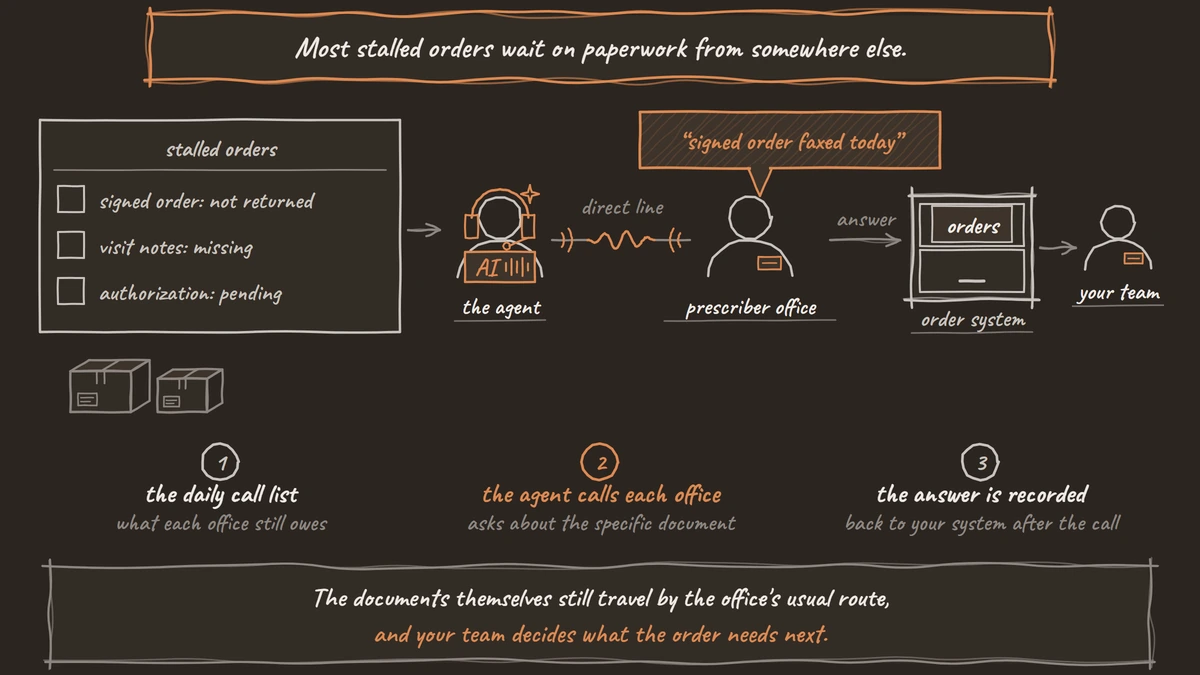
Those rules turn into a daily call list: offices that have not returned a signed order, visit notes that are missing, authorizations still pending. Campaigns work through that list from a CSV upload. The agent calls each prescriber office, names your company, asks about the specific document and records the answer, such as "signed order faxed today" or "doctor out until Monday".
Load the direct line for each office's records or referral desk. The agent talks by voice, so a direct line reaches a person faster than a main number with a long menu. Calling hours run in one time zone per campaign, so split the list by time zone, and you set the retries (0 to 10) for busy lines.
Each answer goes back to your order system through a Webhook node after the call. The documents themselves still travel by the office's usual route, and your team decides what the order needs next.
Scheduling deliveries
Once an order is approved, someone has to book the drop-off. The agent calls the patient, confirms who it is speaking with, then reads back the item and the delivery address. It offers windows from your scheduling or routing system through an HTTP API tool and books the one the patient picks.
The delivery is booked only when your system returns a confirmation. The agent reads that back too, along with any setup the driver will do on arrival, so the patient knows to be home.
Where patient data stays
Order-status and delivery calls carry protected health information, so where the call is processed matters. Self-hosting Dograh means no business associate agreement (BAA) with Dograh is needed. Model providers may need their own BAA when they handle that information, and the phone carrier may need one, depending on what it stores. Many carriers, such as Twilio, offer one. If your servers run in a cloud account such as AWS, Google Cloud or Azure, that provider needs a BAA too, while your own data centre does not. A BAA never moves your own HIPAA liability onto someone else.
Run the speech and language models on your own servers too, and the call audio stays in-house. Our post on HIPAA-compliant voice AI for hospitals covers the setup choices, and our page on self-hosted resupply calls for DME suppliers shows a DME deployment.
Join the Dograh Community
Dograh is an OSS alternative to Vapi. Join our Slack community for queries, releases, best practices & community interactions.
Starting with one call type
Start with the order-status line, because it is inbound, follows one script and needs only read access. Add prescriber-office campaigns once your team trusts the answers the agent writes back.
Check the calls as they come in. QA scores each step of a finished call against your own prompt, such as "did the agent verify before reading the status?", and a full trace shows what the agent heard, said and sent to your tools. Review a random 5 to 10% sample once the line is steady.
Glossary
- Standard written order
- The order a prescriber signs for a DMEPOS item, naming the patient, the item, the quantity and the prescriber. Medicare needs it before it pays for the item.
- Face-to-face encounter
- A visit between the patient and the prescriber about the condition the item treats. Some items need one in the six months before the order.
- Prior authorization
- Approval from the payer before the supplier delivers an item. For items on Medicare's required list, a claim without it is denied.
- Business associate agreement
- A HIPAA contract between a covered entity and a vendor that handles protected health information for it. It sets out how the vendor protects that information.