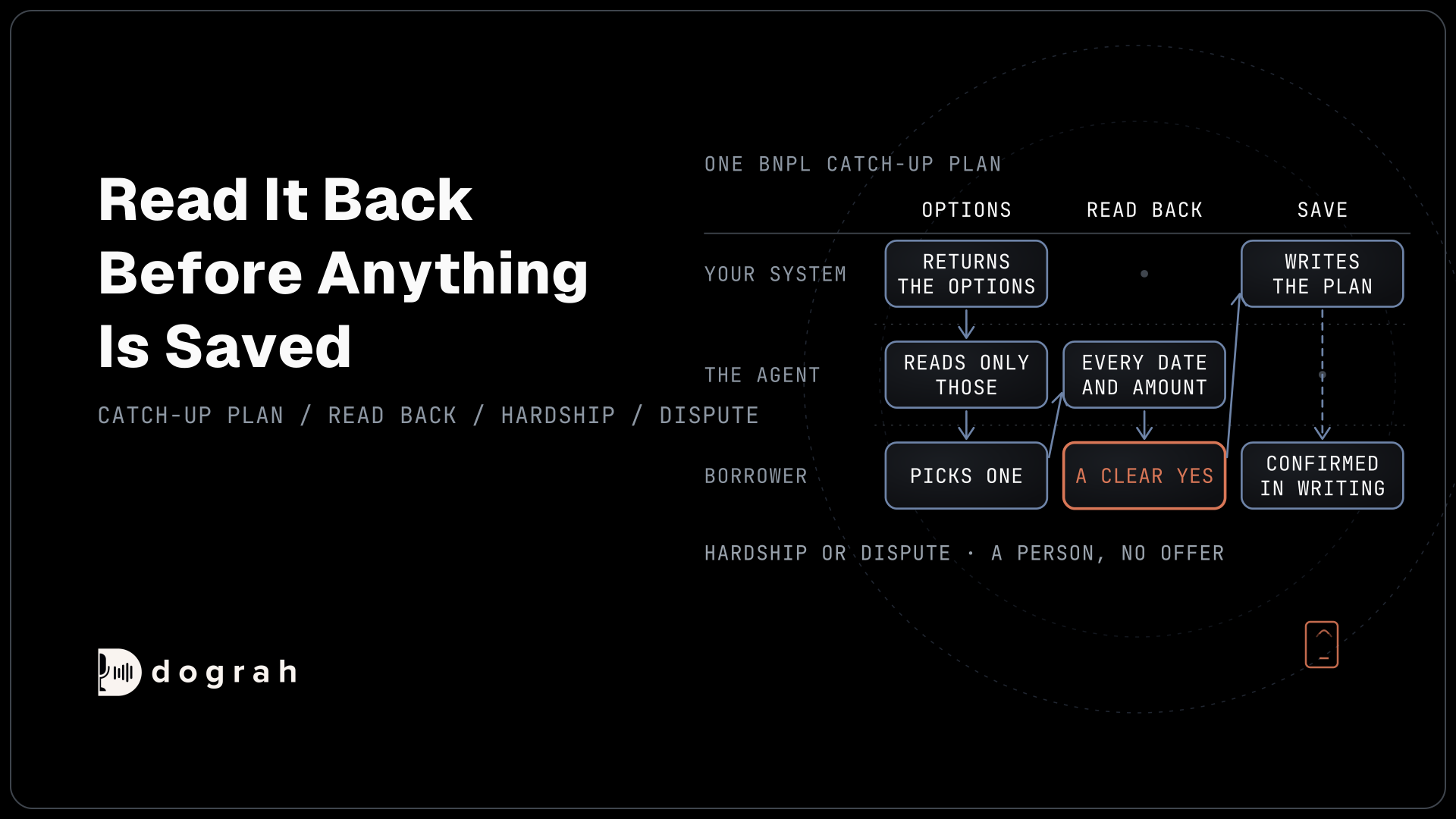

AI voice agents for BNPL repayment plan setup help a borrower who missed an instalment choose a catch-up plan the lender has already approved. After verification, the agent reads the options the lender's system returns, reads the chosen schedule back and writes it to that system. Hardship and disputes go to a person, with no offer made.
Key Takeaways
- The agent reads plan options from your system and never invents one.
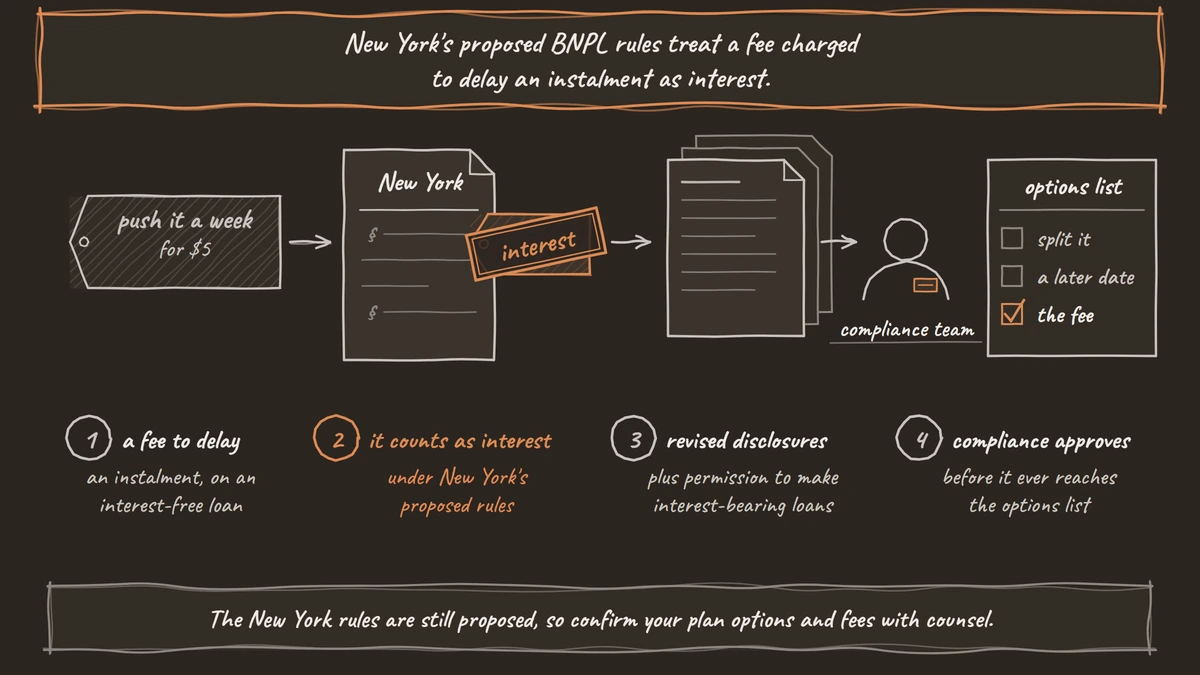
- In New York's proposed rules, a fee to delay an instalment counts as interest.
- Hardship and disputes go to a person, with the reason written first.
This post is part of our guide to AI voice agents for BNPL lenders, where a borrower who cannot pay in full moves to a catch-up plan. Below, we show how each step runs in Dograh, the open-source AI voice agent platform we build, from the options to the hand-off.
Where the plan call starts
The plan call starts where the recovery call ends, with a borrower who wants to pay but cannot cover the full instalment today. Our post on missed-payment recovery in BNPL covers that first call, and the agent can move straight into this one when the borrower says they are short.
Being short is common. The Federal Reserve's 2025 household survey found that 16% of US adults did not pay all of their bills in the prior month. A catch-up plan gives those borrowers a way back before a small miss turns into a closed account.
The call runs under the lender's own name, after the identity check, like every BNPL call. It covers one loan at a time, because many borrowers hold several plans and each one has its own schedule. New York's proposed rules point the same way: a missed payment on one BNPL loan would not be allowed to trigger penalties on another loan with the same lender.
The options come from your system
The agent never makes up a plan. When the borrower asks for time, an HTTP API tool asks your loan system which options this borrower qualifies for today, such as splitting the missed instalment across the next two due dates or moving it to a later date. The agent reads those options and nothing else.
A message, as a typed line or a recorded clip, plays when the tool starts, while the request runs, and you can add a later update if the lookup takes a few seconds. The tool waits 5 seconds by default and does not retry, so the prompt tells the agent what to say if no options come back: a team member will call back with them.
Fees are where an invented option turns into a legal problem. New York's proposed BNPL rules treat a fee charged to delay an instalment as interest. On an interest-free loan, the lender would need permission to make interest-bearing loans and would have to give the borrower revised disclosures first. So a "push it a week for $5" line is a product change your compliance team approves before it ever reaches the options list. The New York rules are still proposed, so confirm your plan options and fees with counsel.

Open Source Alternative to Vapi / Retell
Self-hosted voice agent platform — no per-minute fees
dograh-hq/dograh
Star on GitHub
Reading back the new schedule
Once the borrower picks an option, the agent reads every date and amount back before anything is saved. A line such as "So that's $18.75 on the 14th and $18.75 on the 28th, on top of your usual payments. Is that right?" leaves no room for a misheard date.
Only after a clear yes does a second HTTP API tool write the accepted plan to your system. Add a Preset Parameter with the call's workflow_run_id so your system can ignore a duplicate if the tool fires twice. The agent records the borrower's choice as they stated it, an AI step, and the transcript and recording stay as the exact record of what was agreed.
Your system then sends the written confirmation and, if the plan starts with a payment, its secure payment link. The payment link comes from the lender's own system and the borrower pays on the lender's payment page, so nobody reads out a card number to the agent.
Hardship and disputes go to a person
Some borrowers need more than a date change. Job loss, illness, a death in the family or "I can't afford any of my plans" are hardship signals, and the prompt tells the agent to stop talking about plans and make no offer.
The agent writes the reason to your system through the HTTP API tool, then Transfer Call connects the borrower to your hardship team. It works on Twilio, Telnyx, Plivo, Cloudonix and Asterisk ARI. Dograh calls the team first and connects the borrower only when someone answers. No summary travels with the call by default, which is why the reason is written first. On Twilio, an optional short spoken introduction plays to both people, so keep hardship details out of it. If nobody answers within the 30-second default, the borrower stays with the agent, which writes a callback request.
A dispute is a different path with the same hand-off. A borrower who says the item never arrived, or was returned, is raising a billing error. New York's proposed rules would stop the lender collecting the disputed amount while the dispute is open, so the agent offers no plan on it.
A follow-up call the borrower asks for also has a legal upside. Massachusetts' debt collection regulations limit creditors to two calls they start about a debt in seven days, and a call the borrower requested does not count toward that limit.
Join the Dograh Community
Dograh is an OSS alternative to Vapi. Join our Slack community for queries, releases, best practices & community interactions.
Checking every plan call
Plan calls carry money and sometimes hardship details, so review focuses on what the model said. Replace the QA System Prompt with checks such as whether the agent named an option the tool did not return, quoted a fee, or discussed the plan before the identity check passed.
Hardship reasons are some of the most sensitive things a borrower tells a lender. Self-hosted, the recordings, transcripts and call traces stay in your own storage, and with open-source speech and language models on your servers the audio stays in-house too.
An agency setting up a plan on a full balance is a different call under different rules, covered in AI debt payment plan calls.
Glossary
- Catch-up plan
- A short schedule that spreads a missed BNPL instalment over the next due dates or moves it to a later one. The lender's system decides which plans a borrower qualifies for, and the agent only reads them.
- Fee to delay an instalment
- A fee for pushing an instalment to a later date. New York's proposed BNPL rules treat it as interest, so it needs approval and revised disclosures before an agent ever offers it.
- Billing error
- A borrower's claim that a charge is wrong, such as an item that never arrived. Under New York's proposed rules the lender would not collect the disputed amount while it is open, so it goes to a person.
- Transfer Call
- Dograh's tool for handing a live call to a person. It rings the destination first and connects the borrower only when someone answers.