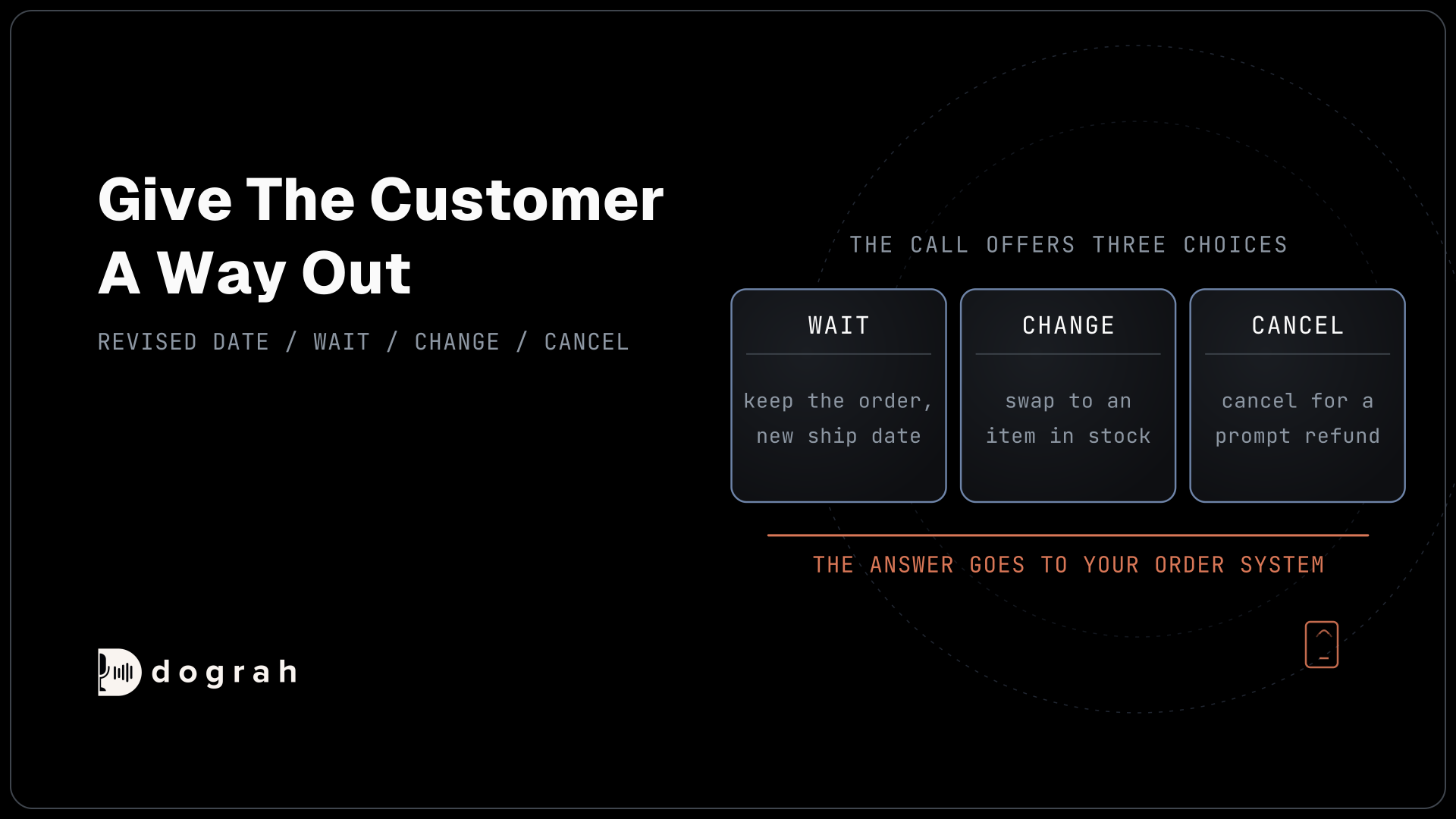

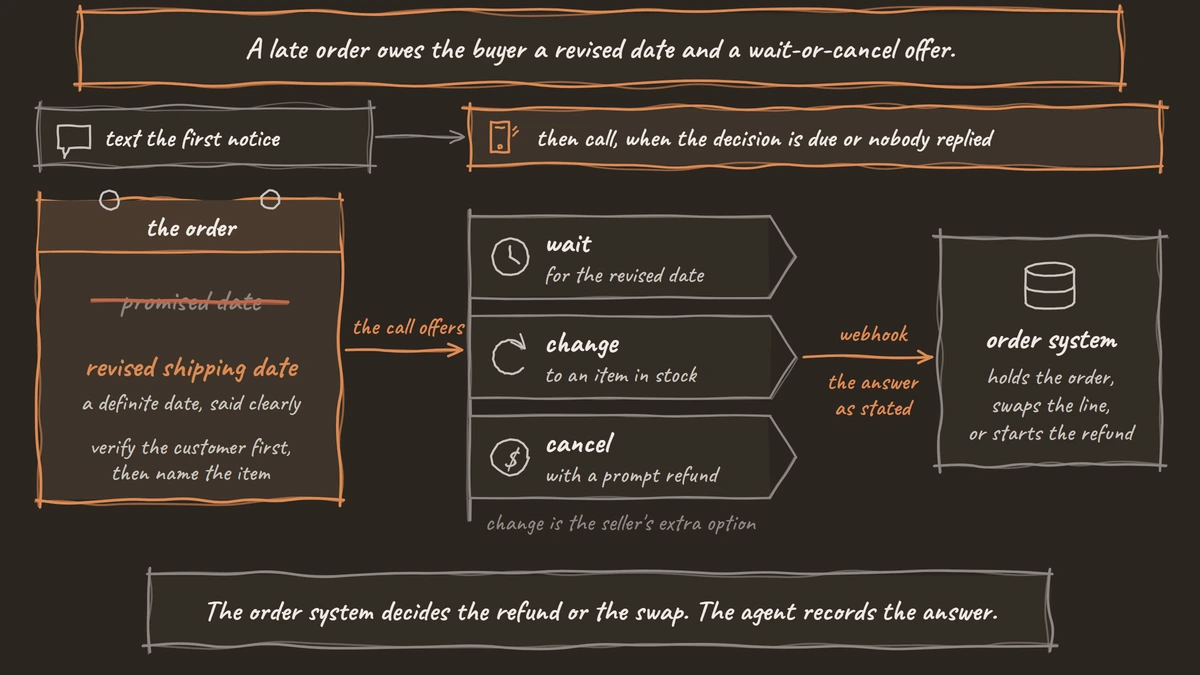
AI voice agents for backorder and delivery-date updates call the customer when an order cannot ship on time or its date moves. The agent verifies the customer, gives the definite revised date, offers the choice to wait, change the item or cancel with a refund, records the answer as stated and writes it to the order system by webhook.
Key Takeaways
- In the US, a late order generally owes the buyer a wait-or-cancel offer.
- Text the first notice. Call when the decision is due or nobody replied.
- Record wait, change or cancel as stated and write it to the order system.
This post is part of our guide to AI voice agents for logistics and delivery. The guide's section on customer calls before the delivery describes this as the call that presents the revised date, records wait, change or cancel as the customer states it and sends the answer to the order system by webhook, with the legal reason for making the offer in the FAQ. Here is the full call. In Dograh, an open-source, self-hostable voice agent platform, the call is a short flow, and the customer's choice goes back to your order system by webhook.
An order that has not shipped is a different call
A backorder call is about an order still sitting in the warehouse, which makes it a different conversation from a parcel running late on the road. The in-transit case, where tracking shows a delay and the customer needs a new window, is covered in our post on AI voice agents for delivery delay and exception alerts. The shipped order a customer rings about is the subject of our post on AI Voice Agents for Order Status and Updates in E-commerce. This post is the order with no parcel yet: the item is out of stock, or the promised date has moved.
Stockouts are common enough to need a process rather than a scramble. DOSS's Stockout Stigma Index, a vendor survey of 1,000 US adults fielded in April 2026, found that 74% had hit an out-of-stock on a product they regularly buy in the past twelve months. When a stockout happens, 45% buy from a different retailer. And 82% say they would try a competitor if their go-to product is frequently out of stock.
That is the moment the backorder call exists for: give the customer a reason to wait, or a clean way out.
The offer US rules expect you to make
In the United States, a seller that cannot ship on time generally has a legal duty to tell the customer, and the notice has a required shape. The Federal Trade Commission's (FTC) Mail, Internet, or Telephone Order Merchandise Rule, at 16 CFR 435.2, says that a seller who cannot ship within the promised time (or within thirty days, if no time was promised) must offer the buyer, without being asked, a choice: consent to the delay, or cancel the order and receive a prompt refund. The offer has to carry a definite revised shipping date, or, if the seller honestly cannot give one, say so.
The rule goes further. If the buyer does not answer before the revised date, the rule generally treats silence as consent to that date when the delay is thirty days or less. When the revised date is more than thirty days out, or no date can be given, silence generally means the order is cancelled unless the buyer agrees to wait. The exact text is in the FAQ, and this is general information rather than legal advice, so confirm your own position with counsel.
Read that rule as a conversation design and it writes the call for you. The agent must state the revised date clearly, offer wait or cancel with a refund, and record which one the customer chose, with a timestamp. A text can make the offer. A call can make it, hear the answer and write it down in the same minute. The question is which orders get which.

Open Source Alternative to Vapi / Retell
Self-hosted voice agent platform — no per-minute fees
dograh-hq/dograh
Star on GitHub
Text first, call for the decision
The first notice about a backorder should be a text or an email, and the call should follow only where a decision is due. Most customers who get a clear message with a revised date and a cancel link decide on their own, and that message comes from your order system, not from a call.
The call is for a short list of orders. The order whose revised date is far enough out that the rule needs an explicit answer rather than silence. The high-value order where a cancellation is worth a conversation and a swap might save it. And the order where the text went unanswered and the revised date is approaching, so the choice has to be made now.
What the call says
The agent must confirm who it is talking to before it names the order or the item. The number on the order finds the record. It does not prove who answered. The greeting names your company and says this is an automated call about an order. The agent then asks for the last digits of the order number or the delivery postcode, and only after a match does it say what the order is and what has changed.
Then the offer. The agent names the item, gives the original date and the definite revised shipping date, and presents the choice in plain words: wait for the new date, change to an alternative that is in stock, or cancel and receive a refund. If the customer asks about an alternative, the agent fetches the current options from your order system through an HTTP API tool and saves the customer's choice the same way. It does not invent a substitute. Stock can change after the call is triggered, so options passed in at the start can go stale.
Dograh runs this as a visual workflow with a fixed greeting, a verification step and the offer step. Each answer is saved as an extracted variable, recorded as the customer stated it, with the transcript and recording as the exact record. Whether a swap is allowed, what the price difference is and whether the refund is eligible are not the agent's calls to make. Your order system checks them through an HTTP API tool during the call, and the agent only reads the result back.
When a customer wants something outside the three choices, such as a partial shipment or a discount for waiting, the agent writes what it has gathered to the order system or the customer relationship management (CRM) system through an HTTP API tool, then hands the call to a person. Transfer Call works on Twilio, with an optional spoken introduction that both sides hear.
Join the Dograh Community
Dograh is an OSS alternative to Vapi. Join our Slack community for queries, releases, best practices & community interactions.
From the stock event to the order system and back
Your order management system (OMS) or enterprise resource planning (ERP) system knows about the backorder first, so it starts the call. When stock allocation fails or a supplier date slips, the system emits an event. Your trigger logic checks that the order needs a call under the rules above, and that the customer's consent flag is set. Then it calls Dograh's API Trigger with the order in the initial context: customer name, order number, item, original date, revised date, the in-stock alternatives. Our tutorial on API Triggers: Start a Voice Agent Call From Any System shows the request.
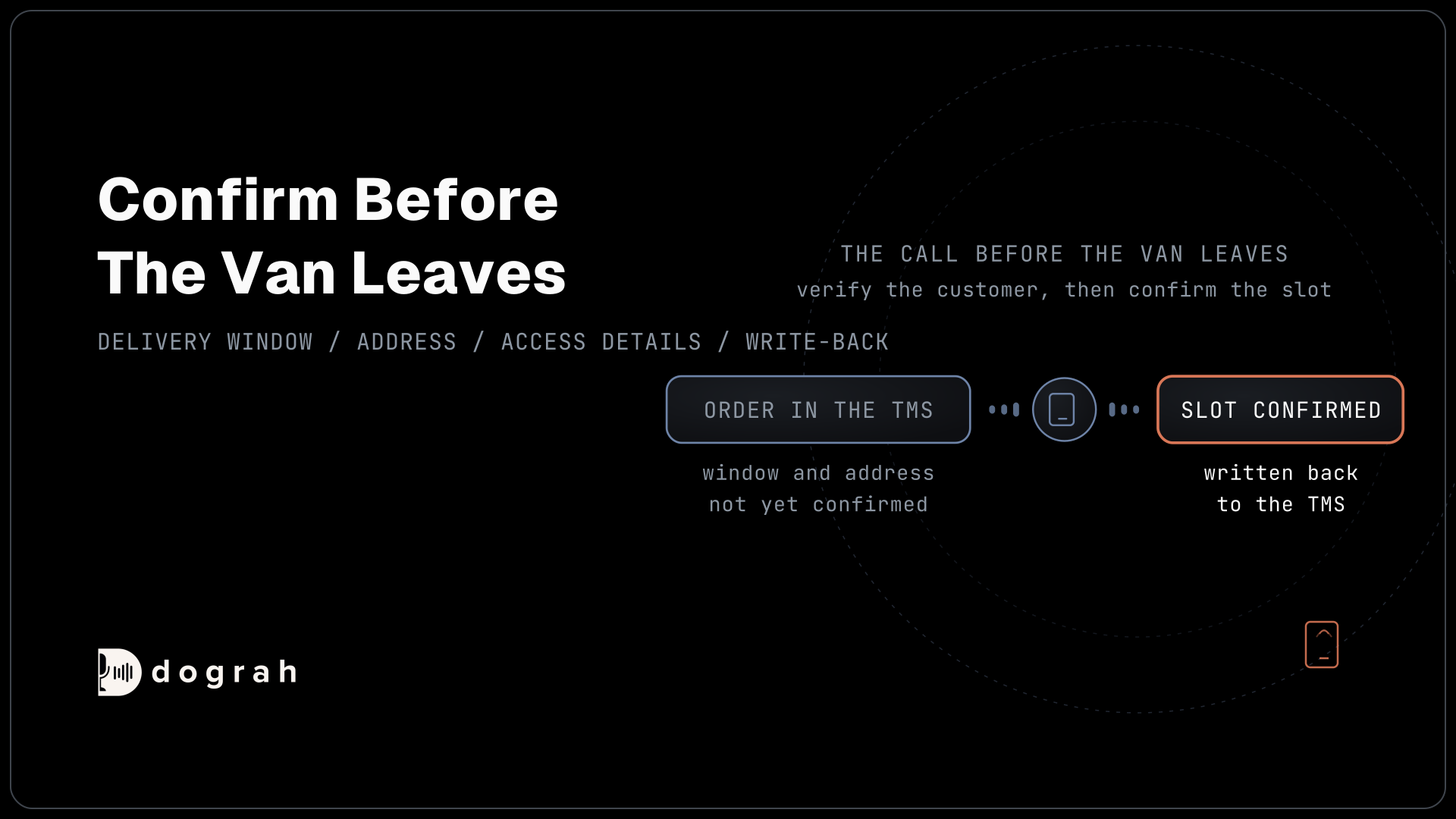
After the call, a webhook carries the answer back: wait, change or cancel, the alternative chosen if any, the revised date the customer heard, and the time. The order system then does what it always does with those facts: holds the order, swaps the line, or starts the refund. The agent never touches money. It records a decision. Our post on webhook-driven voice agents covers the write-back pattern.
One sentence on consent, because this is an outbound call with an AI voice: it generally needs the customer's prior express consent, captured at checkout for calls about their order, and the consent check belongs in the trigger logic before the call is ever placed. Our post on US consent rules for logistics and delivery calls sets out the rules.
What to count, and where the data lives
Four numbers tell you whether the call is doing its job. The share of called customers who chose to wait, split by how long the delay was. The share who changed to an alternative, which is revenue the text alone would have lost. The share who cancelled, which should fall for the orders that got a call rather than silence. And the share of texts answered before a call was ever needed, which should stay the majority.
A backorder call hears names, addresses, what people bought and how they paid for it. Self-hosted Dograh with self-hosted open-weight speech and language models keeps that audio and the transcripts on your own servers. With hosted models, the audio reaches the model provider. The order system stays the system of record either way.
Start with the orders where the revised date is more than thirty days out, since those are the ones where silence cancels the sale. Call those for a month, measure the wait rate against the text-only orders, and widen the rule from there.
Glossary
- Backorder
- An order accepted for an item the seller cannot ship within the promised time because the stock is not available yet.
- Definite revised shipping date
- The specific new date a seller gives when it cannot ship on time; US rules require it, or an honest statement that no date can be given.
- Wait-or-cancel offer
- The choice a seller presents when it cannot ship on time: consent to the delay, or cancel the order and receive a prompt refund.
- Order management system
- The system that holds the order, its items, dates and status; the call reads from it through the API Trigger and writes back to it by webhook.