
An AI virtual receptionist answers many calls at once, at any hour, from your own information. A live answering service puts people on the line, handles upset callers and judgement calls better, and bills per minute or per call. Dograh, the open-source AI voice agent platform we build, lets you run the AI side yourself or on Dograh Cloud.
Key Takeaways
- People handle upset callers and judgement calls better than software does.
- One person takes one call. An agent takes many at once.
- Many owners pick both: AI answers first, people take the hard calls.
This post is part of our guide to AI receptionists, where software and remote people are compared on who answers and how each bills. Below, we compare the two on cost, hours, handoff, accuracy and a busy Monday morning, then show where a mix of both fits.
Two services with similar names
The names overlap, so pin them down first. Here an AI virtual receptionist is software that answers your phone and holds a conversation, and a live answering service is a company whose staff answer your line from somewhere else. Many of those services call their staff "virtual receptionists" too, which is why the word "AI" carries the whole difference.
Both answer the phone, take messages and book appointments. They part ways on who decides the hard calls, how the bill grows and what happens when ten people ring at once.
Callers still lean towards people. In an April 2026 OnePoll survey of 6,000 consumers commissioned by AnswerConnect, a company that sells human answering, 85% said they prefer a real person, which is a good reason to keep a person one request away.
How the two compare on five points
The table sets both sides of the choice next to Dograh, with one example price per row to show how each one bills. Read the prices as a guide to the unit, then price your own volume.
| Live answering service | Hosted AI receptionist | Dograh (self-hosted or Dograh Cloud) | |
|---|---|---|---|
| Cost model | Minutes or calls in a monthly plan, for example PATLive $349 for 200 minutes, then $1.99 a minute | Per call, per caller or per included minute, for example Smith.ai AI Pro $150 for 75 calls | No platform fee self-hosted, 1¢/min on Dograh Cloud. Phone and models billed by your providers |
| Hours | 24/7 on most plans, or answering hours you set | 24/7 | 24/7 |
| Handoff | A receptionist transfers to your destinations, 1, 2 or 10 by Smith.ai plan | Set by the vendor's product and plan | Transfer Call rings your person first, 30 s by default. On no answer the caller returns to the agent |
| Accuracy | Judgement and tone, quality varies by who is on shift | The same answer from your documents every time | The same, plus a full trace and per-step QA for the calls you sample |
| Busy Monday | Answers as many calls as it has free staff on your account | Answers up to the vendor's call limit | 10 calls at once by default self-hosted, a limit you can raise. 10 on Cloud pay as you go, more on request |
Prices for more products, and the build-your-own platforms, sit in our comparison of AI receptionist software.
Cost: how each bill grows
Both kinds of service charge for use, so the bill follows your call volume. A live service prices a person's time. PATLive's plans give 200 minutes for $349 a month and charge $1.99 for each minute over, and Smith.ai's live receptionists charge $300 for 30 calls, then $11.50 a call.
Some services sell both kinds of answering on the same tiers. Abby Connect's Professional plan is $599 for 200 Abby Minutes, and when its AI answers, each Abby Minute covers two minutes of calls.
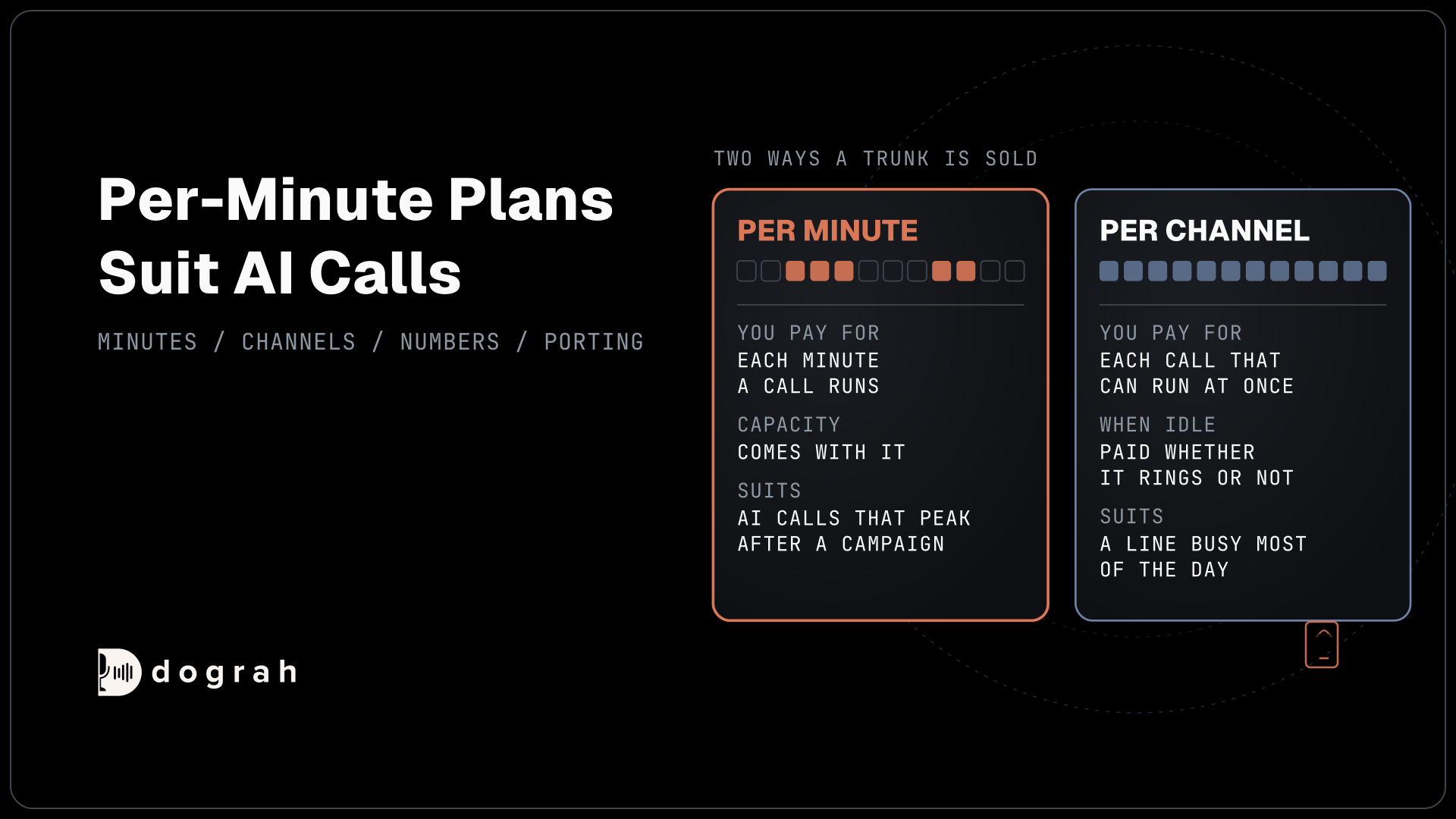
AI receptionists bill per call, per unique caller or per included minute, at a fraction of a person's rate per call. Smith.ai's AI Receptionist Pro plan, for example, is $150 for 75 calls. Self-hosted Dograh has no per-minute platform fee, but servers, model keys and phone minutes still cost money. Dograh Cloud charges a 1¢-a-minute platform fee. Our post on AI receptionist pricing works through one month on each kind of plan, line by line.
Hours and a busy Monday morning
Most live services answer around the clock. Ruby advertises 24/7 live answering, including after hours, weekends and holidays, and Smith.ai's live plans let you set answering hours, with other calls sent to a number or voicemail you choose. An AI receptionist answers at any hour unless you tell it otherwise.
The bigger gap shows at 9 a.m. on a Monday, when six calls arrive in the same minute. One receptionist takes one call at a time, so a live service answers as many of the six as it has people free on your account, and the rest wait or roll over. An agent answers each call up to its concurrency limit. Self-hosted Dograh runs 10 calls at once by default, a limit you can raise, with your servers and phone provider setting the real ceiling. Dograh Cloud pay as you go includes 10, with more on request.
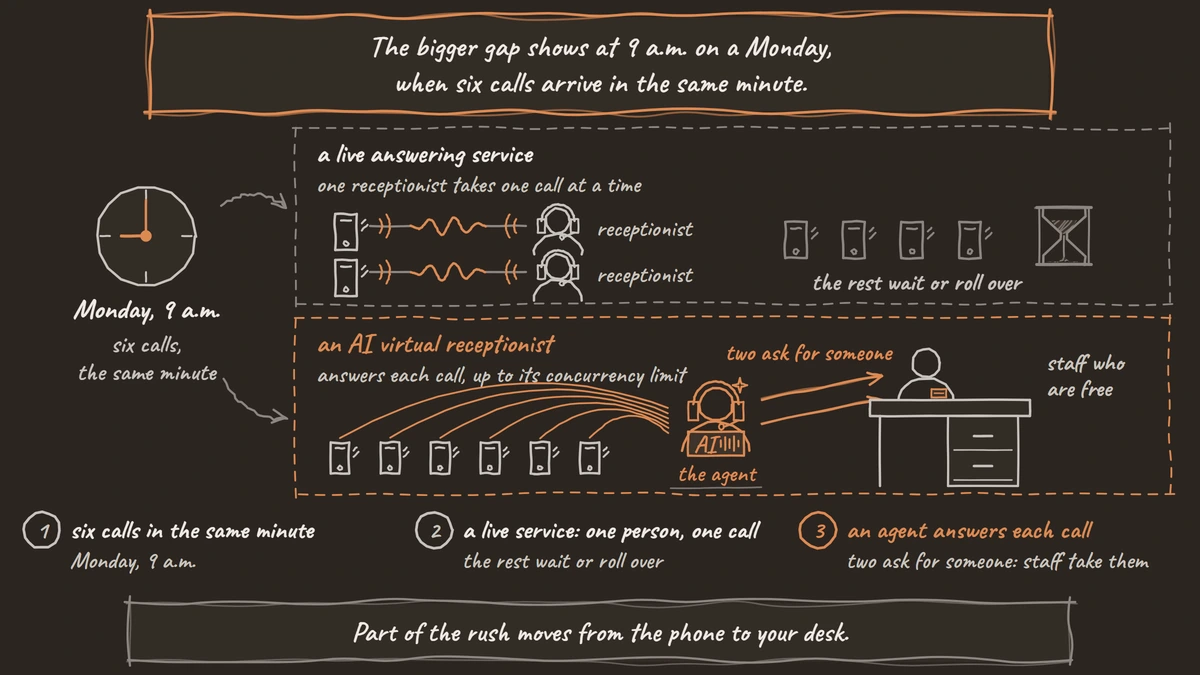
Six answered calls can still need people. If two of the six ask for someone, the agent can only transfer to staff who are free, so part of the rush moves from the phone to your desk. Decide who covers transfers at peak times before the first busy Monday.

Open Source Alternative to Vapi / Retell
Self-hosted voice agent platform — no per-minute fees
dograh-hq/dograh
Star on GitHub
Handoff and accuracy
A live receptionist hands over the way a good assistant would, with a quick word about who is calling. The limit is where the call can go. Smith.ai's live plans include 1, 2 or 10 transfer destinations, depending on the plan.
An agent's handoff is part of its call flow. In Dograh, Transfer Call dials your person first while the caller hears hold music, and joins them only when someone answers, waiting 30 seconds by default. If nobody does, the caller comes back to the agent, which takes a message. Our post on the AI answering service for business follows that path step by step.
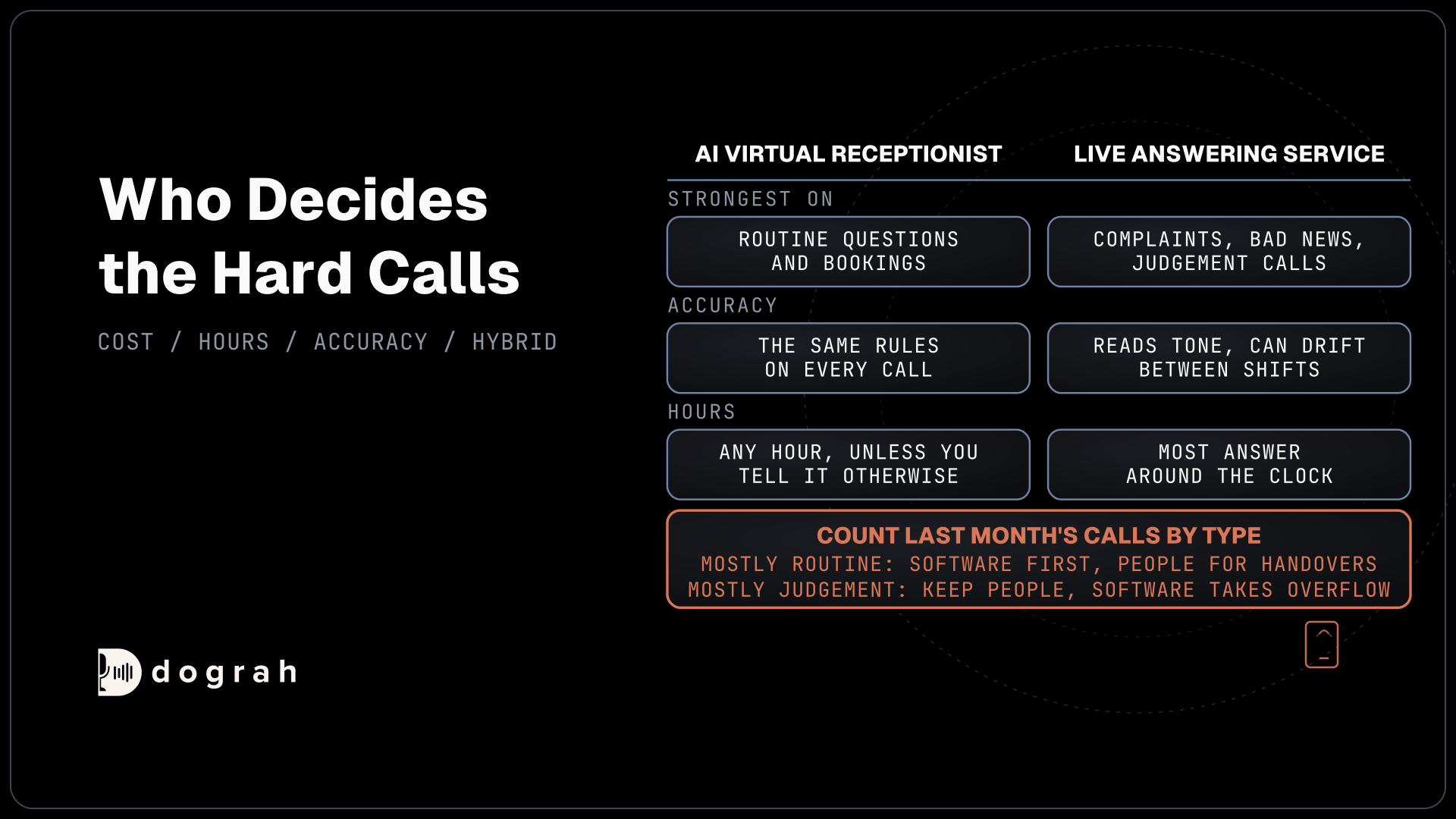
Accuracy splits along the same line. People read tone and handle a question nobody wrote down, but answers can drift between staff and shifts. An agent gives the same answer every time from your documents, which also means a wrong document produces the same wrong answer on every call.
You can check the agent's answers directly. Each call has a full trace of what the agent heard, decided and said, and built-in QA scores every step of the calls you choose to sample. Fixing the document fixes every future call at once.
Where a mix of both fits
People earn their rate on complaints, bad news, sensitive calls and anything that needs a decision. If most of your calls look like that, a live service is the honest choice, and some services deliberately offer only people. PATLive, for one, states that it offers no AI answering.
For most small businesses the calls split, and hybrid answering exists on both sides. Smith.ai's AI Receptionist can pass calls to its live North America-based receptionists, and Abby sells human, AI or mixed answering on the same plans. You can also build the mix yourself. An agent on Dograh answers every call, handles the routine ones and transfers the rest to your staff, or to your answering service's number for overflow, since Transfer Call dials whatever number you give it.
Before you choose, count last month's calls by type. If most are routine questions and bookings, start with software and keep people for the handovers. If most need judgement, keep the people and let software take the overflow.
Join the Dograh Community
Dograh is an OSS alternative to Vapi. Join our Slack community for queries, releases, best practices & community interactions.
Glossary
- Live answering service
- A company whose staff answer your business line remotely, usually billed in monthly bundles of minutes or calls. Many call their staff virtual receptionists, which is easy to confuse with AI software.
- Concurrency limit
- How many calls can be answered at the same moment. A person handles one, while a voice agent handles as many as its limit allows, which in self-hosted Dograh is 10 by default and adjustable.
- Transfer destination
- A phone number a call can be handed to. Live services cap how many you get per plan, and a voice agent can use a fixed number or rules that pick one from what the call collected.
- Hybrid answering
- A setup where software answers first and people take the calls that need judgement, either inside one vendor's plan or by having your own agent transfer to staff or an answering service.