
AI receptionist plans bill per call, per unique caller or per minute, and the monthly price covers only an included bundle. Overage rates, phone minutes and model usage decide the bill. Dograh, the open-source AI voice agent platform we build, has no platform fee when self-hosted and a 1¢-a-minute fee on Dograh Cloud, with phone and models billed separately.
Key Takeaways
- Price last month's calls in each vendor's own unit before comparing.
- Above the included bundle, the overage rate sets most of the bill.
- A bigger plan often beats a small plan plus overage.
This post is part of our guide to AI receptionists, where hosted prices come in different units and only compare at your own volume. Here we sort plans by billing unit, show how overage grows a bill, then price one example month on six receptionist apps and on Dograh.
Four ways AI receptionists bill
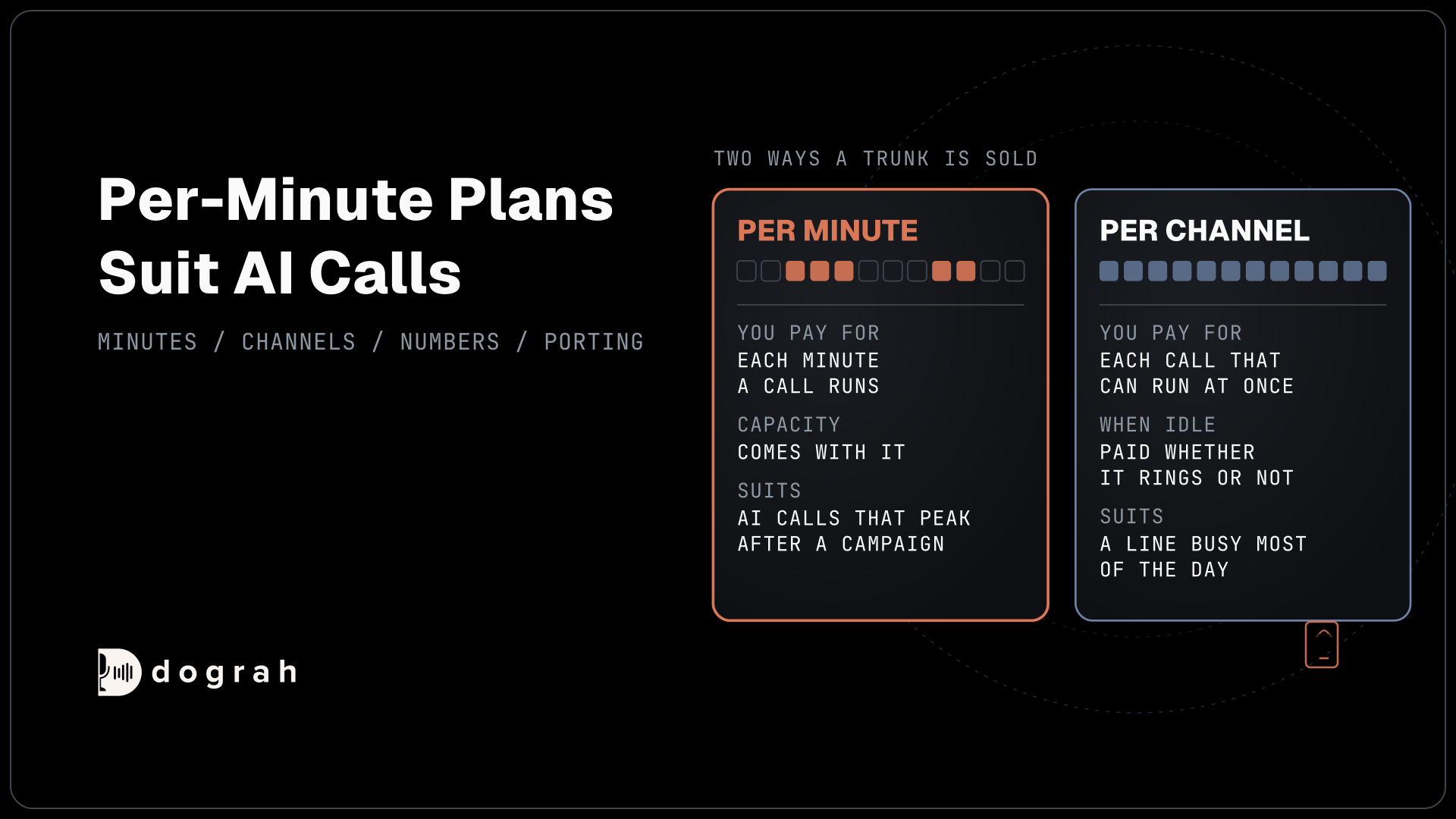
Every plan has a unit, and the unit decides what a busy month costs. Four are common. Per-call plans charge for each answered call, such as Smith.ai's AI Receptionist and Upfirst. Per-caller plans charge for each unique phone number that calls, which is how Goodcall bills. Per-minute bundles include a block of minutes, as Rosie, Dialzara, Frontdesk and RingCentral's AI Receptionist (AIR) do.
The fourth unit belongs to platforms you build on. Dograh Cloud, Vapi and Retell charge a platform fee per minute, and the speech, language and voice models and the phone line are billed on top, often by providers you pick yourself.
What a vendor leaves off the meter matters as much as the rate. Upfirst does not bill spam, calls under 15 seconds or calls where the caller never speaks. Smith.ai counts every answered call by default, filters known spam numbers before the AI answers, and lets you remove up to 10% of calls as spam each cycle. A line that gets many short or junk calls can look very different on these two.
Overage decides the bill above the bundle
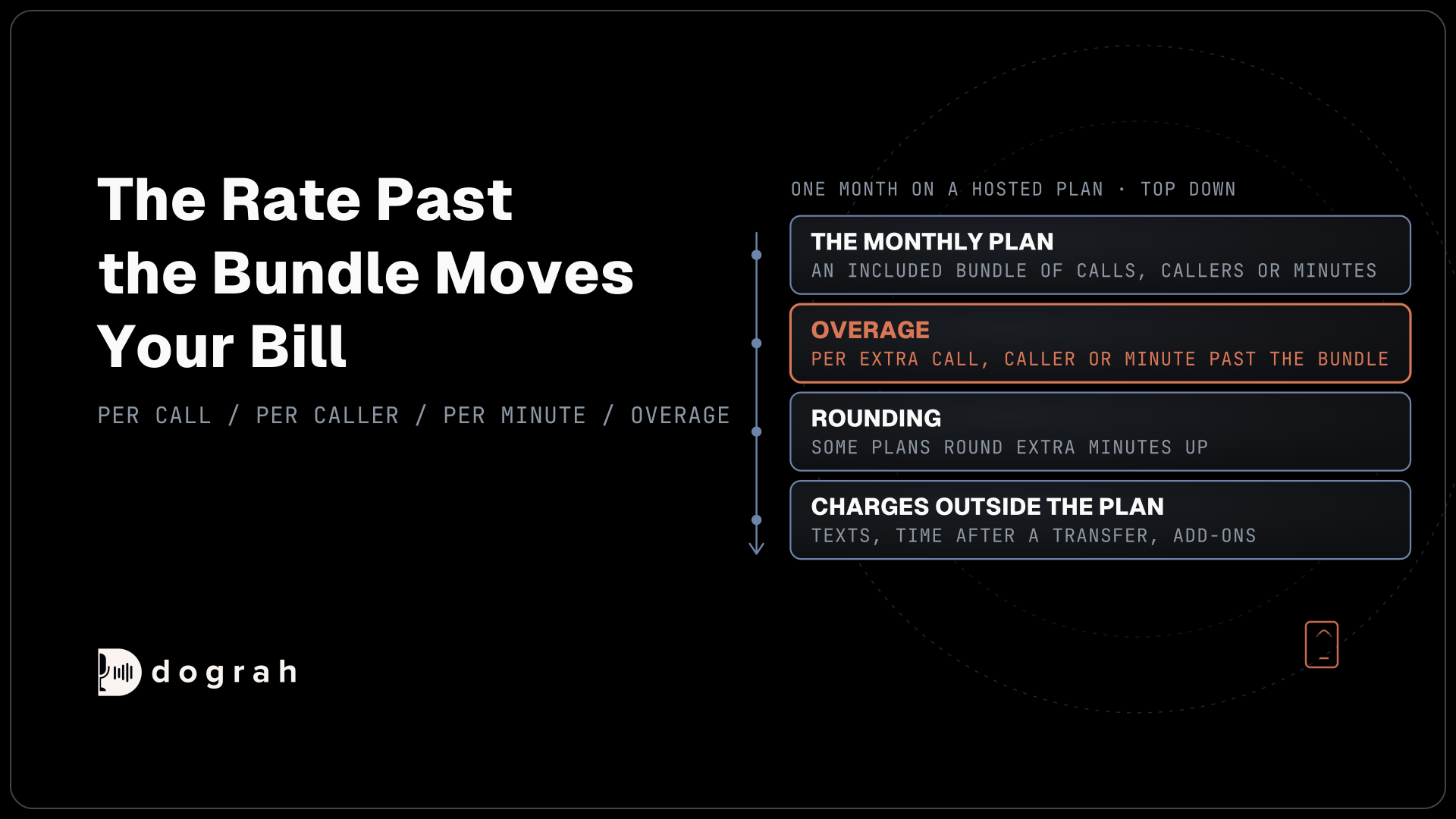
The rate past the bundle is the number that moves your bill. Smith.ai charges $2.17 to $3.00 per extra call, depending on the plan, and Upfirst $0.70 to $1.50. Goodcall charges 15¢ to 79¢ per extra caller. Dialzara charges $0.35 to $0.48 per extra minute, Frontdesk $0.25 and RingCentral AIR $0.50.
Rounding adds a quieter layer. RingCentral's AI Receptionist pricing says minutes past the included 100 are "rounded up and billed in 30-second increments", so a 61-second call past the bundle bills as 90 seconds, or $0.75.
Overage also changes which plan is right. A small plan plus a pile of extra minutes often costs more than the next plan up. You will see that twice in the example below, so check the next tier before you accept an overage line.
One example month on six receptionist apps
Here is one worked example, with Dograh's two options added at the bottom. A small service business takes 300 calls a month, averaging 3 minutes, so 900 minutes, from about 200 different callers. Each product is priced at the plan that fits that month best.
| Product | Plan used | What the plan includes | Example month |
|---|---|---|---|
| Smith.ai AI Receptionist | Pro, 300-call level | 300 calls at $1.67 a call | About $501. Left on the 75-call level: $150 + 225 x $2.50 = $712.50 |
| Upfirst | Pro | 300 calls | $159.95 |
| RingCentral AIR | Standalone | 100 minutes, then $0.50 a minute | $49 + 800 x $0.50 = $449, before 30-second rounding |
| Rosie | Scale | 1,000 minutes | $149 |
| Dialzara | Business Plus | 500 minutes, then $0.40 a minute | $199 + 400 x $0.40 = $359. Business Elite covers 1,000 minutes for $349 |
| Goodcall | Starter | 100 unique callers, then $0.79 each | $79 + 100 x $0.79 = $158. Growth covers 500 callers for $129 |
| Dograh Cloud, your own model keys | Pay as you go | 1¢/min platform fee. Phone and models billed by your providers | About $43.94, line by line below |
| Dograh, self-hosted | Open source | No platform fee, plus a $48 server | About $82.94, line by line below |
Across the six apps, the same 900 minutes run from $149 to over $700, and the plan choice matters almost as much as the product. On Dialzara and Goodcall the bigger plan beats the smaller plan plus overage. Rosie's $49 Professional plan would not cover this month, and it lists no call transfers. Upfirst's plans also list annual prices about a fifth below the monthly ones.

Open Source Alternative to Vapi / Retell
Self-hosted voice agent platform — no per-minute fees
dograh-hq/dograh
Star on GitHub
The same month on Dograh, line by line
On a build-your-own platform the same 900 minutes split into separate lines, each with a public rate. Self-hosted Dograh has no per-minute platform fee, but servers, model keys and phone minutes still cost money. Dograh Cloud charges a 1¢-a-minute platform fee. With your own model keys each provider bills you directly.
Two of the lines depend on how much the agent says and how long its prompt is. For those we use the example 5-minute call from our guide to LLM API pricing for voice agents: 12 exchanges, a 2,000-token prompt sent again on every turn, no caching, about 2,400 spoken characters and $0.0127 on gpt-4.1-mini. That works out to 480 characters and about $0.0025 a minute.
Phone minutes are billed at Twilio's US rates, and speech at Deepgram's rates. Here is the Dograh Cloud month:
- Platform fee: 900 x $0.01 = $9.00
- Phone number: $1.15
- Inbound minutes: 900 x $0.0085 = $7.65
- Media Streams, the audio feed to the agent: 900 x $0.0044 = $3.96
- Speech-to-text, Deepgram Nova-3: 900 x $0.0077 = $6.93
- Voice, Deepgram Aura-2: 432,000 characters x $0.030 per 1,000 = $12.96
- Language model, gpt-4.1-mini: about $2.29
So the Dograh Cloud month comes to about $43.94. Self-hosted, the $9.00 platform line goes and a server takes its place. A DigitalOcean droplet with 8 GB of memory and 4 vCPUs, Dograh's minimum, is $48 a month, which brings the month to about $82.94. At 900 minutes the server is the biggest line, and it stays flat as calls grow until you need more capacity.
The voice line is the easiest to move. Pre-recorded clips can play the lines your agent says most, with a cloned voice for the rest, which our guide to mixing pre-recorded audio with TTS walks through. Local open-weight models remove the per-token and per-minute model lines, in exchange for a GPU server.
Charges outside the plan price
Some charges sit beside the plan. RingCentral notes that AI text messages may cost extra. Phonely bills $0.02 a minute for time after a call is transferred. Smith.ai sells live-agent involvement on a call as a per-call add-on, while a transfer the AI starts carries no fee. Annual billing lowers several plans, in exchange for a year's commitment.
Then there are costs no invoice shows. A product can retire a feature you built on, cap a plan just below your volume, or make your call data hard to take with you. Our post on the hidden costs of closed voice AI platforms covers those, from lock-in to price changes at renewal.
How to price your own month
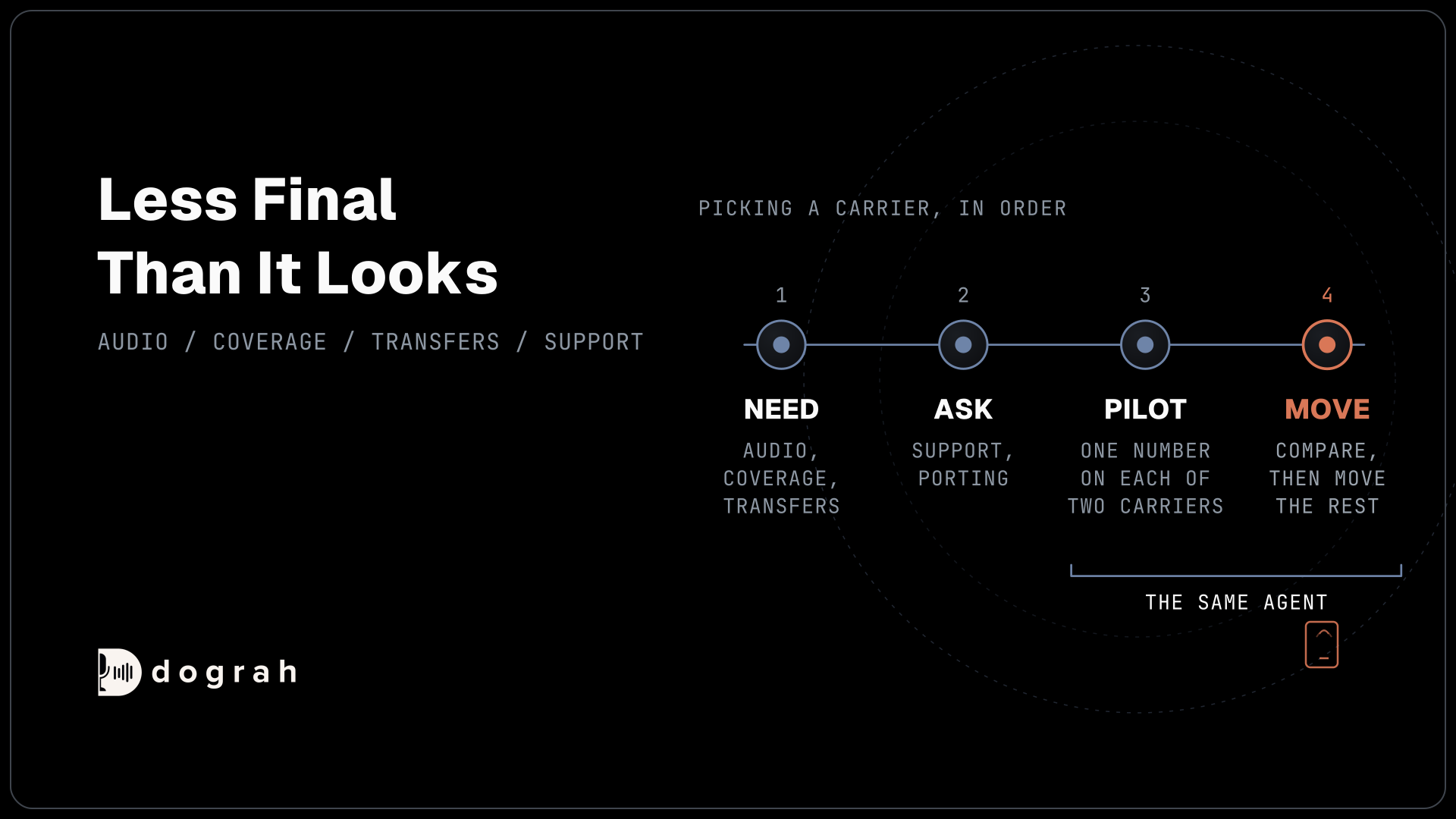
Start from last month's call log, never from the vendor's example customer. Count four things: answered calls, total minutes, unique callers and the share of calls under 15 seconds. Those four cover every unit above.
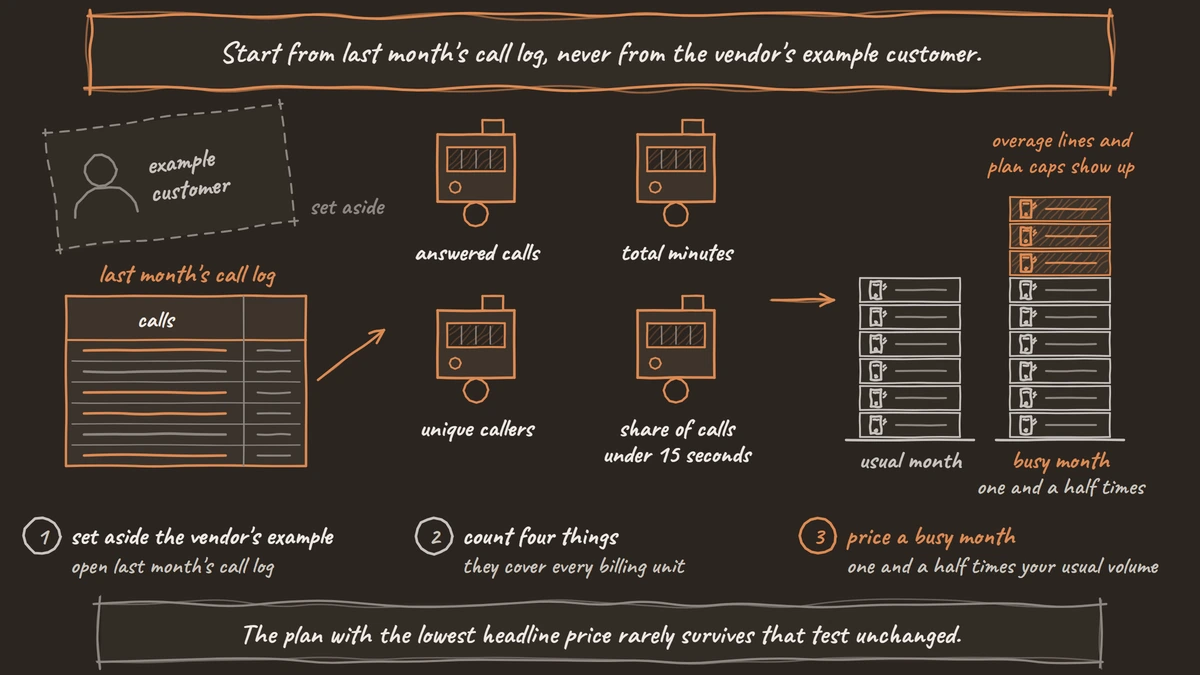
Price each shortlisted product in its own unit, add the overage at its stated rate, and check whether the next plan up beats your total. For a build-your-own platform, write the platform, phone and model lines separately, and add a server if you self-host. Then price a busy month at one and a half times your usual volume, since that is where overage lines and plan caps show up.
The plan with the lowest headline price rarely survives that test unchanged. The one that does is the plan you can budget.
Join the Dograh Community
Dograh is an OSS alternative to Vapi. Join our Slack community for queries, releases, best practices & community interactions.
Glossary
- Billing unit
- What a plan counts to charge you: answered calls, unique callers, included minutes or platform minutes. The same month of calls can cost several times more or less depending on the unit.
- Overage
- The rate a plan charges once you pass its included bundle, such as $2.50 per extra call or $0.50 per extra minute. Past the bundle, it sets most of the bill.
- Media Streams
- Twilio's feature that streams a call's live audio to a voice agent, billed at $0.0044 a minute on top of the inbound minute. It appears as its own line when you run an agent on your own Twilio account.
- Platform fee
- What a build-your-own voice agent platform charges for running calls, separate from models and the phone line. Dograh Cloud charges a 1¢-a-minute fee, and self-hosted Dograh has none.