
AI utility payment plan calls reach customers who are behind on their bill before a shutoff. The agent verifies the account holder, offers only the payment arrangements the utility's customer system returns for that account, reads the terms back and records a clear yes. Hardship, income questions and requests for different terms go to a person.
Key Takeaways
- State rules live in the customer system, so the agent only offers what it returns.
- Terms tailored to a customer's finances are negotiated by people, never by the agent.
- A missed installment gets the utility's written notice. The AI call is only a reminder.
This post is part of our guide to AI voice agents for utilities and energy, where arrangements stay within limits the utility's system returns. We cover what state rules fix and the call before a shutoff, and show how that call runs in Dograh, the open-source AI voice agent platform we build.
Who gets the call, and when
The call goes to customers who are behind but still connected, while an arrangement can still keep the service on. The National Energy Assistance Directors Association's June 2026 update found that one in six US households is behind on its utility bills, and projects total utility debt at about $25 billion by the end of 2026.
The customer information system (CIS) builds two lists: accounts past due but not yet on a final notice, and accounts with a final notice where the state rule still leaves time to agree an arrangement.
The call stays a service call while the service is on. In its 2016 ruling, FCC 16-88, the Federal Communications Commission (FCC) said that a customer who gave a utility their wireless number has consented, under the Telephone Consumer Protection Act (TCPA), to calls closely related to the service, including warnings that not paying will likely lead to a shutoff. An offer of a new product takes a call outside that consent. After a shutoff, existing rules apply, as AI voice agents for utility bill reminders explains.
A utility collecting its own bill is a first-party creditor, so it generally sits outside the Fair Debt Collection Practices Act (FDCPA). The state utility rules below still apply in full.
What state rules fix about the arrangement
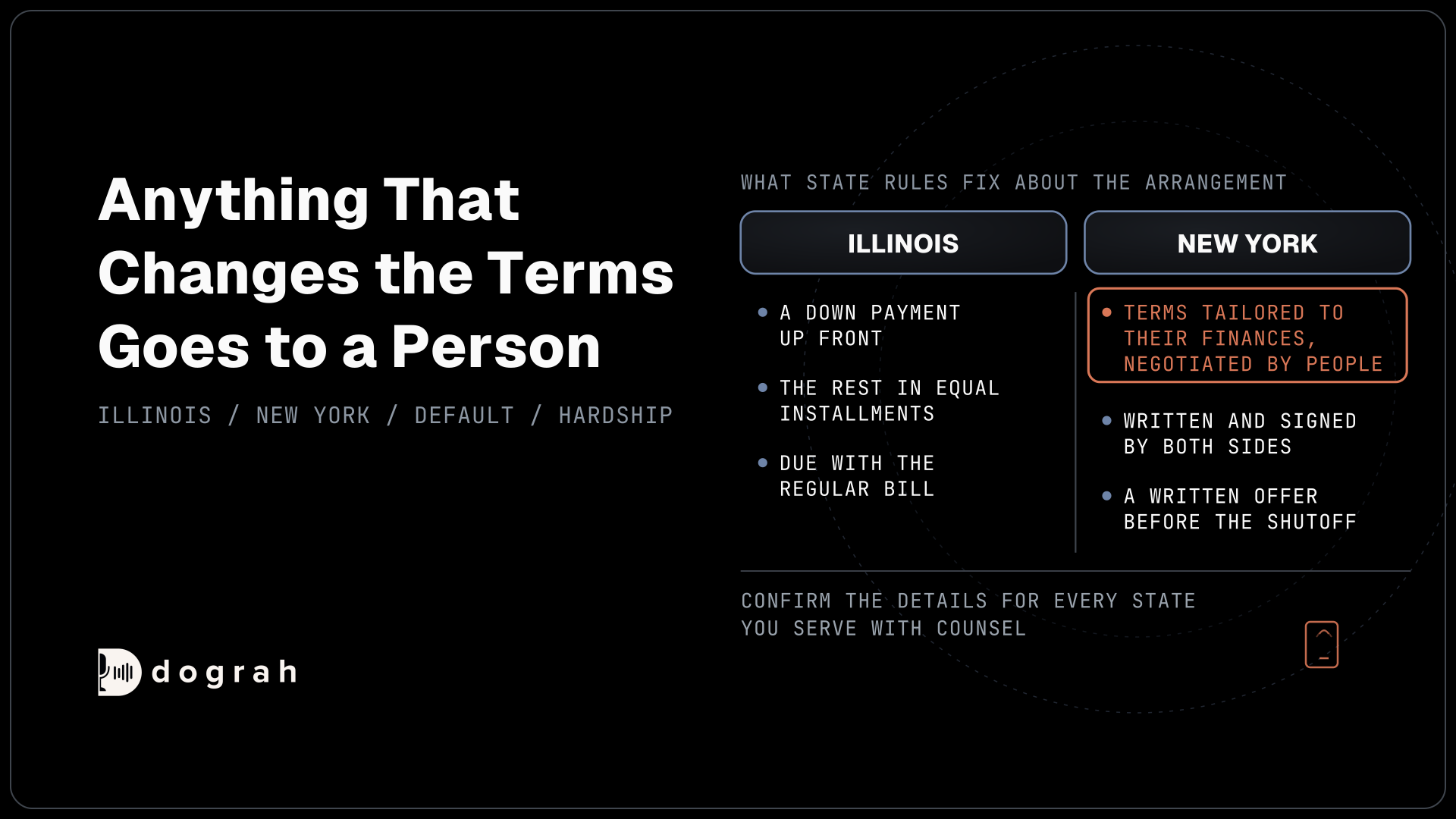
State utility commissions set the shape of an arrangement. Under the Illinois Administrative Code's rule on deferred payment arrangements, a residential customer who owes a past-due amount is eligible for one, unless they failed to complete one in the past 12 months, and stays eligible until the service is disconnected. The customer pays at least 25% of the past-due amount up front, and the utility may lower that. The rest is spread over 4 to 12 billing cycles, or longer if the utility agrees, in equal installments due with the regular bill.
New York goes further on negotiation. Under New York's deferred payment agreement rule, part of its Home Energy Fair Practices Act (HEFPA) rules, the utility must make reasonable efforts to contact the customer and negotiate terms tailored to their finances. A customer who shows need can get installments as low as $10 a month with no down payment. The agreement is written and signed by both sides. The utility can postpone a shutoff by up to 10 days to negotiate, and must make the written offer at least 7 days before the shutoff date, or 10 if it is mailed.
Other states set their own terms, and commissions update them. Encode each state's rules in your billing system, and confirm the details for every state you serve with counsel before the first campaign.
The rules live in the CIS, not the prompt
The agent never works out a plan. It asks the CIS which arrangements this account qualifies for, through an HTTP API tool, and offers only what comes back. The state rules are already applied there, so an Illinois customer hears Illinois terms and a New York customer hears New York terms.
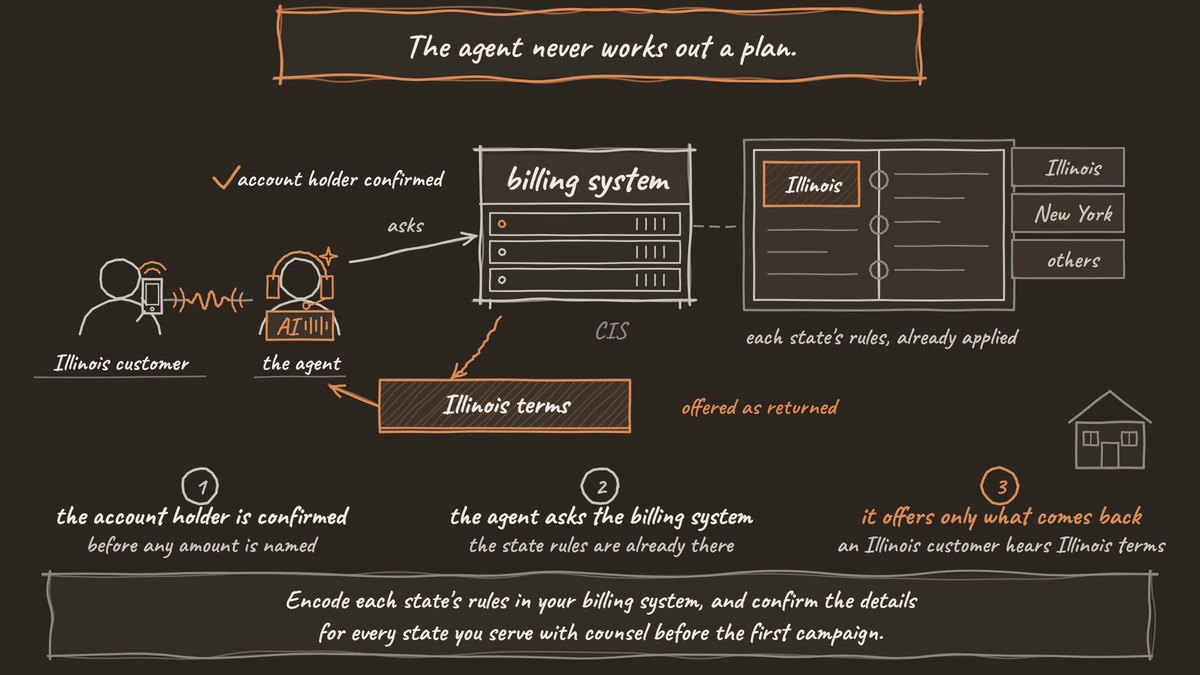
The call runs in a fixed order. The Greeting Text names the utility. Allow Greeting Interruption is on by default, so switch it off on the Start Call node and the name plays in full. The agent confirms the account holder with an approved check, such as the last digits of the account number, before it names the past-due amount and the plans on offer. Once the customer picks one, the agent reads back the down payment, the installment and the number of months, and waits for a clear yes. A second tool writes the arrangement to the CIS. Add a Preset Parameter named workflow_run_id with the value {{initial_context.workflow_run_id}}, so the CIS ignores a second write from the same call.
The written agreement comes from the CIS by mail or e-signature, never from the call. If the CIS returns no plan, or returns an error, the agent says a person will follow up and moves to the handoff. AI voice agents for utility customer support covers the inbound version of the same exchange.

Open Source Alternative to Vapi / Retell
Self-hosted voice agent platform — no per-minute fees
dograh-hq/dograh
Star on GitHub
What goes to a person
Anything that changes the terms goes to a person. That covers a request for a smaller down payment, an income question, a medical certificate, a life-support flag and any question about assistance programs. In Illinois, a customer whose income cannot support any arrangement must be told about local assisting agencies, so the agent says that help exists and hands the call to someone who can name it.
Before the handoff, the agent writes the reason to the CIS through an HTTP API tool. Then Transfer Call rings the utility's team, on Twilio, Telnyx, Plivo, Cloudonix or Asterisk ARI. Dograh calls the team first and connects the customer only when someone answers. On Twilio, it can play a short spoken introduction to both people first. If nobody answers within 30 seconds, the default, the customer stays with the agent, which takes a callback request.
The agent takes no payment and never asks for a card number. If the customer wants to pay now, it asks the utility's own system to send its secure payment link by text or email. If a customer mentions a gas smell, a fixed line plays on its own pathway: leave the building now and call 911 or the gas company from outside.
When an installment is missed
In Illinois, the utility may treat an arrangement as in default when the installment and the current bill are unpaid by the second day after the due date. It must tell the customer by a message on the next bill, a separate written notice or a live phone call. Keep the bill message or written notice as the utility's notice, and use the agent's call only as an extra reminder. The first reinstatement of a defaulted arrangement carries no fee.
In New York, a customer whose finances change can ask to renegotiate, and the utility must do so when the change is shown. That request goes to a person. Calls after a shutoff are collection calls under other rules, which our post on AI voice agents for debt collection covers.
Join the Dograh Community
Dograh is an OSS alternative to Vapi. Join our Slack community for queries, releases, best practices & community interactions.
Running the campaign
Arrangement calls usually run as a daily campaign built from the CIS lists. Calling hours run in one time zone per campaign, so split the list by state and time zone. You set the retries, from 0 to 10. When a customer asks not to be called, the agent writes that to the utility's own list through an HTTP API tool, and the number comes off the next upload.
Dograh's built-in QA scores each step of a sample of calls, and its prompt can flag any call where the agent quoted terms the CIS did not return or named an amount before verification.
Account balances and hardship details are sensitive, so a utility can run the platform on its own servers, where recordings and transcripts stay. Self-hosted Dograh has no per-minute platform fee, but servers, model keys and phone minutes still cost money. Dograh Cloud charges a 1¢-a-minute platform fee. You bring your own keys for the speech and language models or run open models locally, and every call keeps a full trace.
Start with one state and accounts past due but not yet on a final notice. Read the first week's transcripts against the arrangements the CIS wrote, then add final-notice accounts.
Glossary
- Deferred payment arrangement
- A plan that lets a residential utility customer pay a past-due balance over several billing cycles, on top of the regular bill. States such as Illinois and New York set who qualifies and the minimum terms.
- Customer information system (CIS)
- The utility's billing and account system. It holds each account's balance and the state rules for arrangements, so the agent offers only the plans it returns.
- Default
- The state of an arrangement whose installment and current bill are unpaid by the second day after the due date, under the Illinois rule. The utility must tell the customer by a bill message, a separate written notice or a live phone call.
- Reinstatement
- Putting a defaulted arrangement back in place by paying the missed amounts. In Illinois the first reinstatement carries no fee.