
AI service follow-up calls for auto dealerships phone each customer a day or two after a repair order closes. The agent asks how the visit went and whether the problem is fixed, records the answers as said, and sends any problem to the service advisor. It then books the next due service from live slots, with no offer.
Key Takeaways
- A problem raised on the call opens a service-desk case for the advisor.
- Book the next visit only from what the DMS says is due.
- The call never asks for a survey score or quotes a price or discount.
This post is part of our guide to AI voice agents for automotive and dealerships, where reminders win service visits back. Below, we cover the call after a closed repair order. Along the way, we show how that service follow-up call runs in our own open-source AI voice agent platform, Dograh.
Why the call after the repair order matters
A follow-up call catches the unhappy owner before they quietly move to another shop. In Cox Automotive's 2025 Service Industry Study, 45% of owners had a frustration at the dealership. Among them, 24% said the service took longer than expected, 13% said the dealer tried to push additional services, and 12% said the final price was higher than the estimate.
The same study found that 88% of owners say the service experience affects whether they go back to that dealer to buy a vehicle. So the follow-up is about more than a rating. It is the dealer's chance to fix a bad visit while the owner still answers the phone.
Some dealership agents turn this call into a pitch for the work the customer declined. With pushy upselling already on the owner's list of complaints, that is the wrong call to make the day after a visit. The design below checks the visit first and books only what is due.
What starts the follow-up call
The trigger is the repair order (RO) closing in your dealer management system (DMS). When the DMS closes a repair order, it can start the follow-up call itself through the API Trigger, with the RO number, the advisor's name and the next service due passed in as variables. A day or two after the visit works well, because the owner has driven the car by then.
If your DMS cannot send requests, export yesterday's closed repair orders once a day and upload them to Campaigns as a CSV, with the same values as columns. You set the retries (0 to 10), and calling hours run in one time zone per campaign. Your export decides how often each owner hears from you, so skip owners who already had a reminder or recall call that week.

Open Source Alternative to Vapi / Retell
Self-hosted voice agent platform — no per-minute fees
dograh-hq/dograh
Star on GitHub
The satisfaction check, recorded as said
The call opens in the dealership's name and verifies before it talks about the car. The Greeting Text names the dealership, with a fallback for the first name, such as {{first_name | there}}. Then the agent confirms the owner with an approved check, such as the last four characters of the VIN or the postcode, before it names the vehicle or the work done.
The check itself is short. It asks for one rating and one open question, then the question that matters more than both: "Is the problem you brought the car in for fixed?" The agent records each answer as the customer said it, and the transcript and recording keep the exact words. Our post on AI voice agents for NPS and CSAT surveys covers how to write the rating and the follow-up question.
The agent never mentions the manufacturer's survey and never asks for a particular score on it. That is a design rule in the prompt, and QA checks it on every call it reviews.
When the customer has a problem
A problem raised on the follow-up opens a service-desk case. That covers a comeback (the same fault back after the repair), a warning light, a new noise, a question about the bill, or an owner who is simply unhappy. The agent records what the customer said and gets them to a person.
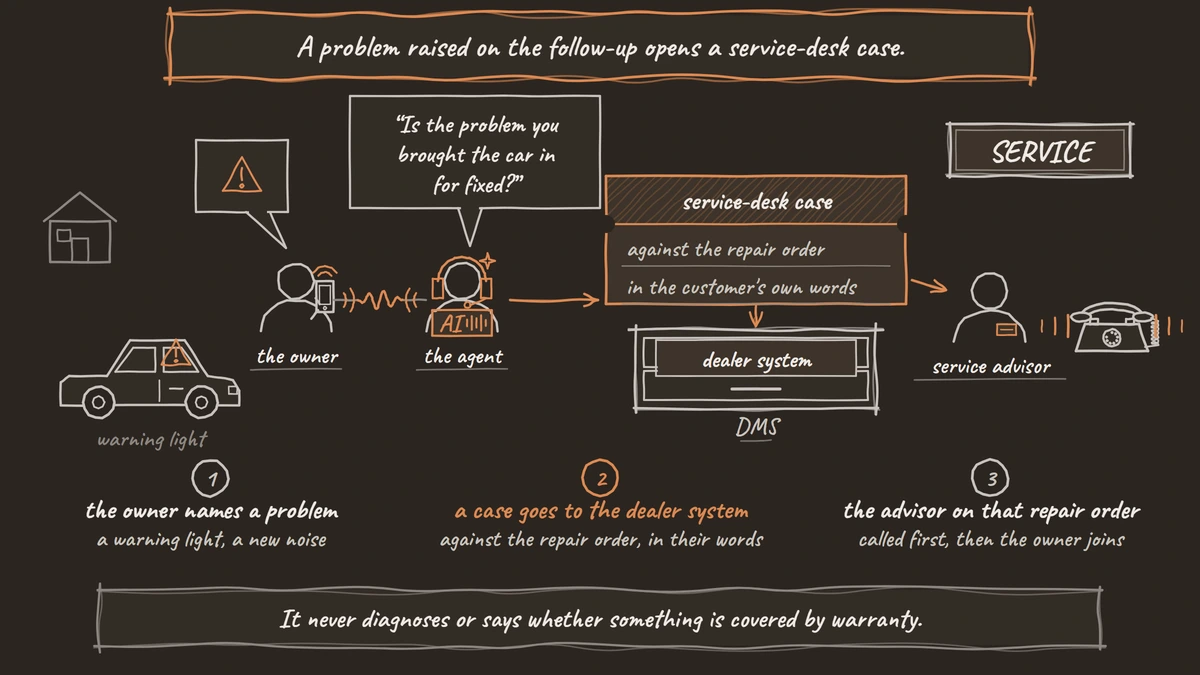
It never diagnoses or says whether something is covered by warranty. Goodwill and discounts stay off the call too. Those calls belong to the advisor, the same rule our post on service appointment booking in automotive sets for inbound calls.
First, an HTTP API tool writes the case to the DMS against the RO, with the problem in the customer's own words. Then Transfer Call puts the owner through to the service desk. Set its destination to Dynamic HTTP Resolver, and your system returns the number of the advisor on that repair order. Dograh calls the advisor first and connects the owner only when someone answers. It works on Twilio, Telnyx, Plivo, Cloudonix and Asterisk ARI.
If nobody picks up within the 30-second default, the owner stays with the agent. The prompt tells it to offer a callback, and the agent writes that request to the DMS so the advisor sees it at the top of the list.
Booking the next visit
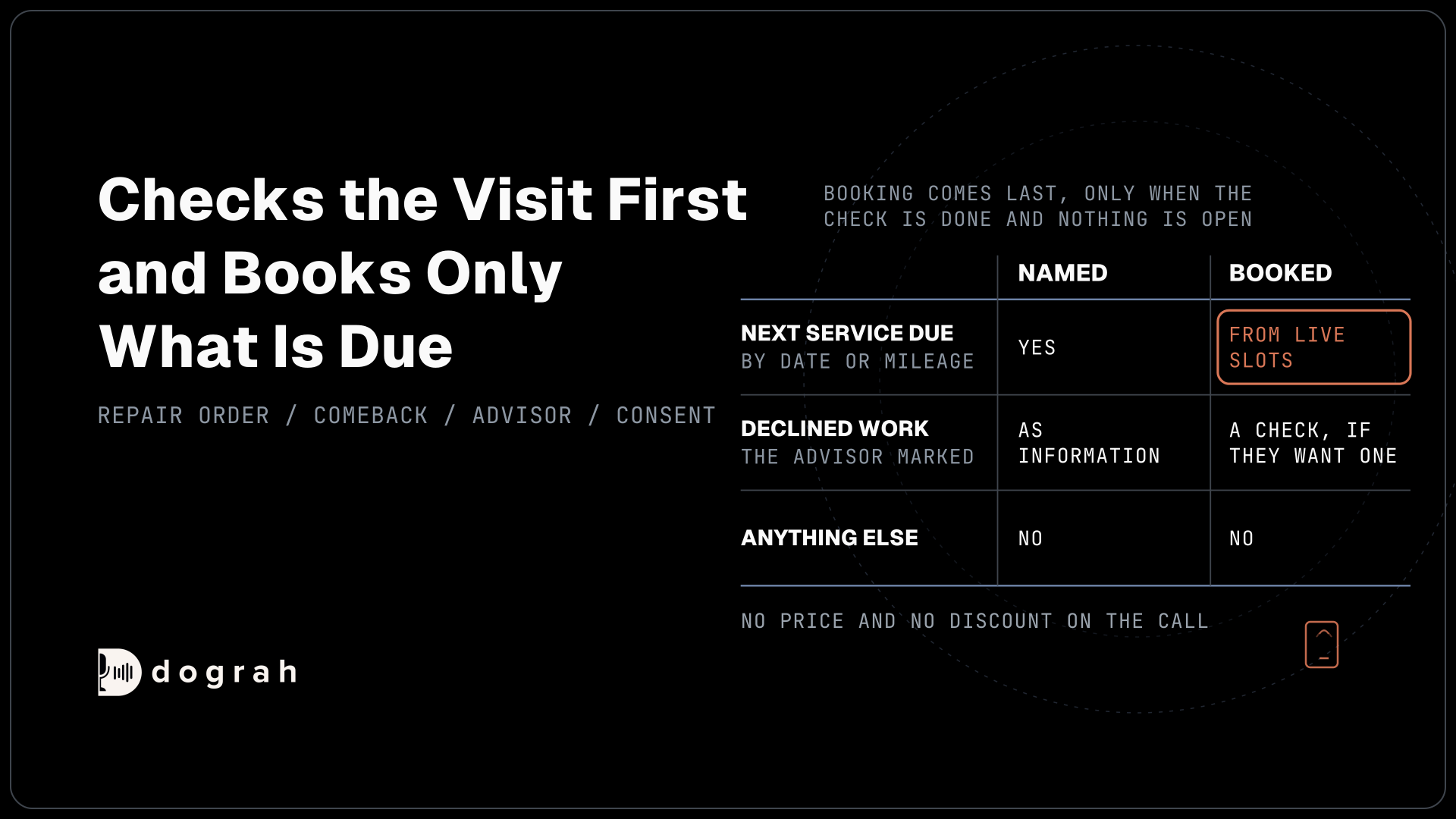
Booking comes last, and only when the check is done and nothing is open. An HTTP API tool asks the DMS what is due next, by date or mileage, plus any declined work the advisor marked for follow-up. The agent offers the next service the DMS says is due, with live slots, and nothing else.
Declined work is named as information: "Your advisor noted the rear tyres were close to the limit. Would you like to book a check?" There is no price and no discount on the call. Add a Preset Parameter carrying workflow_run_id to the booking tool, so a retried request does not book two bays.
The offer stays off for a legal reason. Under the FCC's calling rules, a call that includes an advertisement needs the owner's prior express written consent, and a number on a repair order is not that. AI voice agents for service reminders in automotive explains the consent line in full. Confirm your own position with counsel before the first campaign.
Join the Dograh Community
Dograh is an OSS alternative to Vapi. Join our Slack community for queries, releases, best practices & community interactions.
What goes back to the DMS
Every call ends with a record your service manager can sort. A Webhook node sends the outcome after the call: the rating, the comment as said, whether the problem is fixed, any case opened and any visit booked, with links to the transcript and recording. If the DMS times out, the webhook retries on its own.
The QA node checks the calls you choose to sample. Write its System Prompt to flag any call that mentioned a survey score, a price, a discount or a likely cause of a fault. Each step gets its own score and tags, so you see which part of the call slipped.
You can self-host the platform on the dealer group's servers or run it on Dograh Cloud, with your own keys for any speech and language models, or open models you run yourself. The opening can be a pre-recorded clip in the advisor's own voice, with text-to-speech for the rest.
Self-hosted Dograh has no per-minute platform fee, but servers, model keys and phone minutes still cost money. Dograh Cloud charges a 1¢-a-minute platform fee. Start with one store's closed repair orders and read the first week of transcripts with the service manager.
Glossary
- Repair order (RO)
- The DMS record of one service visit, with the vehicle and the work done under one advisor. Closing it is what starts the follow-up call.
- Comeback
- A car that returns with the same fault after a repair. On a follow-up call it is a service-desk case, written to the DMS and handed to the advisor.
- Declined work
- Recommended work the customer chose not to do on the visit. The agent mentions it only if the advisor marked it for follow-up, and never with a price.
- Prior express written consent
- A signed written agreement the FCC's calling rules require before an artificial-voice call that includes an advertisement. A phone number on a repair order is not that agreement.