
AI redeployment outreach calls for staffing agencies phone contractors before their assignment ends, once the client has said whether it will extend. The agent checks availability, reads open roles the applicant tracking system returns, and records each answer as the worker said it. The results go back to the ATS, where a recruiter makes the match.
Key Takeaways
- Ask the client about an extension before the worker hears anything.
- Availability goes into the ATS as fields a recruiter can sort.
- The agent reads matching roles, and a recruiter makes the placement and sets pay.
This post is part of our guide to AI voice agents for staffing and recruitment, where a recruiter makes every decision. Below, we cover redeployment, from the end-date calendar to the role match. Throughout, we show how the outreach calls run in Dograh, the open-source AI voice agent platform we build.
Why the end date is the deadline
A good contractor whose assignment ends with nothing lined up takes the next offer they get, and it may not be yours. Every day of bench time costs the worker pay and the agency a placement. Demand makes that more likely. The American Staffing Association's Staffing Index put staffing jobs in the week of 10 to 16 August 2026 at 5.5% higher than the same period a year earlier.
Measure the program before you change it. Jombone, a staffing software company, suggests a simple count: of the workers whose assignments ended last month, how many took another placement from you within 30 days. That is your redeployment rate. Track it for the weeks before the calls start and the weeks after, and judge the program on your own number, not a published average.
The end-date calendar
The first call is to the client, and a person makes it. Before any worker hears that an assignment is ending, the account manager runs an extension check, asking the client whether the assignment will be extended. Only confirmed endings join the call list, so nobody hears "your job is ending" about a role the client was about to renew.
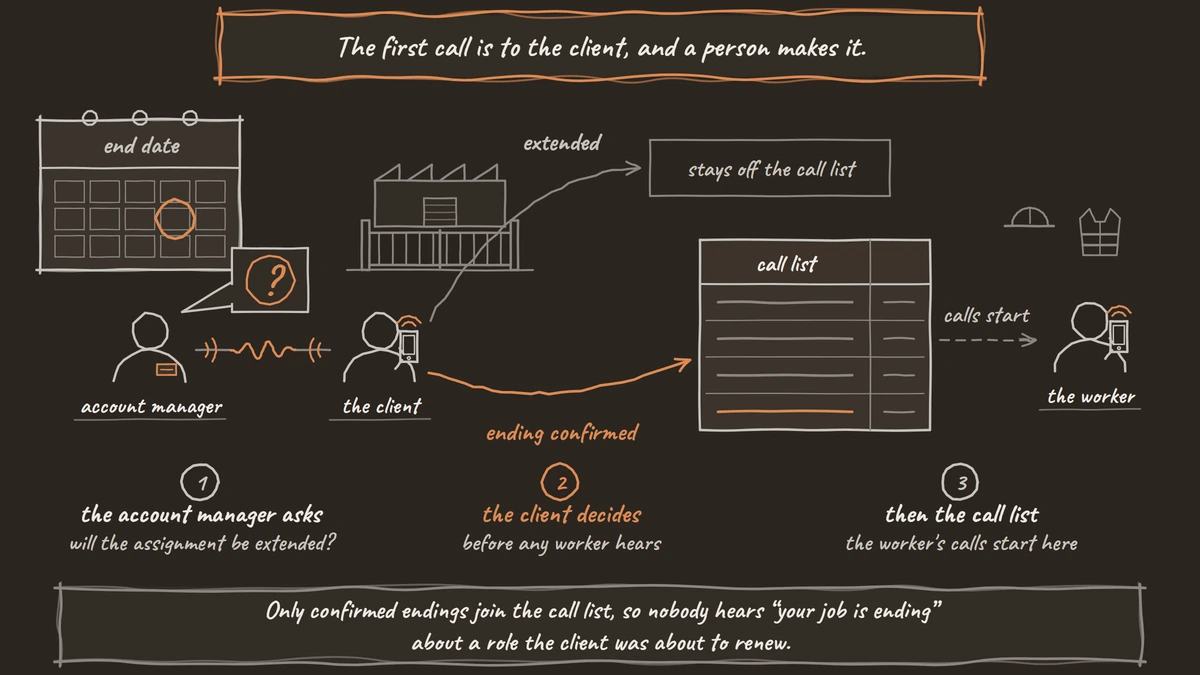
From there, the end date in the ATS drives the sequence. A common pattern is an availability check about a month out, a call about matching roles around two weeks out, and a last call in the final week for anyone still unplaced. Your agency sets the timing.
Your ATS exports the day's list to Campaigns as a CSV, with columns such as the end date, the current client and the worker's certifications, or it starts each call through the API Trigger on the right date. You set the retries (0 to 10). Calling hours follow one time zone per campaign, so split the list by time zone. Consent, call caps and opt-outs work as in AI voice agents for candidate re-engagement.

Open Source Alternative to Vapi / Retell
Self-hosted voice agent platform — no per-minute fees
dograh-hq/dograh
Star on GitHub
The availability check
The call greets in the agency's name, verifies the worker, and only then talks about the assignment. Once verified, the agent can name the current client, because the worker is there every day.
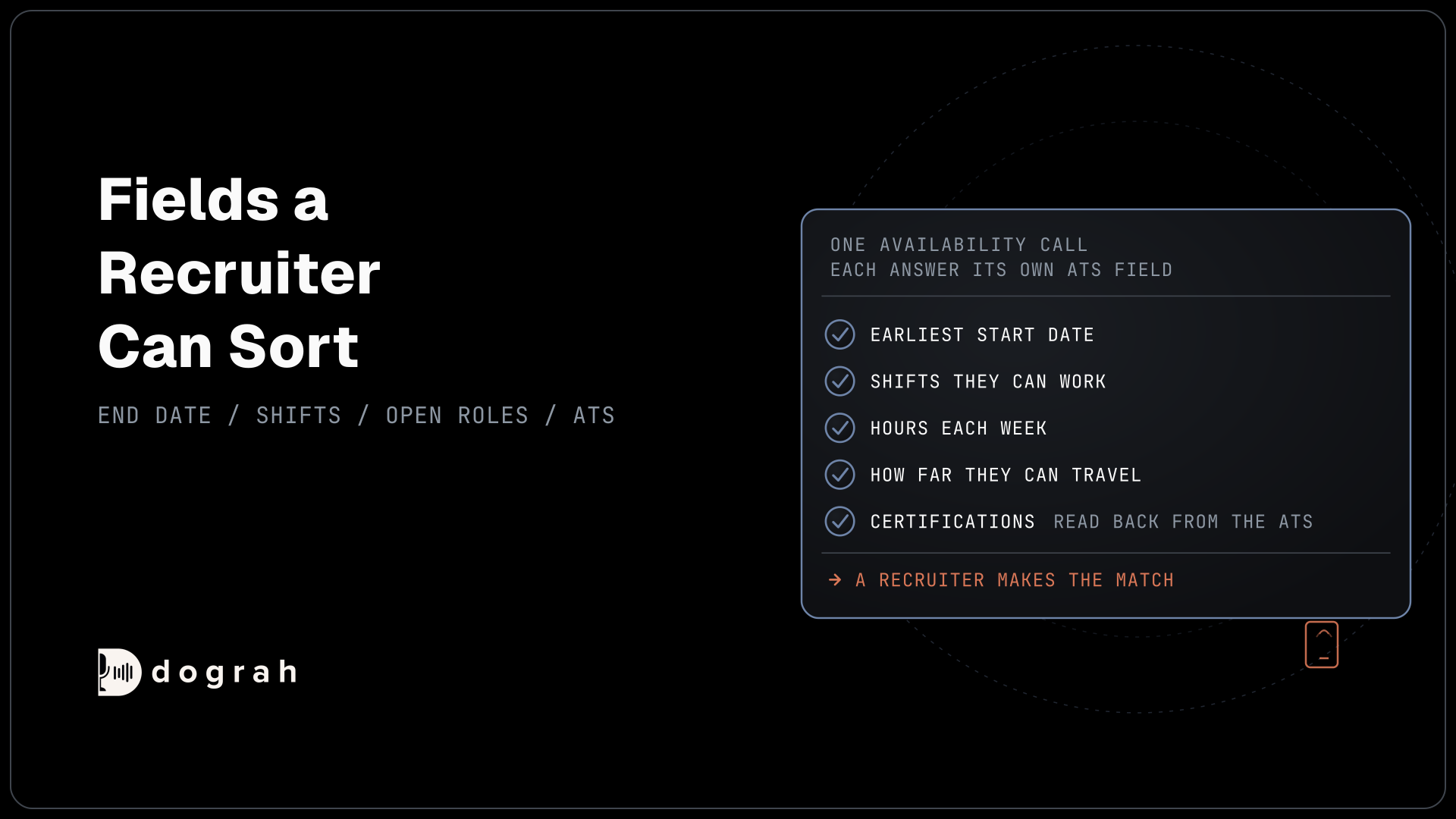
Then it asks what the next assignment needs to look like: the earliest date they can start, the shifts they can work, the hours they want each week and how far they can travel. Each answer goes into its own field in the ATS.
Certifications come from the ATS, not from the worker's memory. The agent reads back what is on file, such as a forklift certificate or a food handler card, with its expiry date, and asks whether anything has changed. A pay floor is asked only if your agency allows it, and the agent records the figure as said without comment.
The agent records each answer as the worker said it, and the transcript and recording keep the exact words. A worker who wants a break is recorded with the date they gave, so the next call waits for it.
The new-role call
The role call reads only what the ATS returns. An HTTP API tool asks the ATS or job board for open roles that match the worker's fields: title, location, shift and start date. The tool hands the whole response to the language model, so build the endpoint to return only what the agent may read out.
The agent reads up to three roles. It names a new client only after the worker says yes to the role, and it never discusses pay, negotiates or promises a placement or a start date. A yes is recorded as interest, and the agent books a call with the recruiter from slots the recruiter's calendar returns, with a workflow_run_id Preset Parameter so a retry does not book twice.
What stays with the recruiter
The recruiter owns the match and the pay. The submission, the decision to put a worker forward to a client, stays with the recruiter too. The agent's job ends at a clear record of what the worker wants.
Some answers need a person straight away. A worker who mentions a safety problem, harassment or a pay dispute on the current assignment goes to a recruiter at once. The agent writes the details to the ATS first, then Transfer Call puts the call through on Twilio, Telnyx, Plivo, Cloudonix or Asterisk ARI. Dograh calls the recruiter first and connects the worker only when someone answers. If nobody answers within the 30-second default, the worker stays with the agent, which writes an urgent callback request.
If anyone says they are in danger right now, the agent tells them to get to safety and call 911. Once a new placement is agreed, the first-shift call takes over, covered in AI voice agents for candidate reminder and confirmation calls.
Join the Dograh Community
Dograh is an OSS alternative to Vapi. Join our Slack community for queries, releases, best practices & community interactions.
Results back in the ATS
Every call ends with fields a recruiter can act on. A Webhook node sends the outcome after the call: start date, shifts, hours, distance, roles of interest, any problem raised and the next step, with links to the transcript and recording. A temporary failure such as a timeout is retried automatically. Sort the recruiter's queue by assignment end date, so the soonest ending is worked first.
Write the QA System Prompt to flag any call where the agent promised a role or a start date, or named a pay rate. Each step gets its own score and tags, and View Trace shows how long the ATS took to answer each request.
Worker records can stay with the agency: you can self-host the platform on your own servers or run it on Dograh Cloud, with your own keys for any speech and language models, or open models you run yourself. The opening can be a pre-recorded clip in a recruiter's own voice, with text-to-speech for the rest.
Self-hosted Dograh has no per-minute platform fee, but servers, model keys and phone minutes still cost money. Dograh Cloud charges a 1¢-a-minute platform fee. Start with one client's assignments ending next month, and read the first week of transcripts with the recruiters.
Glossary
- Redeployment rate
- The share of workers whose assignments ended in a month who took another placement from the same agency within 30 days.
- Extension check
- The account manager's question to the client about whether an assignment will be extended. It comes before any worker is told the assignment is ending.
- Bench time
- The days a worker spends between assignments with no placement. Calls before the end date aim to keep it short.
- Submission
- A recruiter putting a worker forward to a client for a role. The agent records interest, and the recruiter makes the submission.