
AI phone calls in Canada follow the CRTC's Unsolicited Telecommunications Rules. The safe reading treats an AI voice as an automatic dialing-announcing device, so sales calls need express consent naming the number, calling hours and a clear opening. CASL covers texts, not calls. On Dograh, the open-source AI voice agent platform, self-hosted or on Dograh Cloud, campaigns carry those hours.
Key Takeaways
- An AI sales call needs express consent that names the number you dial.
- Use a National Do Not Call List copy no more than 31 days old.
- CASL covers your follow-up text, while the CRTC rules cover the call itself.
Canada has no law written for AI agents, so older calling rules apply. We explain when an AI agent counts as an automated dialer, the hours and opening, both do-not-call lists, CASL and calls you answer. Then we turn the rules into a checklist and talk about Dograh's settings.
When an AI agent counts as an ADAD
The Canadian Radio-television and Telecommunications Commission (CRTC) writes the calling rules, and its Unsolicited Telecommunications Rules were drafted for machines that play messages. They define an automatic dialing-announcing device (ADAD) as equipment that stores or produces phone numbers and conveys a pre-recorded or synthesized voice message. An AI voice is synthesized, so the safe reading treats an AI agent's outbound calls as ADAD calls.
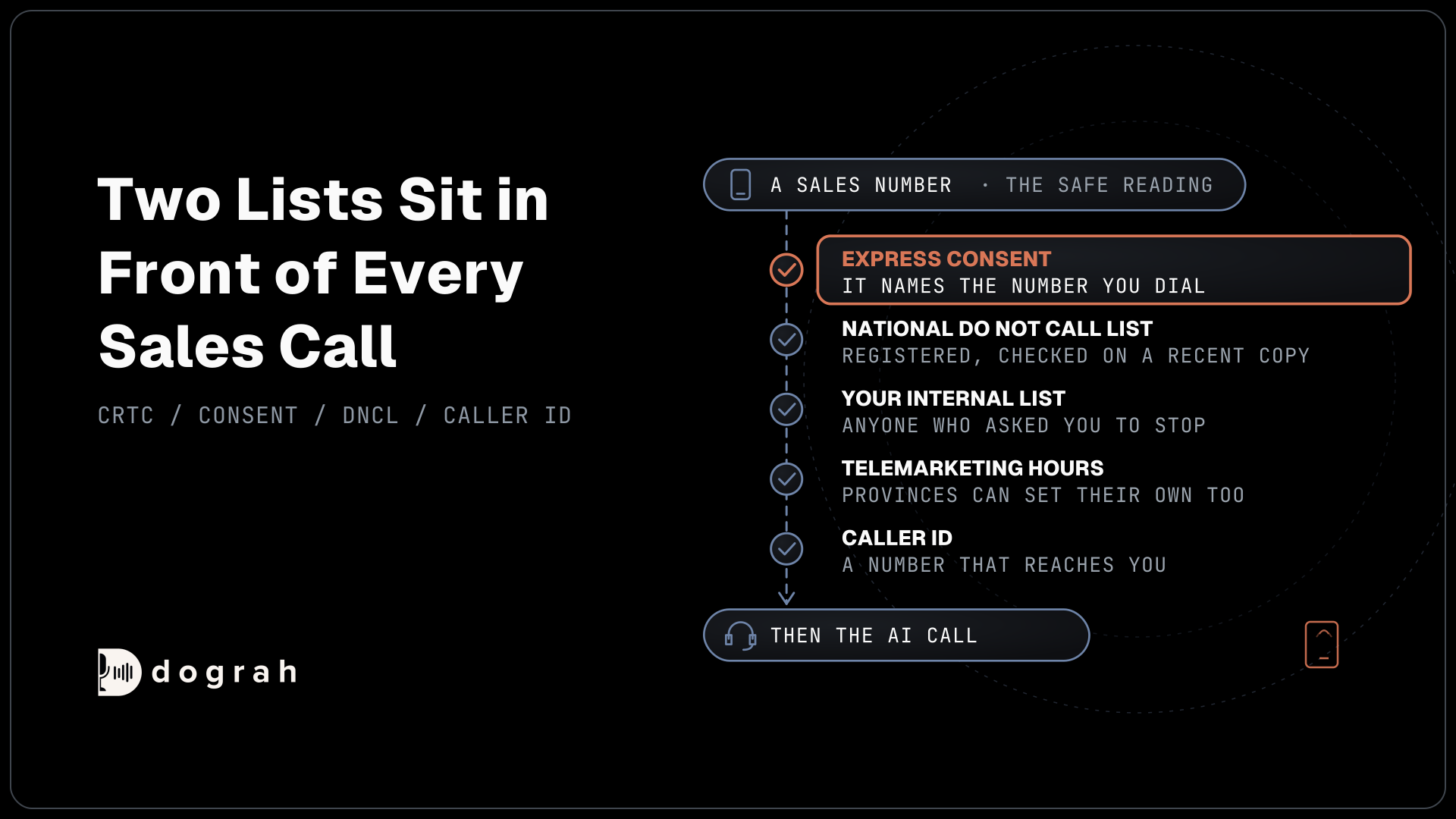
That reading matters most for sales. A sales call made with an ADAD needs the person's express consent to such calls from you or your client, and the consent must name the number you call. It applies even when the number is not on the National Do Not Call List, so a list that only passed a DNCL check is not ready for an AI agent.
Calls that sell nothing still count. A reminder or an account notice placed by an AI agent falls outside the telemarketing rules, yet as an ADAD call it still follows the ADAD hours and opening set out below. Police, fire services, schools and hospitals placing public-service calls are exempt from those conditions.
The question is open at the regulator. The CRTC opened a review of these rules in 2026, Compliance and Enforcement Notice of Consultation CRTC 2026-132, and one of its questions asks whether the ADAD definition captures software that uses synthesized voices or artificial intelligence. A filing in that review quotes the question in full. No decision has been made, so plan on the safe reading. For the US, UK and EU, see our post on whether AI phone calls are legal.
Calling hours, the opening line and caller ID
Calling hours run in the time of the person you call. Telemarketing calls are allowed from 9:00 a.m. to 9:30 p.m. on weekdays and from 10:00 a.m. to 6:00 p.m. on weekends, and ADAD calls that sell nothing follow the same windows. Those are the CRTC's telemarketing hours, and provinces can set their own hours too, so a provincial law on your kind of call can narrow them.
The opening carries the rest. A telemarketing call identifies the caller and the business it calls for as soon as the person answers, and gives a number and contact details on request. An ADAD message opens by naming who the call is for and why, with an email or postal address and a local or toll-free number, and repeats those details at the end if it runs past 60 seconds. The contact details have to keep working for 60 days.
Some limits apply to every ADAD call. It may not ring emergency lines or healthcare facilities, it must show a caller ID, and it must free the line within 10 seconds of the person hanging up. Our post on AI voice agents for debt collection in Canada covers the provincial hours for collections calls.

Open Source Alternative to Vapi / Retell
Self-hosted voice agent platform — no per-minute fees
dograh-hq/dograh
Star on GitHub
The National Do Not Call List and your own list
Two lists sit in front of every sales call. The National Do Not Call List (DNCL) holds personal numbers, and telemarketers must register, pay the fees and use a copy no more than 31 days old. Calls to a registered number need express consent, unless an exemption applies.
The exemptions are narrow. An existing business relationship covers a purchase or a service contract in the last 18 months, or an inquiry in the last 6 months. Registered charities, political parties, survey firms and newspapers selling subscriptions are also exempt. Business-to-business calls are exempt from the DNCL rules, yet the telemarketing and ADAD rules still apply to business numbers.
Your own internal list is stricter. A do-not-call request made during a call has to be processed then, added to your internal list within 14 days and kept for 3 years and 14 days. Express consent itself can be written, oral with an audio recording kept, given online or by toll-free number, and the caller carries the burden of proving it. An AI call can capture oral consent for later calls, but only if you keep the recording with the consent record. Under the Telecommunications Act, penalties reach $15,000 per violation for a company and $1,500 for an individual.
CASL, texts and the calls you answer
Canada's Anti-Spam Legislation (CASL) does not apply to a two-way voice conversation or to a voice recording sent to a phone. So CASL is about the follow-up text, and the CRTC rules are about the call. If your agent sends a quote link by text after the call, that text needs CASL consent on its own.
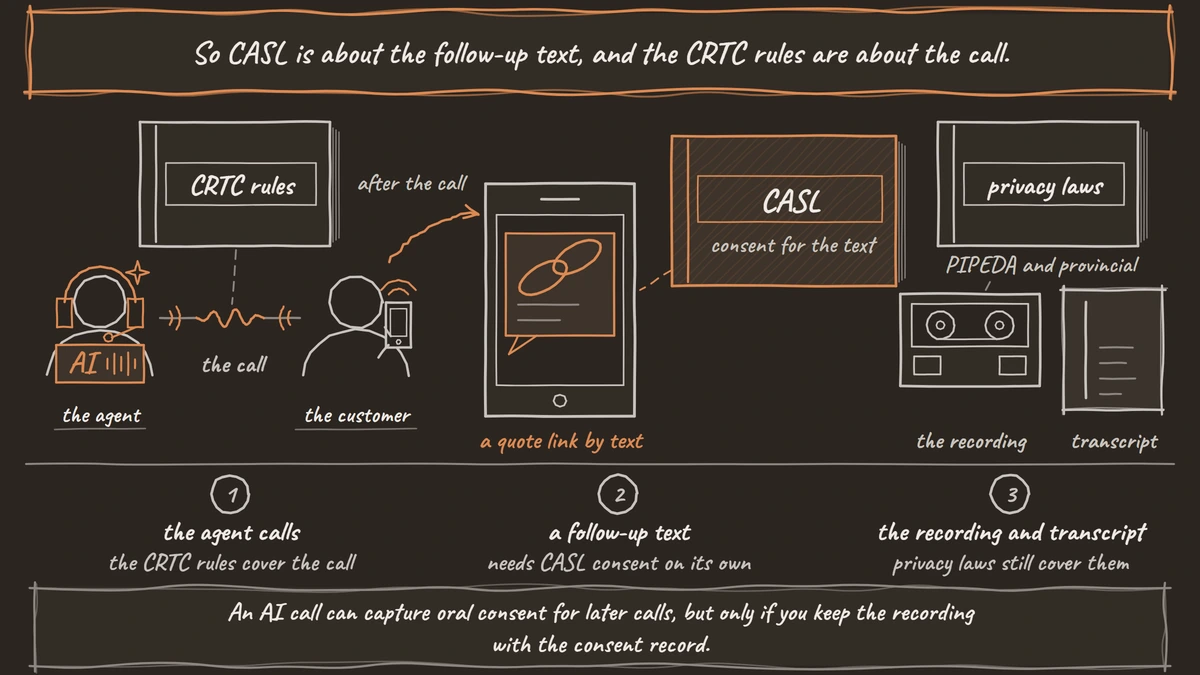
Calls people place to you are different again. The Unsolicited Telecommunications Rules govern calls a business makes, so an AI receptionist answering calls is not making unsolicited calls and generally needs no calling consent. The Personal Information Protection and Electronic Documents Act (PIPEDA) and provincial privacy laws still cover the recording and the transcript. Our post on AI voice agents for telehealth in Canada covers the provincial health privacy side. The inbound point is our reading of the rules, and the rest is the rules as we read them, so confirm with counsel how they apply to your calls and provinces before launch.
Checklist before any outbound AI call in Canada
Run every Canadian campaign through this list before the first number is dialed. Every line ties back to one of the CRTC rules above, and the next section shows where each one is set in the agent.
- Hold express consent to AI calls from your business for every sales number, naming that number, with the proof kept.
- Register with the DNCL and check the list against a copy no more than 31 days old.
- Check your internal do-not-call list, and remove anyone who asked within the last 3 years and 14 days.
- Split the list by time zone and set each campaign's hours in that zone.
- Check whether a provincial law sets tighter hours for your kind of call.
- Name the business and the reason for the call in the opening line, with a local or toll-free number.
- Show a caller ID that reaches you.
- Route stop requests to your internal list the same day.
- Get CASL consent before any follow-up text.
Join the Dograh Community
Dograh is an OSS alternative to Vapi. Join our Slack community for queries, releases, best practices & community interactions.
Setting up Canadian calls in Dograh
The opening line should be fixed text, since a model asked to say required words can paraphrase them away. In Dograh, that text goes in the Greeting Text of the Start Call node, which the agent speaks unchanged as soon as someone picks up. Put the business name, the reason for the call and the toll-free number there. If you tell callers they are speaking with an automated assistant, by choice or because a law requires it, add that line beside the business name.
Canada spans six time zones, and a campaign's Call Schedule runs in one Timezone, so split the list and run one campaign per zone, such as America/Toronto and America/Vancouver. Set weekday Time Slots inside 9:00 to 21:30 and weekend slots inside 10:00 to 18:00. Upload only numbers with the right consent, since your list and your CRM carry that record.
Stop requests need a record after the call. The call disposition do_not_call marks the outcome, and a Webhook node sends it to your internal list so it is added well inside 14 days. For a caller who asks for a human, Dograh calls the destination first and connects the caller only when someone answers, on Twilio, Telnyx, Plivo, Cloudonix and Asterisk ARI.
Recordings can serve as proof of oral consent, so keep them where you control them. Self-hosted, recordings are saved per call unless the server-wide recording switch is off, and there is no automatic deletion, so your retention rule runs in your own storage. To keep call data in Canada, self-host in a Canadian data center with the models running there too. Running Dograh yourself means no per-minute platform fee. You still pay for servers, model keys and phone minutes, and your team looks after the database and upgrades. Support comes from the open-source community, and Enterprise adds custom SLAs. If you would rather not host it, Dograh Cloud runs it for a 1 cent a minute platform fee.
Glossary
- Automatic dialing-announcing device (ADAD)
- The CRTC's term for equipment that dials numbers and conveys a pre-recorded or synthesized voice message. The safe reading includes AI voice agents, and the CRTC is reviewing the definition.
- National Do Not Call List (DNCL)
- Canada's register of personal numbers that do not want telemarketing calls. Telemarketers register, pay fees and use a copy no more than 31 days old.
- Existing business relationship
- A DNCL exemption covering a purchase or service contract in the last 18 months, or an inquiry in the last 6 months.
- Internal do-not-call list
- Your own list of people who asked you to stop. Requests go on it within 14 days and stay for 3 years and 14 days.