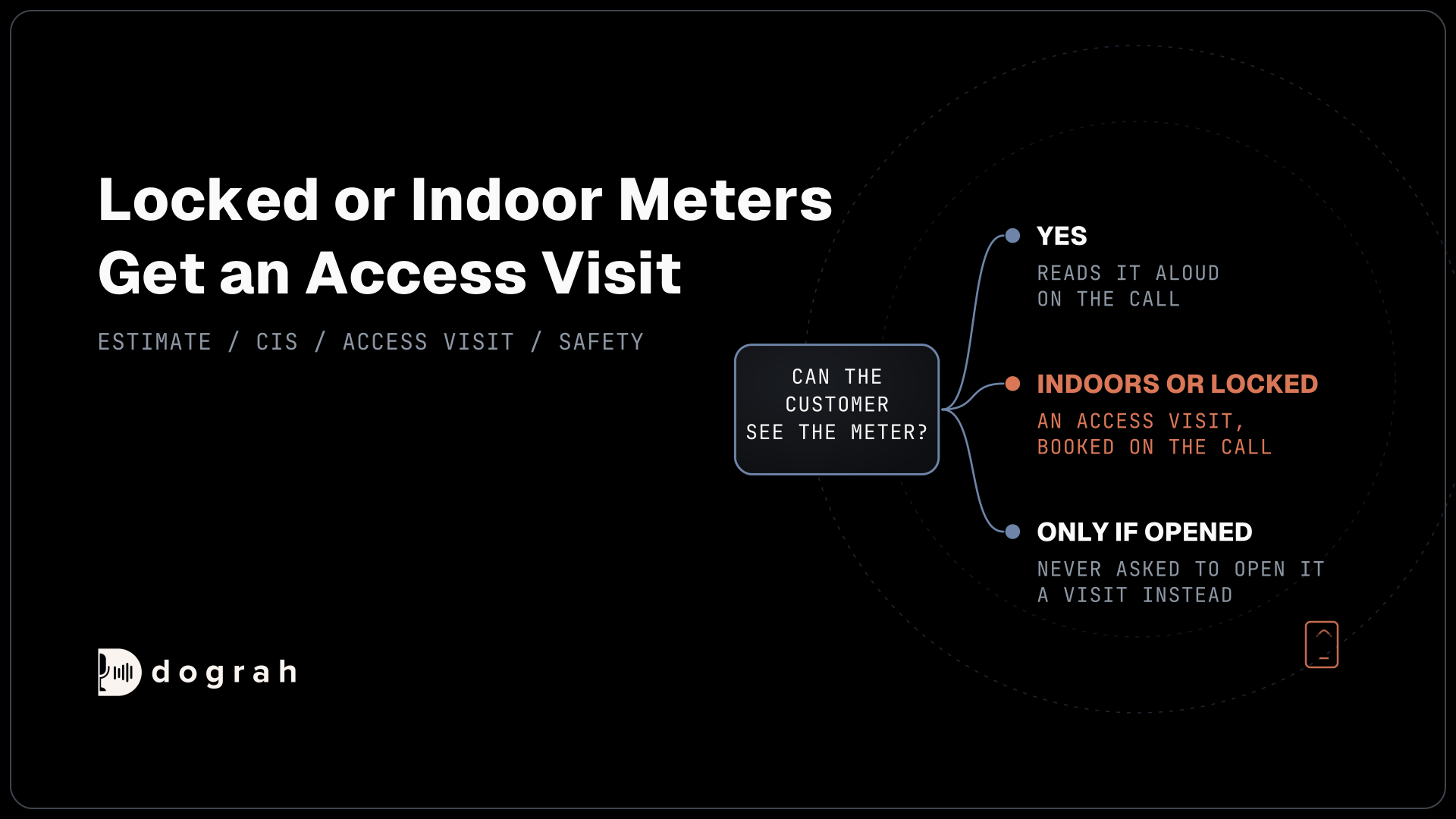

AI meter reading reminder calls phone customers whose meters a reader could not reach, before the next bill is estimated. The agent asks the customer to read the meter aloud, repeats the digits back and sends the reading to the billing system, which checks it. If the meter is indoors or locked away, the agent books an access appointment.
Key Takeaways
- The agent repeats the digits back, and the billing system decides if they fit.
- Locked or indoor meters get an access visit from the scheduler's open slots.
- The agent never asks anyone to open a meter box or touch equipment.
This post is part of our guide to AI voice agents for utilities and energy, where the agent explains bills built on estimated reads. Below, we cover the call before that bill. Along the way, we show how the meter-reading reminder runs in Dograh, the open-source AI voice agent platform from our team.
Why estimated bills turn into complaints
An estimated meter read is a guess, and the customer pays for the gap later. When nobody reads the meter, the utility bills from past use. The City of Minneapolis lists the usual causes for its water customers. Sometimes the meter has stopped or its automatic reader is broken. Other times a reader could not get to the meter.
Smart meters have not closed the gap. In the UK government's smart meter statistics, Great Britain had 42 million smart and advanced meters in homes and small businesses at the end of June 2026, 72% of all meters. Of the 40 million smart meters, 92% were working in smart mode. That leaves about a third of meters that still need someone to read them.
When a real reading comes in, the next bill corrects months of guessing at once. That is the call the support line takes, covered in AI voice agents for utility customer support. A reminder call a few days before the read date stops many of those bills from being estimated at all.
Which accounts get a reminder call
Your customer information system (CIS) already knows which meters were missed, so it builds the list. Some states also say when a utility has to act. Illinois's rule on meter readings expects an actual reading at least every second billing period, and after two estimated bills in a row, the utility must contact the customer to sort out why. A customer reading, one the customer takes and reports, counts as an actual reading, but after six months of customer readings, the utility's own reading is due.
Pennsylvania's rule lets a utility estimate every other month only if it gives the customer a way to read the meter and report it. When access is the problem, it needs an actual or customer reading at least every 6 months and its own reading at least every 12. Other states set their own limits, so confirm which ones apply to your service area with counsel.
From those rules, the list writes itself. It starts with accounts that already have one estimate and accounts on customer readings nearing six months, then adds meters flagged as hard to reach. Your system exports them each day to Campaigns as a CSV, with columns such as the read date and a note on where the meter sits. You set the retries (0 to 10). A campaign's calling hours run in one time zone, so split the meter list by time zone. The call is about the service, so it carries no offers.

Open Source Alternative to Vapi / Retell
Self-hosted voice agent platform — no per-minute fees
dograh-hq/dograh
Star on GitHub
The reminder call, from greeting to reading
The call runs greet, verify, then the reason. The Greeting Text names the utility. The agent then confirms the account holder with an approved check, such as the last four digits of the account number, before it says anything about the account, such as the meter or a bill. Asking for the person by name only finds them, and a phone number finds the account without proving who answered.
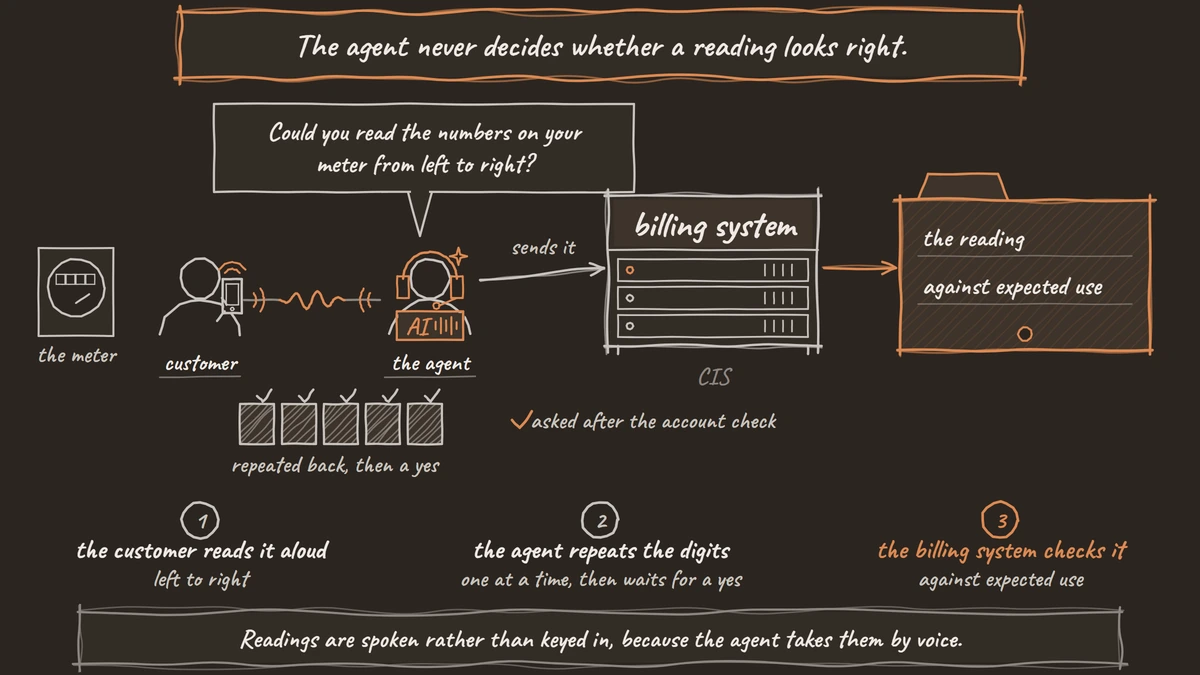
Then comes the ask: "Could you read the numbers on your meter from left to right?" The customer says the digits, and the agent repeats them back one at a time and waits for a yes. Readings are spoken rather than keyed in, because the agent takes them by voice. The agent records the reading as the customer said it, and the transcript and recording keep the exact words.
An HTTP API tool sends the reading to your CIS. Its "When the tool starts" message plays a short line, such as "Let me send that through now", while the request runs. Add a Preset Parameter carrying the call's workflow_run_id, so a retried request is not counted twice.
The agent never decides whether a reading looks right. The CIS does, by checking it against expected use. If the CIS rejects it, the agent asks the customer to read the meter once more. If the second reading fails too, the agent records both and offers an access visit, so a person sees the meter.
Booking an access appointment
Some customers cannot read the meter because they cannot see it. It sits in a locked basement or behind a gate with a dog in the yard. For these, the reminder becomes a booking. An HTTP API tool asks your scheduling system for open windows near the read date, and the agent offers the windows the scheduling system returns and books the one the customer picks.
The agent reads the date and the window back before it books. It also records anything the reader needs, such as a gate code or a dog that must be kept inside, as the customer said it. Use the same workflow_run_id Preset Parameter on the booking tool, so a retry does not take two slots. A day-before reminder can run as a separate campaign from the booked list.
Safety lines and voicemail
The agent never asks anyone to open a meter box or touch equipment. If the digits cannot be seen without doing that, the call books an access visit instead.
A customer who mentions a gas smell needs fixed words the model cannot paraphrase. Put the line on an emergency pathway as Transition Speech, which plays as fixed text with the caller muted: "Please leave the building now, and call 911 or the gas company from outside." For a damaged electric meter or sparks, the line tells the customer to get to safety and call 911. AI voice agents for emergency intake in utilities covers where these words live and how to test the path.
Voicemail handling is off by default. Once you turn it on and set it to Leave a message, the agent plays one fixed message: the utility's name and a callback number, with nothing about the account. A customer who wants to dispute a past bill goes to a person, with the details written to your system first.
Join the Dograh Community
Dograh is an OSS alternative to Vapi. Join our Slack community for queries, releases, best practices & community interactions.
Checking the calls and running them yourself
Every reminder call can be checked after it ends. In the QA node, write the System Prompt to flag any call where the agent named the account before the check passed or judged a reading itself. Flag any call that asked someone to open equipment too. Each step gets its own score and tags, so you see where a call went wrong. View Trace shows each tool request and how long the CIS took to answer.
Meter and account data can stay with the utility, because you can self-host the platform on your own servers or run it on Dograh Cloud. The speech and language models are your choice: your own keys for any provider, or open models on your own servers. The fixed lines can be pre-recorded clips in a real staff voice, with text-to-speech filling in the digits.
Self-hosted Dograh has no per-minute platform fee, but servers, model keys and phone minutes still cost money. Dograh Cloud charges a 1¢-a-minute platform fee. Start with the accounts that already have one estimate, and read a week of transcripts before you widen the list.
Glossary
- Estimated meter read
- A bill figure based on past use because nobody read the meter that period. The next actual reading corrects it, often in one large catch-up bill.
- Customer reading
- A reading the customer takes and reports, by web form or on a call. Illinois counts it as an actual reading, but expects the utility's own reading after six months of them.
- Access appointment
- A booked window when the customer makes sure a reader can reach a meter that is indoors or behind a locked gate.
- Smart mode
- A smart meter that sends its readings to the supplier on its own. A smart meter working in traditional mode still needs someone to read it.