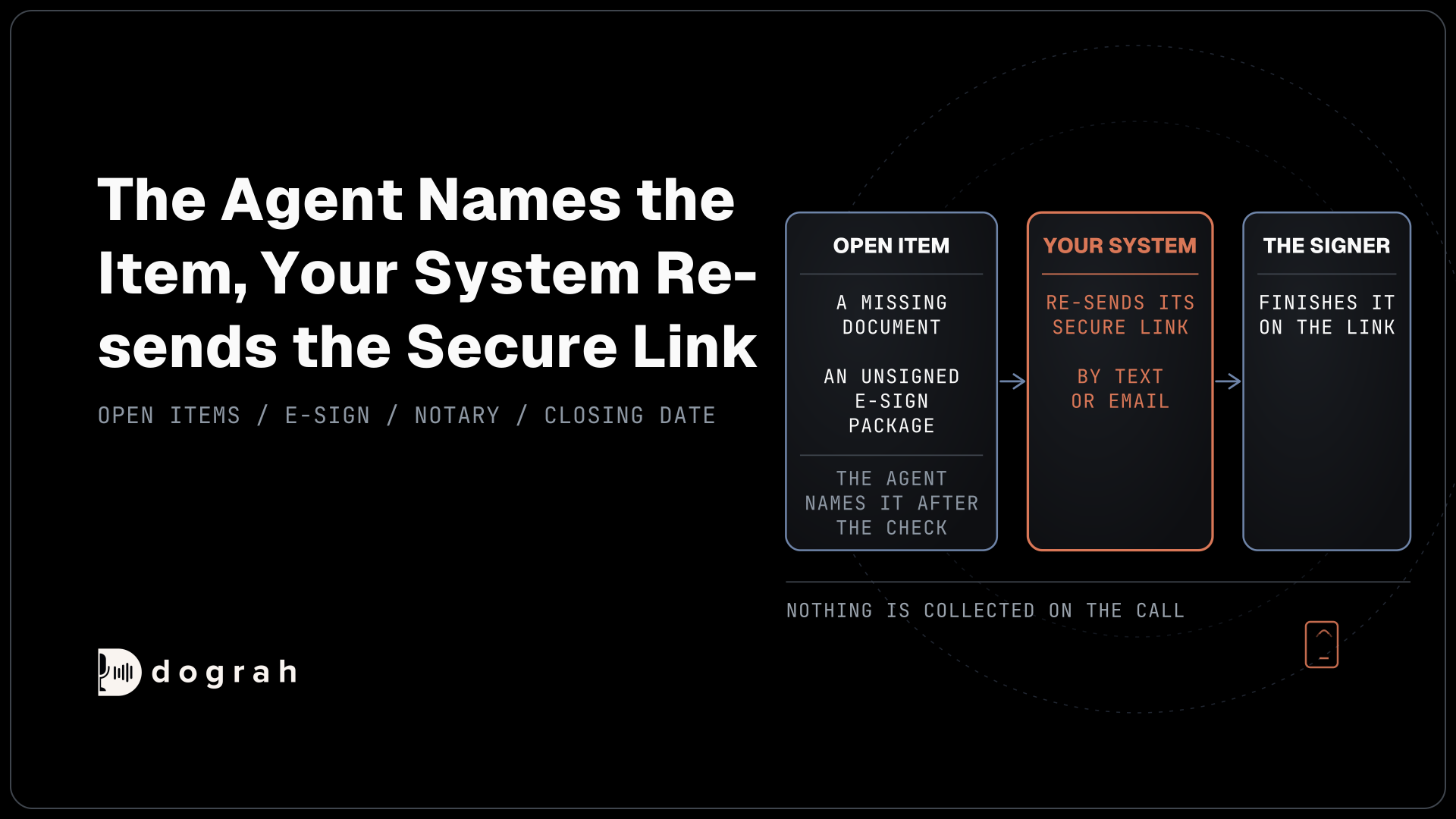

AI escrow document and signature reminder calls work through a file's open items before closing. The agent names the missing document or unsigned package and why the closing needs it, then has the office's own system re-send its secure link. It never collects documents on the call and never gives, confirms or changes wiring instructions.
Key Takeaways
- The office's open-items list decides who gets called, and about what.
- The agent names the item, and your system re-sends the secure link.
- The wire line plays as fixed words on every reminder call.
This post is part of our guide to AI voice agents for title and escrow, where the agent never handles wiring instructions. Below, we cover chase calls for missing documents and signatures. Along the way, we show how the reminder call runs in Dograh, the open-source AI voice agent platform we build.
Why reminder calls carry fraud risk
A document chase is exactly when a fake "updated instructions" message lands, because the buyer or seller is already expecting to hear from the office. Criminals know it. The FBI's 2025 figures, as summarised by ALTA, put real estate fraud losses at $275.1 million in 2025, up from about $173 million in 2024, across 12,368 complaints.
That is the FBI's real estate fraud category on its own. Fake closing wire instructions are counted under business email compromise (BEC) in the FBI's 2025 Internet Crime Report, which our guide covers in its wire-fraud section. Either way, a reminder call that touches money in any form is a gift to the criminal. So the call below names documents and signatures, and it treats every question about funds as a reason to point the caller to a number they already hold.
Build the chase list from open items
Every call starts from what the title production system marks open on the file. On the seller's side that might be a payoff authorization, a trust certificate, a power of attorney, the HOA's contact details or ID for the signing. On the buyer's side, it might be proof of insurance, or an e-sign package sent but not completed. Each item has an owner and a deadline.
Sort the list by days to closing, so a file closing Friday is called before one closing next month. Your system exports it each morning to Campaigns as a CSV, with columns such as the item name, the party and the closing date, or it starts each call through the API Trigger when an item goes overdue.
The endpoint behind the call returns open items only, with nothing about wiring or accounts. You set the retries (0 to 10), and calling hours run in one time zone, so split the list by time zone. The office sets the cadence from the closing date and caps it in its own list. Once the system marks an item received, it drops off the next day's list. Our post on loan document collection caps the lender's follow-ups the same way.

Open Source Alternative to Vapi / Retell
Self-hosted voice agent platform — no per-minute fees
dograh-hq/dograh
Star on GitHub
The document reminder call
The call greets, verifies, then names the item. After the Greeting Text, the agent confirms the person with the check your office sets, such as the date of birth or a passcode set when the file opened. Only then does it name the property or the missing document.
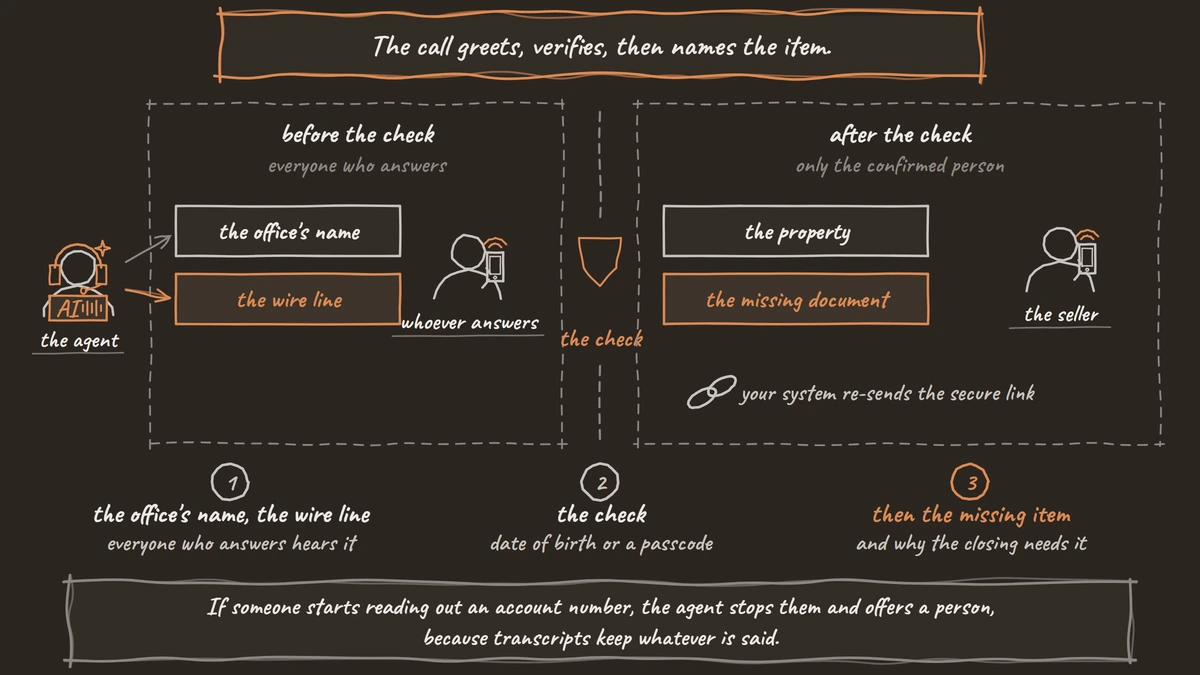
The agent names the item and says why the closing needs it: "We still need the trust certificate, so the title company can confirm who can sign for the trust." An HTTP API tool then asks your system to re-send its secure upload link by text or email, to the contact details already on the file. A second tool records the day the person expects to upload it, as they said it.
Nothing is collected on the call. If someone starts reading out an account number, the agent stops them and offers a person, because transcripts keep whatever is said. Our post on closing coordination calls uses the same upload-link step inside the wider pre-closing call.
The signature reminder call
Signatures stall closings as often as documents do. Most often an e-sign package was sent but never completed, or one initial was missed on a single page. Sometimes a signer has not booked the notary or a remote online notarization (RON) session.
The agent names the package and what is missing, then asks the signer to finish it. It never reads out the document's contents or any figures in it. Your system or the e-sign platform re-sends its own link through the same kind of HTTP API tool. For a notary or RON booking, an HTTP API tool reads the open slots your system returns and books the one the signer picks, with a workflow_run_id Preset Parameter so a retry does not book twice. A signer who wants a different notary goes to a person.
The wire line on every reminder call
The wire line has to play the same way on every call, so it lives in fixed text. Your office writes its own wording, with every element kept: "One thing first: we never give, confirm or change wiring instructions over the phone. Before you send any money, call your escrow officer on the number in your opening documents."
Put the line in the Greeting Text on the Start Call node, after the office's name. That way everyone who answers hears it, even a caller who never passes the check. Switch off Allow Greeting Interruption on that node, because it is on by default and the caller could cut the line short.
Any wiring question later in the call takes a pathway whose Transition Speech repeats the line, with the caller muted so it plays in full. The greeting can also be a pre-recorded clip in the escrow officer's own voice, with text-to-speech filling in the rest of the call. On a speech-to-speech model, play the line as that recording. Then prove it held: write the QA System Prompt to flag any call where bank details or an amount were spoken.
Join the Dograh Community
Dograh is an OSS alternative to Vapi. Join our Slack community for queries, releases, best practices & community interactions.
When the escrow officer takes over
Some answers end the reminder and start a person's work. A party may refuse to sign or dispute a document. A signer may be unavailable before closing, or a caller may say they have already wired money. In each case the agent writes the details to your system first, then puts the call through with Transfer Call.
Set the destination to Dynamic HTTP Resolver, and your system returns the escrow officer on that file. Dograh calls the officer first and connects the caller only when someone answers, on Twilio, Telnyx, Plivo, Cloudonix or Asterisk ARI. If nobody answers within the 30-second default, the caller stays with the agent, which writes a callback request.
Voicemail handling is off by default. If you set it to Leave a message, the message gives the office's name and a callback number only, never the item or the closing date.
The file data can stay with the title company: you can self-host the platform on your own servers or run it on Dograh Cloud, with your own model keys or open models, and every call keeps a full trace.
Self-hosted Dograh has no per-minute platform fee, but servers, model keys and phone minutes still cost money. Dograh Cloud charges a 1¢-a-minute platform fee. Start with the seller-side items on files closing this week, and read the transcripts with your escrow officers.
Glossary
- Open items
- The documents and signatures, plus notary bookings, that the title production system still marks as outstanding on a file. The reminder calls run from this list and stop when an item is marked received.
- E-sign package
- A set of closing documents sent for electronic signature. The agent names an unsigned package or a missed initial, and the e-sign platform re-sends its own link.
- Remote online notarization (RON)
- A notary session held over video. The agent can book a session from slots your system returns, or hand the signer to a person.
- Business email compromise (BEC)
- The FBI's category for scams that use a hacked or spoofed email account or phone number to get money moved, including fake closing wire instructions.