
An AI answering service for painters and remodelers asks your qualification questions before anyone drives out. It records the job type, size, timing and home age, then books the estimate visit through your own system. Dograh, the open-source AI voice agent platform, lets a firm run that intake and booking on its own servers or on Dograh Cloud.
Key Takeaways
- Ask about budget and record it, but never turn a caller away on it.
- A pre-1978 home is a note for the estimator, never a lead-safe verdict.
- Connect Dograh to your estimate calendar and prompt it to offer only returned slots.
An estimator who drives across town to a job the firm does not do loses half a day. The sections below follow the call from the first questions through home age, lead paint, routing and booking, and end with how Dograh saves the answers and books the visit.
What a painting or remodeling call has to settle
The estimator's time is the real cost behind every lead, so the call that books a visit should first settle the job. Many firms are small enough that the person on the ladder is also the one with the phone. The Bureau of Labor Statistics counts 326,900 painter jobs in 2025, and 31% of painters are self-employed.
The market is not growing fast enough to waste a lead either. Harvard's Joint Center for Housing Studies expects homeowner improvement and repair spending to hover around $525 billion a year through the third quarter of 2027, in its October 2026 forecast. In a flat market, every inbound call is worth answering well.
Live receptionist services answer many of these calls today, and some book appointments too. Ruby charges $250 a month for 50 minutes and $395 for 100, with scheduling among its optional features. An AI agent can ask the estimator's full list of questions at any hour and book the visit through your own system. The rest of the contractor call, from a gas smell to messages written into your job system, is covered in our post on the contractor answering service with AI.
Qualification questions before the site visit
The agent asks the questions your estimator would ask on the phone and records each answer in the caller's words. For painting, that means interior, exterior or both, how many rooms or roughly how many square feet, and the surface, such as drywall, wood siding, brick or stucco. For remodeling, it means which room, such as a kitchen, a bath or a basement, and whether walls, plumbing or wiring will move.
Timing and access come next. The agent asks when the caller wants the work to start and whether the home will be lived in during the job. It also asks whether the caller owns the home or rents it, and whether a homeowners association (HOA) has to approve exterior colors or changes. A renter or an HOA approval changes who signs, so the estimator wants to know before the drive.
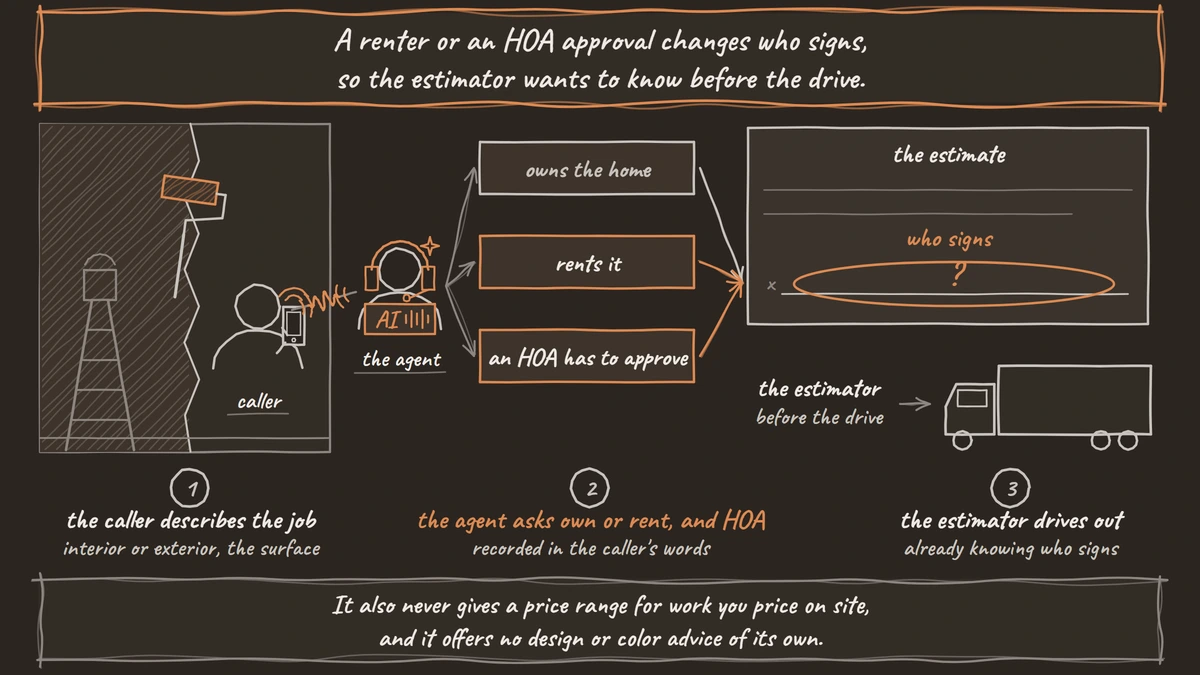
The agent can bring up budget too. It may ask "Do you have a budget in mind?" and records the answer as stated, including "not sure", but it never turns a caller away on budget, because your team decides which jobs to take. It also never gives a price range for work you price on site, and it offers no design or color advice of its own.
Home age and the lead paint rule
Home age matters for painting and remodeling because of lead paint. Under the Environmental Protection Agency's (EPA) Renovation, Repair and Painting Rule, or RRP Rule, anyone paid to disturb painted surfaces in housing or child-occupied facilities built before 1978 must be certified, and their workers trained. The EPA says this applies to all firms, even sole proprietorships.
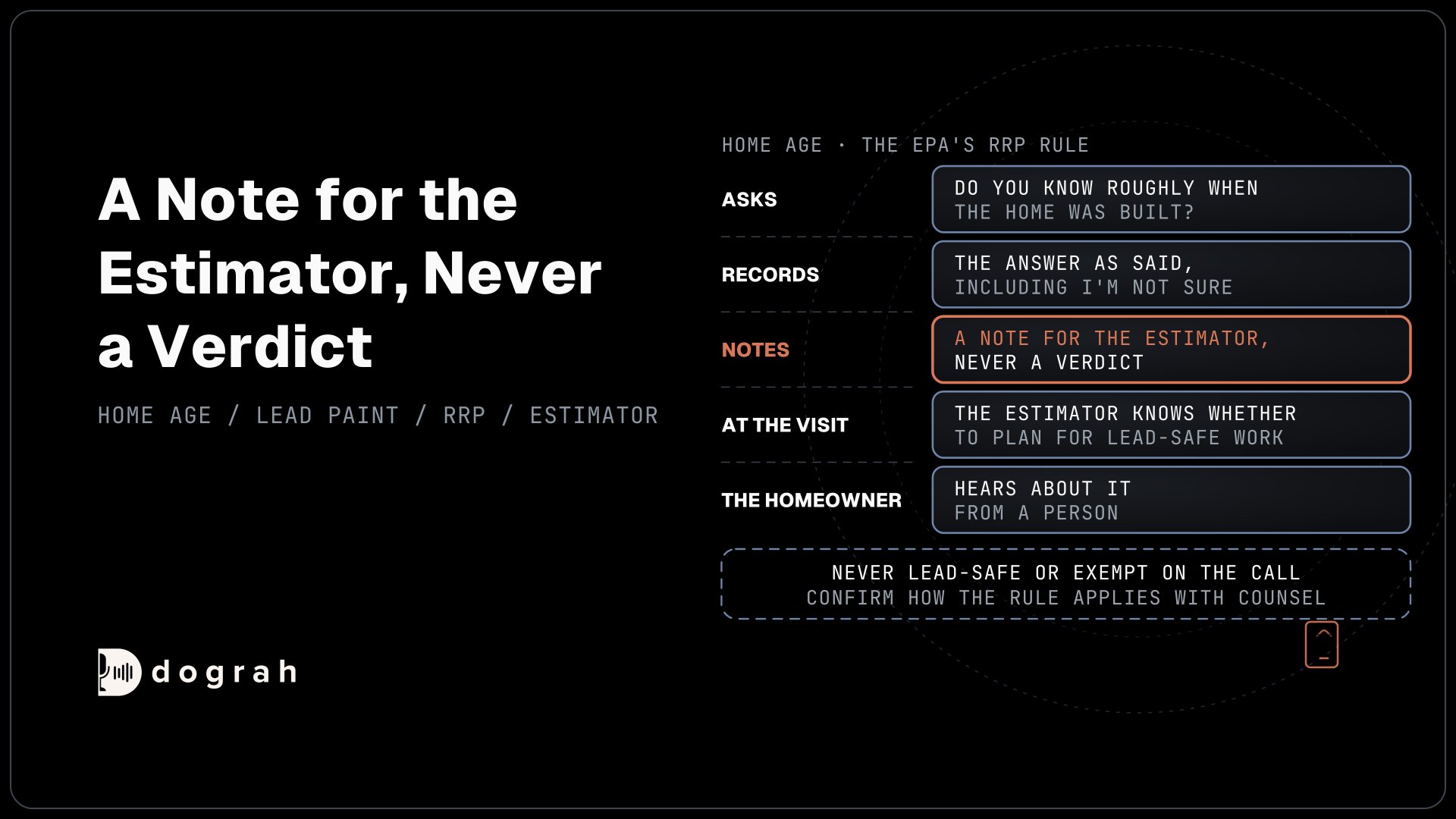
So the agent asks "Do you know roughly when the home was built?" and records the answer, including "I'm not sure". A pre-1978 answer is a note for the estimator, never a verdict. The agent never says a job is lead-safe or exempt, and it mentions your firm's certification only in a line your company wrote as fixed text. The rule has details on scope and exceptions, so confirm how it applies to your work with counsel.
The note pays off at the visit. The estimator arrives already knowing to plan for lead-safe work, and the homeowner hears about it from a person who can answer the follow-up questions.

Open Source Alternative to Vapi / Retell
Self-hosted voice agent platform — no per-minute fees
dograh-hq/dograh
Star on GitHub
Routing by scope to the right estimator
Different jobs go to different people, and the answers from the call decide who. A single room may go to your residential estimator, a whole-house exterior to a senior estimator and a multi-unit building or HOA project to whoever handles commercial bids. The agent does not choose by itself. Your firm writes the rules, and the call follows them.
Some callers want a person now. A property manager with a bid deadline, or a homeowner mid-project with a problem, goes to the right person during office hours through a transfer. After hours, the same caller gets a callback request with a time your firm set. Everyone else books a visit on the spot.
Jobs you do not do need a plain answer too. Keep a short written list of your services and service area in the prompt, such as interior and exterior painting, cabinets and bathrooms within 25 miles. A caller asking for a roof or a job two counties away hears that the firm does not take that work, so nobody waits for a visit that never comes.
Booking the estimate visit through your system
An estimate visit is a booking against real availability, so the agent offers only the slots your system returns. It asks your calendar or field service software for open estimate windows for the right estimator, reads two of them to the caller, then writes the chosen one. It reads the booking back only once your system confirms it.
Photos help the estimator more than any description. If your firm takes them, the agent asks whether the caller can send a few pictures of the rooms or the outside. An HTTP API tool then asks your system to text a secure upload link through your messaging provider, so the caller can send the photos straight to your system after the call.
The visit carries the qualification answers, so the estimator walks in knowing the job. After the visit the work moves to the quote, which our post on AI voice agents for quote follow-up in home services picks up. For booking design itself, see how to build an AI appointment scheduler.
Join the Dograh Community
Dograh is an OSS alternative to Vapi. Join our Slack community for queries, releases, best practices & community interactions.
How this runs in Dograh
Each answer becomes a field on the agent step. With variable extraction you name fields such as job_type, size, start_window, year_built and hoa_approval_needed, each with a type and a short hint. Make year_built a string, so "around 1965" and "I'm not sure" both fit as said. The Extraction Prompt can tell the model to keep the caller's own words, and the call recording stays the exact record.
The booking runs through two HTTP API tools, one that reads open windows and one that writes the visit with the qualification fields. Add a Preset Parameter named workflow_run_id so your system can ignore a repeated booking from the same call. While either tool runs, its Messages speak a short start line, then an update after a delay you set.
Routing by scope uses Transfer Call, which works on Twilio, Telnyx, Plivo, Cloudonix and Asterisk ARI. Its Context Mapping option reads a field such as job_type and picks the destination from your rules, top to bottom. Dograh calls the destination first and connects the caller only when someone answers. If nobody answers within the 30-second default, the caller stays with the agent, and your prompt has it take a callback request. A voicemail greeting counts as an answer, so switch voicemail off on each estimator's line or let it pick up after the Transfer Timeout.
Where Dograh runs is the firm's choice. Running it on your own servers carries no per-minute platform fee, but the servers, model keys and phone minutes still cost money, and your team keeps the database and upgrades in order. Help comes from the open-source community, or from custom SLAs on Enterprise. A firm that would rather not run servers can use Dograh Cloud for a 1¢-a-minute platform fee, with model and phone minutes on top.
Glossary
- RRP Rule
- The EPA's Renovation, Repair and Painting Rule. Firms paid to disturb paint in housing or child-occupied facilities built before 1978 must be certified.
- Qualification question
- A question the agent asks before booking a visit, such as job type or size, so the right estimator goes with the right plan.
- Context Mapping
- A Transfer Call option that picks the destination from a field recorded on the call, such as job type, using rules checked from top to bottom.
- Estimate window
- An open slot on an estimator's calendar, returned by your system. Your prompt tells the agent to offer only these.