
When a caller starts talking, a voice agent stops its own audio, cancels the reply it was still writing and keeps only the words the caller actually heard. Then it answers what the caller just said. In Dograh, you choose for each node whether callers can cut in, and how many words count as an interruption.
Key Takeaways
- A good agent stops within a moment and forgets the words it never said.
- Short backchannels like "yeah" should not stop the agent, so set a word minimum.
- Coughs and noise need a plan, either ignore them or ask the caller to repeat.
Callers interrupt voice agents all the time, whether to correct a date or just to say "yeah". We explain what the agent does in the second it hears them, then walk through worked examples. Then we talk about how to set each case up in Dograh.
What happens the moment a caller interrupts
A voice agent runs as a pipeline. Speech-to-text listens, a language model writes the reply and a voice model speaks it, and the listening half keeps running while the agent talks. That is what lets the agent hear a caller who cuts in, a move called barge-in.
When the agent decides the caller really is speaking, it drops its own turn almost at once. The voice audio stops and the reply the model was still writing is cancelled. Any audio already queued for the phone line is thrown away too. Pipecat's interruption docs describe this sequence, and the framework has interruptions on unless you turn them off.
The step most teams miss comes next. The agent's memory of the call should hold only the part of its reply the caller actually heard, rather than the full sentence it planned. Pipecat stores just the words that were spoken, so the next reply starts from what the caller knows. Then the agent treats the caller's words as a new turn and answers them as it would any other.
A correction during a read-back
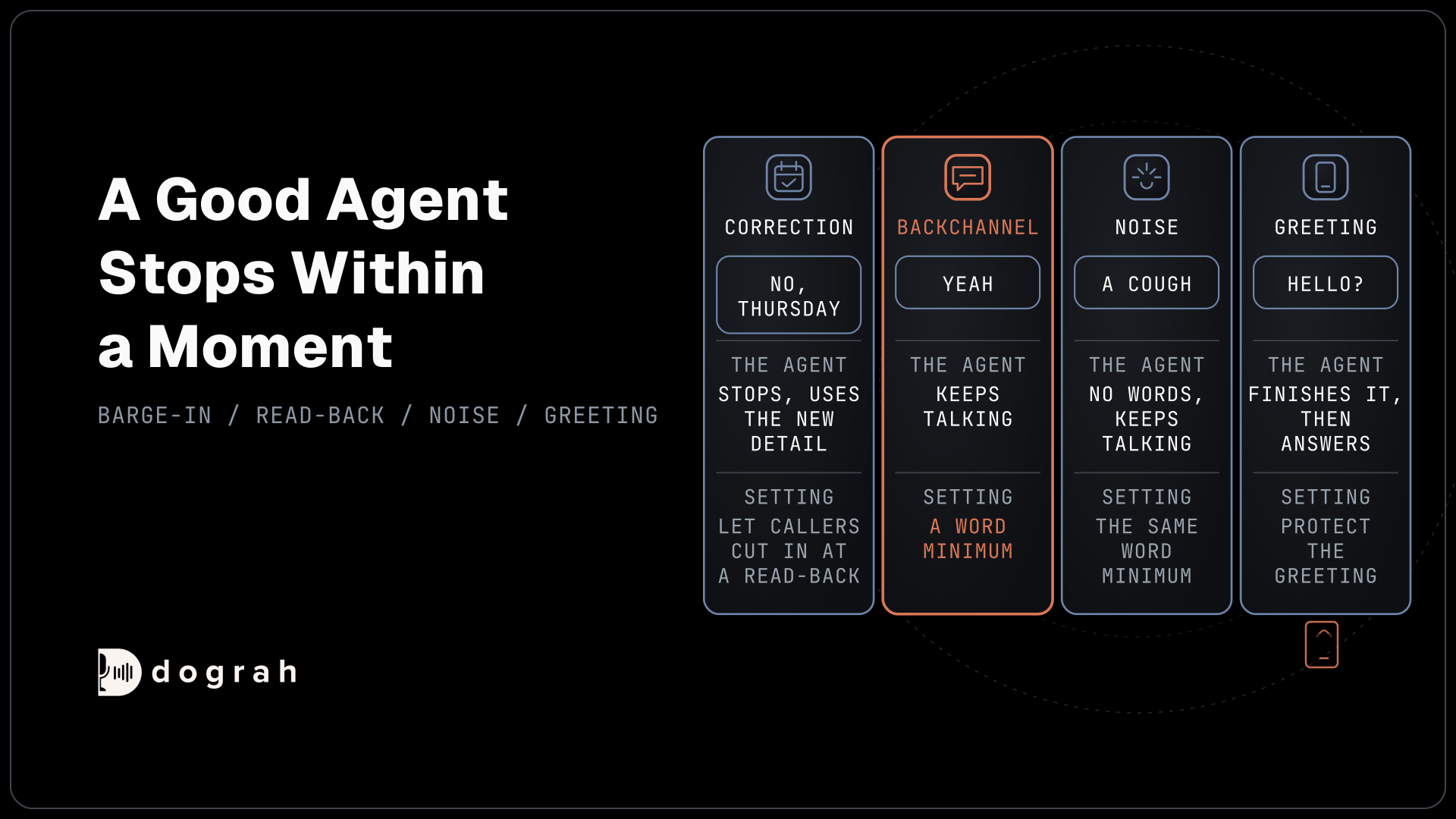
An agent books a dental appointment and reads it back. "So that is Tuesday the 12th at 3 pm, and I will text you a reminder the day before." The caller hears "Tuesday" and cuts in with "No, Thursday." The audio stops a word or two later, and the agent's memory holds only "So that is Tuesday the 12th".
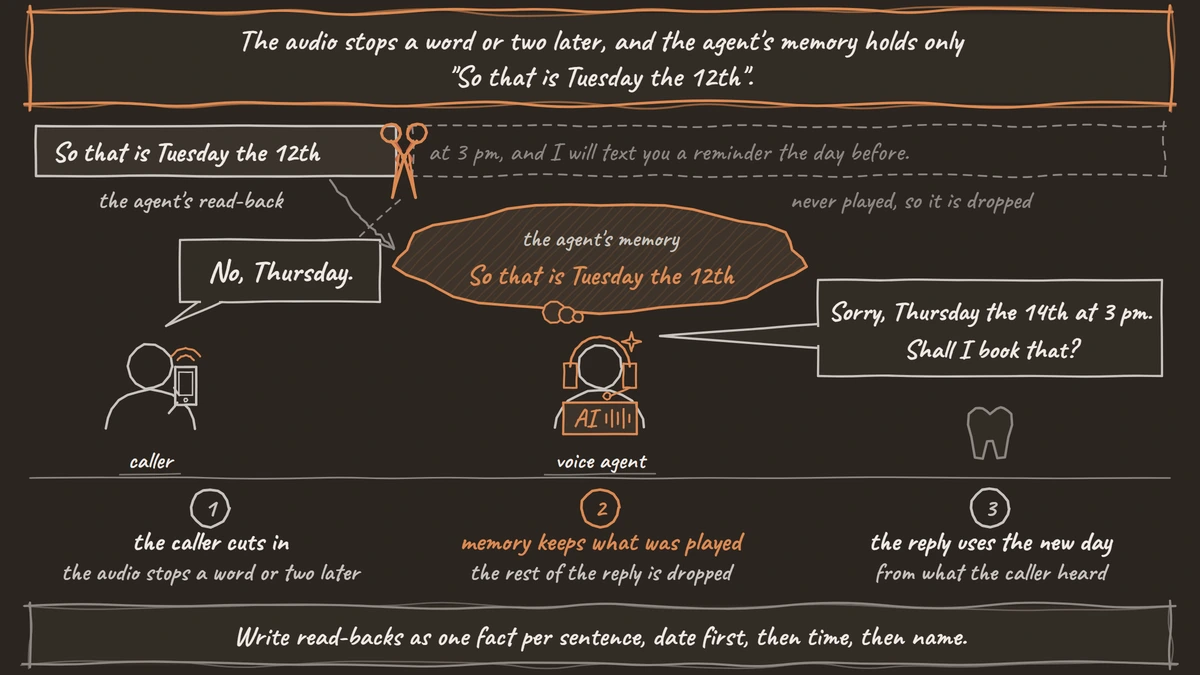
Because the model sees exactly what the caller heard, it can reply "Sorry, Thursday the 14th at 3 pm. Shall I book that?" and move on. If the memory had kept the whole planned reply, the model would believe it had already promised the text reminder, and a later line could refer to a sentence the caller never heard. Twilio's guide to interruption handling makes the same point with an agent that says "as I mentioned, the fee is waived" about words that were never played.
Corrections are the interruptions you most want to catch quickly. Write read-backs as one fact per sentence, date first, then time, then name. A correction then lands right after the wrong detail instead of three facts later, and the caller does not have to remember which part was wrong.
A "yeah yeah" while the agent is talking
Callers fill pauses with small sounds that mean "keep going", such as "yeah", "uh-huh" or "right". These are backchannels. An agent that stops for every one of them sounds jumpy and loses its place in the reply.
The usual fix is a word minimum. The agent keeps talking unless the caller says at least a set number of words, so a lone "yeah" passes under it while "wait, that is wrong" stops the agent. The minimum counts words and ignores meaning, so a doubled "yeah yeah" reaches a two-word minimum and cuts the agent off. On lines where callers often say "yeah yeah" or "okay okay", a minimum of three is worth testing.
Set the minimum too high and real corrections get missed, since "no, Thursday" is only two words. Test it with recordings of your own callers before you settle on a number, because how people backchannel differs by language, region and even by how long the agent's turns are.
A cough, a door slam or a TV in the background
Noise is the hard case, because it has no words. Voice activity detection listens for sound with the shape of speech, and a cough or a raised TV voice can pass that test.
What happens next depends on the strategy. With a word minimum, a cough produces no words, so it never reaches the minimum and the agent keeps talking. With a strategy that stops on any detected speech, the cough stops the agent. Pipecat then finds no transcript for the interruption and runs the model once more, so the agent either asks the caller to repeat or picks up where it stopped.
If callers ring from cars or warehouses, the word minimum is the safer choice. Our post on voice activity detection covers how the detector decides what counts as speech and how to tune it for noisy lines.

Open Source Alternative to Vapi / Retell
Self-hosted voice agent platform — no per-minute fees
dograh-hq/dograh
Star on GitHub
A caller who talks over the greeting
Many callers start talking the moment the line connects, often with "Hello?" while the agent is still saying who it is. That greeting may carry the AI disclosure or a recording notice, which the caller needs to hear in full.
There are two ways to handle it. Let the caller cut in, and the agent stops and answers straight away, which suits a short greeting with nothing the caller must hear. Or protect the greeting, so the agent finishes it while holding what the caller said, then answers it right after instead of losing it. The second choice suits any greeting that carries a notice.
The settings behind each case in Dograh
Dograh, the open-source voice agent platform we build, exposes each of these choices as a setting. The Interruption section of an agent's Settings has an Interruption Strategy, either Minimum words or Voice activity, and a Minimum Words Before Interruption count from 1 to 10. Minimum words with a count of two is what a new agent starts with.
Each Agent node has its own Allow Interruption switch, so you set per node whether callers can cut in. Turn it off on a node that reads a payment amount or a legal notice, and leave it on where corrections are likely, such as a read-back. The Agent node docs describe each node setting.
The Start Call node has Allow Greeting Interruption, and when it is off the caller's speech is held until the greeting finishes. When it is on, the node's own Minimum Words to Interrupt applies, and a separate Allow Interruptions After Greeting switch covers the replies that follow in that node. The Start Call docs cover the opening turn.
The word counts apply to agents built from separate speech-to-text, model and voice providers. Speech-to-speech models handle interruptions with their own speech detection. Deciding when the caller has finished is a separate job, covered in our posts on VAD vs turn detection and barge-in, endpointing and turn-taking.
Join the Dograh Community
Dograh is an OSS alternative to Vapi. Join our Slack community for queries, releases, best practices & community interactions.
Testing interruptions before launch
Before an agent takes real calls, ring it four times and act out each moment above. Correct a read-back halfway through, say "yeah" and then "yeah yeah" while it talks, cough during a long answer, and say "Hello?" over the greeting.
After each call, read the transcript and the agent's next reply. The reply after a correction should use the new detail without referring to anything cut off, a lone "yeah" should not stop the agent, and a protected greeting should play in full before the caller's words are answered. Repeat the four calls whenever you change the interruption settings or the speech-to-text provider.
Running the agent on your own servers or Dograh Cloud
These settings work the same whether you self-host or use the hosted Cloud plan. Running Dograh yourself means no per-minute platform fee. You still pay for servers, model keys and phone minutes, and your team looks after the database and upgrades. Support comes from the open-source community, and Enterprise adds custom SLAs. If you would rather not host it, Dograh Cloud runs it for a 1 cent a minute platform fee.
Glossary
- Barge-in
- A caller speaking while the voice agent is still talking, and the agent stopping to listen instead of talking over them.
- Backchannel
- A short sound such as yeah, uh-huh or right that tells the speaker to keep going. It is not meant as a turn.
- Voice activity detection (VAD)
- A small model that decides whether incoming audio is speech. It hears sound rather than words, so noise can trigger it.
- Word minimum
- An interruption rule that lets the caller stop the agent only after saying a set number of words, so backchannels and coughs pass.