
Twilio Flex is priced per person: from $35 per monthly active user, $150 per named user or $1 per active user hour. Its Agent Copilot add-on helps staff for $0.035 a minute. An AI voice agent on the same Twilio account answers callers. Dograh, the open-source AI voice agent platform we build, runs on your servers or Dograh Cloud.
Key Takeaways
- Flex charges for the people answering, from $1 an active hour to $150 a seat.
- Agent Copilot helps staff during calls and is still a public beta.
- An AI agent on the same number sets how many calls reach Flex.
This post is part of our guide to Twilio pricing, which prices each line under an AI call, from the number up. Below, we price Flex's seat models and Agent Copilot, then put an AI agent in front of Flex on the same account, using Dograh as the example.
What Twilio Flex is for
Flex is Twilio's contact centre for human teams, and every Flex price follows the people who log in. Twilio's Flex docs describe it as "a digital engagement center for sales and customer support teams". Agents work in the Flex interface, TaskRouter routes calls to them, and Studio builds the menus a caller moves through before reaching a person.
That shape matters when you price AI calls. Twilio offers two AI tools for Flex, and both sit beside a human agent during or after the call. So a search for a Flex AI voice agent usually ends at two products on one Twilio account: Flex for the staff, and a voice agent that answers first and passes on the calls that need a person.
Three ways to pay for Flex seats
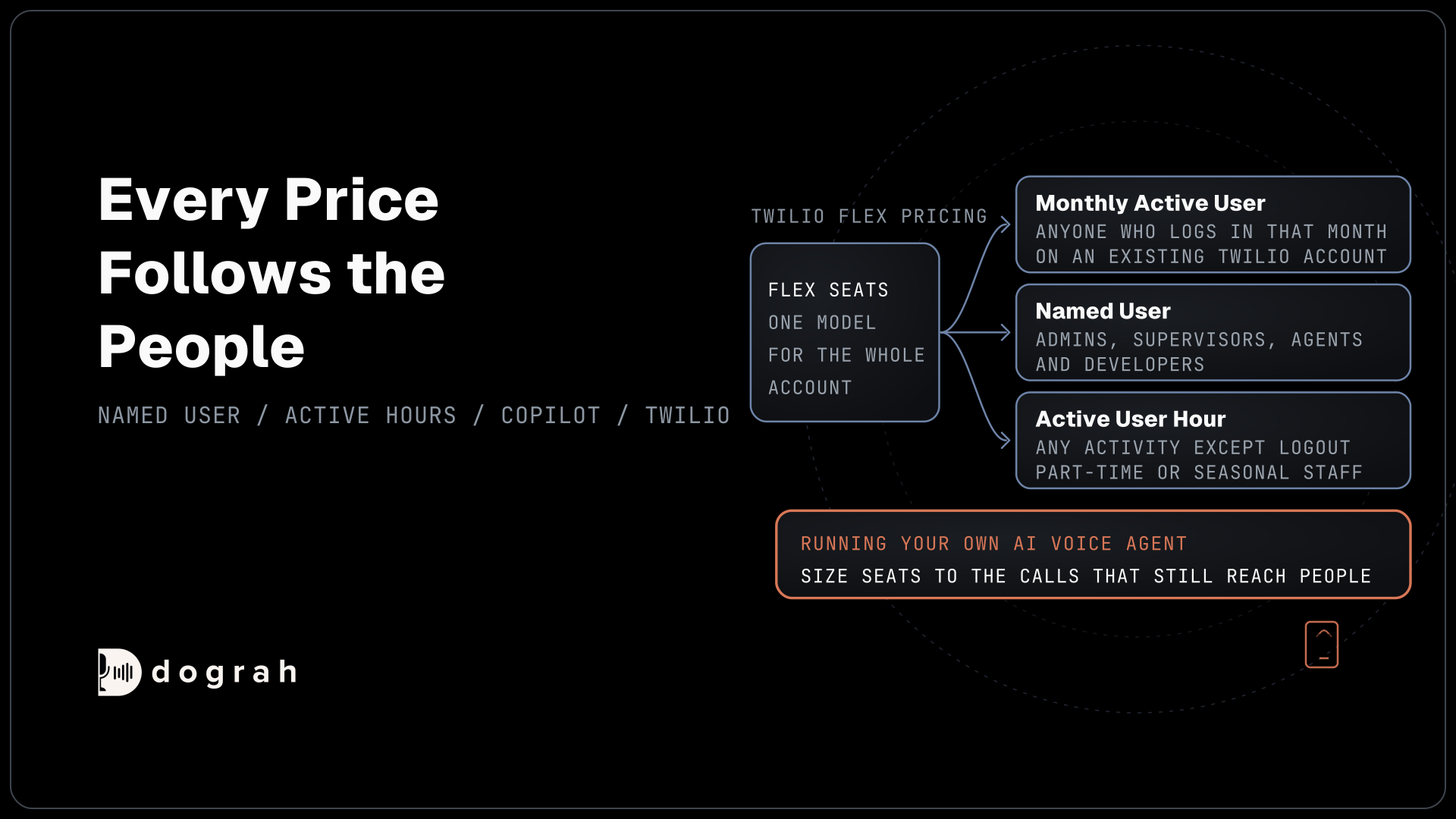
Flex sells seats in three models, and you pick one for the whole account. Twilio says plainly that it does "not mix and match pricing plans".
| Model | Starting price | Who is counted | Good to know |
|---|---|---|---|
| User + usage | $35 per monthly active user | Anyone who logs in at least once that month | Only for Flex on an existing Twilio account. TaskRouter, Studio and other Twilio products are metered on top |
| Named user | $150 per named user a month | Admins, supervisors, agents and developers | Billed on the month's highest count, on a contract |
| Active user hour | $1 per active user hour | Time in any activity except Logout | Users who never log in cost nothing |
New Flex accounts get 5,000 free active user hours as a one-time grant. The hours do not expire, but whatever is left is lost the moment you choose a billing model. Voice minutes and phone numbers sit outside all three models and bill at Twilio's normal rates.
The models reward different teams. Named users suit a full-time team on fixed shifts, because the seat bill stays flat however busy the month gets. Active user hours suit part-time or seasonal staff, since a person logged in for 40 hours costs $40 that month. Monthly active users start lowest per person, with the Twilio products behind Flex billed as you use them.
What Agent Copilot does on a call
Agent Copilot is Flex's AI add-on, and it works for the person on the call. Twilio says it "reduces agents' workload and speeds up their workflows", with post-call summaries, disposition codes and sentiment. Unified Profiles, the second tool, shows the agent a customer's history pulled from other systems.
Copilot is priced per use, at $0.035 per voice minute and $0.005 per digital message, and Twilio labels these public beta prices that may change. Both tools are a limited public beta outside Twilio's SLA, and Twilio says they are not HIPAA Eligible Services or PCI compliant. A clinic or a payments team should keep them out of those workflows for now.
On a busy line the per-minute charge adds up. Copilot on 12,000 voice minutes a month comes to $420, and a person still answers each of those calls.

Open Source Alternative to Vapi / Retell
Self-hosted voice agent platform — no per-minute fees
dograh-hq/dograh
Star on GitHub
An AI agent in front of Flex, on one account
The common design is an AI voice agent that answers first and sends Flex only the calls that need a person. Both run on the same Twilio account, so your numbers, minutes and invoice stay where they are.
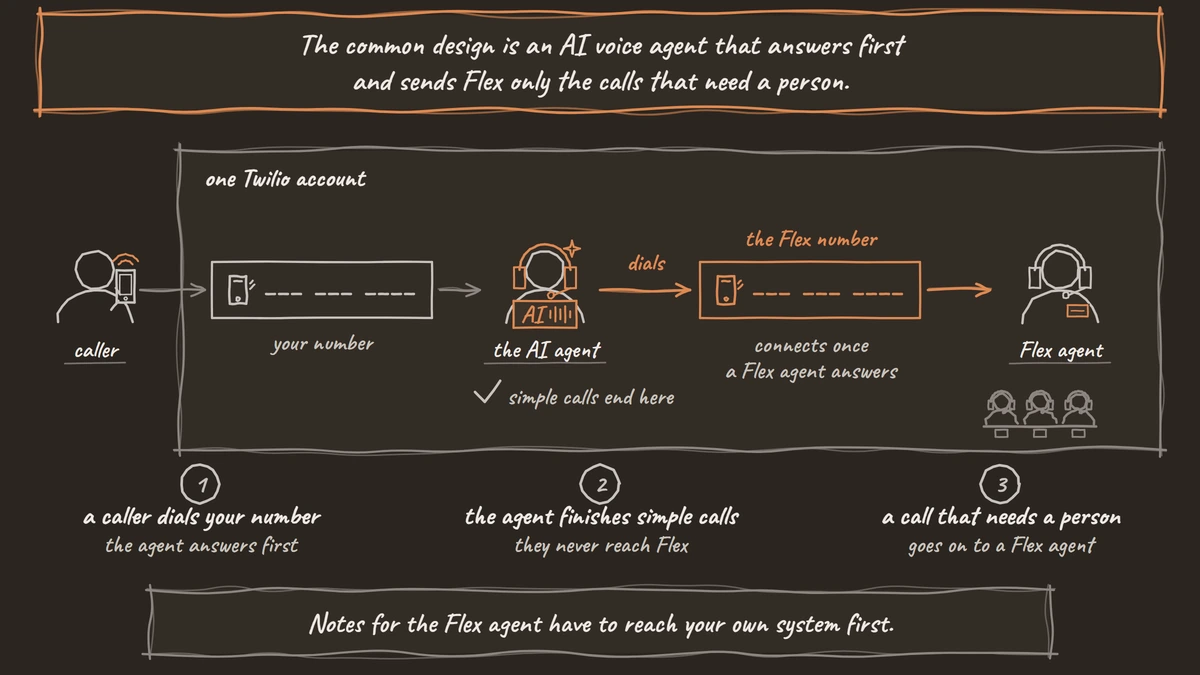
In Dograh, you add your Twilio Account SID and Auth Token under Telephony, then pick an Inbound workflow for the number callers dial. Saving it points that number at the agent straight away, as the Twilio setup guide shows. Removing it later leaves the number blank instead of switching it back, so note the number's Flex settings first, and keep a second Twilio number on your Flex flow for the agent to send callers to.
The hand-off runs through Transfer Call. When a caller needs a person, Dograh dials the Flex number while the caller hears hold music, and connects them once a Flex agent answers. If nobody answers, the line is busy or the timeout passes (30 seconds by default), the agent gets a transfer_failed result and the call carries on with it. On Twilio you can also switch on a short spoken introduction that both people hear before they connect.
Notes for the Flex agent have to reach your own system first. An HTTP API tool can write the caller's details there before the transfer starts. The transfer itself adds a new outbound leg at $0.0140 a minute plus conference minutes from $0.0018 per participant. Our post on how an AI receptionist call transfer works covers the hand-off step by step.
One month of calls, priced as an example
Here is one worked month, built from Twilio's own rates. A support team takes 3,000 inbound calls a month on one local number, each lasting 4 minutes, for 12,000 minutes in all.
With Flex alone and 10 agents on named users, seats cost 10 x $150 = $1,500. Twilio's US voice prices add 12,000 x $0.0085 = $102 for inbound minutes and $1.15 for the number, for $1,603.15 a month. On active user hours, the same 10 agents logged in for 160 hours each cost 10 x 160 x $1 = $1,600 in seats. Copilot on every minute adds $420 on either model.
Now put the AI agent in front. Suppose it fully handles 60% of calls, an assumption for this example, which is 1,800 calls and 7,200 minutes. Each of those minutes costs $0.0085 inbound plus $0.0044 for Media Streams, the fee for sending live audio to the agent, so Twilio bills 7,200 x $0.0129 = $92.88. On Dograh Cloud the platform fee adds 7,200 x $0.01 = $72, and your model keys bill at their own rates, which our breakdown of what an AI voice agent costs per minute prices part by part.
The other 1,200 calls still reach Flex, each with the agent's minutes before the transfer and a transfer leg on top. The seat bill is the line that moves. You size named seats or active hours to the calls that still reach people, and the simple calls stop taking up a person's hour.
Join the Dograh Community
Dograh is an OSS alternative to Vapi. Join our Slack community for queries, releases, best practices & community interactions.
Owning the agent layer on your Twilio account
The agent in front of Flex is where most of the tuning happens, so it pays to own it. Self-hosted Dograh has no per-minute platform fee, but servers, model keys and phone minutes still cost money. Dograh Cloud charges a 1¢-a-minute platform fee. Either way, Twilio stays your carrier and Flex stays your desk for people.
You choose the models behind the agent. Any LLM, speech-to-text or voice provider runs on your own keys, or open-weight models run on your own servers. Lines the agent says on most calls, such as the greeting and the hand-off line, can be pre-recorded clips, with text-to-speech covering the rest.
Every call keeps a full trace with the speech-to-text, AI and voice time for each turn. Built-in QA scores each step of test and live calls on a sample you set, which shows which calls the agent should keep and which belong with Flex before you change the seat count.
For the wider case of keeping Twilio and owning the agent, see our open-source alternative to Twilio voice AI.
Glossary
- Named user
- A Flex seat counted for each admin, supervisor, agent or developer on the account, from $150 a month on a contract. Twilio bills the month's highest count, so a short-lived extra seat still costs a full month.
- Active user hour
- Flex's hourly seat, from $1, counting the time a user spends in any activity except Logout. People who never log in cost nothing, which suits part-time and seasonal teams.
- Agent Copilot
- Flex's AI add-on for human agents, writing post-call summaries, disposition codes and sentiment. It costs $0.035 per voice minute as a public beta price and is not a HIPAA Eligible Service.
- Media Streams
- The Twilio feature that sends a call's live audio to an outside AI agent, at $0.0044 a minute on top of the voice rate. It is how an agent platform hears callers on a Twilio number.