
Thoughtly vs PolyAI is a choice between two jobs. Thoughtly follows up inbound leads for revenue teams across calls, texts and email. PolyAI resolves customer service calls for contact centers, with its own dialog models. For teams that want to own the agent and call data, Dograh, the open-source AI voice agent platform, runs on your servers or Dograh Cloud.
Key Takeaways
- Thoughtly sells inbound lead conversion and says it is not built for cold outbound.
- PolyAI's Dialog-RSN-1 API bills 2 cents a connected minute plus text tokens.
- PolyAI hosts in the US, UK and EU West, and Thoughtly offers residency on Enterprise.
Thoughtly and PolyAI both sell hosted voice agents, but each is built for a different moment with a customer. We compare them in one table, then on the job, channels, building, data and price, and then we talk about Dograh for teams that want to run the agent themselves.
Thoughtly vs PolyAI in one table
Thoughtly sells to the team that owns new leads, and PolyAI sells to the team that owns customer service. The table sets the two side by side from each company's own pages, and the sections after it explain the rows that change a decision.
| Thoughtly | PolyAI | |
|---|---|---|
| Built for | Inbound lead follow-up, qualifying and booking, with results written to the CRM | Customer service calls that end resolved, such as bookings, payments, claims and account changes |
| Buyer | Sales, RevOps and growth teams | CX and contact-center leaders |
| Channels | Voice, SMS, iMessage, WhatsApp and email | Voice, webchat, SMS, RCS and email |
| Who builds | Your team on Flex with self-serve onboarding, then a dedicated CSM and white-glove onboarding from Scale | Agent Studio and Wren for your team, an ADK for code, PolyAI or partners for large builds |
| Models | GPT, Claude or Gemini, custom models on Enterprise | Raven 3.5 and Dialog-RSN-1, plus OpenAI and Bedrock options |
| Phone lines | Thoughtly numbers or your own Twilio or Telnyx | PolyAI numbers or your own carrier over SIP |
| Calls at once | 10 on Flex, 100+ on Scale, custom on Enterprise | 10 included on the Dialog-RSN-1 API, Platform by quote |
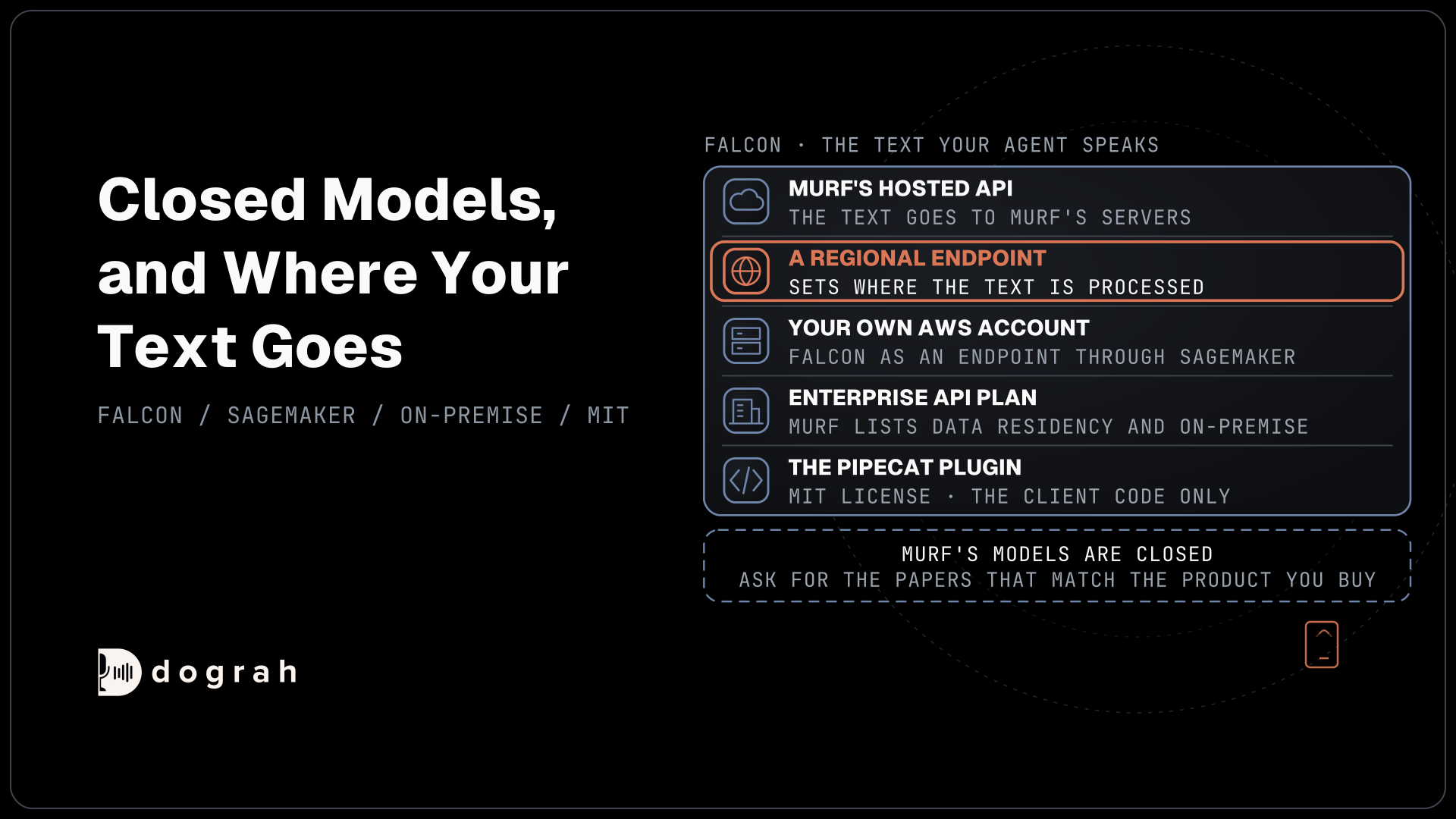
| Where data sits | Thoughtly's cloud, data residency on Enterprise | Regional hosts in the US, UK and EU West, recordings can sync to your S3 bucket |
| Compliance | SOC 2 Type II on Scale on request and on Enterprise, HIPAA with a BAA on Enterprise | ISO/IEC 27001, SOC 2 Type II, PCI DSS, Cyber Essentials Plus, GDPR, HIPAA where relevant |
| Price shape | Quoted plans, price scaling with combined usage volume, concurrency set by plan | Platform per minute by quote, or the Dialog-RSN-1 API at 2 cents a connected minute plus text tokens |
| Code | Closed | Closed |
Two different jobs, lead follow-up and service
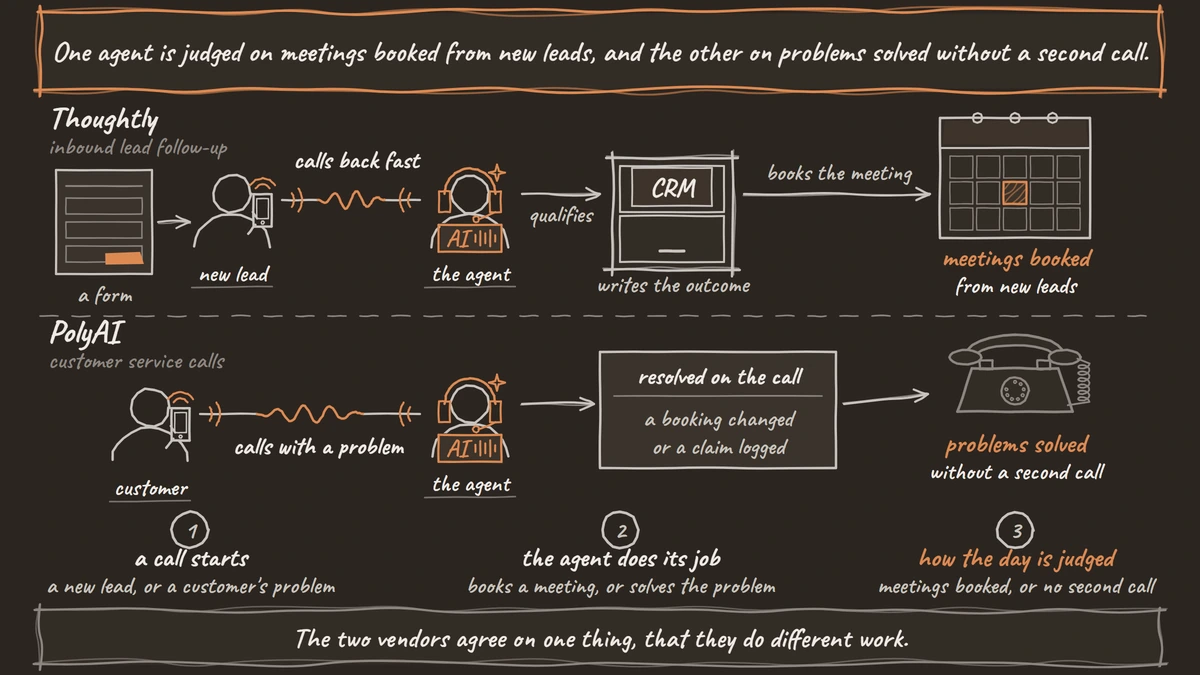
The two vendors agree on one thing, that they do different work. Thoughtly frames the split as revenue conversion against service automation, and calls itself inbound lead conversion, not cold outbound and not an AI SDR. Its agent calls back a new lead fast, qualifies them, books the meeting and writes the outcome into the CRM. It also re-engages leads that went quiet. Thoughtly's own comparison concedes that PolyAI deserves a serious look when the queue is full of order status checks and routine support.
PolyAI argues from the other side, that the job is resolving the caller's problem on the call. In its post on conversational IVR, PolyAI warns that a high containment rate hides failure, since "A caller who hangs up in frustration counts as contained, and so does the same caller calling back the next morning." So it judges agents by resolution, with callbacks counted against the result, and sells into contact centers where a call can end with a booking changed or a claim logged.
That difference decides the measure of success. One agent is judged on meetings booked from new leads, and the other on problems solved without a second call. A buyer with a lead problem and a buyer with a queue problem should not shortlist the same tool. Our Thoughtly review covers how Thoughtly's lead agents work in more depth.
The channels each agent works across
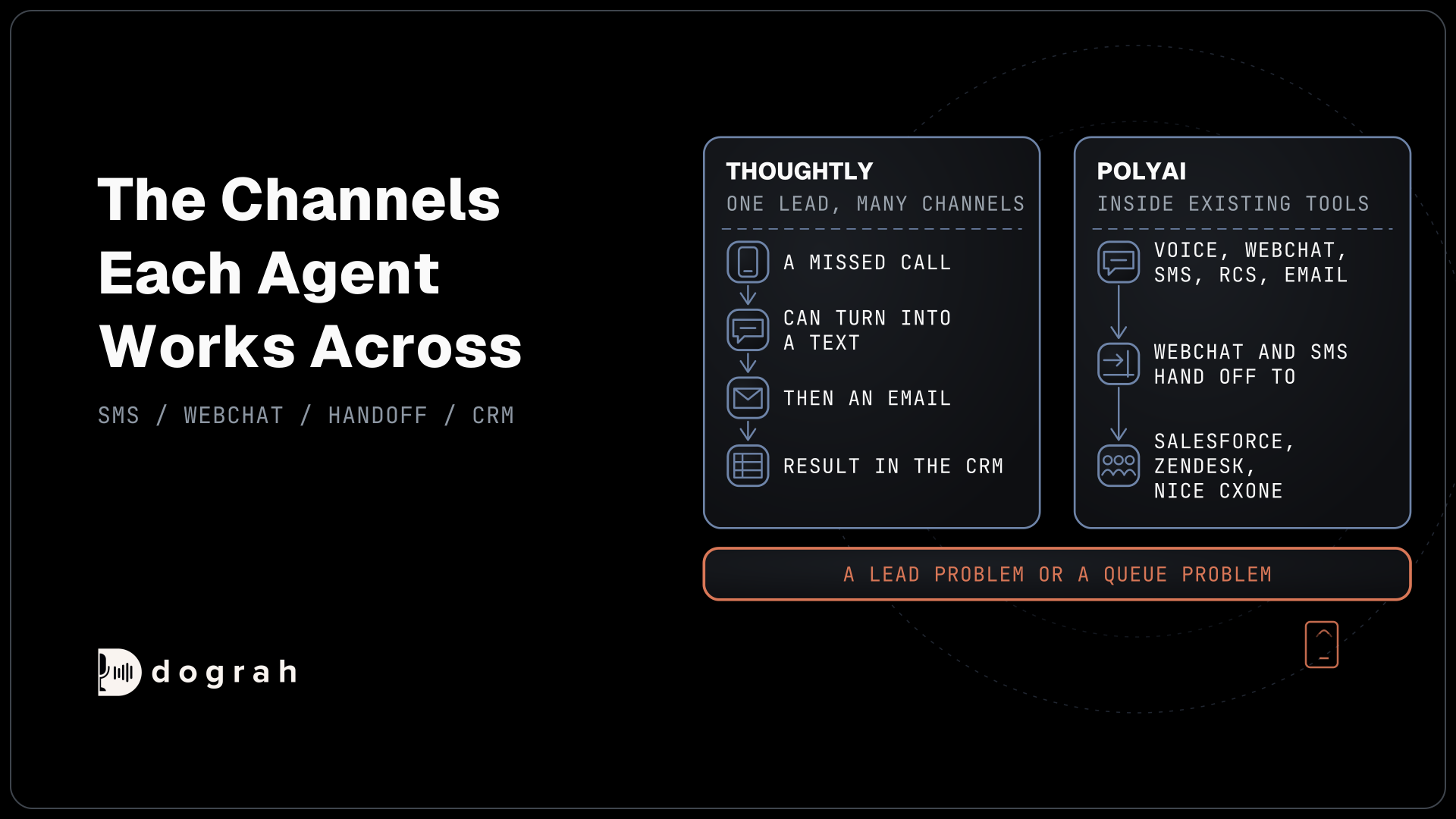
Thoughtly treats a lead as a conversation across channels. One agent can reach the same lead by voice, SMS, iMessage, WhatsApp and email, so a missed call can turn into a text and then an email without a person stepping in. For a sales team that loses leads between the form and the first call, that loop is the product.
PolyAI started with voice and now covers more. It offers a self-serve platform for voice and chat agents, and its channels include webchat, SMS, RCS and email, with webchat and SMS handoff to Salesforce, Zendesk, NICE CXone, Amazon Connect, Webex and Five9. It also has an outbound calling API. The handoff list shows the fit, since PolyAI is meant to sit inside a contact center's existing tools rather than replace them.

Open Source Alternative to Vapi / Retell
Self-hosted voice agent platform — no per-minute fees
dograh-hq/dograh
Star on GitHub
Who builds the agent
Thoughtly's help grows with the plan. Flex is for teams that build and run the agent themselves, with self-serve onboarding, email support and Expert Sessions, and a dedicated CSM with white-glove onboarding starts at Scale. Recent work in Thoughtly's changelog includes version history for agents, a pilot of GPT-Live voices, an MCP server in limited availability and consent and suppression controls. For a revenue team with no engineers, that hands-on help is a large part of the value on the higher plans.
PolyAI now offers two routes. Agent Studio is a self-serve visual tool for building, deploying and monitoring voice agents, with a free sign-up, and Wren builds an agent from a plain description. Developers get an ADK and a platform API. Large contact-center deployments are still built with PolyAI's own team or its partners, which is where integration work and security reviews tend to land.
The setup effort follows the buyer. A Thoughtly agent is meant to be live quickly on a sales team's CRM and calendar. A PolyAI agent can start small in Agent Studio, but a full service deployment touches booking systems, payments and the contact-center stack, so plan for more project time.
Models, phone lines and calls at once
Thoughtly runs on models from the large providers, such as GPT, Claude and Gemini, with a custom model on Enterprise. Calls come in on numbers bought from Thoughtly or on your own Twilio or Telnyx numbers. The concurrency limit sets the size of each plan, 10 calls at once on Flex, 100 or more on Scale and a custom number on Enterprise.
PolyAI makes its own models. Raven 3.5 is its latest Raven model and the one PolyAI recommends for new deployments, and Dialog-RSN-1 handles turn-taking, recognition, function calls and the response from raw audio, with a separate voice for output. OpenAI and Bedrock models are options too. Your own carrier can connect over SIP at no charge, and the Dialog-RSN-1 API includes 10 calls at once, while Platform concurrency is set by quote.
Where call data sits and compliance
Data location splits the two more than any other row. Thoughtly runs in its own cloud, and dedicated infrastructure with data residency comes on Enterprise. HIPAA with a BAA is also Enterprise only, and the SOC 2 Type II report is available on Scale on request and on Enterprise.
PolyAI runs regional API hosts in the US, the UK and EU West, and recordings and transcripts can sync to your own S3 bucket. For teams that want the model inside their own cloud, AWS's announcement shows Dialog-RSN-1 deploying from SageMaker JumpStart into your own AWS account and VPC. PolyAI lists ISO/IEC 27001, SOC 2 Type II, PCI DSS, Cyber Essentials Plus and GDPR, and says its systems meet HIPAA where relevant.
A healthcare or finance buyer should ask both for the plan that carries the BAA or the data-residency terms in writing. Neither vendor's code can be reviewed, so the contract and the audit reports carry the weight. Confirm with counsel which agreements your calls need.
Join the Dograh Community
Dograh is an OSS alternative to Vapi. Join our Slack community for queries, releases, best practices & community interactions.
What each one costs
Neither vendor prints a plan price today, so the shape of the bill is what you can compare. Thoughtly sells Flex, Scale and Enterprise through its sales team. It calls voice minutes, SMS and email unlimited, but its price scales with combined usage volume, concurrency sets each plan's size, and usage above a plan's monthly allowances is billed after the cycle. Our Thoughtly pricing breakdown covers what each plan includes.
PolyAI has two ways to buy. The Platform is priced per minute by quote, billed on connected time with no minimums, and includes performance improvements, maintenance and support around the clock. The Dialog-RSN-1 API costs 2 cents a connected minute plus text tokens, at $2.00 per million input tokens, $0.20 cached and $5.00 output, and telephony and orchestration are not included. Our post on PolyAI pricing explains both routes.
That last point matters for planning. The API covers the model, so a team using it still needs a phone line and a platform to run the call, while the Platform quote covers the whole agent. Ask both vendors to price your real monthly minutes and busiest hour before comparing quotes.
Which one fits your team
Thoughtly fits a sales or growth team whose problem is speed to lead. If inbound forms and ads produce leads that go cold before anyone calls, and you want one agent to follow each lead across calls, texts and email into the CRM, Thoughtly is built for that, with white-glove onboarding from its Scale plan.
PolyAI fits a contact center whose problem is volume. If the queue is full of calls that could end resolved, such as bookings, payments and account changes, and webchat or SMS conversations must hand off inside Salesforce, Zendesk or NICE CXone, PolyAI is the closer fit. It also suits buyers who want its own dialog models and regional hosting in the US, UK or EU.
Teams that need both jobs, or need the whole agent platform on their own servers, are the gap neither product is designed for.
Running either job yourself with Dograh
Dograh, the open-source AI voice agent platform, fits teams that want to run either job themselves and keep the agent and its call data on their own servers, and its CRM link runs through your own API. An HTTP API tool reads or writes a record during the call, and the Webhook node sends the call result after it. Campaigns call lead lists, Transfer Call hands a caller to a person on Twilio, Telnyx, Plivo, Cloudonix and Asterisk ARI, and a QA node reviews each call's transcript node by node after it ends.
The code is open under the BSD 2-Clause license. You can self-host Dograh with Docker Compose on a server with at least 8 GB of RAM and 4 vCPUs, and the Enterprise plan adds on-prem or private-cloud deployment with data residency. With either setup, recordings and transcripts stay in your own storage, and with open-weight models on your hardware the audio never reaches a model provider.
Running it yourself has no per-minute platform fee, but servers, model keys and phone minutes still cost money. Your team looks after the database and upgrades, with community support on open source and custom SLAs on Enterprise. Dograh Cloud charges a 1¢-a-minute platform fee, with models and phone minutes on top.
Glossary
- Containment rate
- The share of calls that never reach a human agent. PolyAI argues it can hide failure, since a caller who hangs up angry still counts as contained.
- Connected minute
- A minute billed only while the call is connected. PolyAI bills its Platform and Dialog-RSN-1 API on connected time.
- Dialog-RSN-1
- PolyAI's dialog model, which handles turn-taking, recognition, function calls and the response from raw audio, with a separate voice for output.
- Concurrency limit
- The number of calls a plan can run at the same moment. Thoughtly sizes its plans by it, 10 on Flex and 100 or more on Scale.