
Talkdesk pricing runs from $85 per user a month for Digital Essentials to $225 for Industry Experience Clouds. AI is metered in units, $0.01 each on Talkdesk's AWS listing. For teams that want to own the voice agent beside Talkdesk, Dograh, the open-source AI voice agent platform, runs self-hosted or on Dograh Cloud.
Key Takeaways
- Talkdesk lists four plans from $85 to $225 per user monthly.
- Talkdesk's AWS listing meters AI at $0.01 per unit, varying by product.
- Talkdesk's AWS terms say contract quantities cannot be decreased during the term.
Talkdesk prints four seat prices, while its AI is sold by quote or as units on AWS. We cover the plans, what they leave to sales, the AI meter and its terms, and a worked month, then what to ask, and then we talk about how Dograh fits beside Talkdesk.
Talkdesk's four plans and what each includes
Talkdesk sells four plans, each priced per user a month. Talkdesk's pricing page lists them with their key features and a line under each that says "For more add-ons and recommendations contact sales".
| Plan | Price per user a month | What the plan includes |
|---|---|---|
| Digital Essentials | $85 | Email, chat, SMS and social, Studio and Routing, live dashboards, API |
| Voice Essentials | $105 | Voice, speech recognition, voicemail transcription, Studio and Routing, Explore BI, API |
| Elite | $165 | Custom reporting, screen recording, performance management, WFM, automated notifications |
| Industry Experience Clouds | $225 | Elite plus industry packages, with Government priced on request |
Both Essentials plans list CXA (customer experience automation), Talkdesk's AI layer, among their key features. The CXA products themselves sit in a separate block on the page with no price, so read that line as access to the AI layer rather than AI usage included in the seat.
Small businesses have a separate door. Talkdesk Express, for businesses under 50 employees in the United States and Canada, includes 25 licenses and $100 in free credit, with no commitment or contract required. Talkdesk shows no monthly figure for Express beyond that.
What the plans leave to sales
The seat price covers the plan, and several lines sit outside it. Every plan card points to sales for add-ons, and the CXA products, Copilot, Autopilot, Navigator, Interaction & Quality Analytics and Identity, carry no price on talkdesk.com. Talkdesk's CXA pricing page says only that pricing runs "From standalone AI automation to fully unified CX deployments".
Autopilot is the product most teams price first, since it is the agent that answers voice and digital contacts. Copilot works beside human agents, Navigator routes, and the analytics products review conversations. Each is a line on the quote, and each has its own meter.
Other lines sit outside the seat as well. In a breakdown of what sits outside a Talkdesk seat, JustCall, which sells a competing phone system, lists telephony, SMS, recording storage, implementation and premium support. Its amounts are not sourced, so treat the list as a set of questions for your quote rather than figures.
So a Talkdesk budget has a priced seat line and a quoted rest. The seat line is known to the dollar, while AI, telephony and services each need a figure from sales before the monthly total means anything.
How Talkdesk AI is metered on AWS
The one public AI price is on Talkdesk's own AWS Marketplace listing. Talkdesk's AWS listing sells Customer Experience Automation, under the name Ascend AI, on contract, with additional usage at $0.01 per unit.
An Ascend AI unit counts something other than minutes or calls. The listing says a unit "reflects usage tied to a specific product and a customer interaction handled by the AI", and that the meter varies by product, such as a voice call, a digital chat or an interaction analyzed. Adding a product adds its own usage, and more interactions raise the unit count. The listing does not give units per product, so a per-call dollar figure cannot be built from it.
Product mix matters as much as volume. Because each product adds its own usage, a call that Autopilot answers, Navigator routes and an analytics product reviews draws units three times over. A team planning several CXA products should ask for the unit count per product on one typical call rather than one blended figure.
The listing also says Ascend AI works "with Talkdesk License, or any other Contact Center", whether on-premises, cloud or hybrid. Talkdesk is selling the AI layer as something separate from the seats, which matters for the question at the end of this post.

Open Source Alternative to Vapi / Retell
Self-hosted voice agent platform — no per-minute fees
dograh-hq/dograh
Star on GitHub
The contract terms behind the AI meter
The AWS listing sets terms that a buyer signs with the price. Contracts run 1, 12, 24 or 36 months, paid upfront or in installments, and entitle you to a set quantity of use for the term. Usage beyond that quantity is billed at the unit rate on top of the contract price.
Two lines deserve a careful read. Talkdesk's refund policy on the listing says payment obligations are non-cancelable, fees paid are non-refundable, and quantities purchased cannot be decreased during the service term. If the contract is not renewed or replaced by its end date, access to the entitlements expires.
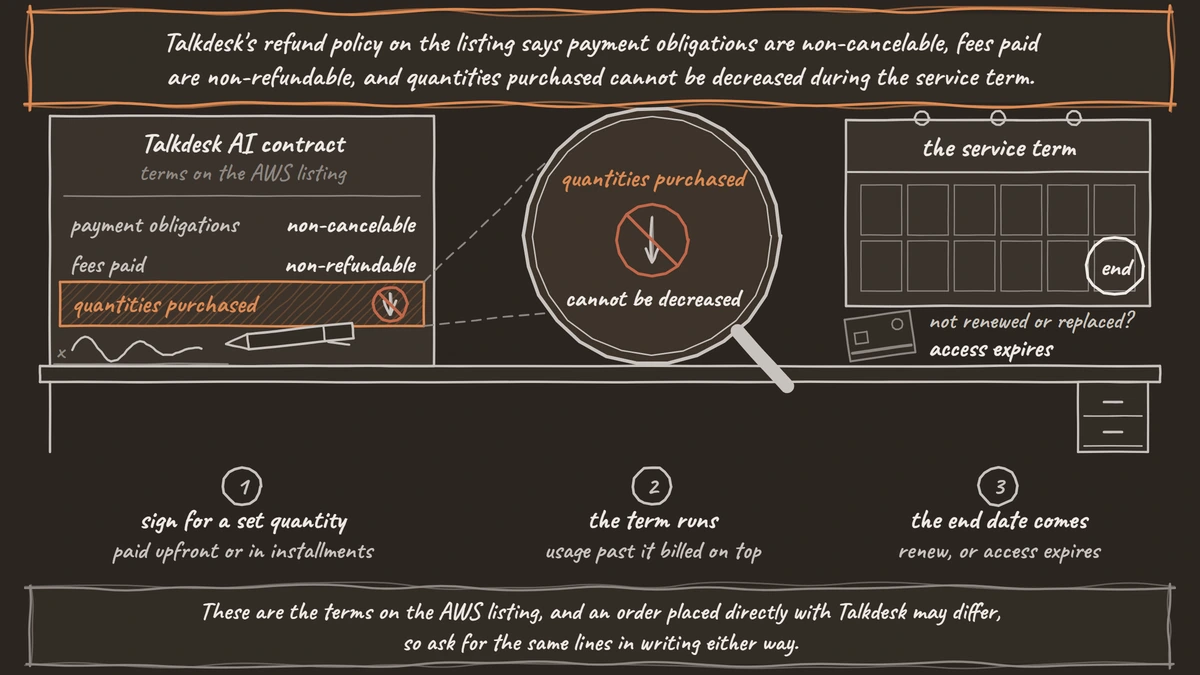
Size the first contract on what you know rather than what you hope to automate. A G2 reviewer quoted on the same listing says the SKU structure can make adoption hard, because a small new capability can trigger wider SKU and contract changes. A short first term leaves room to adjust. These are the terms on the AWS listing, and an order placed directly with Talkdesk may differ, so ask for the same lines in writing either way.
A worked month for 40 voice agents
Seats are the part of the month that can be priced from the page, so the example prices those and shows the AI line as a formula. Take a team of 40 agents taking calls. The figures are our estimate from Talkdesk's list prices.
| Line | Amount a month |
|---|---|
| 40 agents on Voice Essentials at $105 | $4,200 |
| The same 40 on Elite at $165 | $6,600 |
| Difference for WFM, screen recording and custom reporting | $2,400 |
| 30 on Voice Essentials and 10 chat-only agents on Digital Essentials | $4,000 |
| AI on AWS | Units per interaction x interactions x $0.01 |
| Telephony, storage, services | Quoted |
The step to Elite is $28,800 a year for this team, which is the figure to set against a separate WFM tool. For the AI line, ask Talkdesk how many units one Autopilot voice call uses, then multiply by your monthly calls and $0.01. Every 100 units is a dollar. Talkdesk prices seats per user, so a center that runs shifts should also ask whether concurrent licensing is offered, since that would change the seat count more than the plan choice. Our Genesys Cloud AI alternatives post sets Talkdesk beside other suites at 500 seats.
Join the Dograh Community
Dograh is an OSS alternative to Vapi. Join our Slack community for queries, releases, best practices & community interactions.
What drives a Talkdesk quote and what to ask
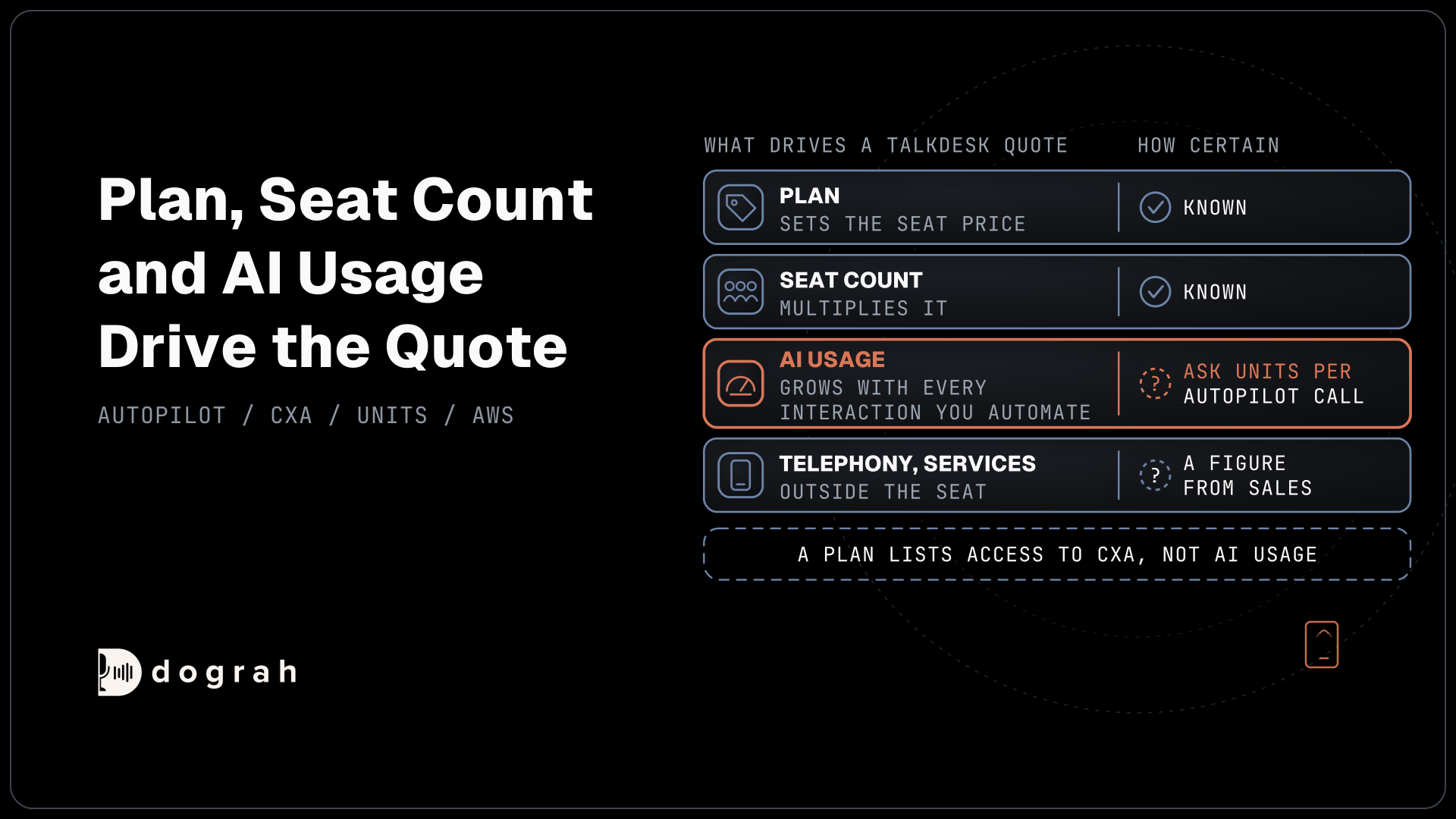
Plan, seat count and AI usage drive the quote, in that order of certainty. The plan sets the seat price, the seat count multiplies it, and AI usage grows with every interaction you automate. A short question list turns the quoted lines into numbers.
Start with AI. Ask how many units one Autopilot voice call, one chat and one Copilot-assisted call use, whether the unit rate on your order matches the $0.01 on AWS, and what quantity your contract includes before usage is billed on top.
Then ask about terms. Ask for the contract length, whether seat and unit quantities can come down at renewal, and whether buying through AWS or direct changes any of it. Ask how telephony is rated and what recording storage costs past any included amount.
Last, ask where recordings and transcripts are stored and for how long, and how you export them if you leave. Ask whether the AI models that answer your calls can be changed, and who processes the call audio. Those answers shape the risk of the AI layer as much as its price.
Where Dograh fits beside Talkdesk
Dograh, the open-source AI voice agent platform, runs the AI side of a call, and seats, WFM and digital queues stay in Talkdesk. Talkdesk's own listing sells its AI as a layer that works with any contact center, and Dograh sits in the same place. One call type goes to an agent your team runs, and our Talkdesk AI Agents alternatives post covers how a Talkdesk flow passes those calls across.
Callers go back to people through an ordinary transfer. Transfer Call dials a Talkdesk queue number, and Dograh calls the destination first and connects the caller only when someone answers. A transfer that rings out, hits a busy line or fails returns its result to the agent, and the call carries on. It runs on Twilio, Telnyx, Plivo, Cloudonix and Asterisk ARI.
The models and the data are choices on this side. The speech and language models are chosen per agent, on your own keys or as open models you host, and each provider bills by its own meter rather than in units. Your own keys move the contract to you while the call text still reaches the model provider, and self-hosting keeps recordings on your servers. Pre-Call Data Fetch loads the caller's record from your endpoint before the greeting, and our guide to AI voice agents for BPO and contact centers covers handoff routing in depth.
The platform is its own line next to the Talkdesk bill. When you run Dograh yourself there is no per-minute platform fee, and what you pay for is the servers, the model keys and the phone minutes. The database and the upgrades are also your team's to look after. Support on the open-source version comes from the community, with custom SLAs available on Enterprise. Dograh Cloud is the way to skip the hosting, at a 1¢-a-minute platform fee, and pay as you go includes 10 concurrent calls, with more on request, while a self-hosted install runs 10 by default and can be raised.
Glossary
- CXA (customer experience automation)
- Talkdesk's name for its AI layer, covering Autopilot, Copilot, Navigator, analytics and Identity. The products are quoted, and AWS meters them in units.
- Ascend AI unit
- The billing unit on Talkdesk's AWS listing, $0.01 each. One unit reflects usage by a specific product on a customer interaction, so counts vary by product.
- Service Term
- The contract period on the AWS listing, 1 to 36 months. Quantities bought cannot be decreased during it, and fees paid are non-refundable.
- Talkdesk Express
- Talkdesk's offer for businesses under 50 employees in the US and Canada, with 25 licenses, $100 in free credit and no contract.