
RunPod rents GPUs by the second: an RTX 5090 is $1.19 an hour on Secure Cloud and an H100 PCIe $2.89. Cost per call is that hourly price divided by the calls the card handles in the hour. Dograh, the open-source AI voice agent platform, runs the calls, self-hosted or on Dograh Cloud.
Key Takeaways
- Cost per call is the hourly GPU price divided by that hour's calls.
- An always-on pod on a quiet line costs far more per call.
- Serverless Flex bills cold starts, so live phone lines suit pods better.
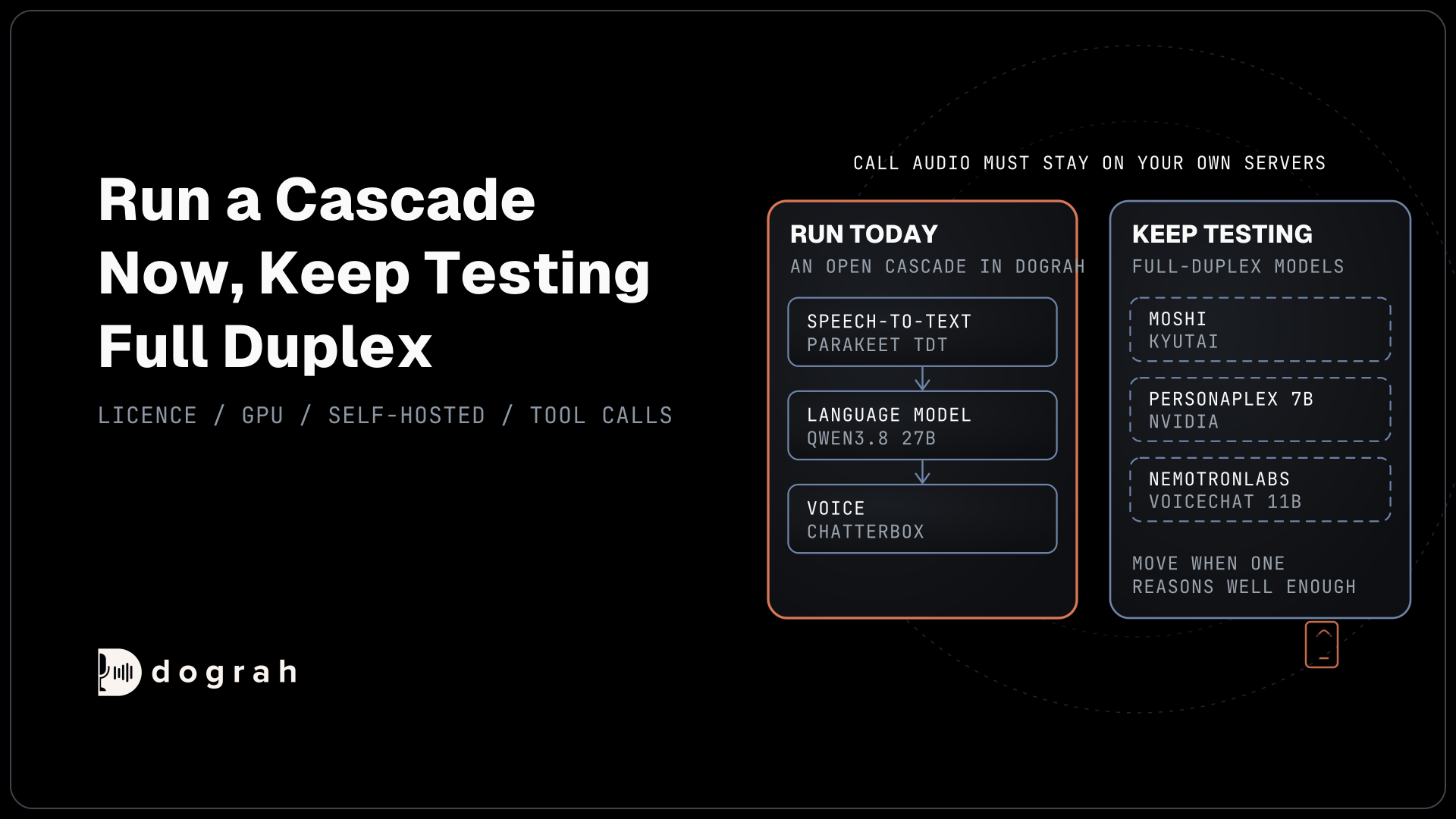
This post is part of our guide to running voice AI on local, self-hosted models, where open-weight models keep call audio on servers you control. Below, we turn RunPod's hourly prices into a cost per call, then compare pods with Serverless and add the storage lines.
RunPod's GPU prices for a voice stack
RunPod sells the same cards in two clouds, and the hourly rate is the starting point for every sum below. These are the cards that fit a voice stack, from a 24 GB card for a small model up to an 80 GB card for several calls on a bigger one.
| GPU | Memory | Secure Cloud per hour | Community Cloud per hour |
|---|---|---|---|
| RTX 4090 | 24 GB | $0.89 | from $0.34 |
| RTX 5090 | 32 GB | $1.19 | from $0.69 |
| RTX 6000 Ada | 48 GB | $0.99 | from $0.74 |
| L40S | 48 GB | $1.09 | from $0.79 |
| A100 PCIe | 80 GB | $1.79 | from $1.19 |
| H100 PCIe | 80 GB | $2.89 | from $1.99 |
RunPod's GPU prices are on-demand rates. The worked examples below use Secure Cloud, so swap in the Community rate if your setup runs there.
Three billing rules shape the bill. According to RunPod's Pod billing rules, pods are billed by the second for compute and storage, with no fees for data coming in or going out, which matters for a call that streams audio both ways for minutes. Savings plans are deprecated and can no longer be bought. RunPod also sells reservations for longer commitments through its sales team, so ask about those before a long contract.
From an hour to a cost per call
A GPU bills by the hour, and a call lasts minutes, so the useful number is what one call costs. The sum is the hourly price divided by the calls the card handles in that hour. Calls per hour are the calls running at once, times the calls each slot fits in an hour, times the share of the hour the slots are busy.
The input you cannot read off a price list is how many calls one card carries at once. The only published figures are vendor models. Spheron's sizing model, from a GPU cloud vendor, puts about 6 sessions on an RTX 5090 and about 14 on an H100 PCIe, both running Llama 3.1 8B at 4-bit with the Kokoro voice. Its table has no speech-to-text model in it, and it advises running production at 50 to 70% of that ceiling.
Here is the sum as an example, with 5-minute calls on an RTX 5090. Each of the 6 slots fits 60 / 5 = 12 calls an hour, so a fully busy card handles 6 x 12 = 72 calls. $1.19 / 72 = $0.0165 a call, or $0.0033 a call minute.
At 60% load, inside Spheron's advice, the card handles 72 x 0.6 = 43.2 calls, and $1.19 / 43.2 = $0.0275 a call. On an H100 PCIe at 14 sessions, the card handles 14 x 12 = 168 calls an hour, and $2.89 / 168 = $0.0172 a call when fully busy.
A bigger model changes all of this. A 27B model leaves far less room for parallel calls than an 8B one, so your sessions per card come from a test, not from this table. Our comparison of which open-weight model to put on the card covers tool calls and speed.
A quiet line costs more per call
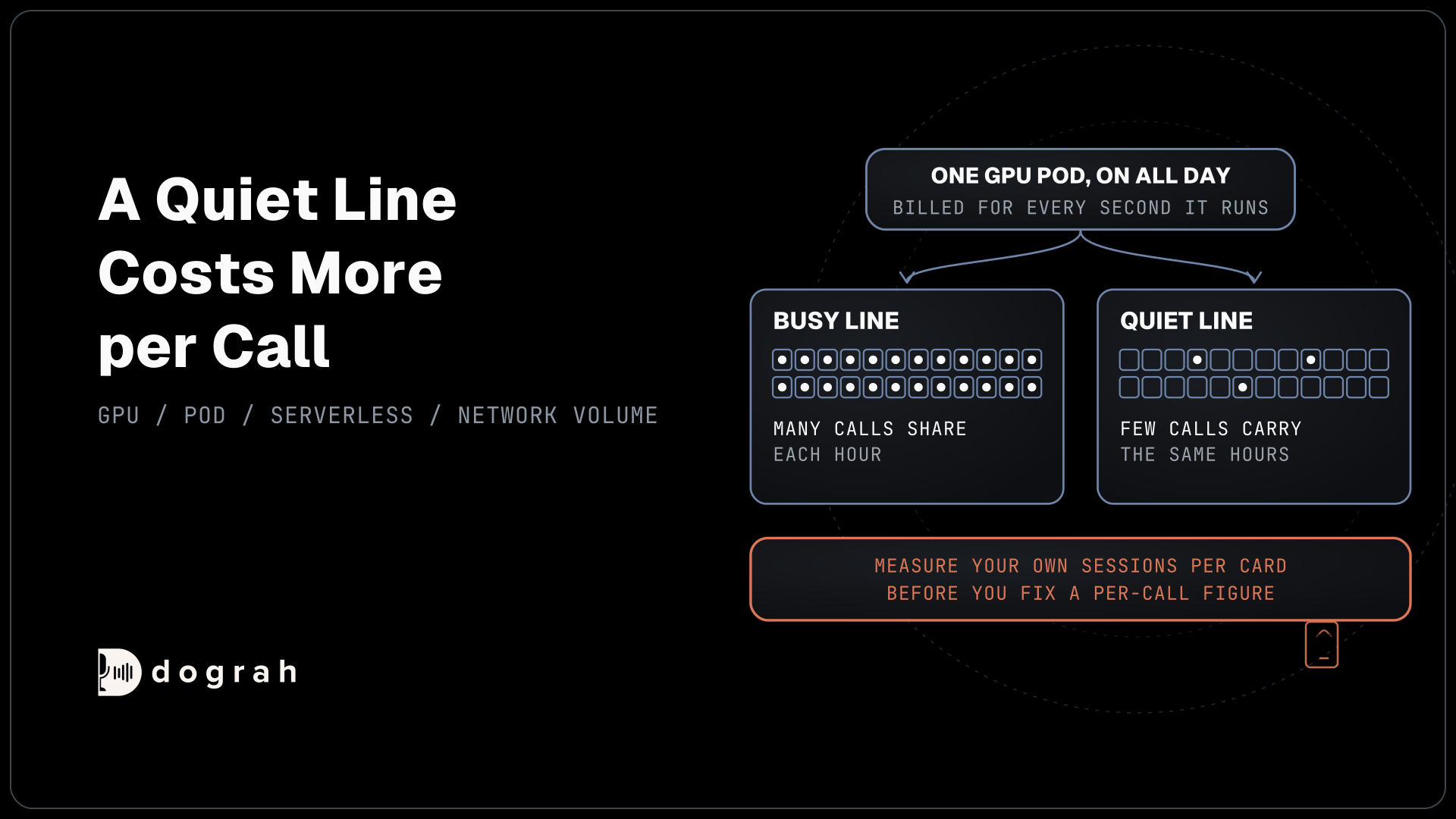
A pod bills every hour it runs, whether the phone rings or not, so the cost per call falls only as call volume rises. That is the number most budgets miss.
Take the same RTX 5090 pod, left on all day so the line can answer at any hour. It costs $1.19 x 24 = $28.56 a day. With 200 five-minute calls a day, each call carries $28.56 / 200 = $0.1428 of GPU time. With 2,000 calls a day, provided one card can carry the busiest hour, it drops to $0.0143.
The same card costs nearly ten times as much per call on the quieter line. A self-hosted GPU gives you a fixed, predictable bill, and it only becomes a small one per call when the line is busy. For the monthly cost of each card kept on all month, see our post on running voice AI on your own GPUs.

Open Source Alternative to Vapi / Retell
Self-hosted voice agent platform — no per-minute fees
dograh-hq/dograh
Star on GitHub
Pods or Serverless for live calls
RunPod's Serverless runs workers that start on demand, and its billing suits batch jobs better than a phone line. Flex workers scale to zero when no requests arrive and bill per second at their own rates, for example $1.79 an hour on an RTX 5090, $1.34 on an RTX 4090 and $5.39 on an H100.
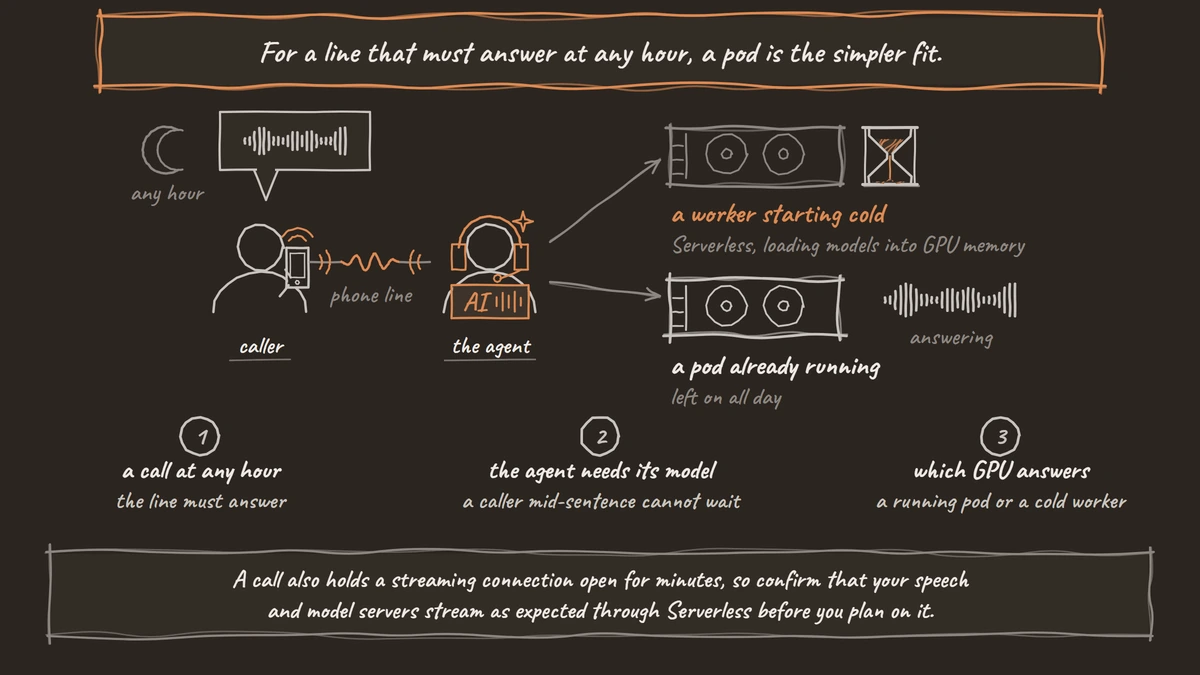
The catch for voice is what counts as billed time. RunPod's Serverless billing charges from the moment a worker starts until it fully stops, rounded up to the nearest second. That includes the cold start, while the worker loads the models into GPU memory, and an idle timeout of 5 seconds by default after the last job. RunPod says FlashBoot brings cold starts under 200 ms. A caller mid-sentence still cannot wait for a model to load, so test that claim with your own model size.
Active workers stay running all day with no cold start, and RunPod offers discounts on them through sales. Kept on around the clock, a Flex RTX 5090 at $1.79 costs about 50% more per hour than the same card as a pod at $1.19. A call also holds a streaming connection open for minutes, so confirm that your speech and model servers stream as expected through Serverless before you plan on it. For a line that must answer at any hour, a pod is the simpler fit.
Storage, spend limits and the rest of the bill
The GPU is the biggest line, but storage and account rules add to it. Model weights need a disk. A volume disk costs $0.10 per GB a month while the pod runs and $0.20 while it is stopped, so a 100 GB volume for weights costs $10 a month running and $20 stopped. A network volume costs $0.07 per GB a month under 1 TB, whether the pod runs or not.
Two account rules can stop calls. Pods stop when the account balance reaches $0, and a pod without a network volume is then terminated with its data, weights included. A new on-demand pod also needs at least one hour of credits to start, and the default spend limit is $80 an hour across the account. Keep a network volume for the weights and top up before the balance runs low.
Dograh itself needs no GPU. It is the orchestration layer that runs the call flow, tools and telephony, and the speech and language models are a separate layer you choose. A pod running vLLM or Speaches connects through Local Models by its base URL.
Pre-recorded clips play the lines your agent says most, so the voice model on the card works on fewer of them. Phone minutes come from your carrier at its own rates. Self-hosted Dograh has no per-minute platform fee, but servers, model keys and phone minutes still cost money. Dograh Cloud charges a 1¢-a-minute platform fee.
Before you fix a per-call figure, measure your own sessions per card with load testing a voice agent over the phone. For the deployment as a whole, see self-hosted voice AI on open-weight models.
Join the Dograh Community
Dograh is an OSS alternative to Vapi. Join our Slack community for queries, releases, best practices & community interactions.
Glossary
- Cost per call
- The GPU's hourly price divided by the calls it handles in that hour. It depends on how many calls run at once, how long each lasts and how busy the line is, so the same card can cost $0.0165 or $0.1428 a call.
- Cold start
- The time a serverless worker spends starting and loading models into GPU memory before it can answer. RunPod bills it, and a live caller cannot wait through one mid-turn.
- Flex worker
- A RunPod Serverless worker that scales to zero when no requests arrive and bills per second while it runs. It suits bursty batch jobs better than a phone line that must answer at any moment.
- Network volume
- RunPod storage that lives apart from any one pod and bills whether the pod runs or not. It keeps model weights safe when a pod stops at a $0 balance and is terminated.