
Rime TTS pricing starts with $50 of free usage a month. Flex has no monthly fee and charges $0.030 a minute for Mist v3 and $0.050 for Coda v2, and Scale takes 20% off for $100. For teams that want to own the platform, Dograh, the open-source AI voice agent platform, runs Rime voices self-hosted or on Dograh Cloud.
Key Takeaways
- Rime meters its voices by characters, counting about 1,000 characters as one minute.
- By our estimate, a three-minute call costs about 4 cents on Mist v3 Flex.
- Scale beats Flex once your Flex usage would pass $100 a month.
A Rime rate sheet fits on one screen, but a call's cost depends on what your agent says. We cover the plans and meters, one call, one month, which plan fits and what to ask, and then we talk about how Dograh runs Rime voices.
Rime's plans and rates in one table
Rime sells four plans, and every model on them is priced per minute. Rime's pricing page lists two text-to-speech models, Mist v3 and Coda v2, beside Prism, a speech-to-speech model, and Rime STT, its speech-to-text model.
| Plan | Monthly fee | Mist v3 | Coda v2 | Prism | Rime STT |
|---|---|---|---|---|---|
| Free | $0, no card | Inside $50 of usage | Inside $50 of usage | Inside $50 of usage | Inside $50 of usage |
| Flex | None | $0.030 | $0.050 | $0.080 | $0.002 |
| Scale | $100, returned as credit | $0.024 | $0.040 | $0.064 | $0.0016 |
| Enterprise | Annual commitment | Volume rate | Volume rate | Volume rate | Volume rate |
The Free plan gives $50 of usage every month across all four models. It renews monthly and does not roll over. Flex bills by the minute to your card each month, with nothing to cancel. Scale's $100 comes back as $100 of credit a month, unused credit rolls over up to $200, and usage past the credit is billed at the same Scale rates.
Two of the four meters arrived in October 2026. Prism launched on 28 October as an English-only model for voice agents, with its own turn detection and tool calling. Rime STT launched on 20 October and transcribes English and Spanish. A cascade agent voices its replies with Mist v3 or Coda v2, and our guide to Rime for voice agents compares those two on speed, languages and phone audio.
Characters, minutes and call audio
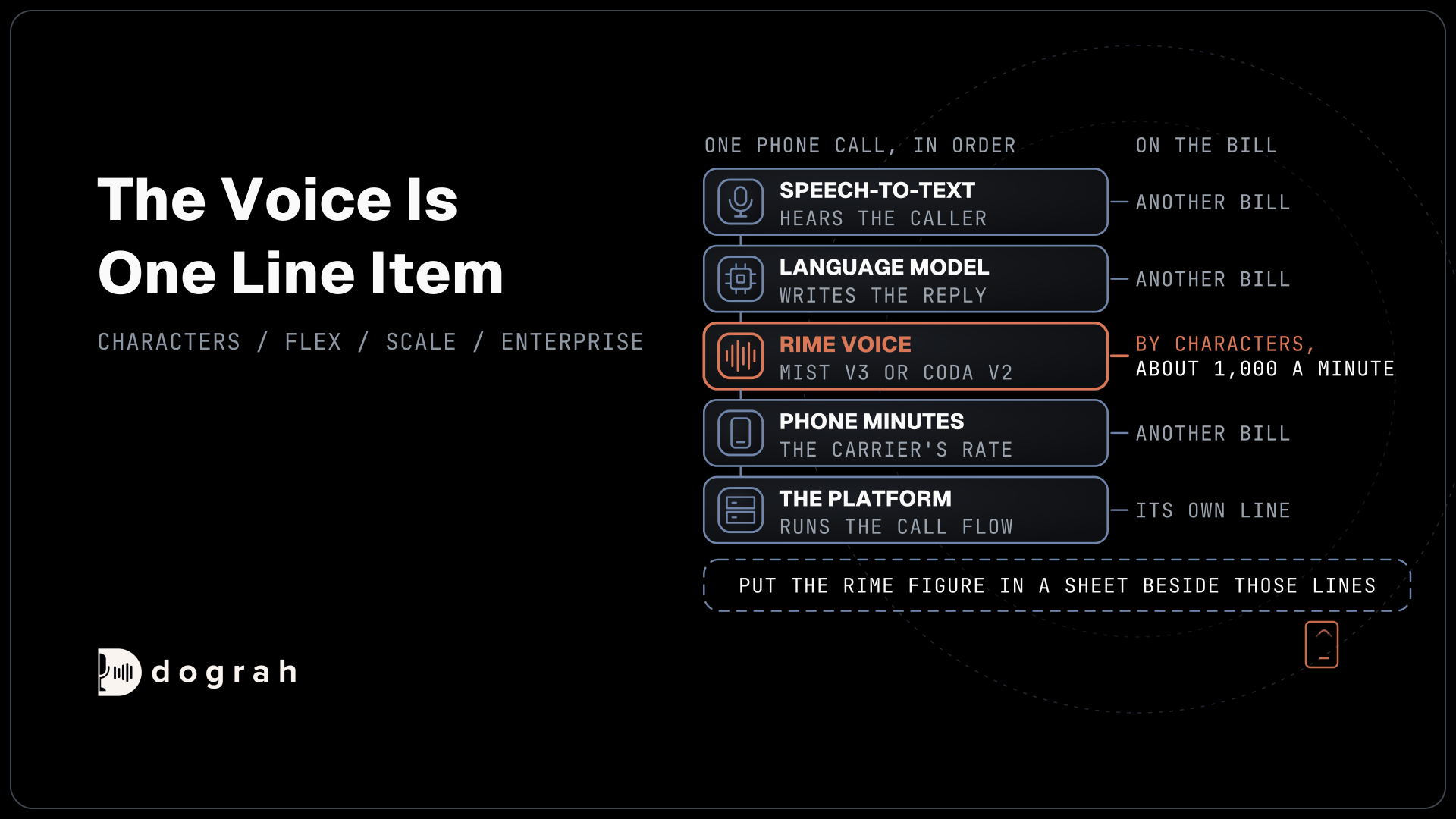
Each Rime meter counts something different, and that decides which number you should plan with. Rime uses character metering for its text-to-speech, counting the characters generated at about 1,000 a minute. So one minute of Mist v3 or Coda v2 is roughly 1,000 characters of text your agent sends, and a fast or wordy agent uses more of them than its talking time suggests.
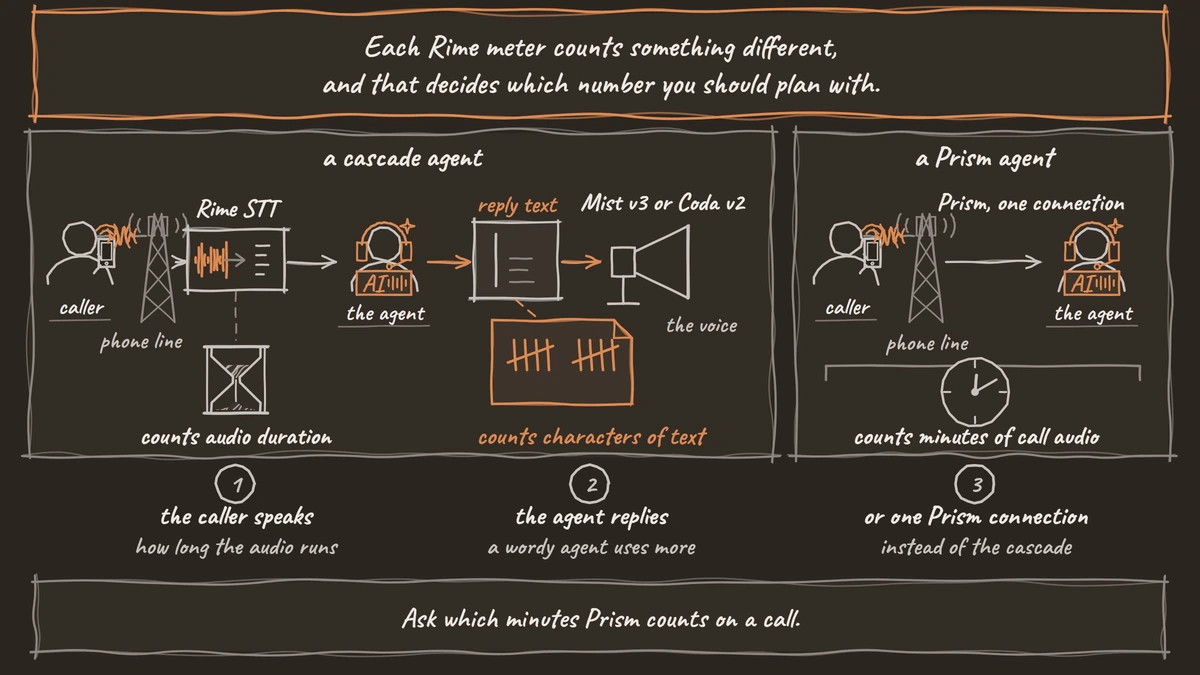
The other two meters follow audio. Prism is metered by the minute of call audio, and Rime STT by audio duration. The Prism overview says one connection does the work of speech-to-text, a language model and text-to-speech, so a Prism minute covers three jobs that a cascade pays for on three bills.
That is the main caution for anyone budgeting a cascade on Mist v3 or Coda v2. As an independent breakdown of Rime's pricing argues, the voice is one line item, and its bill follows how much text your agent writes. Speech-to-text, the language model and the phone minutes sit next to it, so the Rime rate is never the cost of a call minute on its own.
What one phone call costs in Rime audio
A per-call figure is our own estimate, so the assumption comes first. Take a three-minute phone call where the agent speaks about 45% of the time. That is about 1.35 minutes of Rime audio, or about 1,350 characters at Rime's own conversion.
| Model and plan | Rime audio per call | Cost per call | Per minute of the call |
|---|---|---|---|
| Mist v3 on Flex | 1.35 minutes | about $0.041 | about $0.014 |
| Mist v3 on Scale | 1.35 minutes | about $0.032 | about $0.011 |
| Coda v2 on Flex | 1.35 minutes | about $0.068 | about $0.023 |
| Coda v2 on Scale | 1.35 minutes | $0.054 | $0.018 |
Two things move these numbers more than the plan does. A recorded greeting and disclosure of about 15 seconds takes 0.25 minutes off what Rime voices, which brings Mist v3 on Flex to about $0.033 a call. An agent that talks 60% of the call needs about 1.8 minutes, about $0.054 on the same plan. Short replies save as much as a plan change.
Prism works out differently. If Rime counts every minute of the three-minute call, as "minute of call audio" suggests, the call comes to $0.24 on Flex and about $0.19 on Scale, with no separate speech-to-text or language model bill. That reading is ours, so confirm which minutes count before you set Prism against a cascade.

Open Source Alternative to Vapi / Retell
Self-hosted voice agent platform — no per-minute fees
dograh-hq/dograh
Star on GitHub
A month of calls on each plan
Monthly volume decides the plan, so here are the same three-minute calls at two volumes. Each row keeps the 1.35 minutes of Rime audio per call from the estimate above.
| Calls a month | Rime minutes | Mist v3 | Coda v2 |
|---|---|---|---|
| 1,000 | 1,350 | $40.50 of usage, inside the Free plan's $50 | Flex $67.50, or Scale $100 with $46 of credit rolling over |
| 3,000 | 4,050 | Flex $121.50, or Scale $100 with $2.80 rolling over | Flex $202.50, or Scale $162 |
At 1,000 calls, Mist v3 stays inside the Free plan and Coda v2 fits Flex. At 3,000 calls, Scale wins on both models, by $21.50 on Mist v3 and $40.50 on Coda v2. These figures cover the voice only. Our Rime vs Cartesia comparison prices a larger month against Cartesia's credits.
The rest of the call sits on other bills. Speech-to-text, the language model and the phone minutes each charge for the same three minutes, and the carrier's rate alone can outweigh the voice. Put the Rime figure in a sheet beside those lines before you compare plans, then rerun it with the call length and talk share from a week of your own calls.
Which plan fits which monthly spend
The plan that costs least follows your usage at Flex rates. Scale's $100 buys what $125 would on Flex, because every Scale rate is 20% lower, so Scale comes out ahead as soon as your Flex usage would pass $100 in a month.
| Your monthly usage at Flex rates | Plan that costs least |
|---|---|
| Up to $50 | Free |
| $50 to $100 | Flex |
| Over $100 | Scale |
| A yearly volume deal, on-prem or a BAA | Enterprise |
Rollover credit softens a quiet month on Scale. Unused credit carries forward, but the balance stops growing at $200, so a long run of quiet months gains nothing past that point. The Free plan works the other way. Its $50 resets each month and never carries over, and Rime's own advice is to move to Flex when you need more.
The Free plan also suits building and testing. Its $50 covers about 1,660 minutes of Mist v3 or 1,000 minutes of Coda v2, which is room for hundreds of test calls before a card goes on file.
Join the Dograh Community
Dograh is an OSS alternative to Vapi. Join our Slack community for queries, releases, best practices & community interactions.
What Enterprise adds and what to ask Rime
Enterprise moves the deal from a card to a contract. Rime lists volume rates on every model, an annual commitment and invoiced billing. It adds cloud, VPC or on-prem deployment, SLAs with a Forward Deployed Engineer and a Linguist, custom voices, and fine-tuning Prism on your own calls. A BAA for HIPAA and a SOC 2 Type II report are Enterprise items too, and whether your calls need a BAA is a question to confirm with counsel.
A few questions settle the rest. Ask how many requests your plan can run at once, since a busy phone line needs one voice stream per live call. Ask which minutes Prism counts on a call. Ask what happens to Scale credit if you move to Enterprise or back to Flex, and what volume rates look like for each model. If you self-host Rime's models on Enterprise, ask how the license is priced next to the cloud rates.
Agents still on the older Mist models have one more item to check. Rime retires Mist v1 and Mist v2 on 3 December 2026, so confirm that every agent names Mist v3 or Coda before then.
Where Dograh fits with Rime voices
Rime is a built-in voice provider in Dograh, the open-source AI voice agent platform, and it runs on your own Rime key. The bill goes to your Rime account at the rates above. Dograh handles the call flow, the tools and the phone line, and you pick the speech and language models for each agent as a separate layer. In the Model field, type coda or pick mistv3, since Rime's changelog retires mist and mistv2 on 3 December 2026.
The Rime minute that costs nothing is the one you never send. Lines the agent says on every call, such as the greeting or a recorded disclosure, can play as pre-recorded clips, and every clip that plays is a line Rime never voices. Our post on cutting voice AI costs with pre-recorded audio works through the savings. View Trace on each call shows the voice time for every turn, so you can see which replies run long.
Rime receives the text of every reply, wherever the platform runs. Your own key moves the contract to you while the text still reaches Rime, so a team that needs the voice inside its own walls can ask Rime about on-prem models or run open voices on its own servers.
The platform is its own line next to the Rime bill. Run Dograh on your own servers and no per-minute platform fee applies, though the servers, the model keys and the phone minutes are still yours to pay. Your team also keeps the database running and applies each upgrade. Support questions go to the open-source community, and the Enterprise plan adds custom SLAs. Dograh Cloud takes the hosting off your hands for a 1¢-a-minute platform fee, with 10 concurrent calls included on pay as you go, while a self-hosted install runs 10 by default and can be raised.
Glossary
- Character metering
- Billing a voice by the characters of text sent to it. Rime meters Mist v3 and Coda v2 this way and prices them per minute at about 1,000 characters each.
- Rollover credit
- Unused Scale credit that carries into the next month. On Rime's Scale plan it rolls over until the balance reaches $200.
- Speech-to-speech model
- A model that hears the caller's audio and answers in speech over one connection. Rime's Prism is one, billed by the minute of call audio.
- Talk share
- The share of a call during which the agent is speaking. It sets how many minutes of Rime audio a call uses, 45% in our three-minute example.