
Open-source alternatives to Thoughtly split into platforms you run and frameworks you build on. Thoughtly is a hosted agent that follows up inbound leads by voice, text and email and syncs your CRM. For teams that want to own the calls, Dograh is the open-source platform to host yourself or run on Dograh Cloud, writing each outcome to your CRM.
Key Takeaways
- Thoughtly follows up inbound leads across voice, text and email on its cloud.
- Dograh runs the calls open source and writes outcomes to your CRM through APIs.
- Pipecat and LiveKit Agents are frameworks, so the CRM code is yours to write.
Thoughtly is a hosted agent that follows up inbound leads across channels and logs them in the CRM. This post compares the open-source options, shows how a call agent updates a CRM it does not own and covers when staying fits. Then we talk about how Dograh runs the calls.
Open-source Thoughtly alternatives in one table
The open options split into a platform you run and frameworks you build on. Thoughtly is the baseline, and each row asks every option the same question.
| Option | What it is | Code | Channels | CRM | Where it runs |
|---|---|---|---|---|---|
| Thoughtly (baseline) | Hosted agent for inbound lead follow-up | Closed | Voice, SMS, WhatsApp, iMessage, email | Two-way sync built in | Thoughtly's cloud, dedicated infrastructure on Enterprise |
| Dograh | Open-source AI voice agent platform for the calls | BSD 2-Clause | Phone and web calls, texts through your own provider | Reads and writes through HTTP API tools, MCP tools and webhooks | Your servers, Dograh Cloud, or on-prem on Enterprise |
| Pipecat | Python framework for voice pipelines | BSD 2-Clause | Whatever you build | Code you write | Your servers or Pipecat Cloud |
| LiveKit Agents | Agent framework on LiveKit's media server | Apache-2.0 | Whatever you build | Code you write | Your servers or LiveKit Cloud |
The hosted platforms, such as Retell AI and Synthflow, belong in a different comparison. Our guide to Thoughtly alternatives covers them with prices.
What Thoughtly does for a revenue team
Thoughtly is built to convert inbound leads, and it calls itself "inbound lead conversion, not cold outbound". Its tagline is "Everyone deserves a follow up", and its agents respond to new leads, qualify them and book meetings, with every interaction logged to the CRM.
The reach is wider than voice. Thoughtly's omnichannel agents run one agent "across voice, SMS, WhatsApp, iMessage (via Linq), email, webhooks, and automations" with a shared contact record. Thoughtly's plans, Flex, Scale and Enterprise, all include two-way CRM sync with HubSpot, Salesforce, Zoho and others, uncapped minutes and your own Twilio or Telnyx numbers, and Thoughtly says the price scales with combined usage volume. Concurrent calls run from 10 on Flex to 100 or more on Scale.
Two newer pieces matter for builders. Thoughtly's MCP server is read-only and in limited availability, so an AI client can view conversation history but never change agents or contacts. Thoughtly for Agents is a separate product that gives a coding agent a phone line at $0.10 per connected minute for each phone participant, with carrier charges on top, either twice the carrier charge per leg on Thoughtly's telephony or billed by your own carrier. Our guide to Thoughtly pricing covers the plans.
How a call agent updates a CRM it does not own
An open-source call agent can keep a CRM current without being one. It needs three moments wired to the CRM's API, and every open stack works this way.
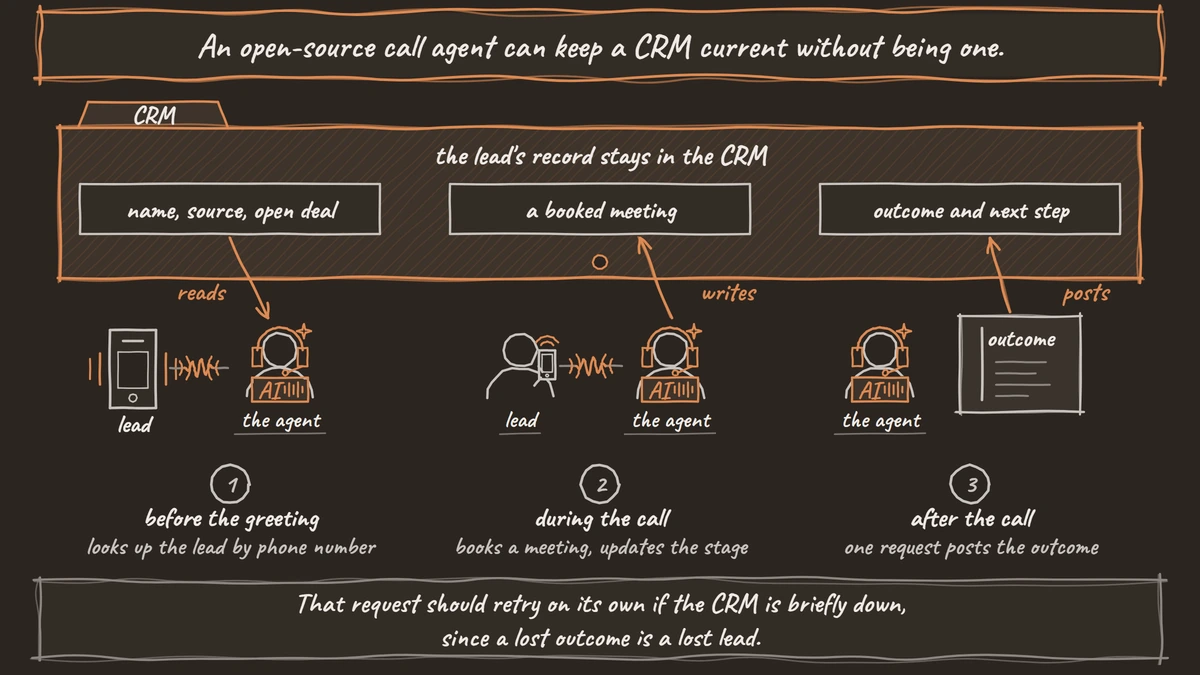
Before the greeting, the agent looks up the caller or the lead by phone number, so it knows the name, the source and any open deal when it says hello. During the call, it reads and writes through API calls, such as checking a calendar, booking a meeting or updating a lead's stage. Each write should carry a unique call ID, so a retry does not book the same slot twice.
After the call, a single request posts the outcome, with the answers gathered, the transcript link and the next step, to your CRM or to an automation tool such as n8n. That request should retry on its own if the CRM is briefly down, since a lost outcome is a lost lead.
On a framework you write each of these hooks in code. On a platform they are settings on the agent.

Open Source Alternative to Vapi / Retell
Self-hosted voice agent platform — no per-minute fees
dograh-hq/dograh
Star on GitHub
Open frameworks, Pipecat and LiveKit Agents
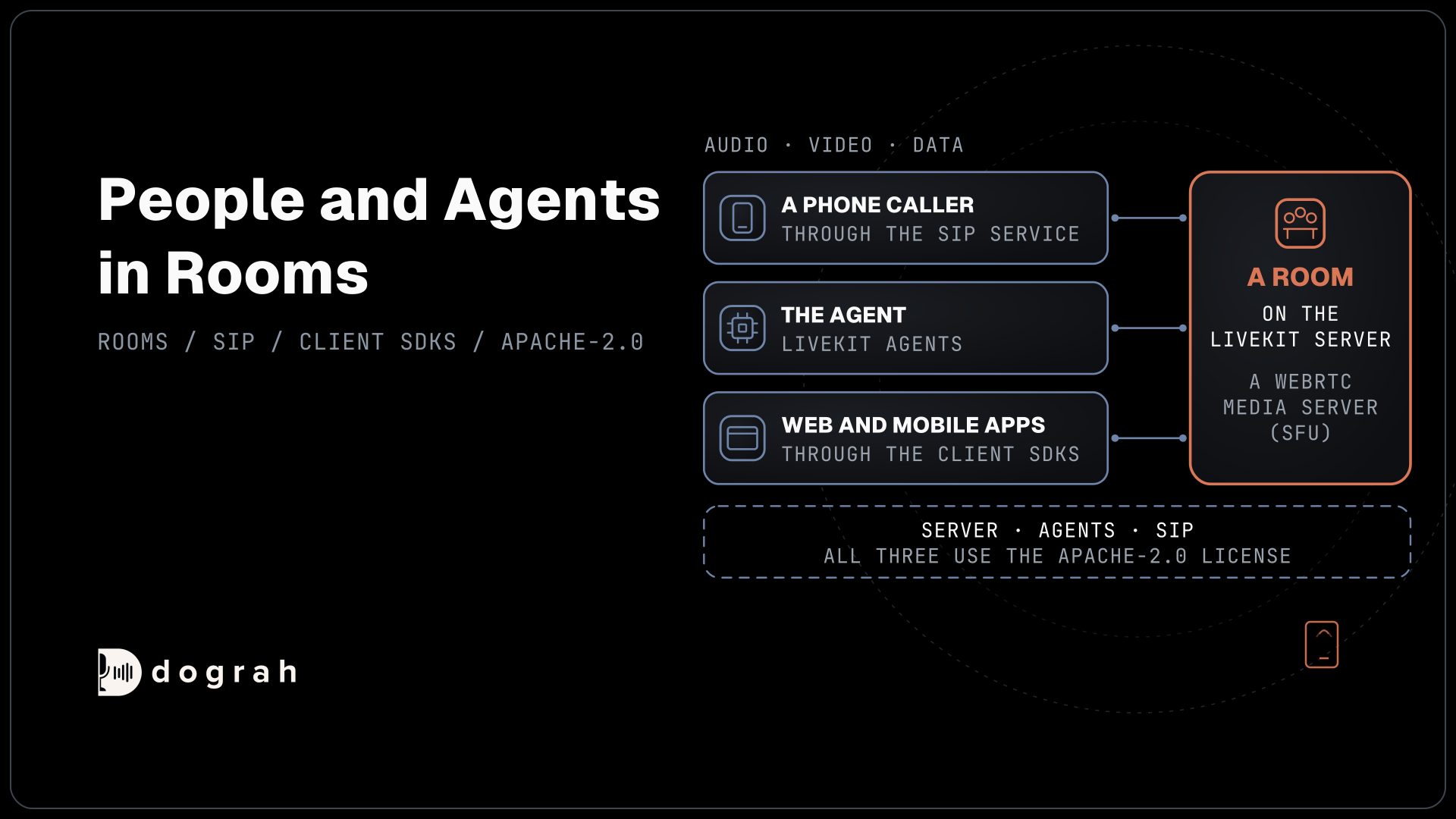
The second group is for teams that want to write the agent themselves. Pipecat is a BSD 2-Clause Python framework, maintained by Daily, that chains speech-to-text, a language model and a voice into a pipeline. LiveKit Agents is an Apache-2.0 framework that runs agents on LiveKit's open-source media server, with a SIP service for phone calls.
Both give you full control and both are free to run on your own servers. What they leave to you is the product around the call, which for a Thoughtly buyer means the lead lists, retries, quiet hours, the CRM hooks above and a screen your sales operations team can use.
That is a fair trade for a developer team building its own product. It is a long road for a revenue team that wants agents calling leads this quarter. Our comparison of open-source voice AI frameworks goes deeper on each one.
When staying on Thoughtly makes sense
Thoughtly is the better fit for a team that wants one hosted agent across every channel. Voice, SMS, WhatsApp, iMessage and email share one contact record, so a follow-up text can pick up where a call ended without any code.
It also fits when you want CRM-triggered automations and write-back that work out of the box, uncapped minutes inside a concurrency cap, and quiet hours per channel that can follow each contact's time zone. Scale adds SOC 2 Type II reports on request and a 99.9% uptime SLA, and Enterprise adds HIPAA with a BAA, dedicated infrastructure and data residency. Where your calls need a BAA, counsel can tell you which vendors across your stack need one.
Most of all, it fits a team with no one to run servers. If that is you, staying is a sound choice.
Join the Dograh Community
Dograh is an OSS alternative to Vapi. Join our Slack community for queries, releases, best practices & community interactions.
What moving off Thoughtly takes
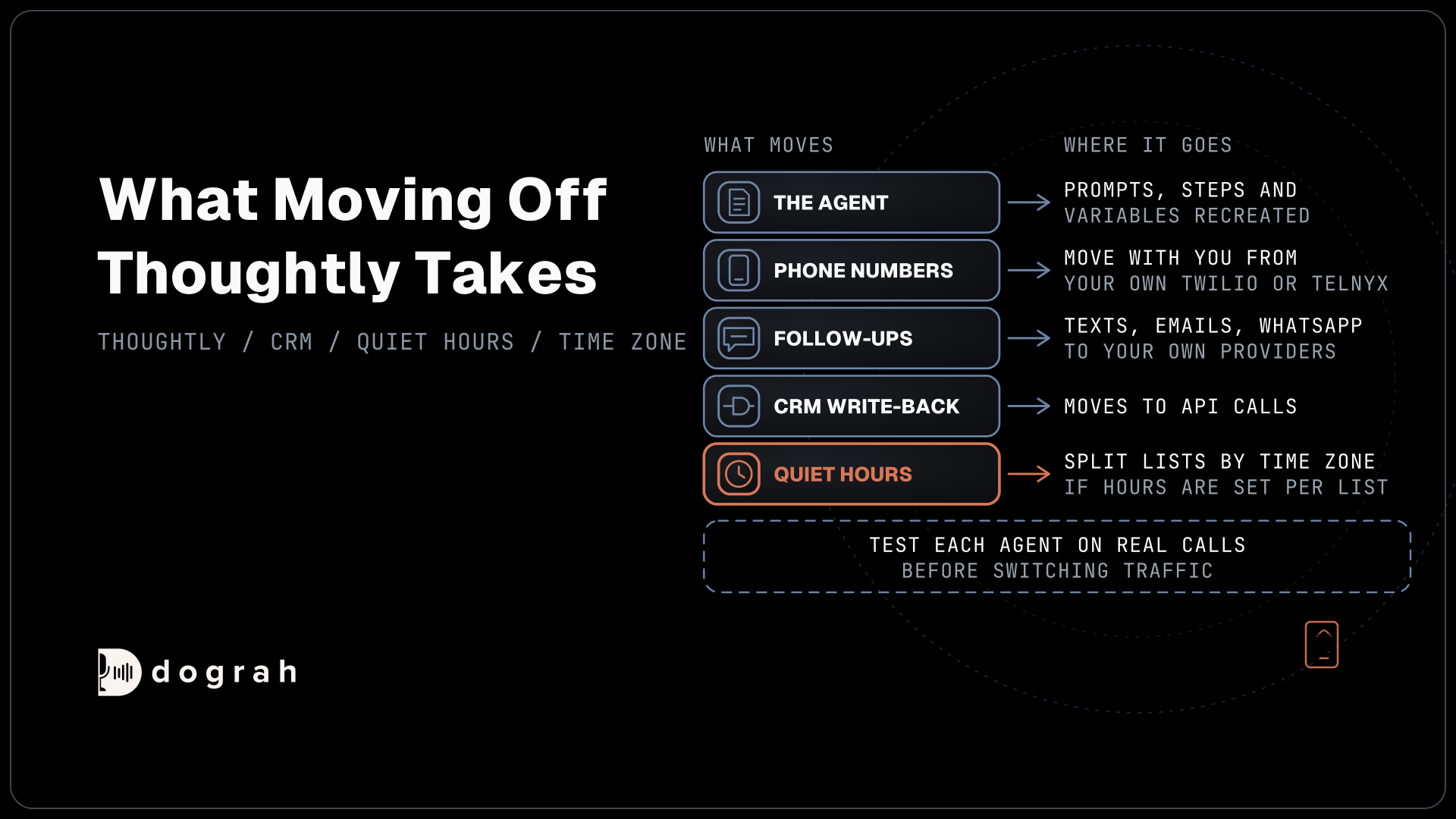
Moving is mostly rebuilding the agent and rewiring its connections. Each agent's prompts, steps and variables are recreated in the new stack, and it pays to test each one on real calls before switching traffic.
Phone numbers are the easy part when they already sit in your own Twilio or Telnyx account, since they move with you. Texts, emails and WhatsApp follow-ups move to your own providers, called from the agent during the call or by your automation tool after it. CRM write-back moves to the API calls described above.
Quiet hours need a fresh look. Thoughtly can follow each contact's time zone, so check how your new stack sets calling hours and split lead lists by time zone where it needs one setting per list.
Dograh runs the calls, your CRM keeps the record
Dograh, the open-source AI voice agent platform, runs the calls and leaves the contact record in the CRM you already use. The three CRM moments are settings on the agent. Pre-Call Data Fetch looks the caller up before the greeting, and Dograh's tools read and write during the call.
HTTP API tools call your CRM's endpoints, and MCP tools connect an MCP server whose tools the agent can use. The tool's Messages play a short line as it starts, and an update if it runs long, so the caller hears something while the tool works. After the call, a Webhook node posts the outcome and retries on its own if the CRM is briefly down.
Texts go out through your own provider via an HTTP API tool. Campaigns dial lead lists with retries and calling hours in one time zone per campaign. On Twilio, Telnyx, Plivo, Cloudonix and Asterisk ARI, Transfer Call calls the destination first and connects the caller only when someone answers. Dograh vs Thoughtly compares the two side by side.
Since the code is BSD 2-Clause, the same lead agent runs on your own servers with Docker Compose, or on-premise and in a private cloud on Enterprise. Self-hosting carries no per-minute platform fee, yet servers, model keys and phone minutes still cost money, and the database and upgrades become your team's job. The open-source community answers questions, Enterprise adds custom SLAs, and Dograh Cloud runs the whole thing for a 1¢-a-minute platform fee.
Glossary
- Two-way CRM sync
- A connection that reads lead data from the CRM and writes call outcomes back to it. Thoughtly builds it in, and open stacks wire it through APIs.
- Quiet hours
- Set times when an agent may not call or message a contact. Thoughtly sets them per channel and can follow each contact's time zone.
- Webhook node
- The Dograh step that posts a call's outcome to your system after the call. Temporary failures are retried automatically.
- Omnichannel agent
- One Thoughtly agent that works across voice, SMS, WhatsApp, iMessage and email, with a shared contact record so each channel picks up where the last one ended.