
Murf prices its API by the character. Falcon 2.1, its streaming model, costs 1 cent per 1,000 characters, and self-serve plans stream 5 voices at once on US-East and 2 elsewhere. Teams that want Murf voices on a platform they own can run them in Dograh, an open-source AI voice agent platform, on their own Murf key.
Key Takeaways
- A live voice agent pays Murf's API rate per character, not a Studio plan.
- Self-serve plans stream 5 voices at once on US-East and 2 elsewhere.
- Regional endpoints keep text and audio in one region for every customer.
Murf sells a voiceover studio and an API, and only the API runs a phone agent. We cover how the API is priced, what counts toward the bill, stream limits, a 10,000-call month, Enterprise and data. Then we talk about how Dograh runs Murf voices on your own key.
How Murf prices its API
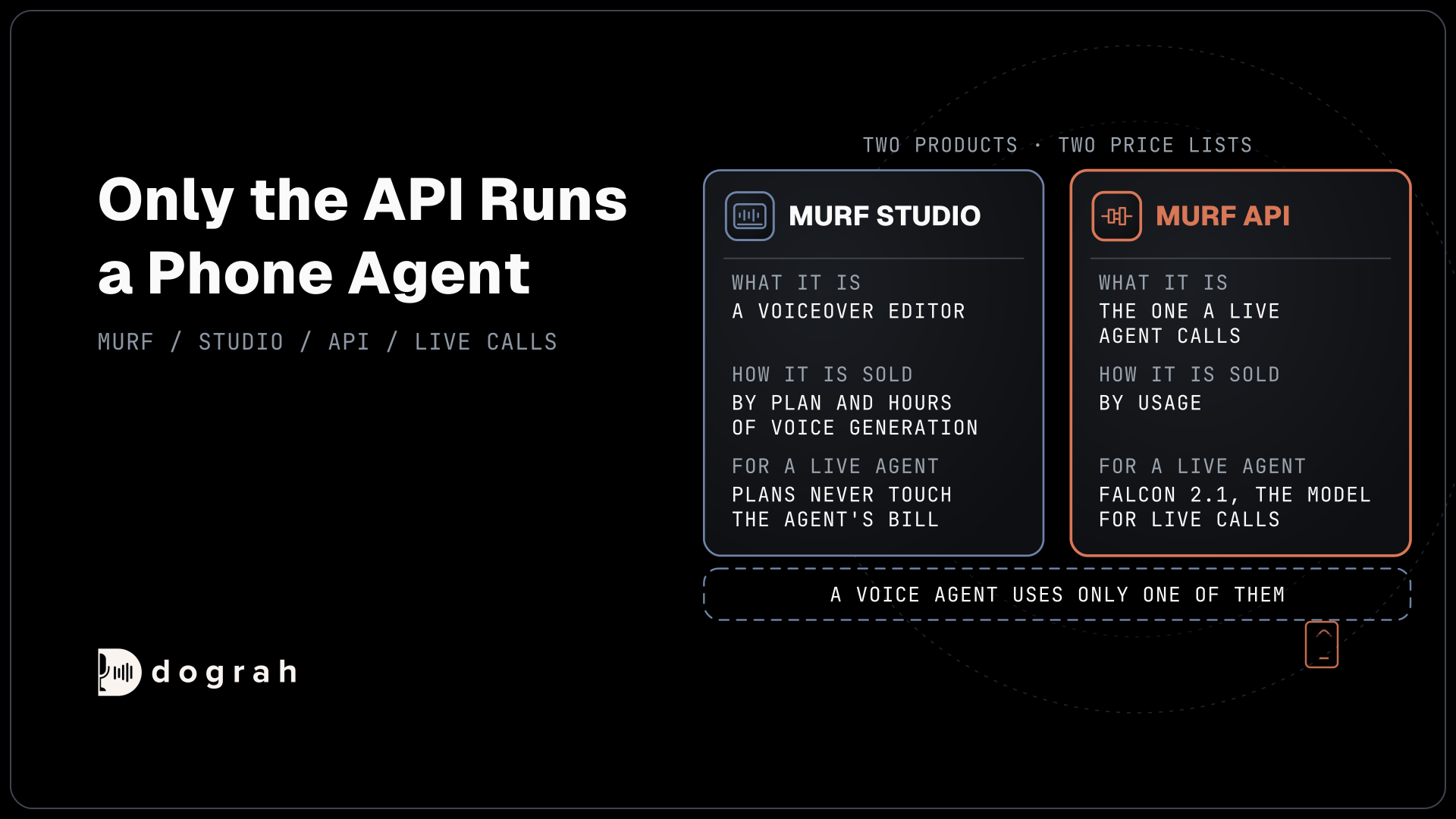
Murf has two products with two price lists, and a voice agent uses only one of them. Murf Studio is a voiceover editor sold by plan and by hours of voice generation, while the Murf API is sold by usage. A live agent calls the API, so Studio plans and their generation hours never touch its bill.
The API is priced by the character. Murf's Falcon 2.1 page puts its streaming voice model at 1 cent per 1,000 characters, which is $10 for a million characters. Falcon 2.1 is the model for live calls, since Murf's older Gen2 model is decommissioned for streaming and now runs only through the non-streaming Synthesize endpoint.
Speech to Text, still in beta, is billed at $0.12 an hour of audio. The free plan has no time limit and lasts until its trial credits run out, and Murf's startup program gives companies with fewer than 100 employees 50 million free characters for three months. Pay as you go and Enterprise sit above the free plan.
What counts toward the character bill
Murf bills the text the agent speaks, not the length of the call. A 10-minute call where the caller does most of the talking can cost less voice than a 3-minute call where the agent reads out a long policy, so the agent's word count is the number to watch.
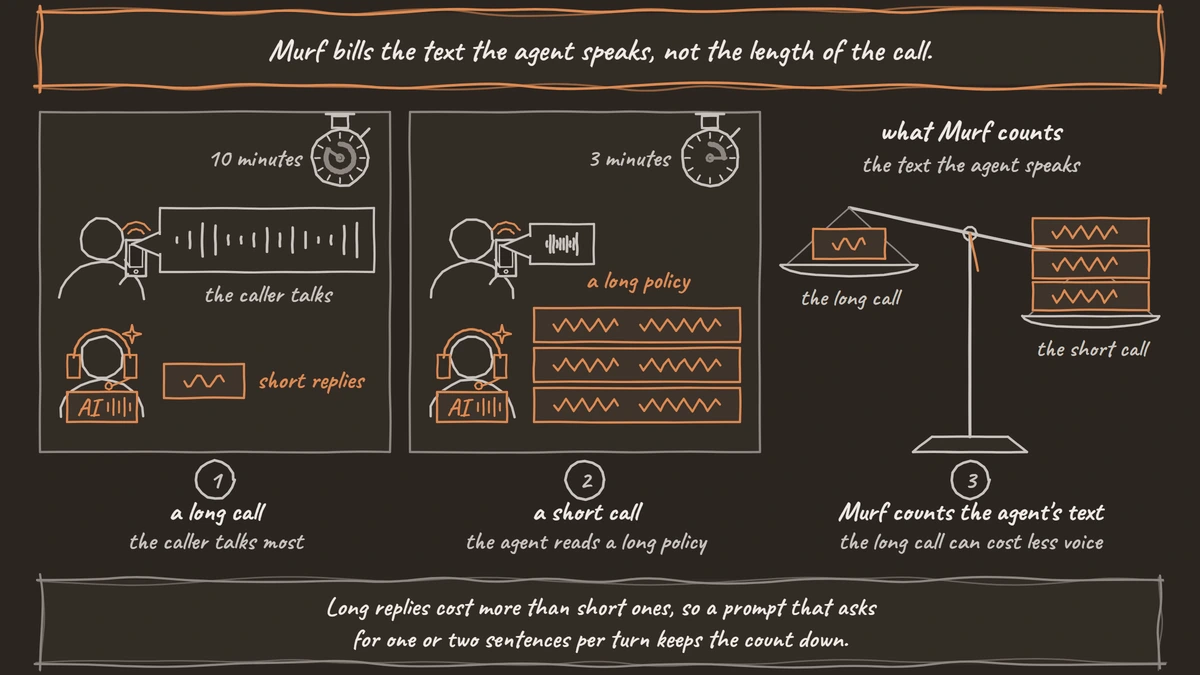
Two habits move it most. Long replies cost more than short ones, so a prompt that asks for one or two sentences per turn keeps the count down. Lines the agent says on every call, such as the greeting or a disclosure, cost characters again on each call, and a fallback that repeats a question when the caller is silent adds characters nobody planned for.
The character you never send costs nothing. A recorded clip plays without asking Murf for audio, so fixed lines played as clips leave the Murf bill entirely. Our post on cutting voice AI costs with pre-recorded audio works through how much that saves.
Streams are set by plan and endpoint
The second limit on a Murf bill is how many voices can speak at once. Murf's rate limits give the Free and Pay as you go plans 5 concurrent Falcon 2.1 streams on the US-East endpoint and 2 on the global and other regional endpoints. Enterprise limits are custom, up to 10,000 concurrent calls.
The limit is counted per region, and going over it fails the request rather than queueing it. An HTTP stream gets a 429 error with a Retry-After header, and a WebSocket gets an error frame and closes. Speech to Text has its own limit, 5 streams on Free and 20 by default on Pay as you go, up to 150 on request. Our guide to Murf TTS for voice agents explains how the per-region limits work on live calls.

Open Source Alternative to Vapi / Retell
Self-hosted voice agent platform — no per-minute fees
dograh-hq/dograh
Star on GitHub
A worked month of 10,000 calls
A worked example shows how characters and streams add up. Take a reminder and support line with 10,000 calls a month, where the agent speaks about 2,400 characters on each call and calls last about 4 minutes.
| Step | Sum | Result |
|---|---|---|
| Characters spoken | 10,000 x 2,400 | 24,000,000 |
| Falcon 2.1 voice | 24,000,000 / 1,000 x $0.01 | $240 for the month |
| Calls an hour | 10,000 over 22 working days of 8 hours | About 57 |
| Calls at once, on average | 57 x 4 minutes / 60 | About 3.8 |
The voice bill is $240 for the month on Falcon 2.1. An average of 3.8 calls at once fits inside the 5 streams on US-East but sits above the 2 on a regional endpoint, and peak hours run higher than the average. A stream is busy only while the agent speaks, so this is a safe upper bound, but a team that needs a regional endpoint at this volume should talk to Murf about Enterprise first.
What Enterprise adds, and where data goes
Data location depends on the endpoint you call. Regional endpoints keep audio in that region for every customer, and Enterprise adds region-specific keys and contract terms. Murf's data residency page lists 11 regional environments, from US-East and India to the UK, EU Central and Japan, and keeps text, generated audio and processing data in the chosen region. Account metadata such as profiles and usage stays in the United States.
The global URL routes each request to a nearby region, so Murf advises against it when residency is strict. Enterprise adds reserved capacity, region keys with their own concurrency, a covenant that your text and audio never train models, tiered volume discounts on prepurchased characters, custom voices and 24x7 priority support with a customer success manager.
Murf can also run outside its own cloud. Falcon 2.1 is offered as a SageMaker endpoint in your own AWS account, where AWS bills you and pays Murf and no Murf server is in the request path, or as a licensed on-premise install on your hardware or VPC. Speech to Text is not part of those options.
Join the Dograh Community
Dograh is an OSS alternative to Vapi. Join our Slack community for queries, releases, best practices & community interactions.
Who Murf's API pricing fits
Murf's per-character rate suits agents that speak in short turns. A booking or reminder line where the agent confirms a name and a time sends few characters per call, so the voice stays a small line next to telephony and the language model. Falcon 2.1 voices can also switch languages inside one sentence, such as Hindi and English, which helps lines where callers mix the two.
It fits less well where many voices must speak at once on self-serve. Two streams on a regional endpoint is tight for an outbound campaign, so a team calling hundreds of people an hour either uses US-East or moves to Enterprise. Agents that read long text aloud, such as policy terms or order histories, run up characters quickly, and those are the calls to price first.
Questions to ask before you scale on Murf
A short list of answers decides whether the per-character rate holds at your volume. Ask what discount tiers Enterprise gives on prepurchased characters, and how many concurrent streams it reserves on the endpoint you need. Ask whether the region you picked can raise its stream limit without a contract, or whether only US-East can.
Ask what the SageMaker route costs at your call volume, since the AWS listing adds instance charges to Murf's software fee. And ask how many free characters your trial carries before you plan a pilot on it, then measure your agent's real characters per call on recorded test calls.
Murf voices in Dograh, and the platform bill
Murf is a built-in voice provider in Dograh, the platform that runs the call around the voice. It uses your own Murf key with falcon-2 as the default model and the global endpoint as the default Base URL, which you can switch to a regional host for residency. Dograh is the orchestration layer that runs the call flow, tools and telephony, and the speech and language models are a separate layer you choose.
Your Murf bill stays exactly as this post describes, on your own Murf account. Lines the agent repeats on every call can play as pre-recorded clips, and every clip that plays is a line Murf does not bill. Your own key moves the voice contract to you while the text still goes to Murf, so a team that needs the voice on its own servers runs one of the open-source TTS models instead.
The platform is its own line next to the Murf bill. Running Dograh yourself means no per-minute platform fee. You still pay for servers, model keys and phone minutes, and your team looks after the database and upgrades. A self-hosted install runs 10 calls at once by default, a limit you can raise. Support comes from the open-source community, and Enterprise adds custom SLAs. If you would rather not host it, Dograh Cloud runs it for a 1 cent a minute platform fee. The 40,000 call minutes in the example above add $400 on Cloud, and Pay as you go includes 10 concurrent calls.
Glossary
- Character bill
- What Murf charges for the text a voice speaks rather than for call time. Falcon 2.1 costs 1 cent per 1,000 characters, so the agent's words set the bill.
- Concurrent stream
- One voice generating audio at a given moment. Murf's self-serve plans allow 5 Falcon 2.1 streams on US-East and 2 on other endpoints.
- Regional endpoint
- A Murf host tied to one region, such as EU Central. Calling it keeps text, audio and processing data in that region, while account metadata stays in the US.
- Pre-recorded clip
- A fixed line recorded once and played as audio during a call. Murf generates nothing when a clip plays, so the line adds no characters.