
MiniMax Speech gives voice agents two current models, Speech 2.8 HD at $100 and 2.8 Turbo at $60 per million characters, streamed over a WebSocket that returns 8 kHz phone audio. Teams that want to own the platform can run MiniMax voices on Dograh, the open-source AI voice agent platform, self-hosted or on Dograh Cloud.
Key Takeaways
- Speech 2.8 HD ranks 28th of 105 models in blind listener votes.
- Speech 2.8 Turbo costs $60 per million characters against $100 for HD.
- In Dograh, a MiniMax voice needs your Group ID on the provider connection first.
MiniMax ranks well with listeners, yet few guides test it on a phone line. We cover its two models, how its WebSocket streams on 8 kHz calls, voices, pronunciation and a priced month, then set up a MiniMax voice in Dograh with Speech Caching and test it on a call.
Speech 2.8 HD and Turbo for live calls
MiniMax's current speech models are Speech 2.8 HD and Speech 2.8 Turbo. HD aims at the most natural sound, and Turbo keeps the same features with a focus on speed and price. Both cover 40 languages, and the Speech 2.8 launch post adds sound tags such as (breath) and (chuckle) plus fillers like "um" and "uh", which help an agent sound less read aloud.
The launch post gives no speed figure for 2.8. The figure often quoted for MiniMax, end-to-end latency under 250 milliseconds, is MiniMax's own claim for the older Speech 2.6, so measure 2.8 on your own calls before you plan around a number.
Listeners rate the 2.8 models highly. On the Artificial Analysis Speech Arena, a live leaderboard built from blind votes, Speech 2.8 HD sits at rank 28 and 2.8 Turbo at rank 34 of 105 models, ahead of 2.6 HD and 2.6 Turbo at 39 and 40.
How MiniMax streams on a phone call
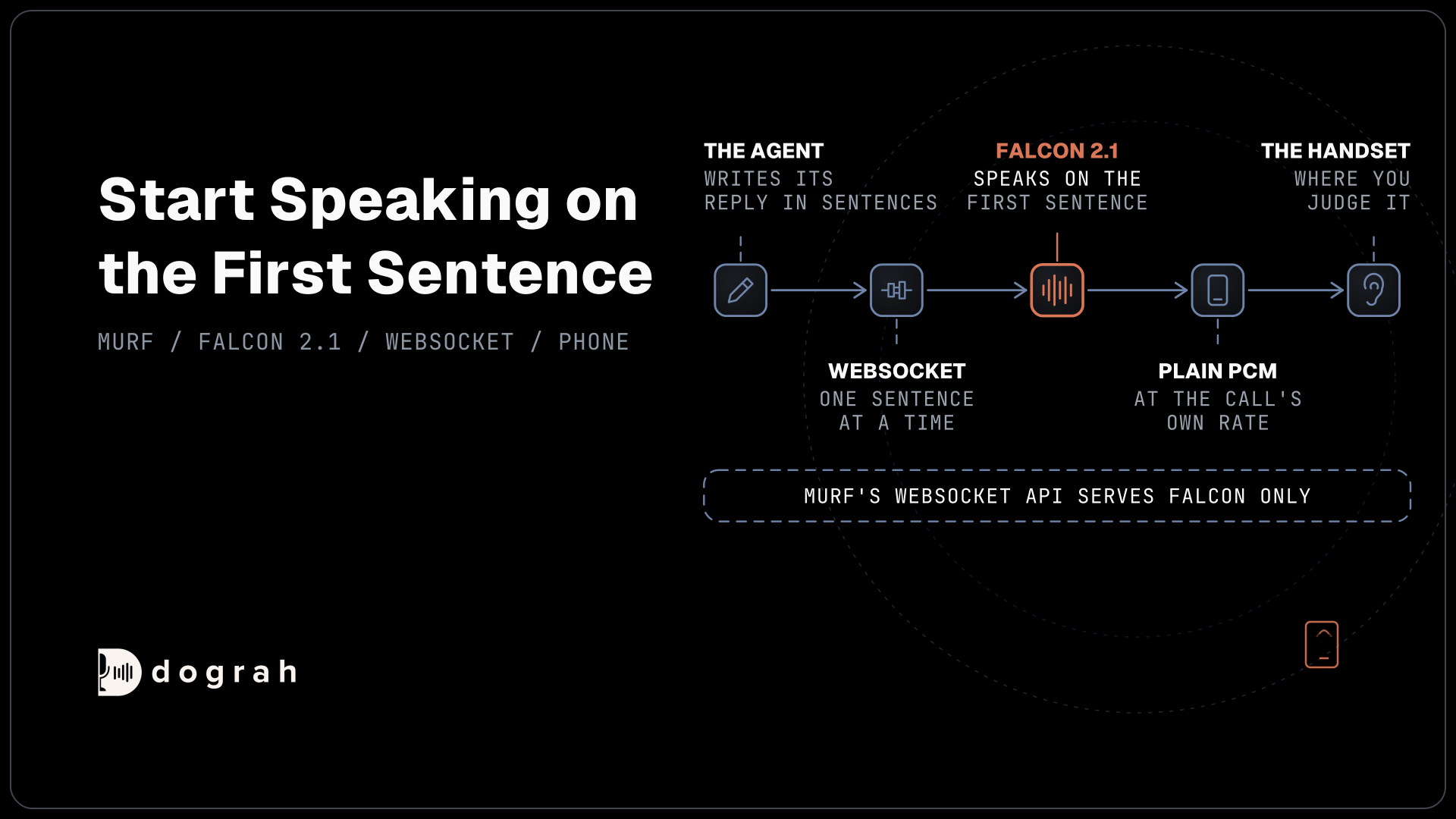
A voice agent writes its reply a few words at a time, and MiniMax's bidirectional WebSocket is built for that. Text can arrive in any size of chunk, the server gathers it into sentences, and a chunk that ends in sentence punctuation is spoken right away. The same connection takes text in and sends audio back for the whole reply.
The output fits phone lines directly. The API offers an 8,000 sample rate and G.711 mu-law, the format most phone networks carry, alongside plain PCM. Dograh opens one WebSocket session per call and asks for audio at the call's own rate, 8 kHz on Twilio, Telnyx, Plivo, Cloudonix, Asterisk ARI, Exotel and Vobiz, and 16 kHz on Vonage and WhatsApp.
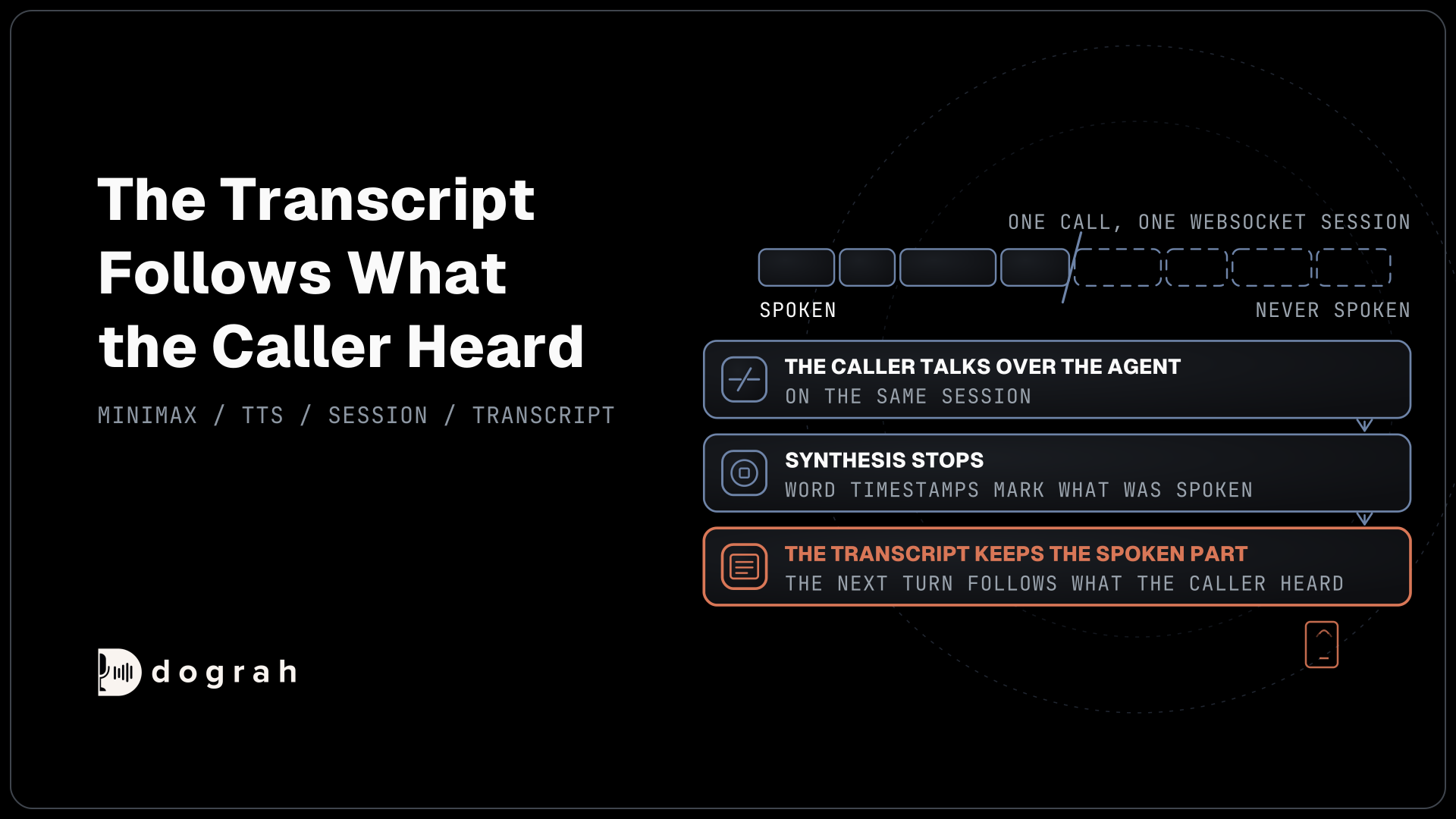
Interruptions are handled on the same session. When the caller talks over the agent, synthesis stops, and word timestamps keep the part of the reply that was actually spoken in the transcript, so the next turn of the conversation is based on what the caller heard.

Open Source Alternative to Vapi / Retell
Self-hosted voice agent platform — no per-minute fees
dograh-hq/dograh
Star on GitHub
Voices, languages and pronunciation
MiniMax voices are named by ID, such as English_Graceful_Lady or English_Persuasive_Man, and a team can add its own. Rapid Voice Cloning costs $1.5 per voice and Voice Design, which builds a new voice from a description, costs $3 per voice, both charged the first time the voice is used.
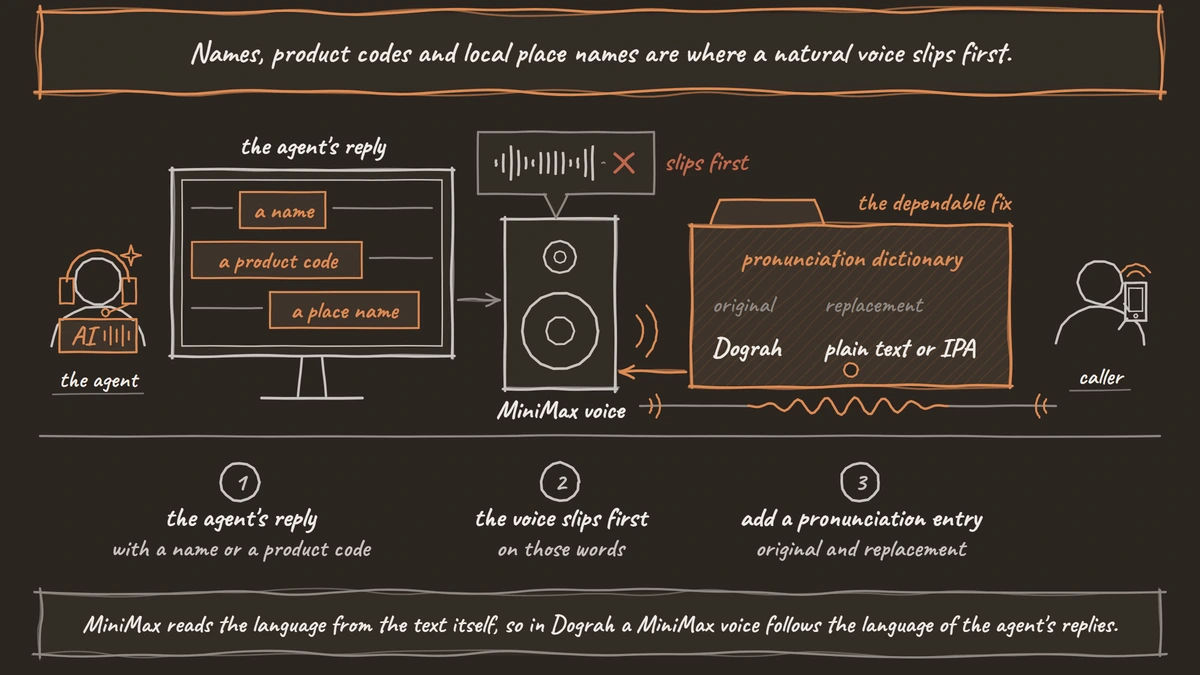
MiniMax reads the language from the text itself, so in Dograh a MiniMax voice follows the language of the agent's replies. Keep the agent's prompt in the language callers speak, and pick a voice made for that language, since an English voice reading Spanish text sounds like a visitor.
Names, product codes and local place names are where a natural voice slips first. Dograh's pronunciation dictionary for MiniMax takes entries written as original and replacement, such as Dograh/(ˈdoʊɡrɑː), in plain text or IPA. Text normalization offers basic and quality, though MiniMax treats quality as basic over the streaming connection, so the dictionary is the dependable fix. Our post on how to reduce robotic-sounding TTS covers the prompt side of the same problem.
What a month of MiniMax speech costs
MiniMax charges by the character, $100 per million on Speech 2.8 HD and $60 per million on Turbo. Here is an example for an appointment line.
- 1,000 calls a month, with the agent speaking about 1,800 characters on each.
- 1,000 x 1,800 = 1.8 million characters.
- 1.8 million x $100 per million = $180 on HD, or 1.8 million x $60 per million = $108 on Turbo.
Repeated lines are where the bill shrinks. Dograh's Speech Caching reuses generated MiniMax audio for repeated phrases for 24 hours, so a greeting spoken on many calls is generated once and reused until it expires. Lines that never change can also play as pre-recorded clips, which send no characters at all.
Our guide to pre-recorded audio and TTS shows which lines suit each, and the best text-to-speech APIs for voice agents puts MiniMax's rate beside other vendors.
Join the Dograh Community
Dograh is an OSS alternative to Vapi. Join our Slack community for queries, releases, best practices & community interactions.
Setting up a MiniMax voice in Dograh
MiniMax is a built-in voice provider in Dograh, so it runs on your own key with no code, and the Group ID comes first. Open Providers in the sidebar, click Add Provider and choose MiniMax. The provider connection takes the API key, the Group ID from your MiniMax dashboard under Account, then Group, and a Base URL. Without a Group ID the call fails with the message "MiniMax TTS requires a group_id".
The Base URL defaults to MiniMax's global endpoint, https://api.minimax.io/v1/t2a_v2. Change it to https://api-uw.minimax.io/v1/t2a_v2 for US-West, or to https://api.minimaxi.chat/v1/t2a_v2 for an account on MiniMax's mainland China platform.
Next, open Models, click Add Configuration and choose BYOK, then pick the MiniMax connection on the TTS tab. The voice settings show Model, which defaults to speech-2.8-hd with speech-2.8-turbo as the other choice, and Voice, which defaults to English_Graceful_Lady and accepts any voice ID. Speed runs from 0.5 to 2.0, Volume from just above 0 to 10, and the pronunciation entries go in the same form.
To turn on caching, open the agent's Settings, go to General and switch on Enable Speech Caching, which is off by default. Each agent picks its model configuration in the editor's Model tab, and the live agent changes when you publish. Test with the Phone Call button in the editor header, then open the call trace to see the voice time of each turn on HD and on Turbo.
Where the text goes and running Dograh yourself
MiniMax receives the text of each reply at the endpoint set in the Base URL and returns audio, so the words reach MiniMax even when Dograh runs on your own servers. Bring your own key moves the contract to your MiniMax account, while the text still travels out. Dograh is the orchestration layer that runs the call flow, tools and telephony, and the speech and language models are a separate layer you choose, so a team that cannot send text out at all would pick an open voice on its own GPU.
The MiniMax bill reaches your own account wherever the platform runs. Self-hosted Dograh has no per-minute platform fee, but servers, model keys and phone minutes still cost money. Dograh Cloud charges a 1¢-a-minute platform fee. If you host it, the server, database and upgrades are your team's job, with community help on the open-source edition and custom SLAs on Enterprise.
Start with Turbo on a test number, switch on Speech Caching, and move to HD only if callers notice the difference.
Glossary
- Group ID
- An account identifier MiniMax requires with every speech request, found in the MiniMax dashboard under Account, then Group. In Dograh it sits on the MiniMax provider connection.
- Bidirectional WebSocket
- One open connection that takes text in and sends audio back for a whole reply. MiniMax gathers the text into sentences and speaks each one as it completes.
- Sound tags
- Markers such as (breath) or (chuckle) that Speech 2.8 turns into sounds, along with fillers like um and uh, so a reply sounds less read aloud.
- Speech Caching
- A Dograh agent setting that reuses generated MiniMax audio for repeated phrases for 24 hours, so a line spoken on every call is not billed each time.