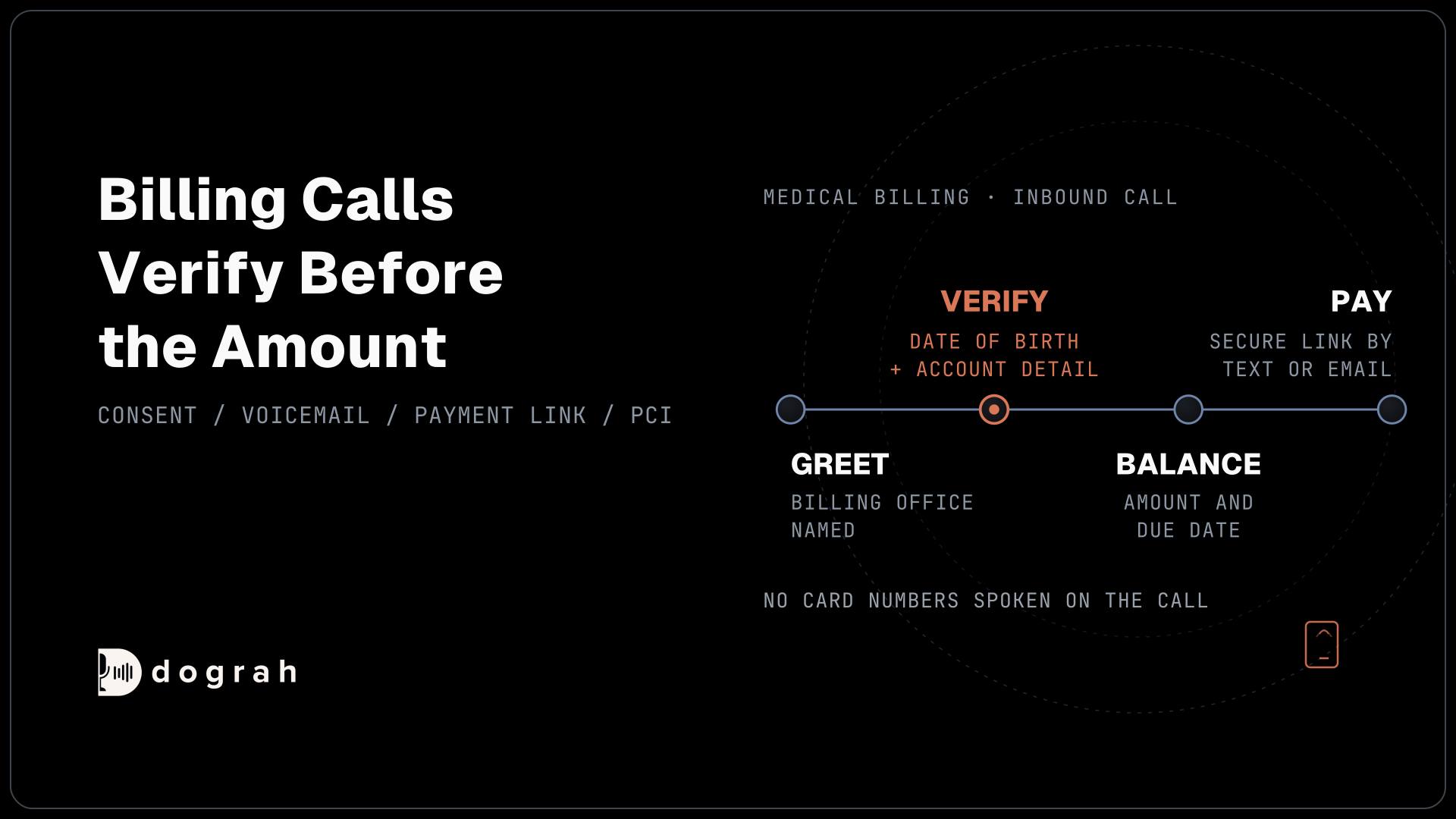

HIPAA-compliant voice AI for medical billing treats a patient's balance as protected health information. The agent verifies the caller before it says any amount and calls about balances only when the patient has consented. Voicemails carry no amounts, and payment goes to a secure link or a payment line, never a card number read aloud.
Key Takeaways
- A balance tied to a named patient is PHI, so it waits for verification.
- Billing calls fall outside the healthcare exemption and need the patient's consent.
- Card numbers never go through the voice call, its recording or its transcript.
A balance read to the wrong person tells them a patient got care and what it cost. We cover verifying the caller before any amount, consent for outbound balance calls, payment by secure link instead of voice, and what each call leaves in Dograh. It is part of our guide to voice AI in healthcare.
A balance is health information
A balance looks like a number, but it says a lot. Under the Health Insurance Portability and Accountability Act (HIPAA), the definition of health information covers payment for a person's care, and it covers spoken information as well as records. A balance tied to a patient's name and a provider is protected health information (PHI).
The provider's name can be the most revealing part. "You owe $240 to the oncology group" tells a listener more than any diagnosis code. That is why a billing call runs greet, verify, disclose, the same order as any other patient call, and why the amount is the last thing the agent says, not the first.
Verify the caller before saying the amount
The Greeting Text on the Start Call node names the billing office and asks how it can help. If a recording notice sits in that greeting, turn off Allow Greeting Interruption on the same node, since it is on by default and a caller can talk over the notice. If you use Pre-Call Data Fetch to look up the caller's number, return a record reference only. A matching number finds an account, and it never proves who is calling.
The agent then asks for a date of birth and one account detail, and your endpoint answers verified or not. Verifying patient identity before a voice agent shares PHI covers that endpoint and the failure path in full.
Only after a pass does a second tool return the balance and its due date. Build it as an HTTP API tool whose response holds those two fields and nothing else, since everything the tool returns reaches the model and can be spoken. A short message plays while the lookup runs, and you can add a later update, such as "I'm still checking", if your billing system is slow.
Spouses and adult children often call about a parent's bill. HIPAA lets providers share some details with family when the patient agrees or does not object, but that call takes judgment, so a prompt instruction sends them to billing staff.

Open Source Alternative to Vapi / Retell
Self-hosted voice agent platform — no per-minute fees
dograh-hq/dograh
Star on GitHub
Outbound balance calls need consent
The healthcare exemption that lets providers place reminder calls to mobiles without consent excludes billing outright. The FCC's rule says exempt calls may not include accounting, billing, debt collection or other financial content. Under the Telephone Consumer Protection Act (TCPA), the FCC has also ruled that AI-generated voices count as artificial voices, so a voice agent's balance call to a mobile needs the patient's prior express consent for that number.
Check consent before the number goes on the call list, not during the call. Patient consent for automated healthcare calls covers how consent is given and withdrawn.
Voicemail needs the strictest rule of all, because anyone in the household can play it. Under HIPAA's minimum necessary principle, the message names the billing office and gives a callback number, and never the amount or the provider's specialty. When the patient calls back, the inbound flow takes over and verification happens there.
Payment never happens by voice
Payment happens outside the voice call, and card numbers should never be spoken to the agent. When a verified patient wants to pay, an HTTP API tool asks the provider's billing system or payment provider to send its secure payment link by text or email. The tool reports back whether the link went out, and the patient pays on the provider's own payment page.
A patient who wants to pay on the phone goes to your payment line. Transfer Call works on Twilio, Telnyx, Plivo, Cloudonix and Asterisk ARI. The payment line is dialed first and the patient is joined once it answers, so the patient lands with a billing clerk or a PCI-compliant IVR that takes the card.
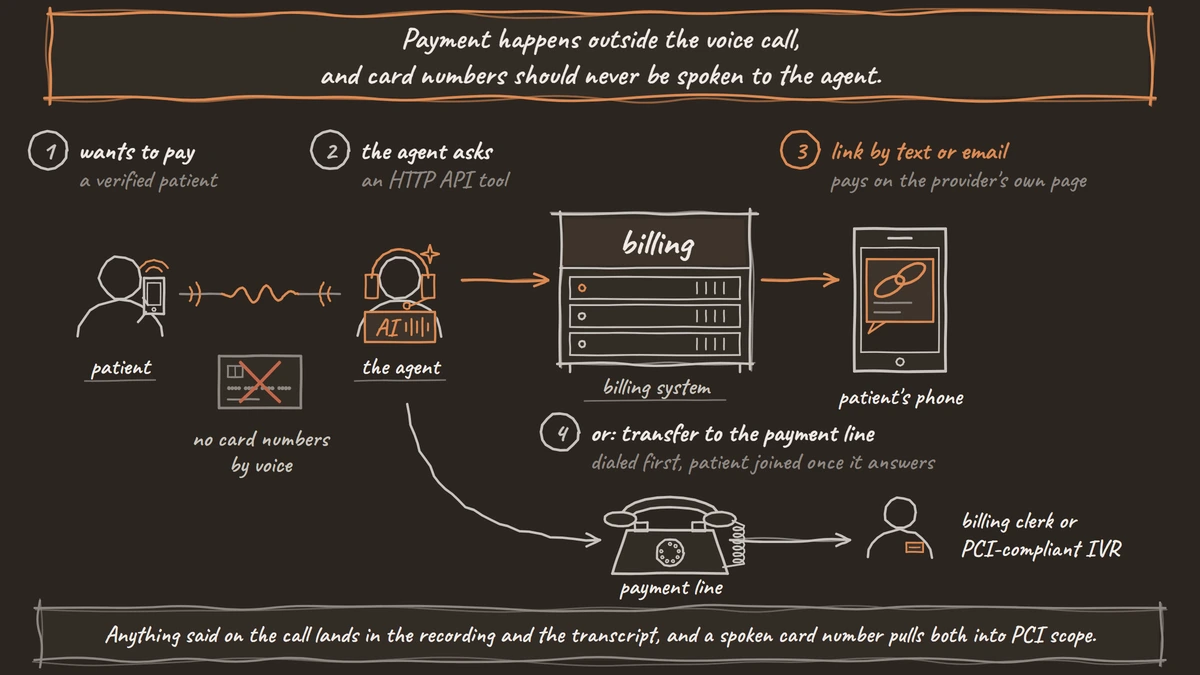
Patients still start reading card digits sometimes. Add a prompt instruction to stop them politely and offer the link instead. Anything said on the call lands in the recording and the transcript, and a spoken card number pulls both into PCI scope. PCI-compliant payment calls with a voice agent covers the payment side in detail.
What a billing call leaves behind
A self-hosted install stores each billing call in your own systems. Three recordings and a transcript go to object storage, and a call record goes to Postgres with the fields the agent extracted, amounts included. Server logs record each tool call's inputs at the default INFO level, so send account references to your billing tools rather than full statements. What counts as PHI on a voice agent call maps every copy.
Billing recordings stay until you remove them, so put your retention schedule on your storage, and delete one patient's call by removing its record and files through your own process on the database and storage.
Join the Dograh Community
Dograh is an OSS alternative to Vapi. Join our Slack community for queries, releases, best practices & community interactions.
Run on your own servers, Dograh needs no BAA, since your call data never reaches the company. Check the phone carrier on what it stores, since that decides whether it needs a BAA, and Twilio and many others offer one. A cloud account needs that provider's BAA. Hosted speech and language models receive the audio and text they process, so each provider needs its own review, and open-weight models on your servers keep the audio in-house. Telemetry is on by default in a self-hosted install and sends anonymous usage data, so turn it off with ENABLE_TELEMETRY=false and remove POSTHOG_API_KEY before the first balance call.
A billing office that self-hosts pays no per-minute platform fee to Dograh, though servers, model keys and phone minutes still cost money. Dograh Cloud charges a 1¢-a-minute platform fee instead. Once an account moves to a collection agency, debt collection law adds its own calling rules, so confirm the consent records and the hand-off point with counsel before the first outbound balance call.
Start with inbound balance questions, which need no outbound consent. They prove the verify step, and their transcripts show which payment route patients choose.
Glossary
- Prior express consent
- Permission a patient gives, usually by providing the number for this purpose, for a provider to place an automated or artificial-voice call to it. Billing calls to mobiles need it because the healthcare exemption excludes them.
- Payment link
- A secure web address from the provider's billing system or payment provider, sent by text or email, where the patient pays. The card details go to the payment page, never through the voice call.
- PCI scope
- The systems that handle card data and must meet the card industry's security standard. A card number spoken on a call pulls the recording and transcript into it.
- Minimum necessary
- HIPAA's principle that a disclosure includes only what its purpose needs. A balance voicemail needs a name and a callback number, not the amount or the service.