
At xAI's list price of $1.25 per million input tokens and $2.50 per million output, grok-4.3 handles our 5-minute example call for about $0.038, and grok-4.7 for $0.062 before reasoning. Dograh, the open-source AI voice agent platform we build, connects Grok's text models through OpenRouter, self-hosted or in the cloud.
Key Takeaways
- grok-4.3 runs our example call for about 61% of grok-4.7's price.
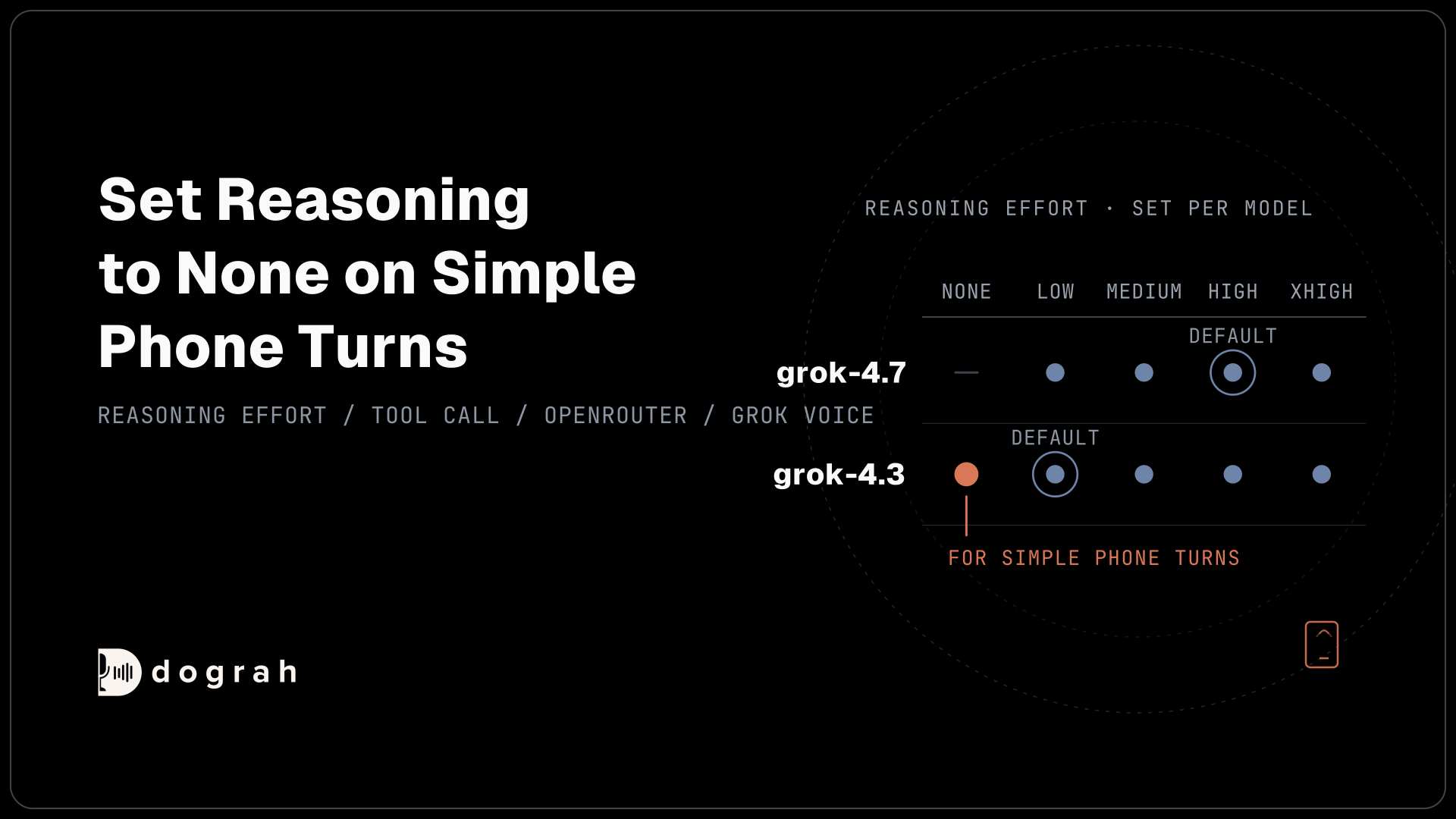
- grok-4.7 reasons at high effort by default, which adds tokens and wait.
- For simple phone turns, set grok-4.3's reasoning effort to none.
This post is part of our guide to LLM API pricing for voice agents, where we count the tokens in one phone call and price it model by model. Here we run it on each Grok model in Dograh to find when the faster one is enough.
xAI's prices for each Grok model
xAI prices its Grok models per million tokens, with a lower rate for input it has seen recently. The rates below are xAI's model prices and apply to prompts under 200,000 tokens, which covers any phone call. Past that size, every token in the request bills at double.
| Model | Context window | Input | Cached input | Output |
|---|---|---|---|---|
| grok-4.7 | 500,000 | $2.00 | $0.50 | $6.00 |
| grok-4.6 | 500,000 | $2.00 | $0.50 | $6.00 |
| grok-4.5 | 500,000 | $2.00 | $0.30 | $6.00 |
| grok-4.3 | 1,000,000 | $1.25 | $0.20 | $2.50 |
| grok-4.20-0309-non-reasoning | 1,000,000 | $1.25 | $0.20 | $2.50 |
| grok-build-0.1 | 256,000 | $1.00 | $0.20 | $2.00 |
The grok-4.20 reasoning and multi-agent variants carry the same rates as grok-4.3. Requests sent to xAI's US regional endpoint cost 10% more.
One 5-minute call on each Grok model
Our example call is the one the guide builds: 12 turns, each sending a 2,000-token system prompt with the conversation so far and about 25 new tokens from the caller, and each returning a reply of about 50 tokens. Across the call that is 29,250 tokens in and 600 out.
On grok-4.3, input costs 29,250 x $1.25 / 1,000,000 = $0.0366 and output 600 x $2.50 / 1,000,000 = $0.0015, so the call costs $0.0381, about $0.0076 a minute. The same sum on each model gives the table below.
| Model | 5-minute call, no cache | Per minute | Best-case cache |
|---|---|---|---|
| grok-4.7 or grok-4.6 | $0.0621 | $0.0124 | $0.0225 |
| grok-4.5 | $0.0621 | $0.0124 | $0.0172 |
| grok-4.3 or grok-4.20 non-reasoning | $0.0381 | $0.0076 | $0.0103 |
| grok-build-0.1 | $0.0305 | $0.0061 | $0.0093 |
The cached column assumes every turn after the first reads its earlier part from cache, leaving 2,850 new tokens and 26,400 cached. xAI caches automatically when requests start the same way, and its caching guide recommends sending an x-grok-conv-id header to raise the hit rate. Budget on the no-cache column until your usage shows cache hits.

Open Source Alternative to Vapi / Retell
Self-hosted voice agent platform — no per-minute fees
dograh-hq/dograh
Star on GitHub
Reasoning is the cost the table leaves out
Reasoning tokens bill as output, and on Grok they can outweigh the spoken reply. Our example counts only the 50 tokens the agent says each turn. A reasoning model writes its thinking first, and that thinking is billed at the output rate and has to finish before the first word reaches the caller.
xAI sets the reasoning effort options per model. grok-4.7 offers low, medium, high and xhigh effort, with high as the default. grok-4.3 adds a none setting to the same list and defaults to low. For example, if grok-4.7 thinks for 100 tokens a turn, the call adds 1,200 output tokens, another $0.0072, which takes it from $0.0621 to about $0.069. The price is the smaller problem. The wait is the bigger one.
Artificial Analysis measures time to first answer token on its own benchmark tasks, which carry longer prompts than a phone turn. grok-4.7 at high effort averages about 31 seconds there, and at low effort about 9. grok-4.3 without reasoning averages about 1.2 seconds. A phone turn should come back in about 800 milliseconds in total, so reasoning at any effort is a poor fit for live turns.
When the smaller, faster model is enough
For most phone agents, grok-4.3 with reasoning set to none is the model to start with. Booking a slot or confirming an order are short, structured turns, and the agent's prompt and tools already carry the logic. It costs about 61% of grok-4.7 per call, and without reasoning it answers in a time a caller can live with.
grok-4.7 is worth its price on turns where the agent must weigh several facts before answering, such as a dispute or an eligibility check. Even then, keep that work off the live turn where you can. A tool call to your own system can do the checking, and the agent only reads back the result.
Price is only one test. The first check in choosing an LLM for voice agents is whether tool calls survive spoken input, and grok-4.3 should pass it before you budget on it.
Grok in Dograh: text models and Grok Voice
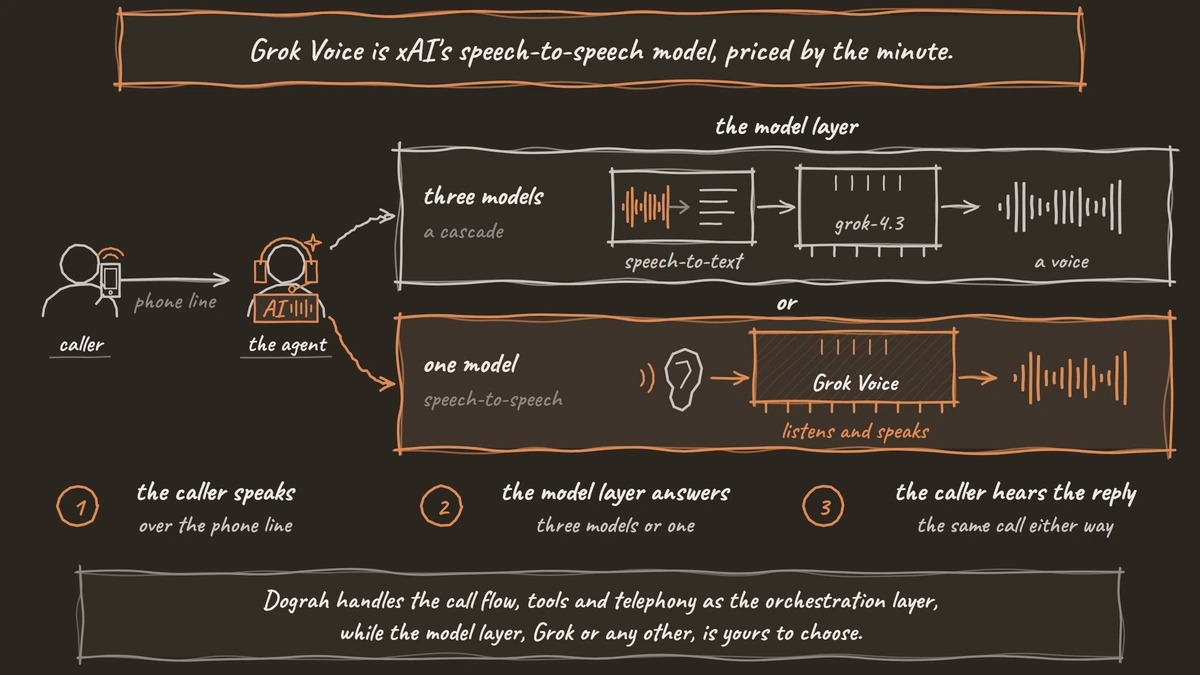
In Dograh, Grok's text models run through OpenRouter with your key, and Grok Voice runs as a realtime option. Dograh handles the call flow, tools and telephony as the orchestration layer, while the model layer, Grok or any other, is yours to choose. OpenRouter sets its own price for each Grok model, so treat xAI's rates above as a guide to that bill.
Grok Voice is xAI's speech-to-speech model, priced by the minute. grok-voice-3.0 costs $0.08 a minute plus $0.004 per text input, so our five minutes come to about $0.40. That one price covers listening and speaking, while a cascade on grok-4.3 adds speech-to-text and a voice to its $0.0381. Our comparison of realtime voice APIs for phone agents covers how Grok Voice sounds and handles a call.
Each agent can use its own model, saved as a named model configuration, so a support agent on grok-4.3 and an escalation agent on a larger model can sit side by side. Self-hosted Dograh has no per-minute platform fee, but servers, model keys and phone minutes still cost money. Dograh Cloud charges a 1¢-a-minute platform fee. The Grok tokens stay on your own OpenRouter or xAI bill.
Join the Dograh Community
Dograh is an OSS alternative to Vapi. Join our Slack community for queries, releases, best practices & community interactions.
Glossary
- Reasoning effort
- The setting that controls how much a Grok model thinks before it answers. grok-4.7 defaults to high and grok-4.3 to low, and only grok-4.3 offers none, which suits short phone turns.
- Cached input
- Input that matches the start of a recent request and bills at a lower rate, $0.20 per million on grok-4.3 against $1.25 for new input. xAI applies it automatically when requests begin the same way.
- Time to first answer token
- The time before the first word of a reply appears, thinking included. On a phone call the voice cannot start until it arrives, so it decides whether the caller hears silence.
- Speech-to-speech model
- A model that takes the caller's audio and answers in audio, with no separate speech-to-text or voice step. Grok Voice is priced per minute for this, where Grok's text models bill per token.