
Genesys Cloud pricing runs from $75 per user a month for CX 1 to $240 for CX 4, billed annually. AI is metered in Experience Units, $1 each in Genesys's US billing example. For teams that want to own the voice agent beside Genesys, Dograh, the open-source AI voice agent platform, runs self-hosted or on Dograh Cloud.
Key Takeaways
- Genesys lists CX 1 to CX 4 at $75 to $240 per user monthly.
- AI features draw Experience Units, $1 each in Genesys's US billing example.
- A tier checkmark grants access to a product, not free use of it.
Genesys prints four seat prices, but most AI on its bill is counted in units. We cover the tiers, how units meter AI, what a unit costs and a worked month, then fair use and what to ask, and then we talk about how Dograh fits beside Genesys.
Genesys Cloud's four tiers and what each adds
Genesys Cloud sells four tiers, priced per user a month and billed annually. Genesys's pricing page bases every price on an annual commitment and notes that usage-based pricing may apply.
| Tier | Price per user a month | What the tier adds |
|---|---|---|
| CX 1 | $75 | Voice, routing, speech-enabled IVR, outbound, recording |
| CX 2 | $115 | Digital channels, omnichannel routing, quality and knowledge |
| CX 3 | $155 | Full WEM, forecasting and scheduling |
| CX 4 | $240 | Journey and resource management, 30 Experience Units per named agent |
Every organization also gets a monthly pool of Experience Units, 250 on named-user licenses and 350 on concurrent ones. Genesys sells three license types, named, concurrent and hourly interacting, and the US page lists named prices only. A team that runs shifts should ask for concurrent pricing in writing, since the pool and some per-user allowances are larger on concurrent licenses.
The annual commitment also fixes the seat count for the year. Before signing, ask how seats added mid-term are priced and whether the count can come down at renewal, because the published prices assume that commitment and a center that shrinks keeps paying for the seats it bought.
What each tier leaves as an add-on
The lower tiers list features that cost extra. On Genesys's feature matrix, digital channels and omnichannel routing are add-ons on CX 1. WEM is an add-on on CX 1 and CX 2, and so are speech and text analytics. AI Studio, AI Guides and virtual agents carry a units marker on every tier, which means they draw Experience Units whatever tier you buy.
Genesys's help center explains the marker. A checkmark means the license qualifies you to use a product, and it "does not mean the product is included at no additional cost." Read the matrix as a list of what you may switch on. Then price each feature you plan to use, either as an add-on or as units.
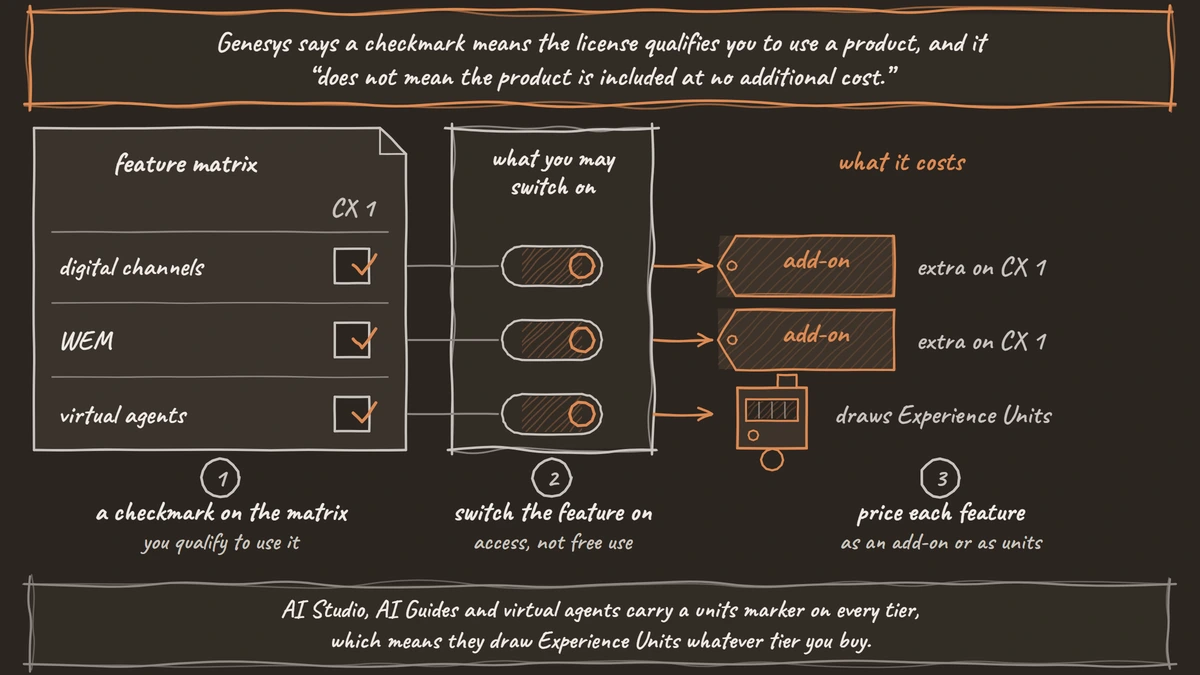
This changes how tiers compare. A CX 1 team that needs chat, WEM and analytics pays three add-ons on top of $75, while CX 2 at $115 includes digital channels and CX 3 at $155 adds WEM and analytics. Price the add-ons on the lower tier before choosing it, because the gap of $80 a user between CX 1 and CX 3 can close quickly.
How Experience Units meter AI
Experience Units are the one meter for Genesys AI, and each feature draws them at its own rate. Genesys renamed its AI Experience tokens to Genesys Cloud Experience Units on 6 November 2026, and calls it a name change only. The Experience Units model lists the rates.
| AI feature | What one unit buys |
|---|---|
| Voice bot | 17 minutes, each call rounded up to 15 seconds |
| Digital bot | 51 sessions |
| Virtual Agent | 2 interactions (0.5 units each) |
| Agentic Virtual Agent | 1.2 units per interaction |
| Agent Copilot | 40 units per named user (60 concurrent) |
| Speech and text analytics | 30 units per named user (45 concurrent) |
| AI Summary and Insights | 50 summaries |
| AI Scoring | 20 evaluations |
| AI Translate | 2 translations |
| Predictive routing | 17 routes |
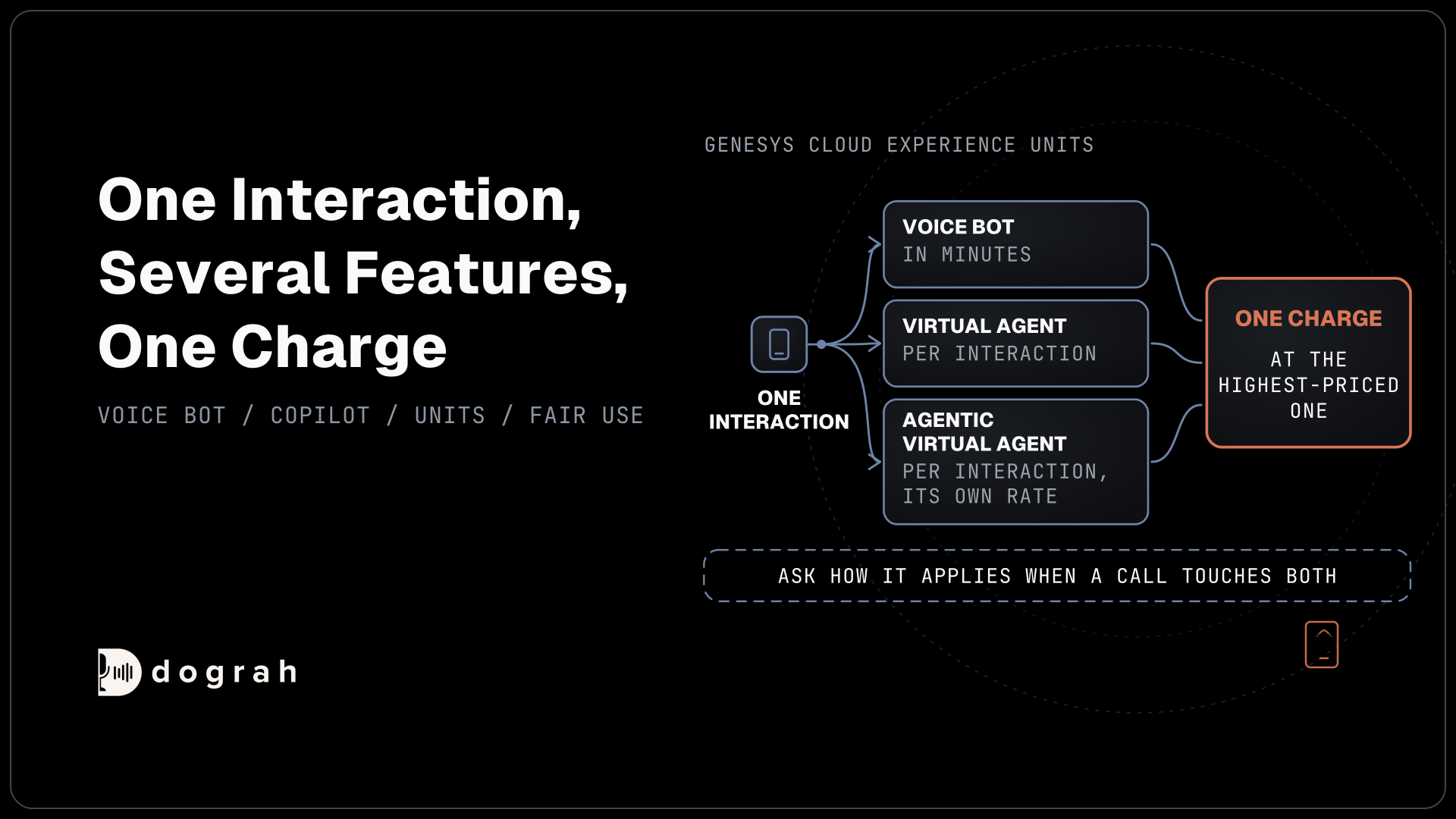
Units renew each month and do not carry over. When one interaction uses several AI features, Genesys bases the charge on the highest-priced one.
Some features share a meter. With Agent Copilot switched on, Supervisor Copilot summaries and insights draw no units of their own, because Genesys says they rely on Agent Copilot. A team planning both should price Copilot first and treat the supervisor features as part of it.

Open Source Alternative to Vapi / Retell
Self-hosted voice agent platform — no per-minute fees
dograh-hq/dograh
Star on GitHub
What a unit costs and how the invoice reads
Genesys's own billing example prices a unit at $1 for a US customer. The units billing article calls this "the published rate for this United States customer", and adds that its figures are representative only. Confirm the unit rate for your currency and contract in your order form.
The example shows how overage works. A customer runs 15,912 minutes of voice bot time in a month. That is 936 units, and after the 250-unit pool, 686 units are overage, billed at $686. Genesys bills overage monthly in arrears, whether the contract is monthly or annual.
The invoice then shows an average rate rather than $1. Genesys spreads the charge across every unit used, including the free ones, so the same example reads as 936 units at about 73 cents. That average falls as more of your usage sits inside the pool, so compare months by total units and overage instead of the rate on the invoice.
Units can also be bought ahead. Genesys offers prepaid units monthly or annually, with usage billing for anything past them, and a prepaid commitment is the place to ask for a lower rate. Organizations still on the older AI Experience bundles move to units when their contract renews, so a renewal is also the moment to check which features your current bundle covered.
A worked month for 50 CX 2 agents
A worked month needs one assumption per meter, and the figures are our estimate at Genesys's $1 example rate. Take 50 named agents on CX 2, a voice bot that answers 3,000 calls averaging four minutes, and Agent Copilot for every agent.
| Line | Units | Amount a month |
|---|---|---|
| 50 CX 2 seats at $115 | $5,750 | |
| Voice bot, 12,000 minutes at 17 a unit | about 706 | |
| Less the 250-unit pool | about 456 billed | about $456 |
| Agent Copilot, 50 users at 40 | 2,000 | about $2,000 |
| Total before telephony and other usage | about $8,206 |
Copilot outweighs the voice bot here, because it is billed per user whatever the call volume. Rounding each call up to the next 15 seconds adds a little to the bot line. The seat line alone is $69,000 a year on the annual commitment.
Swap the voice bot for the agentic virtual agent and the AI line changes shape. The same 3,000 calls at 1.2 units each come to 3,600 units, about $3,350 after the pool. Our Genesys Cloud AI alternatives post sets these lines beside other suites at 500 seats.
Join the Dograh Community
Dograh is an OSS alternative to Vapi. Join our Slack community for queries, releases, best practices & community interactions.
Fair use meters and what to ask Genesys
Each seat comes with a fair use allocation on several meters, and usage past it is billed. Genesys's fair use policy covers BYOC Cloud minutes, data storage, basic routing and IVR, API calls, voice transcription, bring-your-own SMS and outbound campaigns. Committed overage tiers are open to negotiation.
BYOC Cloud is the clearest example. A CX 2 named seat comes with 5,000 BYOC Cloud minutes a month (100,000 for 20 agents), so the 50 agents above have 250,000 minutes before overage of $0.00120 a minute in 6-second steps. Basic IVR minutes count from the start of the flow, including time spent in a bot flow or a virtual agent.
A short question list closes the gaps. Ask for the unit rate in your currency and whether prepaying lowers it. Ask which meter your voice flows use, minutes for a voice bot or interactions for a virtual agent, and how the highest-tier rule applies when a call touches both. Ask for concurrent seat prices if you run shifts, and for each add-on your tier lists as extra. Last, ask for the overage rates on every fair use meter at your expected volume, and how long recordings and transcripts are kept.
Where Dograh fits beside Genesys
Dograh, the open-source AI voice agent platform, handles the calls an AI agent answers, while seats, WEM and digital queues stay in Genesys. What it can take is a call type that would draw voice bot or virtual agent units. A Genesys flow sends those calls to a number the agent answers, and our Genesys Cloud AI vs open source post covers that wiring.
Callers go back to people through an ordinary transfer. Transfer Call dials a Genesys queue number, and Dograh calls the destination first and connects the caller only when someone answers. When nobody answers, the line is busy or the transfer fails, the agent gets the result back and keeps the call going. It runs on Twilio, Telnyx, Plivo, Cloudonix and Asterisk ARI.
The meters work differently on this side. There are no units, and the speech and language models are chosen per agent on your own keys or as open models you host, so each provider bills by its own meter. View Trace shows the speech-to-text, AI and voice time for every turn. For handoff routing in more depth, see our guide to AI voice agents for BPO and contact centers.
The platform is its own line next to the Genesys bill. A self-hosted Dograh install carries no per-minute platform fee, yet the servers it runs on, the model keys and the phone minutes are all paid by you. Keeping the database healthy and applying upgrades falls to your own team. The open-source community answers support questions, and Enterprise brings custom SLAs. For a team that does not want to run servers, Dograh Cloud hosts the platform for a 1¢-a-minute platform fee, and pay as you go includes 10 concurrent calls, with more on request, while a self-hosted install runs 10 by default and can be raised.
Glossary
- Experience Unit
- Genesys Cloud's meter for AI features, renamed from AI Experience tokens in November 2026. Each feature draws units at its own published rate.
- Fair use allocation
- The usage a Genesys license includes each month, such as BYOC Cloud minutes or Experience Units. Usage beyond it is billed as overage.
- Highest-tier rule
- Genesys's rule that an interaction touching several AI features is charged at the rate of the highest-priced one, not the sum.
- BYOC Cloud
- Bring Your Own Carrier on Genesys's cloud, where your carrier supplies phone lines and Genesys meters the minutes against a fair use allocation.