
A funeral home answering service built on an AI voice agent greets every caller in a calm voice recorded by your own staff. When a family calls to report a death, the agent writes down a few facts and rings the on-call director straight away. It answers price questions from your own lists, as the FTC Funeral Rule requires.
Key Takeaways
- Death calls reach the on-call director within a minute, after a few facts.
- Families first hear a greeting recorded by a member of your own staff.
- Price answers come only from your own lists, with no estimates.
A family calling a funeral home at 3 a.m. needs a calm voice and a director quickly. This post sets out how an AI voice agent handles that first call, the script around it, price questions under federal rules and testing before a family relies on it.
A family should reach a person fast
The strongest objection to an AI answering service is a fair one. A family reporting a death should hear a person, and soon. The design below starts from that. The agent's job on a death call is to get the on-call director on the line within a minute, carrying the facts the director needs, and nothing more.
At 3 a.m. the usual alternative is voicemail or an answering service operator who has never met the family. An agent that greets them in a voice your own staff recorded, asks a few gentle questions and rings the director at once is closer to what the family wants than either. Some homes keep a person on first calls during office hours and use the agent at night and for overflow, and that split works well. The setup shown here runs on Dograh, our open-source AI voice agent platform.
Calls are changing in what they ask about, too. The National Funeral Directors Association projects a US cremation rate of 63.4% against 31.6% for burial. More callers ask about cremation options and prices, and the agent should answer those as clearly as questions about a full service.
The first call, step by step
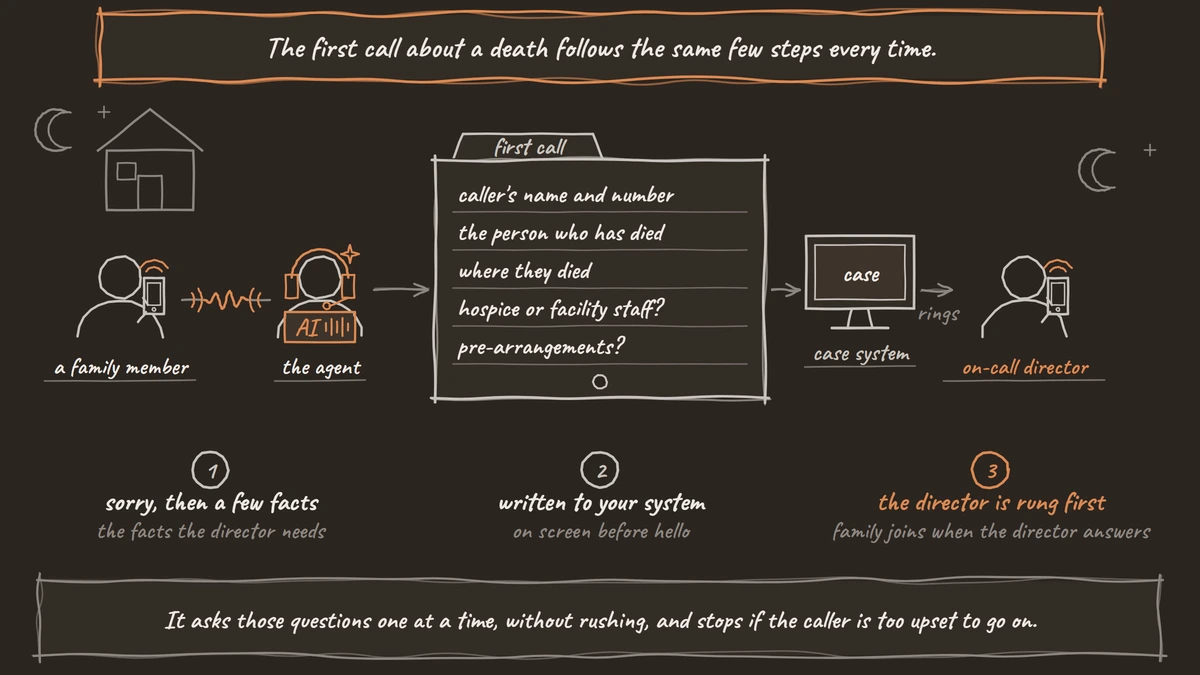
The first call about a death follows the same few steps every time. After the greeting, the agent says it is sorry for the caller's loss and asks for the facts the director needs:
- the caller's name and a callback number
- the name of the person who has died
- where they died, such as at home, in a hospital or in a care home
- whether hospice or a facility's staff are involved
- whether the person made pre-arrangements with your home
It asks those questions one at a time, without rushing, and stops if the caller is too upset to go on. It then writes them to your case system through an HTTP API tool, so the director has them on screen before saying hello.
Then it transfers the call to a person, with the details written to your system first. The Transfer Call tool does this on Twilio, Telnyx, Plivo, Cloudonix and Asterisk ARI. It rings the on-call director first and connects the family only when the director answers. On Twilio it can also play a short spoken introduction that both sides hear, such as the deceased's name and where they died. That introduction is off by default.
When the director does not pick up
Directors sleep, drive and sometimes miss a call. If the on-call phone is not answered within the timeout, 30 seconds by default, the family stays with the agent. It tells them, in the words you choose, that the director will call back shortly, and writes an urgent callback request to your system. Your own on-call setup can then page a second director.
Never leave a family waiting in silence. A short, honest line such as "I could not reach the director just now, and they will call you back within 15 minutes" is kinder than a long hold. Our post on after-hours coverage with AI voice agents covers the on-call side in more detail.

Open Source Alternative to Vapi / Retell
Self-hosted voice agent platform — no per-minute fees
dograh-hq/dograh
Star on GitHub
A calm script for the worst night
Start with the greeting. In the Start Call node, the Greeting Type can be a pre-recorded audio file instead of text read by a synthetic voice. Ask a member of your staff to record a short, warm greeting with the funeral home's name, so the first voice a family hears belongs to someone at your home. If you want callers to know they are speaking with an automated assistant, or a law where you operate requires it, say so in that recording.
Allow Greeting Interruption is on by default, which lets a family start talking at once. Keep it on unless the greeting carries a notice that must play in full.
Keep every line after that short and plain, with one question at a time and no small talk. Ask the agent to repeat names back, because a misspelled name on a death certificate hurts.
Some calls are emergencies. If the caller is not sure the person has died, the agent tells them to call 911 now. If anyone is in danger, it tells them to get to safety and call 911. Write both as fixed Transition Speech, which plays word for word. Deaths under hospice care often reach the hospice first, and our post on AI voice agents for home health and hospice covers that side of the call.
Price questions under the Funeral Rule
Families often call to ask what a funeral or a cremation costs. The Federal Trade Commission's Funeral Rule says a funeral provider must give anyone who asks by phone accurate information from its price lists, along with other readily available information that answers the question. The general price list itself is handed over in person when arrangements are discussed. Some state funeral boards add their own rules on price quotes, so check with your state board and confirm the full set with counsel.
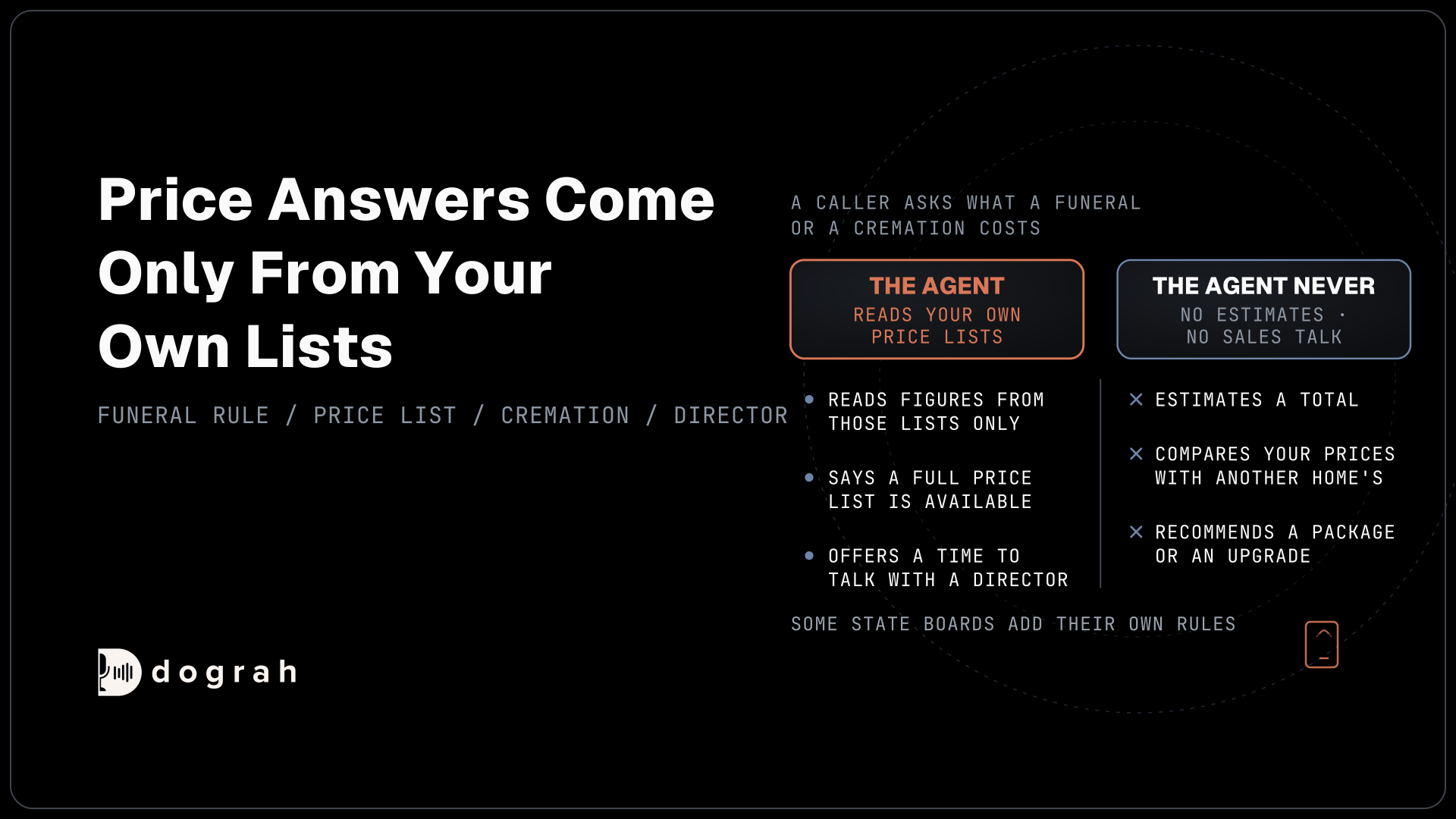
That rule shapes the agent. Load your current general price list, casket price list and outer burial container price list into the Knowledge Base, which takes PDF, DOCX, DOC, TXT and JSON files of up to 5 MB each. The agent reads figures from those lists only. It never estimates a total or compares your prices with another home's.
No sales talk. The prompt tells the agent to answer the question asked, mention that a full price list is available, and offer a time to talk with a director. It never recommends a package or an upgrade. Replace the files the day your prices change, so the list the agent reads is the list you hand out.
The other calls the agent handles
Most calls to a funeral home are not about a death that just happened. People call for service times and directions, to send flowers, to ask about an obituary or to leave a message for a director. The agent answers those from the same Knowledge Base, or takes a message and writes it to your system.
During the day, the same agent can take the overflow when staff are with families. Each call that needs a person still goes to one, through the same transfer.
Hospitals, hospices and care homes call too, often at night, to ask for a removal. Their staff need the same quick route to the director, with a different short list: the facility's name, the contact on shift and whether the release paperwork is ready. Give the agent that second list, so a nurse calling from a ward is not asked questions meant for a family.
Join the Dograh Community
Dograh is an OSS alternative to Vapi. Join our Slack community for queries, releases, best practices & community interactions.
Test it overnight from a real phone
Test calls from the browser cannot transfer, so a browser test proves nothing about the most important part of the call. Call your own number from a mobile, at night, and play each kind of caller: a family reporting a death at home, a hospice death, a price question, a caller who is crying and cannot finish.
Check that the facts reach your case system, that the director's phone rings and that the callback request appears when nobody answers. Then turn on QA, which scores each step of a finished call against your own prompt. Score every price answer against your list in the first weeks, and every first call. Once the line is steady, a random 5 to 10% sample of the other calls is enough. Each call also keeps a full trace of what the agent heard and said.
Where the agent runs
Calls to a funeral home carry names, causes of death and family details. The platform is open source, so the agent can run on your own servers with your own keys for the speech and language models, or in the cloud. Self-hosted Dograh has no per-minute platform fee, but servers, model keys and phone minutes still cost money. Dograh Cloud charges a 1¢-a-minute platform fee.
Each call keeps its recording and transcript, which help when a family later asks what was said. On a self-hosted setup, call recording can be switched off for the whole server, while transcripts are still saved. Decide what you keep before the first call, and delete old files from your own storage on your own schedule.
Glossary
- First call
- The call in which a family or a facility tells a funeral home that someone has died. It starts the removal and the arrangements, so it goes to the on-call director.
- On-call director
- The funeral director responsible for first calls outside office hours. The agent rings this person through Transfer Call after writing the facts down.
- General price list
- The funeral home's itemised list of goods and services with prices. Under the FTC Funeral Rule, phone questions are answered from it and the list is handed over in person.
- Transition Speech
- Fixed text or a recorded clip that a Dograh agent plays word for word when it moves to a new step. Emergency lines use it so the wording never changes.