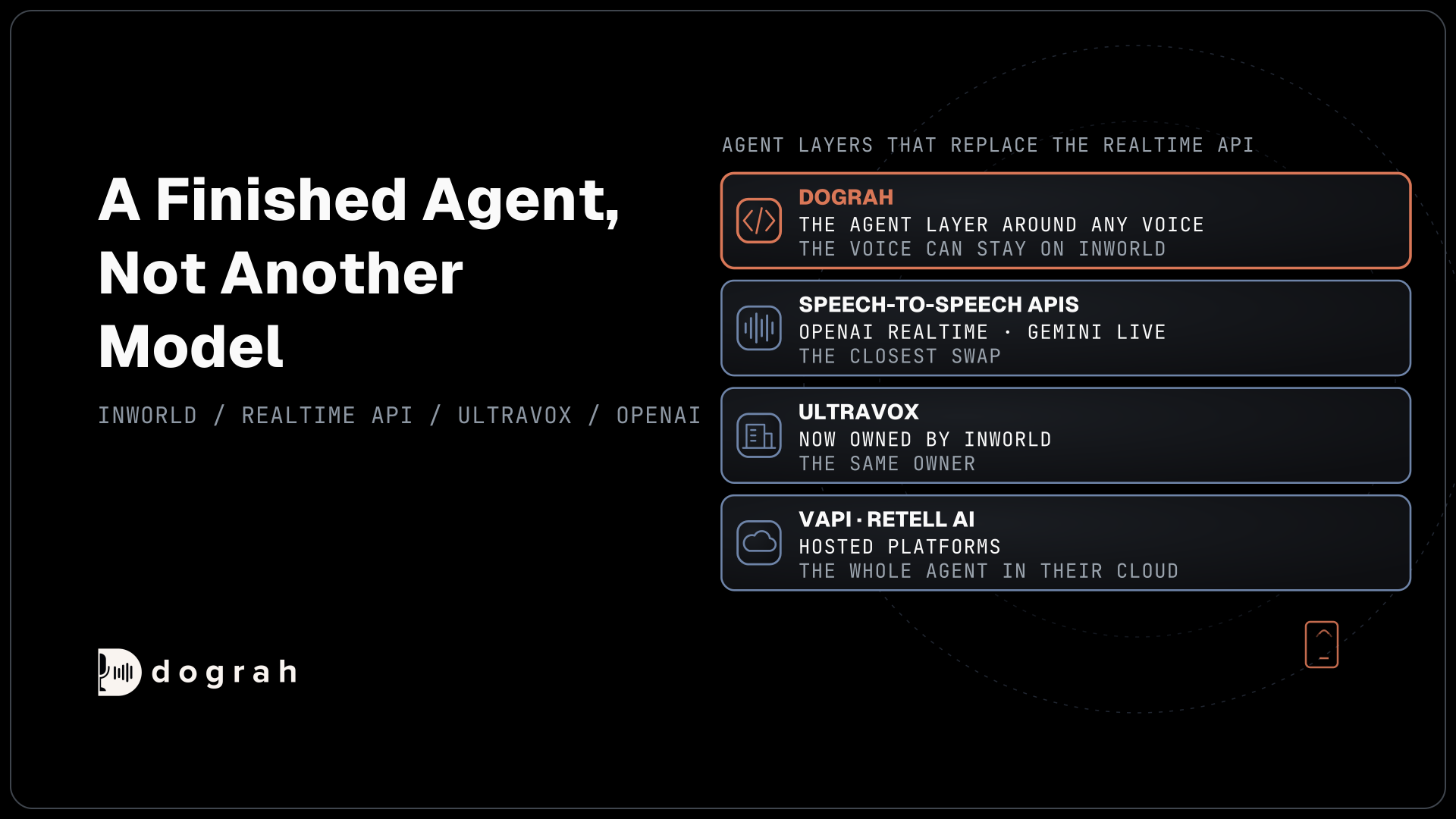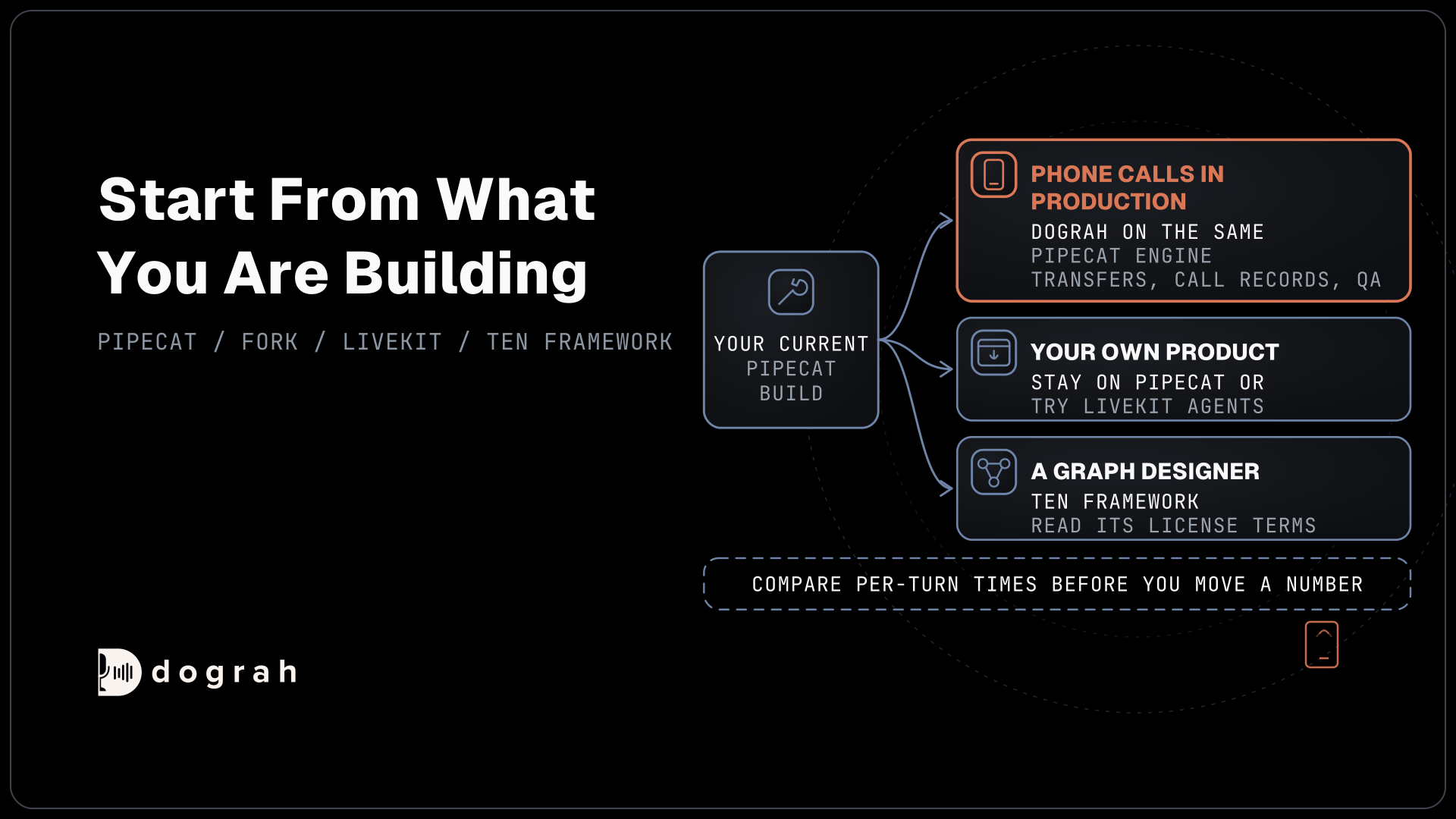

Dograh vs Murf.ai compares a platform with a voice company that now sells agents too. Murf makes Falcon voices, Finch speech-to-text, a voiceover studio and Murf Agents, built by its own team. Dograh, the open-source AI voice agent platform, runs Falcon on your Murf key for teams that want to own the platform, self-hosted or on Dograh Cloud.
Key Takeaways
- Murf Studio edits pitch, speed and pauses per sentence or per word.
- Dograh is the open-source platform and runs Falcon on your Murf key.
- Murf Agents is built and run by Murf's engineers and priced through sales.
Murf.ai is a voice AI company with a voiceover studio, the Falcon voice API and now a managed agent service. Dograh is an open-source AI voice agent platform that can run Falcon as its voice. This post compares the two on both layers, then we talk about when each fits.
Dograh vs Murf.ai at a glance
Some rows show where the two combine, and others where they compete. Each row asks both the same question.
| Row | Murf.ai | Dograh |
|---|---|---|
| What it is | A voice AI company with Studio, the Falcon API, Finch speech-to-text and Murf Agents | An open-source AI voice agent platform |
| Code | Closed models | Open source under BSD 2-Clause |
| Voices | Murf's own library, 200+ voices in 35 languages | Murf on your key, or ElevenLabs, Cartesia, Inworld, Deepgram, Rime and other providers, or open voices you host |
| Speech-to-text | Finch-Indic and Finch-Global | Deepgram, Cartesia, Sarvam, Soniox and others, or Dograh's own models |
| Agents | Murf Agents, designed and run by Murf's team | Built by your team in the Agent Builder or on the canvas |
| Phone | Your phone system or SIP trunks such as Telnyx, Twilio, Vonage, Genesys and Exotel | Twilio, Telnyx, Plivo, Vonage, Exotel, Vobiz, Cloudonix and Asterisk ARI |
| Business systems | Murf lists CRMs, calendars, Zapier, Make and n8n | HTTP API tools, MCP tools, the Webhook node and Pre-Call Data Fetch |
| Where it runs | Murf's cloud. Falcon also on-prem or in your AWS account. Murf says Murf Agents can run in the cloud or on-premise | Your servers with Docker Compose, Dograh Cloud, or on-prem on Enterprise |
| Price shape | Falcon $0.01 per 1,000 characters. Murf Agents through sales | Self-hosted, no per-minute platform fee. Dograh Cloud, 1¢/min platform fee |
| How they combine | Falcon is a voice provider inside Dograh | Since v1.51.0, on your own Murf key |
A voice layer and a platform layer
Murf and Dograh meet on two layers, and the answer differs on each. On the voice layer they work together, because Falcon is one of the voices a Dograh agent can speak with. On the platform layer they are two ways to get a phone agent, since Murf Agents answers inbound and outbound calls as a service that Murf's agent designers and forward deployed engineers build and keep improving.
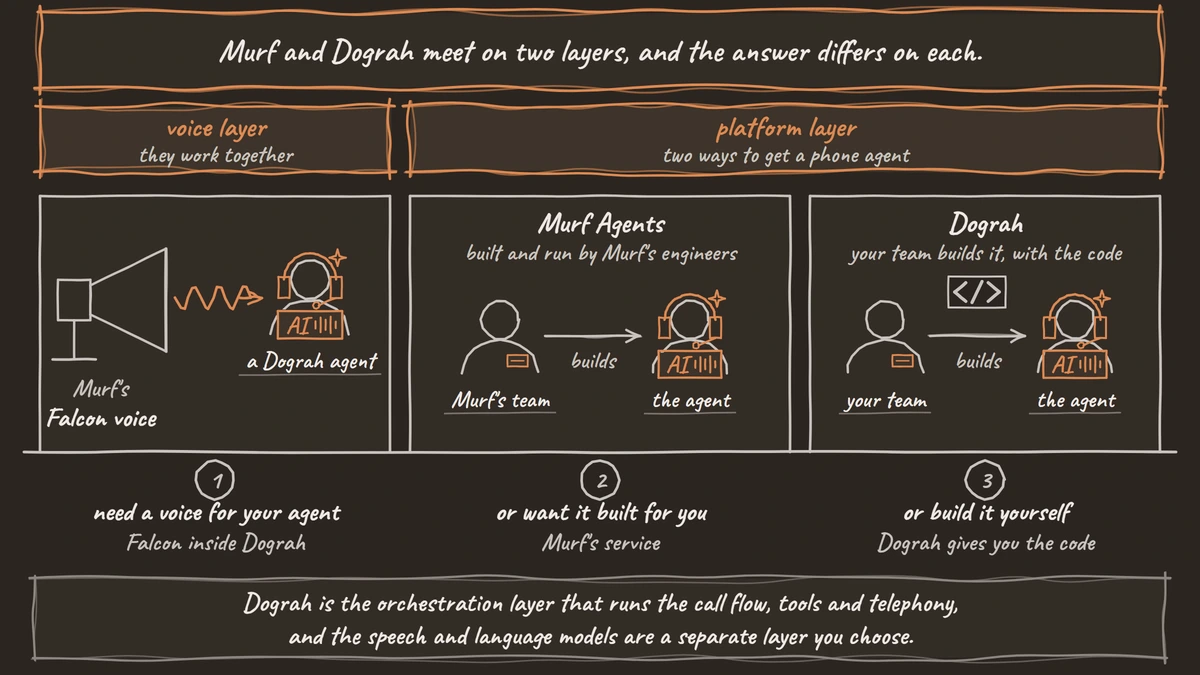
Dograh is the orchestration layer that runs the call flow, tools and telephony, and the speech and language models are a separate layer you choose. Falcon can be the voice in that layer, with any speech-to-text and language model beside it.
So the first question is what you are buying. If you need a voice for an agent you will build and run, Falcon inside Dograh is a normal setup. If you want someone else to build the agent, that is a choice between Murf's service and building on a platform yourself.
Murf's Falcon voice inside Dograh
Falcon has been a built-in voice provider in Dograh since v1.51.0, on your own Murf key. Its client comes from Murf's own open-source Pipecat plugin, which ships under the MIT license. The model field reads falcon-2, which Murf now maps to Falcon 2.1, so the default already uses the current model.
Three more fields set the voice. The voice is a Murf Voice ID from Murf's Voice Library, the locale must be one that voice supports, and the base URL is Murf's global endpoint unless you choose a regional one for data residency. Each agent picks its own voice in the Model tab, so one agent can speak Falcon while another uses a different provider.
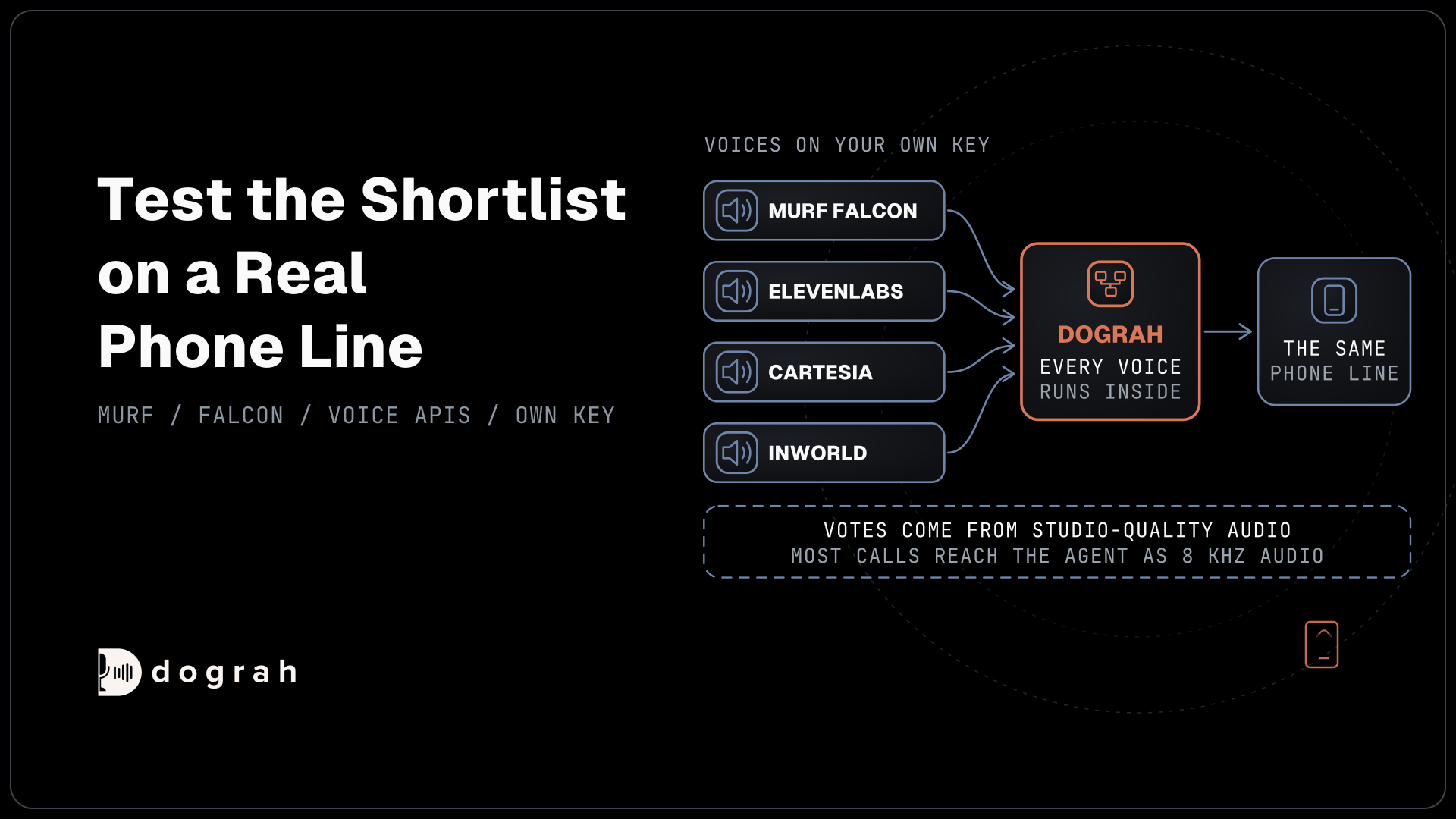
Finch is not offered as a Dograh provider, so the agent hears the caller through Deepgram, Cartesia, Sarvam, Soniox or another speech-to-text option. Our post on Murf TTS for voice agents walks through the setup, Murf's regions and how Falcon sounds on 8 kHz phone audio.

Open Source Alternative to Vapi / Retell
Self-hosted voice agent platform — no per-minute fees
dograh-hq/dograh
Star on GitHub
Murf Agents and Dograh as platforms
Murf Agents is a done-for-you service. Murf says its agents plug into your phone system or SIP trunks such as Telnyx, Twilio, Vonage, Genesys and Exotel, and it lists CRMs such as Salesforce and HubSpot, calendars, and Zapier, Make and n8n among its integrations. Murf adds that buyers can pick cloud or on-premise deployment, with data residency in more than 10 regions. Murf does not publish a price for Murf Agents, and buyers go through Contact Sales.
Dograh leaves the build with your team and gives you the code. You describe the agent to the Agent Builder, approve the requirements it lists, and edit on the canvas afterward. Business systems connect through HTTP API tools and MCP tools during the call, Pre-Call Data Fetch pulls records before the greeting, and the Webhook node sends results out after it.
On the phone side, Dograh connects to Twilio, Telnyx, Plivo, Vonage, Exotel, Vobiz, Cloudonix and Asterisk ARI. On Twilio, Telnyx, Plivo, Cloudonix and Asterisk ARI, Transfer Call dials the destination first and connects the caller only when someone answers. Campaigns run outbound lists, and a QA node scores each step of test and live calls.
Recorded lines with a Falcon fallback
A useful way to combine the two is to record the lines that never change. With pre-recorded audio in Dograh, the greeting and common answers play as recordings of a real person, and the agent falls back to a Falcon voice only when it needs to say something new, such as an order number.
Each pre-recorded clip that plays is text Murf never voices, so it adds no characters to the Falcon bill and starts faster than generated speech. Pick a Falcon voice close to the recorded speaker, so the switch is less noticeable. Our post on pre-recorded audio and TTS covers the pattern in depth.
Join the Dograh Community
Dograh is an OSS alternative to Vapi. Join our Slack community for queries, releases, best practices & community interactions.
Where text goes and what each one bills
With Falcon inside Dograh, the agent's reply text goes to Murf's endpoint to be voiced. Your own key moves the contract to you, while the text still reaches Murf, and the regional endpoint decides where it is processed. Falcon 2.1 can also run on-premise or as a SageMaker endpoint in your own AWS account, which Murf says keeps text and audio in that account, while Dograh's Murf setting points at Murf's own API endpoints. A team that wants the voice on its own servers can run open voices through an OpenAI-compatible speech server instead.
Falcon bills at 1 cent per 1,000 characters on your own Murf account, wherever the agent runs, and our guide to Murf.ai pricing works through a month of calls. The platform is a separate line. Dograh on your own servers, set up with Docker Compose, has no per-minute platform fee of its own. Servers, model keys and phone minutes still cost money, and your team keeps the database running and applies upgrades. The open-source community handles support questions, Enterprise customers get custom SLAs, and Dograh Cloud runs everything for a 1¢-a-minute platform fee, 10 calls at once included.
Where Murf wins
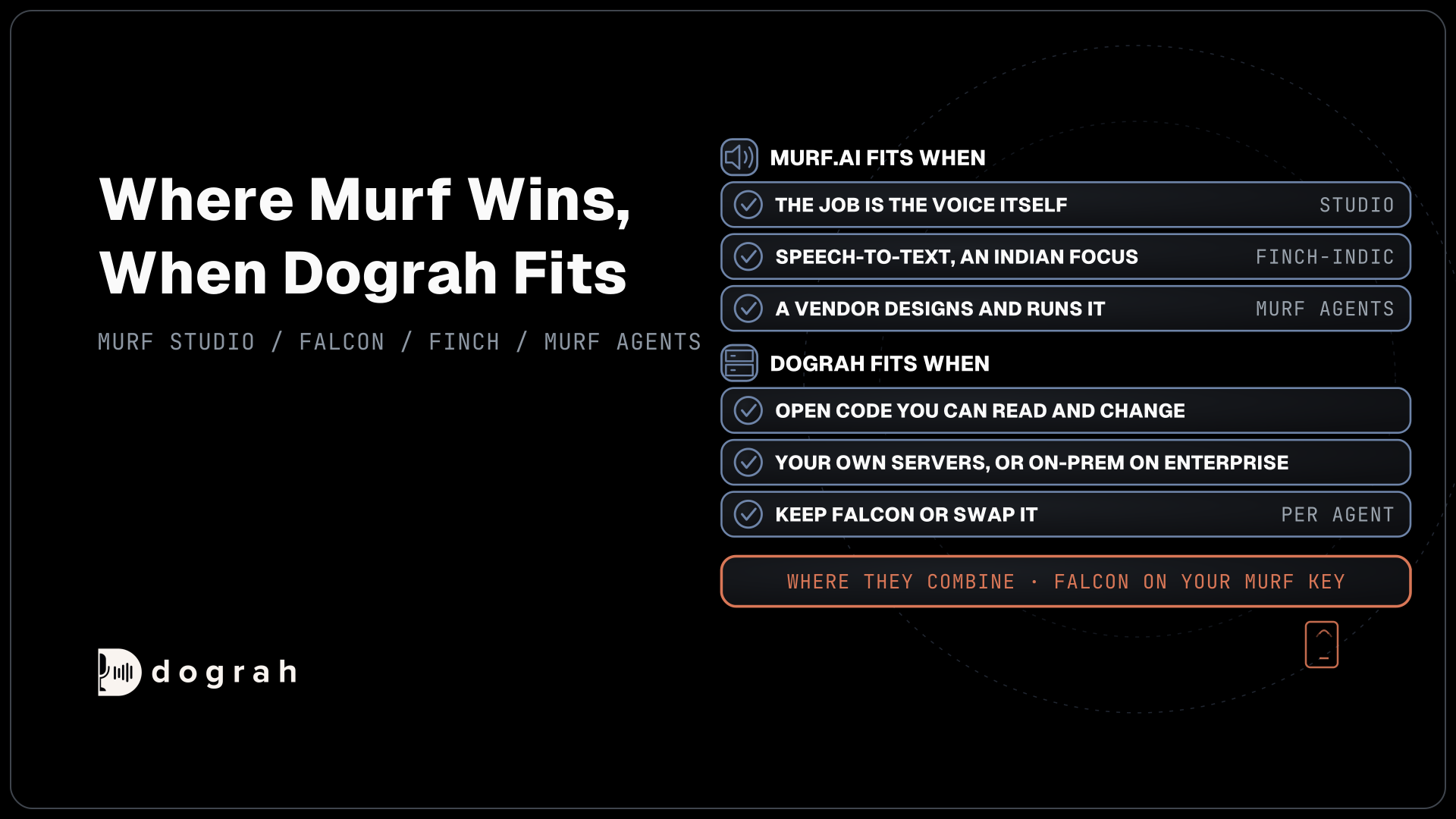
Murf wins wherever the job is the voice itself, or a finished agent you do not want to build. For voiceovers, e-learning and video, Murf Studio sets pitch, speed and pause length per sentence or per word, and its pronunciation editor fixes a word once for every script. Murf lists more than 200 voices in 35 languages, and dubbing and translation sit alongside. A phone platform does not try to replace a media editor.
Murf also covers speech-to-text with an Indian focus. Finch-Indic detects the language on its own and takes 8 kHz phone audio. And for buyers who want a vendor to design, run and keep improving the agent, Murf Agents does exactly that, with its own engineers and an on-premise option. If either of those is your need, Murf fits better.
When Dograh fits
Dograh fits when you want to own the platform around the voice. That means open code you can read and change, the platform on your own servers or on-prem on Enterprise, and the freedom to keep Falcon or swap it per agent without rebuilding anything. If you are still weighing options, our list of Murf.ai alternatives sorts them by what they replace.
To test the fit, start on Dograh Cloud or self-host with Docker Compose, add your Murf key, and set one agent's voice to Falcon. Place a real call with the editor's Phone Call button, then open View Trace and check the voice time for each turn.
Glossary
- Voice Library
- Murf's catalog of voices, each with its own Voice ID. A Dograh agent stores that ID to choose its Falcon voice, with a locale the voice supports.
- Murf Agents
- Murf's voice agent service for inbound and outbound calls. Murf's own designers and engineers build and run each agent, and pricing goes through sales.
- Forward deployed engineer
- A vendor engineer who works inside the customer's project to build and tune the product for them. Murf staffs Murf Agents this way.
- Pre-recorded clip
- A recording of a real person that a Dograh agent plays for a fixed line. It uses no voice provider characters and starts at once.