
Dialpad AI voice agent alternatives are divided into suite agents, dedicated platforms and open-source frameworks. Dograh is the open-source platform that ships ready to use and keeps your agent if you change phone systems, while Vapi, Retell AI and Bland are hosted. RingCentral AI Receptionist and Aircall are the suite agents, and LiveKit Agents and Pipecat are the frameworks.
Key Takeaways
- Dialpad Resolve bills AI Agent Credits only when the AI does real work.
- Suite agents sell one price. Platforms split platform, models and phone.
- A dedicated platform like Dograh keeps your agent if you change phone systems.
Dialpad’s AI agent makes sense for teams that already run on Dialpad. We cover why teams look past Dialpad Resolve and compare every option in one table, then show how Dograh keeps your agent if you change phone systems, before other suite agents, standalone platforms, frameworks and a priced month.
Why teams look for a Dialpad alternative
Two things send teams looking: how Dialpad prices its agent, and how the company is changing. Dialpad's AI agent product is Dialpad Resolve, which Dialpad describes as agentic AI for voice and digital interactions. Dialpad sells it at custom pricing, as a pool of AI Agent Credits. Credits are used only when the AI delivers value, and a conversation is billable only when the AI retrieves information or takes a real action such as scheduling, routing or an order lookup.
That is a fair model for a buyer, because a caller who ends the call after a greeting costs nothing. The catch is that the credit price sits in your quote, so you cannot compare it with a per-minute rate until Dialpad gives you one.
The seats around it are published. Dialpad's Support plans, its contact center tier, list Essentials at $89, Advanced at $119 and Premium at $149 per user a month. Dialpad describes its AI as a cross-platform layer on a dual-cloud architecture, with HIPAA readiness once a business associate agreement is signed.
The company is also changing shape. Dialpad and Ada announced on 4 November 2026 that they are combining. Ask your account team how Resolve fits into the combined product before you sign a long contract.
Dialpad AI voice agent alternatives compared
Every alternative to Dialpad's agent sits on one side of a simple split. A suite agent lives inside the phone system you rent from the same vendor, so the numbers, routing, reports and AI come from one place. A dedicated platform is an agent tied to no phone system. You connect it to whatever you run by forwarding a number or pointing a SIP trunk at it.
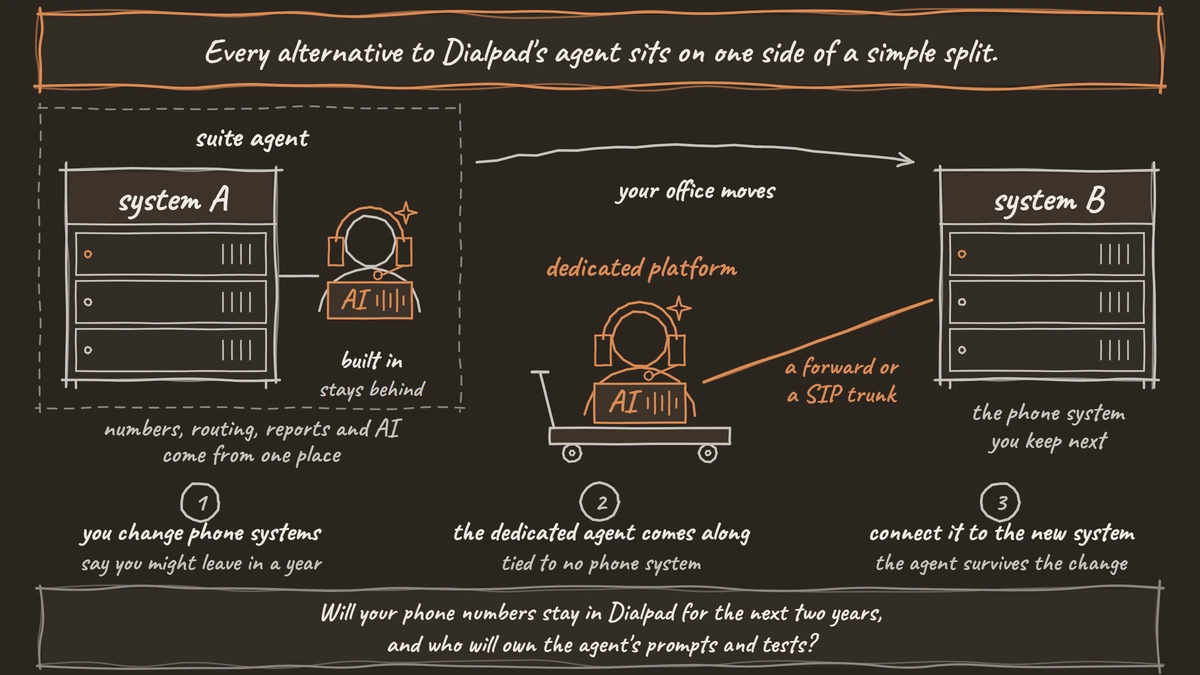
The table sets each option against that split, with the prices each vendor publishes. Dograh, in the second row, comes next, followed by the rival suites and platforms.
| Option | Suite or platform | Phone systems it works with | List price | Open source | What you get, and what's missing |
|---|---|---|---|---|---|
| Dialpad Resolve (baseline) | Suite agent | Dialpad | AI Agent Credits, custom pricing | Closed | Billing only when the AI does real work. Tied to Dialpad, and the credit price sits in your quote. |
| Dograh | Dedicated platform | Forwarded numbers, SIP trunks, Twilio, Telnyx, Plivo and other carriers | Self-hosted no platform fee. Cloud 1¢-a-minute platform fee. Models and phone on top | Open source | The full product with your models and phone line. Your team runs it, or you use Cloud. |
| RingCentral AI Receptionist | Suite agent | Any phone system by forwarding or SIP | $49 a month with 100 minutes, then $0.50 a minute | Closed | Works with any phone system by forwarding or SIP. Minutes past the first 100 cost $0.50 each. |
| Aircall AI Voice Agents | Suite agent | Aircall, standalone option | From $99 a month, $0.29 a minute or bundles | Closed | Standalone from $99 a month, in bundles up to 10,000 minutes. Seats are priced separately. |
| Talkdesk, Five9, NiCE | Suite agent | Their own contact center | AI on top of seat plans | Closed | AI on top of seat plans in their own contact center. Priced for larger centers. |
| Vapi | Dedicated platform | Your carrier or SIP | $0.05 a minute hosting, plus models and phone | Closed | Choose every model. Hosting leaves out models and phone, and HIPAA is a $2,000 a month add-on. |
| Retell AI | Dedicated platform | Your telephony or SIP | $0.055 a minute voice infrastructure, plus models and phone | Closed | A voice infrastructure fee with 20 calls at once included. Model, voice and phone are added. |
| Bland | Dedicated platform | Your carrier or Bland's | $0.14 a minute, or $0.12 plus $299 a month | Closed | Models included in one rate, and you can bring your own carrier. |
| PolyAI | Managed platform | Your phone lines | Plans from $49 a month, or per minute | Closed | A managed build for customer-service teams, with plans from $49 a month or a per-minute Platform plan. |
Dograh: an open-source Dialpad alternative to self-host
Dograh is the open-source AI voice agent platform we build, released under the BSD-2-Clause license with its source on GitHub. It belongs on the dedicated-platform side, so Dialpad can stay your phone system while the agent answers the calls you send it. It is a finished product rather than a framework: a visual flow builder, telephony, call transfer, a history of every call, and QA that scores each step of a call, test or live.
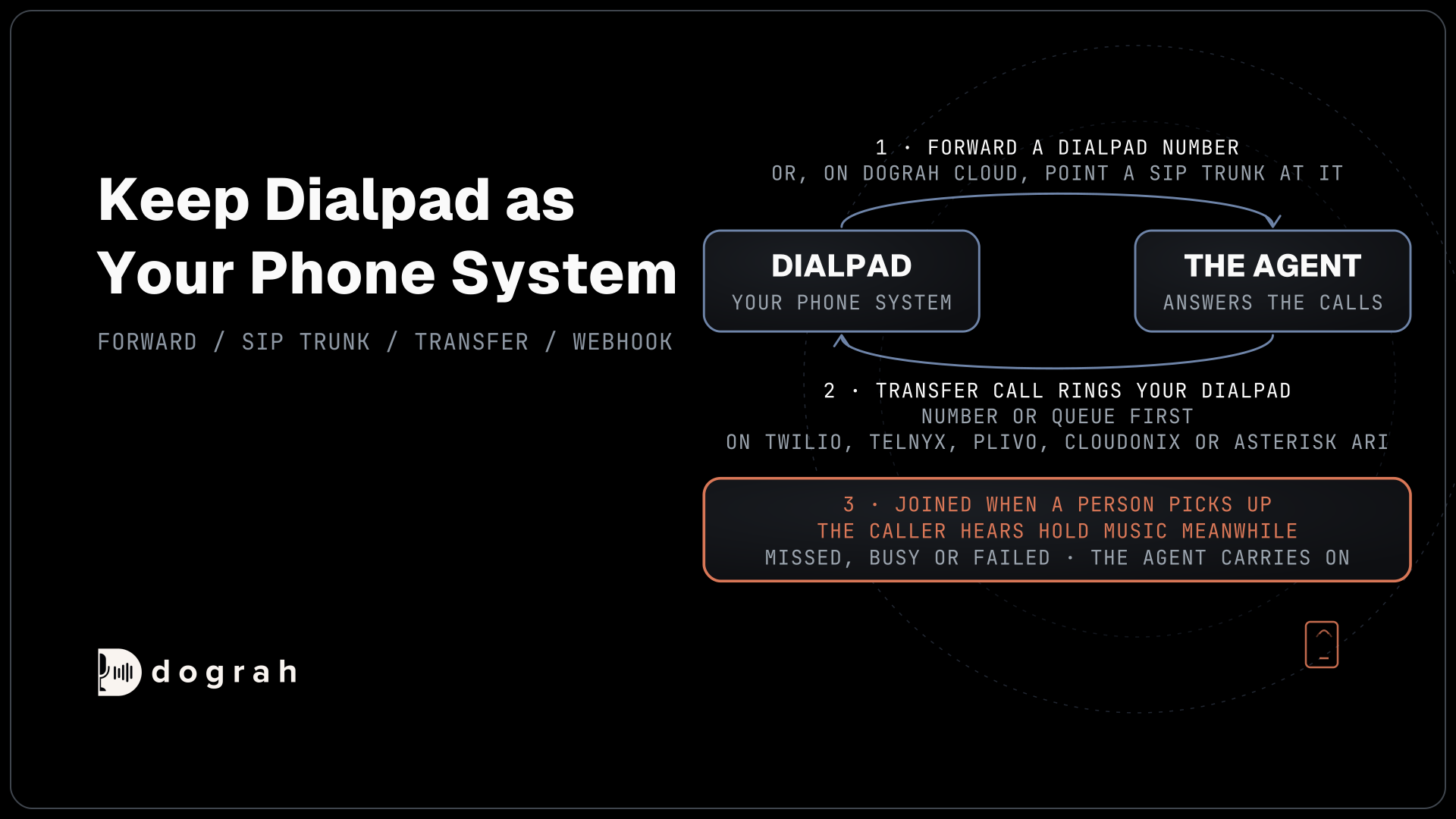
Calls reach the agent by forwarding a Dialpad number to a number on a supported provider, or on the managed cloud by pointing a SIP trunk at Dograh Managed SIP. The providers are Twilio, Vonage, Plivo, Telnyx, Cloudonix, Asterisk ARI or your own SIP trunk, and each number stays in your own carrier account.
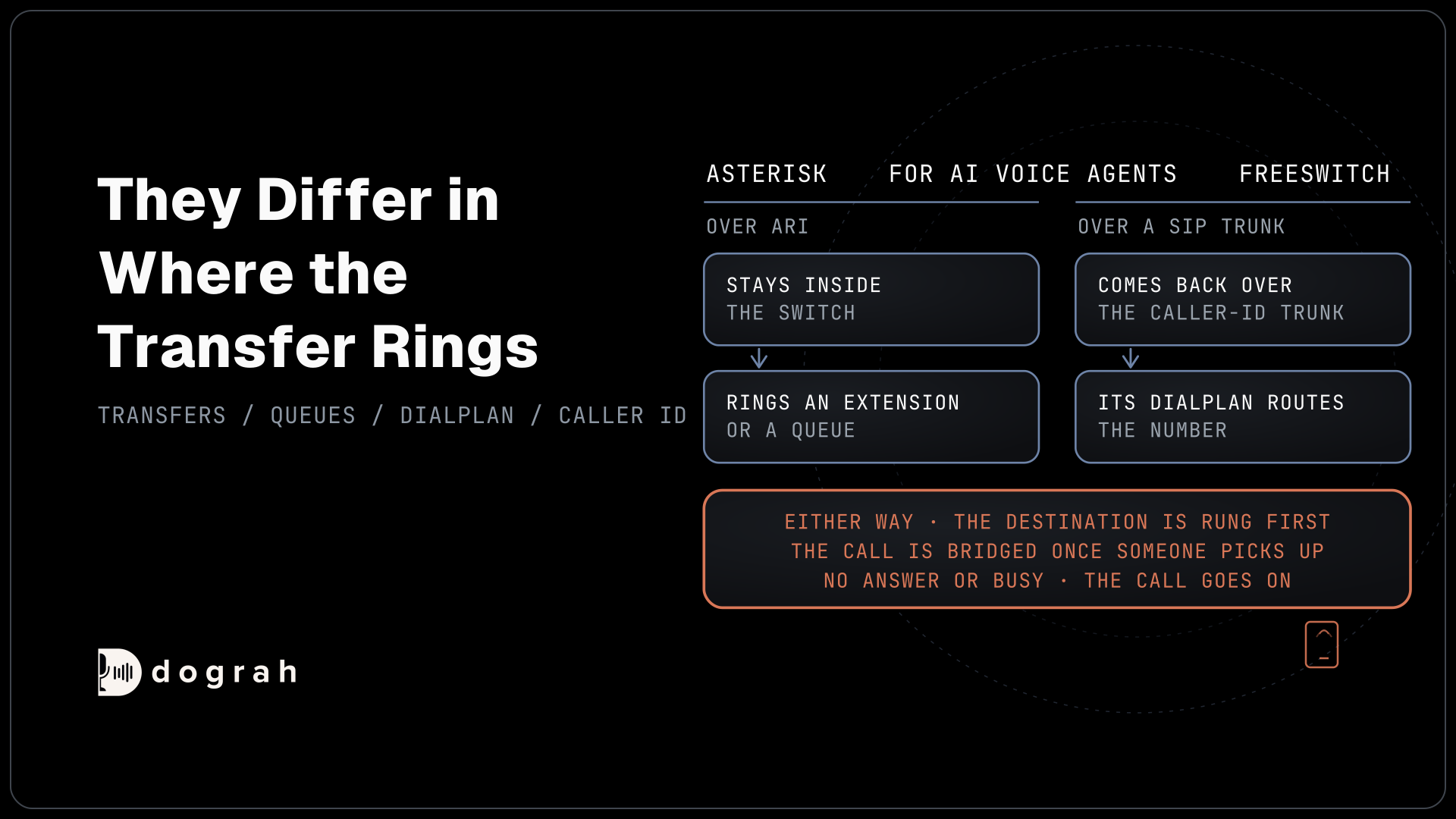
When a caller asks for a person, Transfer Call dials the destination first, here your Dialpad number or queue, and connects the caller only when someone answers. The caller hears hold music meanwhile, and a missed, busy or failed transfer returns transfer_failed to the agent, which carries on. It works on Twilio, Telnyx, Plivo, Cloudonix and Asterisk ARI.
During the call the agent reaches your systems through HTTP API tools, for example to look up an order or book a slot, and after the call a Webhook node sends the results to your CRM or helpdesk.
Self-hosting starts with Docker Compose on a machine with at least 8 GB of RAM and 4 vCPUs, with no GPU needed while models come through API keys. Dograh Cloud runs it for you, and Dograh Enterprise adds on-prem deployment. Self-hosted Dograh has no per-minute platform fee, but servers, model keys and phone minutes still cost money. Dograh Cloud charges a 1¢-a-minute platform fee, the $100 line in the 10,000-minute month later in this post. You pick the models, from Dograh's own to any supported provider on your key or open-weight models you host, and only the open-weight route keeps call audio on your servers. Pay as you go on Cloud includes 10 calls at once.
Self-hosting hands your team the server, the database and each upgrade, with community support for the open-source edition and custom SLAs on Enterprise. A team that wants full control of its agent usually takes on that work in exchange for owning the whole stack.
Other suite agents
The suite side wins on convenience. If your team already lives in Dialpad and wants the AI in the same app as its calls and reports, Resolve is the shortest path, and nobody has to wire anything. Our post on built-in AI receptionists in phone systems vs a voice agent covers that trade for other phone systems.
Most phone and contact center vendors now sell an AI agent of their own. Two publish clear prices for small and mid-sized teams.
RingCentral AI Receptionist starts at $49 a month on its own with 100 minutes included, then $0.50 a minute in 30-second steps. RingCentral says it works with any business phone system through call forwarding or SIP, which makes it a suite agent you can use without moving your lines. Our breakdown of RingCentral AI Receptionist pricing prices a busy month on it.
Aircall sells AI Voice Agents from $99 a month as a standalone product, at $0.29 a minute pay as you go, with bundles of 1,000 minutes for $250, 3,500 minutes for $805 and 10,000 minutes for $1,900.
Larger contact center suites follow the same pattern at a higher price. Talkdesk sells Autopilot, Five9 sells AI Agents as an add-on and NiCE sells AI agents built on Cognigy, each on top of seat plans. Our guide to Talkdesk AI Agents alternatives compares those suites side by side.

Open Source Alternative to Vapi / Retell
Self-hosted voice agent platform — no per-minute fees
dograh-hq/dograh
Star on GitHub
Dedicated voice agent platforms
The platform side wins on control. You choose the language model, the speech-to-text and the voice, you see each call's full record, and the agent survives a change of phone system. If you might leave Dialpad in a year, an agent built on a dedicated platform moves with you, while a suite agent stays behind with the old contract.
The other dedicated platforms also sell the agent and leave the phone system to you. Each one bills differently, so read what the per-minute figure covers.
Vapi bills hosting at $0.05 a minute and passes model costs through at cost, while the phone line comes from your own provider. Its Core package costs $29 a month with 10 concurrent calls, Pro starts at $999 a month with 30, and HIPAA is a $2,000 a month add-on. Our Vapi pricing post adds up the full bill.
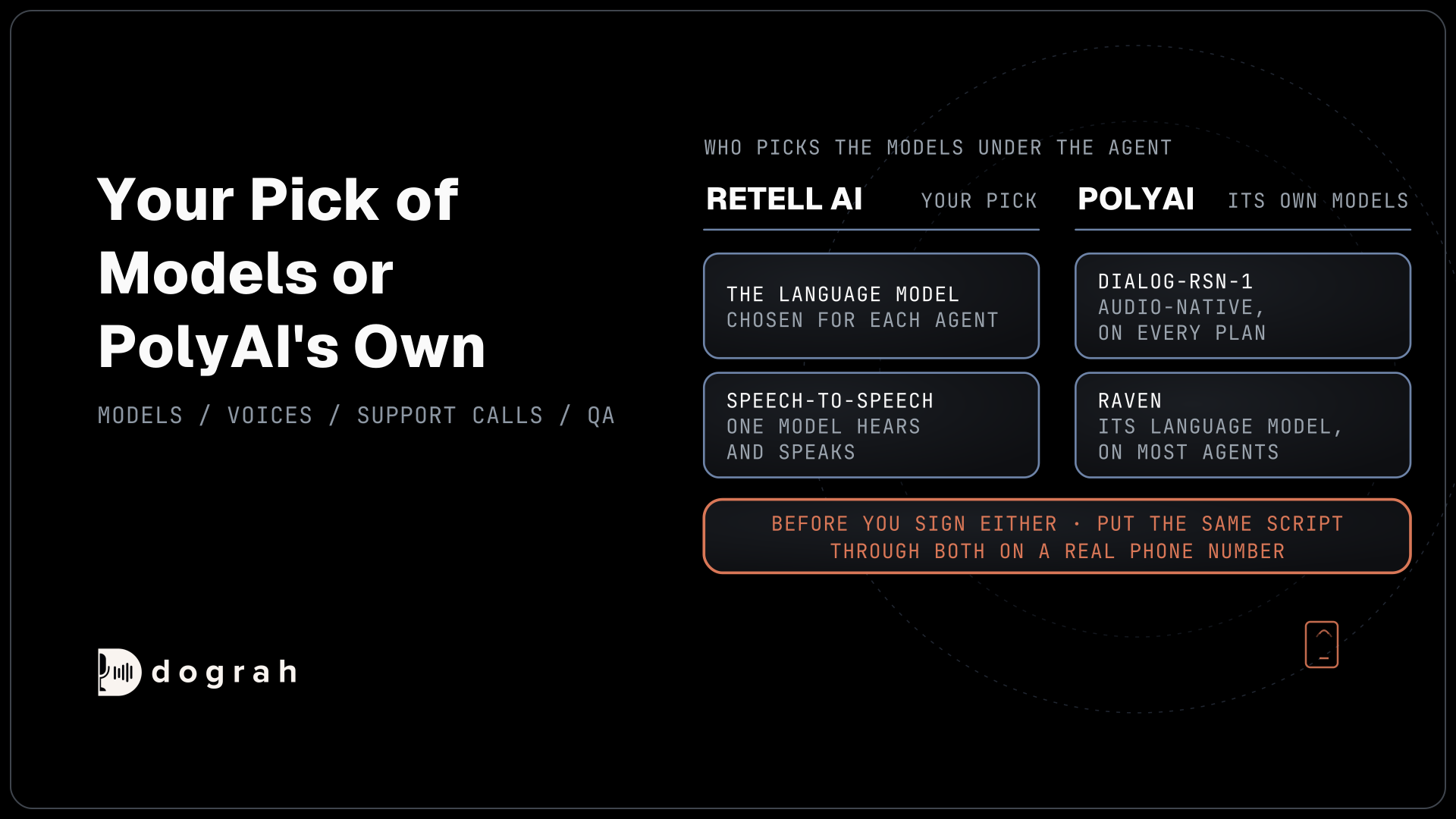
Retell AI charges $0.055 a minute for voice infrastructure, with an all-in range of $0.07 to $0.31 a minute depending on the models you pick, with 20 calls at once included and your own telephony or SIP at no extra charge.
Bland folds its own models into a single rate and lets you bring your own carrier. Start costs $0.14 a minute, and Build costs $0.12 a minute plus $299 a month. PolyAI suits customer-service teams that want a managed build, with plans from $49 a month and a per-minute Platform plan.
Whichever you shortlist, run the pilot on a real phone number. A phone line usually carries 8 kHz audio, against 16 kHz in a browser demo, so an agent that sounds sharp in a demo can mishear callers on the line.
Open-source frameworks: LiveKit Agents and Pipecat
LiveKit Agents and Pipecat are open-source frameworks, which makes them a different purchase from everything above. They hand your engineers code libraries for the voice pipeline, and the phone connection, the builder, call records and QA are yours to build. They suit a product team building its own voice agent product more than a team replacing Dialpad's agent this quarter. Pipecat ships under the BSD 2-Clause license and LiveKit Agents under Apache 2.0, and Dograh itself runs on a fork of Pipecat.
One 10,000-minute month on each
A labeled example shows how differently these products bill. Take a team with 2,000 calls a month that last five minutes each, so 10,000 minutes. The suite rows are the vendor's price for its whole agent. The platform rows are the platform fee alone, with models and phone still to add.
| Option | Line for 10,000 minutes | Still to add |
|---|---|---|
| Dialpad Resolve (baseline) | Credits per billable conversation, from your quote | Support seats if you use them |
| Dograh Cloud | 10,000 x $0.01 = $100 | Your models and phone |
| RingCentral AI Receptionist | $49 + 9,900 x $0.50 = $4,999 | Nothing for the agent itself |
| Aircall AI Voice Agents | 10,000-minute bundle = $1,900 | Nothing for the agent itself |
| Bland Build | $299 + 10,000 x $0.12 = $1,499, models included | Phone time |
| Retell AI | 10,000 x $0.055 = $550 | Models, voice and phone |
| Vapi | 10,000 x $0.05 = $500 | Models and phone |
The rows are not like for like, and that is the point of the split. A suite price includes the models and voice, so it is easy to budget. A platform's line is only one of three, and the model line can be small or large depending on the language model you choose. Price your own model and carrier rates before you compare totals.
When staying on Dialpad makes sense
Dialpad's own agent is a sound choice when the phone system is settled. If your numbers will stay in Dialpad, your team already works in its app and reports, and nobody wants to own models or prompts, Resolve asks for no wiring at all, and its credit billing means a caller who ends the call after a greeting costs nothing. Before you sign a long contract, ask how Resolve fits the combined Dialpad and Ada product.
What moving off Dialpad takes
Moving the agent does not have to mean moving your phone system. Your Dialpad numbers can stay where they are, and you forward one of them, or point a SIP trunk, at the new agent. If you forward to a Twilio number, note that saving an inbound workflow on it in Dograh switches that number to the agent at once, so copy its current settings first.
Then run the pilot on a real phone number rather than a browser demo, and test each transfer back to your Dialpad queue over a real call, since a browser test call cannot run a transfer. Move one number at a time and keep Resolve running on the rest as your fallback until the new agent's QA scores hold up.
Join the Dograh Community
Dograh is an OSS alternative to Vapi. Join our Slack community for queries, releases, best practices & community interactions.
Picking your Dialpad AI voice agent alternative
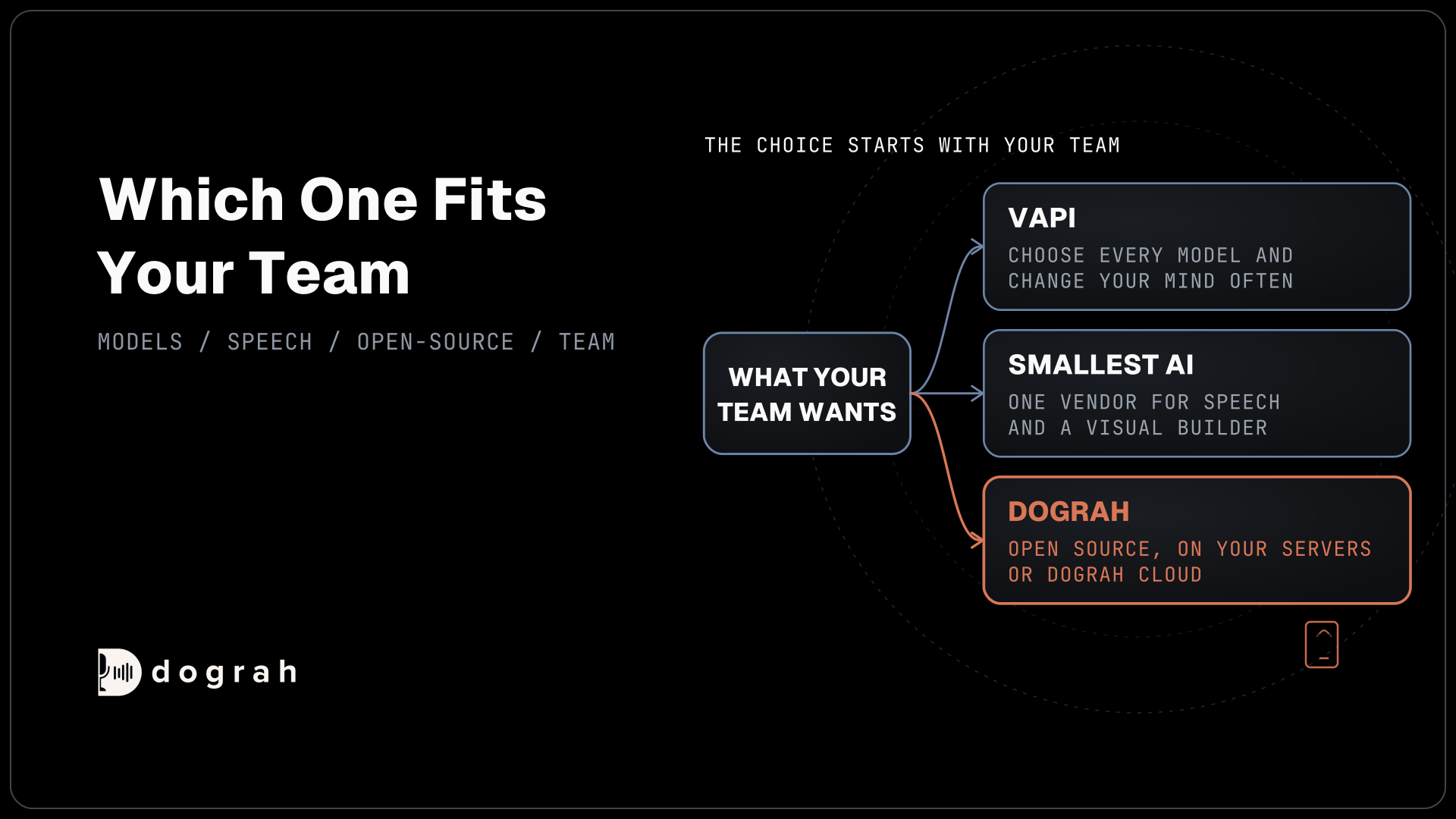
Start from who will own the agent. If an operations or engineering owner wants to choose the models, read every call and keep the agent through any change of phone system, start with Dograh, self-hosted or on Dograh Cloud. If you want one price with the models included, RingCentral AI Receptionist and Aircall AI Voice Agents fit, and Talkdesk, Five9 and NiCE fit larger contact centers. If you want a hosted dedicated platform, compare Vapi, Retell AI, Bland and PolyAI on your own minutes, with models and phone added, and if you would rather build the agent yourself, look at LiveKit Agents or Pipecat.
If you are still unsure, answer two questions before any demo. Will your phone numbers stay in Dialpad for the next two years, and who will own the agent's prompts and tests? If the numbers stay in Dialpad and nobody on the team wants to manage models, the suite side fits. If an operations or engineering owner wants to tune the agent and read every call, the platform side fits better.
Whichever way you lean, compare totals only after the model and phone lines are in.
Glossary
- AI Agent Credits
- The unit Dialpad uses to bill Dialpad Resolve. A conversation uses credits only when the AI retrieves information or takes a real action, such as scheduling or an order lookup.
- Suite agent
- An AI voice agent sold inside a phone or contact center system you rent from the same vendor, such as Dialpad Resolve or Aircall AI Voice Agents. It is easy to switch on and usually stays behind if you change phone systems.
- Call forwarding
- Sending calls from an existing business number to another number, such as one a voice agent answers. It lets a team add an agent without moving its numbers or phone system.
- Concurrent calls
- How many calls an agent can handle at the same moment. Vapi's Core package includes 10, Retell AI includes 20, and Dograh Cloud's pay as you go includes 10.