
Claude Sonnet 5.5 lists at $2 for a million input tokens and $10 for a million output, which puts our 5-minute example call near $0.084, while Claude Haiku 5.5 runs it for about $0.004. Dograh, the open-source AI voice agent platform we build, reaches Claude through AWS Bedrock or OpenRouter, and you can self-host it or use Dograh Cloud.
Key Takeaways
- Claude 4.7 and later count about 30% more tokens for the same call.
- Sonnet 5.5 still comes in under Sonnet 4.6 per call.
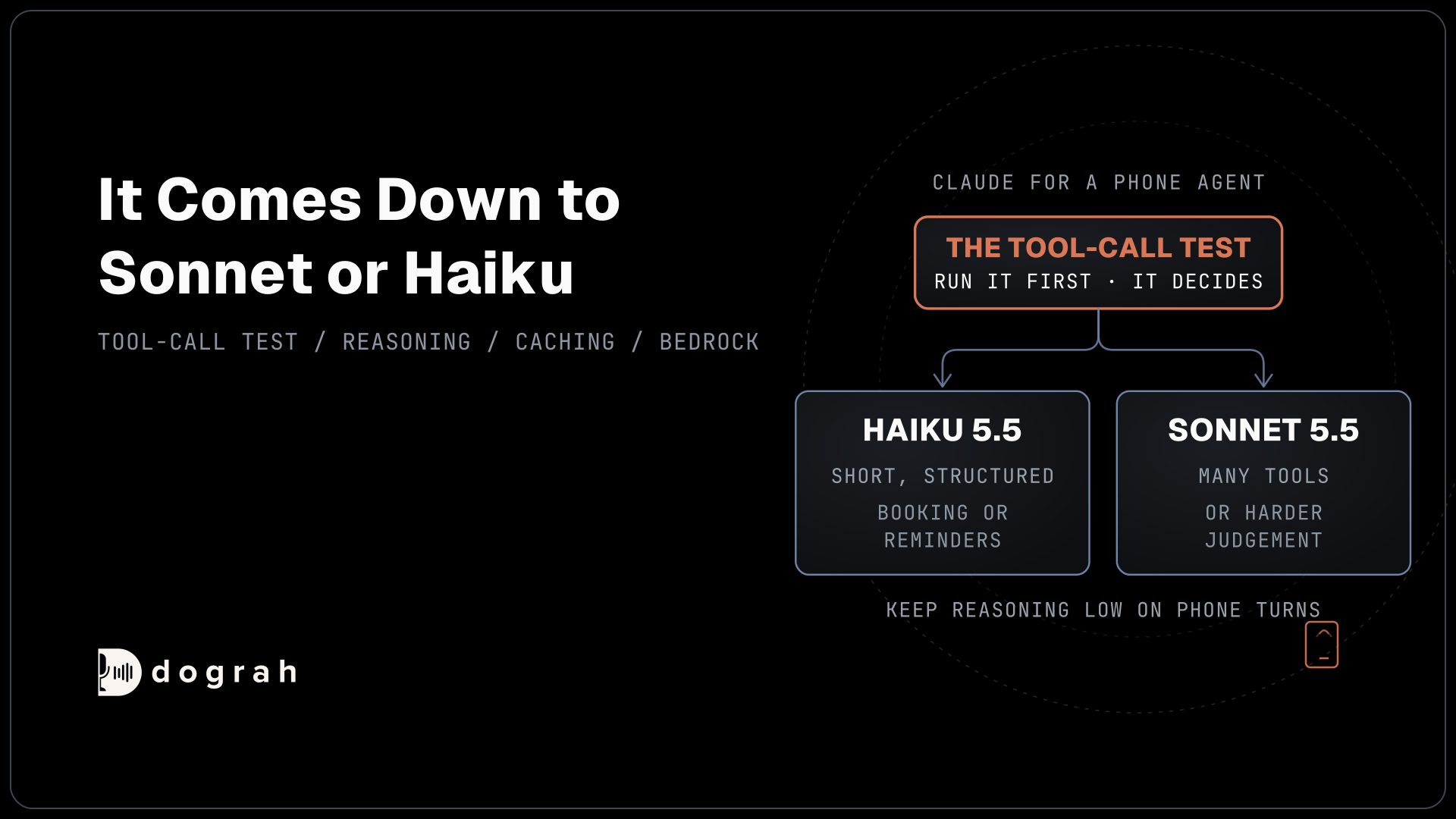
- Keep reasoning low on phone turns, since it delays the first spoken word.
This post is part of our guide to LLM API pricing for voice agents, where one 5-minute call is priced on every major model family. Here we run that call through each Claude model, then see which one answers fast enough to run a phone agent in Dograh.
Anthropic's prices for each Claude model
Anthropic prices Claude per million tokens, with separate rates for input, output and the two sides of its prompt cache. The rates below are Anthropic's API prices for the models still on sale. A cache write stores the start of a prompt for reuse, and a cache hit reads it back at a fraction of the input rate.
| Model | Input | Cache write (5 min) | Cache hit | Output |
|---|---|---|---|---|
| Claude Fable 5.1 | $10 | $12.50 | $0.25 | $50 |
| Claude Opus 5.5 | $4 | $5 | $0.20 | $20 |
| Claude Opus 5 | $5 | $6.25 | $0.50 | $25 |
| Claude Sonnet 5.5 | $2 | $2.50 | $0.10 | $10 |
| Claude Sonnet 5 | $2 | $2.50 | $0.20 | $10 |
| Claude Sonnet 4.6 | $3 | $3.75 | $0.30 | $15 |
| Claude Haiku 5.5 | $0.10 | $0.125 | $0.01 | $0.50 |
| Claude Haiku 4.5 | $1 | $1.25 | $0.10 | $5 |
Haiku 5.5's rates apply to prompts up to 100,000 tokens, which covers any phone call. Output costs five times input on every model, but on a call that matters less than the list suggests, because the agent sends far more than it speaks.
One 5-minute call on every Claude model
Our example call runs 12 exchanges with a 2,000-token system prompt sent on every turn, with the caller adding roughly 25 tokens a turn and the agent answering in about 50. The guide counts it turn by turn and arrives at 29,250 input tokens and 600 output tokens. Treat it as an example and swap in your own prompt size.
Claude adds one wrinkle. Claude 4.7 and later use a newer tokenizer that, by Anthropic's own count, turns the same text into about 30% more tokens, so the same call counts 38,025 input and 780 output tokens on the 5 and 5.5 models. On Sonnet 5.5 that works out as 38,025 x $2 / 1,000,000 = $0.0761 for input, plus 780 x $10 / 1,000,000 = $0.0078 for output, $0.0839 for the call or about $0.0168 a minute.
| Model | Tokens counted (in / out) | 5-minute call, no cache | Per minute | Best-case cache |
|---|---|---|---|---|
| Claude Fable 5.1 | 38,025 / 780 | $0.4192 | $0.0838 | $0.0939 |
| Claude Opus 5.5 | 38,025 / 780 | $0.1677 | $0.0335 | $0.0410 |
| Claude Opus 5 | 38,025 / 780 | $0.2096 | $0.0419 | $0.0598 |
| Claude Sonnet 5.5 | 38,025 / 780 | $0.0839 | $0.0168 | $0.0205 |
| Claude Sonnet 5 | 38,025 / 780 | $0.0839 | $0.0168 | $0.0239 |
| Claude Sonnet 4.6 | 29,250 / 600 | $0.0967 | $0.0193 | $0.0276 |
| Claude Haiku 5.5 | 38,025 / 780 | $0.0042 | $0.0008 | $0.0012 |
| Claude Haiku 4.5 | 29,250 / 600 | $0.0323 | $0.0065 | No cache: prompt under 4,096 |
Two results stand out. Sonnet 4.6 counts fewer tokens and still costs more per call than Sonnet 5.5, because its rates are 50% higher. And Haiku 5.5 runs the whole call for under half a cent, about an eighth of Haiku 4.5.
Real calls run higher than this. When a request carries tools, Anthropic adds a hidden tool-use system prompt of 286 tokens on the 5.5 models, which is 3,432 more input tokens over 12 turns, about $0.0069 more on Sonnet 5.5. Reasoning tokens bill as output, and the after-call work your platform runs adds its own requests.

Open Source Alternative to Vapi / Retell
Self-hosted voice agent platform — no per-minute fees
dograh-hq/dograh
Star on GitHub
What caching saves on a short phone prompt
Caching can cut a Claude call by about three quarters, if the prompt qualifies. At best, turns 2 to 12 pull everything they repeat from cache, so only 3,705 of Sonnet 5.5's 38,025 input tokens are new. Those new tokens bill at the cache-write rate of $2.50, the 34,320 cached ones at $0.10, and the call drops from $0.0839 to $0.0205.
Claude caches only when the request marks what to cache, and only above a minimum cacheable prompt length. Anthropic's caching guide sets that minimum at 512 tokens for Fable 5.1, Opus 5 and the 5.5 models, 1,024 for Sonnet 5 and Sonnet 4.6, and 4,096 for Haiku 4.5. A cache entry lasts five minutes and is refreshed each time it is read, which a live call easily keeps warm.
Haiku 4.5 is the model this trips up. Its 4,096-token minimum sits above the 2,850 tokens of this call's biggest request, so every token bills at full price. Anything that changes the start of the request, such as a new step's instructions, also starts the cache again, so budget on the no-cache column and treat the cached one as a ceiling.
Which Claude model is fast enough for a phone turn
Speed narrows the choice more than price does. A natural phone turn comes back in about 800 milliseconds, and speech-to-text and the voice take their share of that, so the model needs to start answering almost at once.
Artificial Analysis measures each model's time to first answer token on its benchmark tasks, which carry much longer prompts than a phone turn. Haiku 4.5 without reasoning averages about 0.9 seconds there and Sonnet 4.6 without reasoning about 2 seconds. Sonnet 5.5 appears only with reasoning on, and even at low reasoning effort it averages about 4 seconds. Those numbers are slow next to a phone turn, so test each model on your own short prompt, with reasoning set as low as the task allows.
For most phone agents the choice comes down to Sonnet or Haiku. Haiku 5.5 suits short, structured flows such as booking or reminders, where the price is close to nothing. Sonnet 5.5 earns its cost on calls with many tools or harder judgement. Opus and Fable cost $0.17 to $0.42 a call in the example and add wait time a caller hears. Before you settle on one, choosing an LLM for voice agents describes a tool-call test to run first, and its result should decide between the two.
Running Claude in Dograh with your own keys
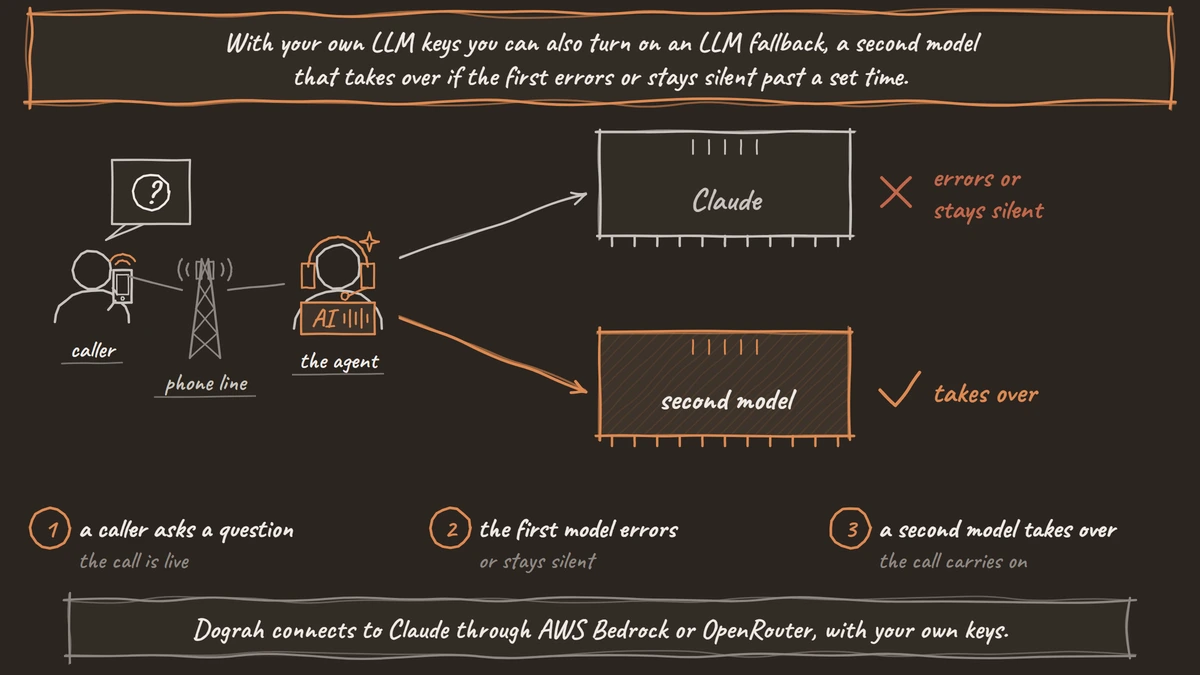
Dograh connects to Claude through AWS Bedrock or OpenRouter, with your own keys. Dograh runs the orchestration, meaning the call flow, the tools and the phone line, while Claude sits in the separate model layer you pick. Bedrock and OpenRouter, such as Amazon Bedrock, set their own prices, so the Anthropic figures above apply when you call Anthropic directly.
Each agent can use its own model. Named model configurations, saved on the Models page, let one agent use Claude and another gpt-4.1, and switching is a change in the agent's settings. With your own LLM keys you can also turn on an LLM fallback, a second model that takes over if the first errors or stays silent past a set time, 1.5 seconds by default.
Self-hosted Dograh has no per-minute platform fee, but servers, model keys and phone minutes still cost money. Dograh Cloud charges a 1¢-a-minute platform fee. The Claude bill stays between you and your route, and our comparison of BYOK and managed models shows how platforms that resell the model bill for it.
Join the Dograh Community
Dograh is an OSS alternative to Vapi. Join our Slack community for queries, releases, best practices & community interactions.
Glossary
- Cache write
- Storing the start of a prompt so later requests can reuse it. Anthropic charges 1.25 times the input rate for a 5-minute cache write, and on a phone call the new part of each turn bills at this rate when caching is on.
- Minimum cacheable prompt
- The shortest prompt Claude will cache: 512 tokens on Fable 5.1, Opus 5 and the 5.5 models, 1,024 on Sonnet 5 and Sonnet 4.6, and 4,096 on Haiku 4.5. A shorter request runs without caching and no error comes back.
- Time to first answer token
- The wait between sending a request and the first word of the reply. On a phone call the voice can start speaking only after it, so reasoning that runs first adds silence the caller hears.
- Reasoning effort
- How much a model thinks before it answers. Higher effort adds output tokens, which bill at the output rate, and adds seconds before the first word, so phone agents usually run it low.