
On AWS Bedrock, Claude Sonnet 5.5 costs $2 per million input tokens and $10 per million output on the global profile, about $0.084 for our example 5-minute voice call, or $0.092 on a US profile. Haiku 5.5 costs about $0.004. Dograh, the open-source AI voice agent platform, reaches Claude through Bedrock or OpenRouter, self-hosted or on Dograh Cloud.
Key Takeaways
- Bedrock's global profile matches Anthropic's list price for Claude.
- A US or EU geographic profile costs 10% more and keeps requests in that geography.
- Budget the uncached price, then add reasoning, speech, voice and phone minutes.
This post is part of our guide to LLM API pricing for voice agents, which turns token rates into the cost of one phone call. Below, we price one 5-minute call on Bedrock line by line, from the global or geographic choice to the setup in Dograh.
Bedrock's rates for the models a phone agent uses
Bedrock bills language models per million tokens, with one rate for what you send and another for what the model writes back. The rates below are AWS's Standard tier rates in us-east-1, as input and output per million tokens.
| Model | Global profile | US geographic profile |
|---|---|---|
| Claude Opus 5.5 | $4 / $20 | $4.40 / $22 |
| Claude Opus 5 | $5 / $25 | $5.50 / $27.50 |
| Claude Sonnet 5.5 | $2 / $10 | $2.20 / $11 |
| Claude Haiku 5.5 | $0.10 / $0.50 | $0.11 / $0.55 |
| Claude Haiku 4.5 | $1 / $5 | $1.10 / $5.50 |
| Amazon Nova Pro | $0.80 / $3.20 | n/a |
| Amazon Nova Lite | $0.06 / $0.24 | n/a |
| Amazon Nova Micro | $0.035 / $0.14 | n/a |
On the global profile, every Claude rate equals Anthropic's own list price, so the figures in our post on Claude API pricing for voice agents carry over. Claude on Bedrock is billed through AWS Marketplace and shows on your AWS bill under Anthropic. Nova models are Amazon's own and bill as ordinary Bedrock usage.
Global or geographic: the 10% choice
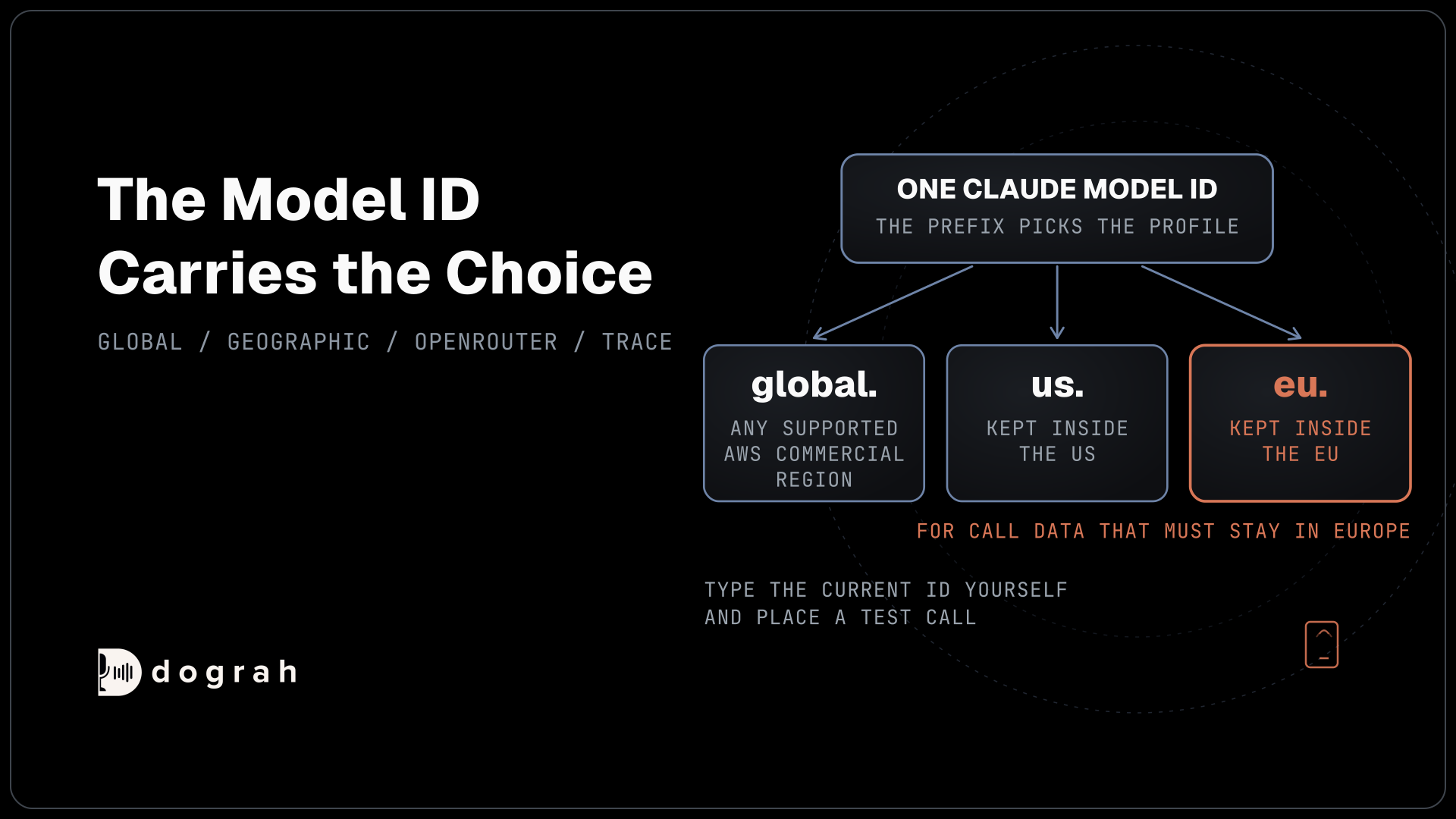
Each Claude model on Bedrock is called through an inference profile, and the profile sets both the price and where requests may run. AWS's cross-region inference guide describes a geographic profile as keeping data "within geographic boundaries" such as the US, EU or APAC, at standard pricing. A global profile can run in "any supported AWS commercial Region worldwide", for "approximately 10% savings".
In practice the model ID carries the choice. global.anthropic.claude-sonnet-5-5 is the global profile, while us. or eu. in front of the same name keeps the request inside that geography. AWS's own advice is to "choose Geographic for compliance requirements", and it adds no routing charge for either.
For a line whose call data must stay in Europe, the eu. profile is the one to use, and our post on EU-hosted LLM, STT and TTS providers covers the rest of that stack. A geographic profile also keeps the model nearer your servers, which matters for latency, as our post on reducing voice-agent latency with server colocation explains.
One 5-minute call on Bedrock
This worked example uses the pillar's call: 12 exchanges with a 2,000-token prompt sent again on every turn, which comes to 29,250 input and 600 output tokens. Claude 4.7 and later count about 30% more tokens for the same words, so Claude 5.5 models are priced at 38,025 input and 780 output tokens. The IDs are on the Claude Sonnet 5.5 model card.
Here is Sonnet 5.5 on the global profile, line by line:
- Input: 38,025 x $2 / 1,000,000 = $0.0761
- Output: 780 x $10 / 1,000,000 = $0.0078
- Call: $0.0839, about $0.0168 a minute, or $83.85 for 1,000 calls
| Model, example call | Global per call | US geographic per call | 1,000 calls, global |
|---|---|---|---|
| Claude Opus 5.5 | $0.1677 | $0.1845 | $167.70 |
| Claude Sonnet 5.5 | $0.0839 | $0.0922 | $83.85 |
| Claude Haiku 5.5 | $0.0042 | $0.0046 | $4.19 |
| Claude Haiku 4.5 (29,250 / 600 tokens) | $0.0323 | $0.0355 | $32.25 |
| Amazon Nova Pro (29,250 / 600 tokens) | $0.0253 | n/a | $25.32 |
| Amazon Nova Lite (29,250 / 600 tokens) | $0.0019 | n/a | $1.90 |
| Amazon Nova Micro (29,250 / 600 tokens) | $0.0011 | n/a | $1.11 |
The prompt sent on every turn makes up most of each bill, so a shorter prompt saves more than a shorter reply. Nova's own tokenizer may count the same words a little differently, so treat its rows as the pillar's estimate.

Open Source Alternative to Vapi / Retell
Self-hosted voice agent platform — no per-minute fees
dograh-hq/dograh
Star on GitHub
What the example leaves out
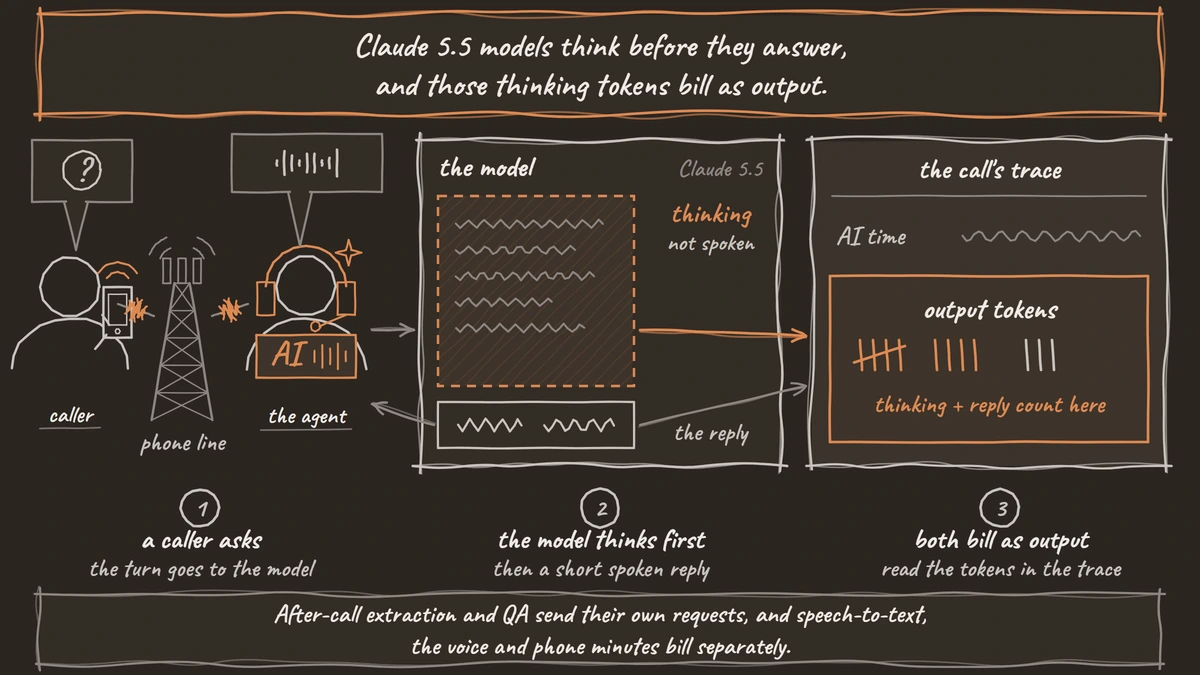
The figures above cover the model's visible reply and nothing else. Claude 5.5 models think before they answer, and those thinking tokens bill as output. Dograh's Bedrock route sends no effort setting, so the model's default (high for Sonnet 5.5) applies. Haiku 5.5 defaults to medium. Test a real call and read the output token count before you budget.
The example also prices every token at full rate. Prompt caching would cut the cost of the repeated prompt, but Dograh's Bedrock route leaves it off, so budget the uncached figure. Bedrock's discounted tiers don't fit a live call either. Flex is meant for "non-time-sensitive workloads", Batch is not live, and Claude 5.5 models offer only the Standard tier.
Nova Sonic 2.0, Amazon's speech-to-speech model, is priced per thousand tokens of speech and text: $0.003 for speech in, $0.012 for speech out, $0.00033 for text in and $0.00275 for text out. Our example counts text tokens only, so we don't turn those into a per-call figure.
Finally, the language model is one line of the call. After-call extraction and QA send their own requests, and speech-to-text, the voice and phone minutes bill separately, as the pillar's section on the LLM line next to speech-to-text and voice sets out.
Bedrock or OpenRouter for Claude
Bedrock and OpenRouter both reach Claude at Anthropic's list price, and they differ in how the fee and the bill work. OpenRouter charges its fee "when you buy credits", 5.5% on Standard and 8% on Business, and never on individual requests. With your own provider keys, the first $25,000 of inference a month carries no fee, then 5%.
As a worked example, Sonnet 5.5 bought with Standard credits costs $0.0839 x 1.055 = about $0.0885 a call, or about $88.46 for 1,000 calls. Bedrock's global profile stays at $0.0839, and its US profile at $0.0922.
The bigger difference is the account. Bedrock bills on your AWS account, under your IAM permissions and AWS agreements, which suits a team already running on AWS. OpenRouter gives one key for many model makers and lets you set which provider it tries first, which suits a team comparing models before it commits.
Join the Dograh Community
Dograh is an OSS alternative to Vapi. Join our Slack community for queries, releases, best practices & community interactions.
Setting up Claude on Bedrock in Dograh
Dograh is the orchestration layer, running the call flow, tools and phone line, and Claude is the model layer underneath it, so the Bedrock bill stays on your own AWS account. Open Providers in the sidebar and add an AWS Bedrock provider with an access key that has bedrock:InvokeModel permission, its secret key, the region and the model ID, as the inference providers page lists.
The dropdown's example IDs are older models such as Claude Sonnet 4 and Nova v1, so type the current ID yourself, for example global.anthropic.claude-sonnet-5-5 or us.anthropic.claude-sonnet-5-5, and place a test call. Then pick that connection on the LLM tab of a model configuration under Models, as the LLM settings describe. Named configurations let one agent run Sonnet 5.5 and another Haiku 5.5.
Self-hosted Dograh has no per-minute platform fee, but servers, model keys and phone minutes still cost money. Dograh Cloud charges a 1¢-a-minute platform fee. Either way the Bedrock line stays on AWS's bill at AWS's rates. For more on running your own keys, see bring your own LLM keys to an open-source voice agent platform.
LLM fallbacks are off by default. Turn one on and a second model, such as Haiku 5.5 or the same Claude through OpenRouter, takes over on an error or after no output for 1,500 ms. Each call's trace shows the AI time and tokens of every turn, so you can compare models on real calls.
Glossary
- Inference profile
- The Bedrock setting, carried in the model ID's prefix, that decides which AWS regions may serve a request. `global.` lets it run anywhere AWS supports, while `us.` or `eu.` keeps it inside that geography.
- Geographic profile
- An inference profile that keeps requests inside one geography such as the US or EU. On Claude it costs 10% more than the global profile, and AWS suggests it for compliance needs.
- Effort setting
- A request setting that tells a Claude 5.5 model how hard to think before answering. When none is sent, the model's default applies, high for Sonnet 5.5 and medium for Haiku 5.5, and the thinking bills as output tokens.
- Prompt caching
- Reusing a prompt the model has already read, at a fraction of the input rate. It would cut the repeated prompt's cost on every turn, but Dograh's Bedrock route leaves it off, so the uncached price is the one to budget.