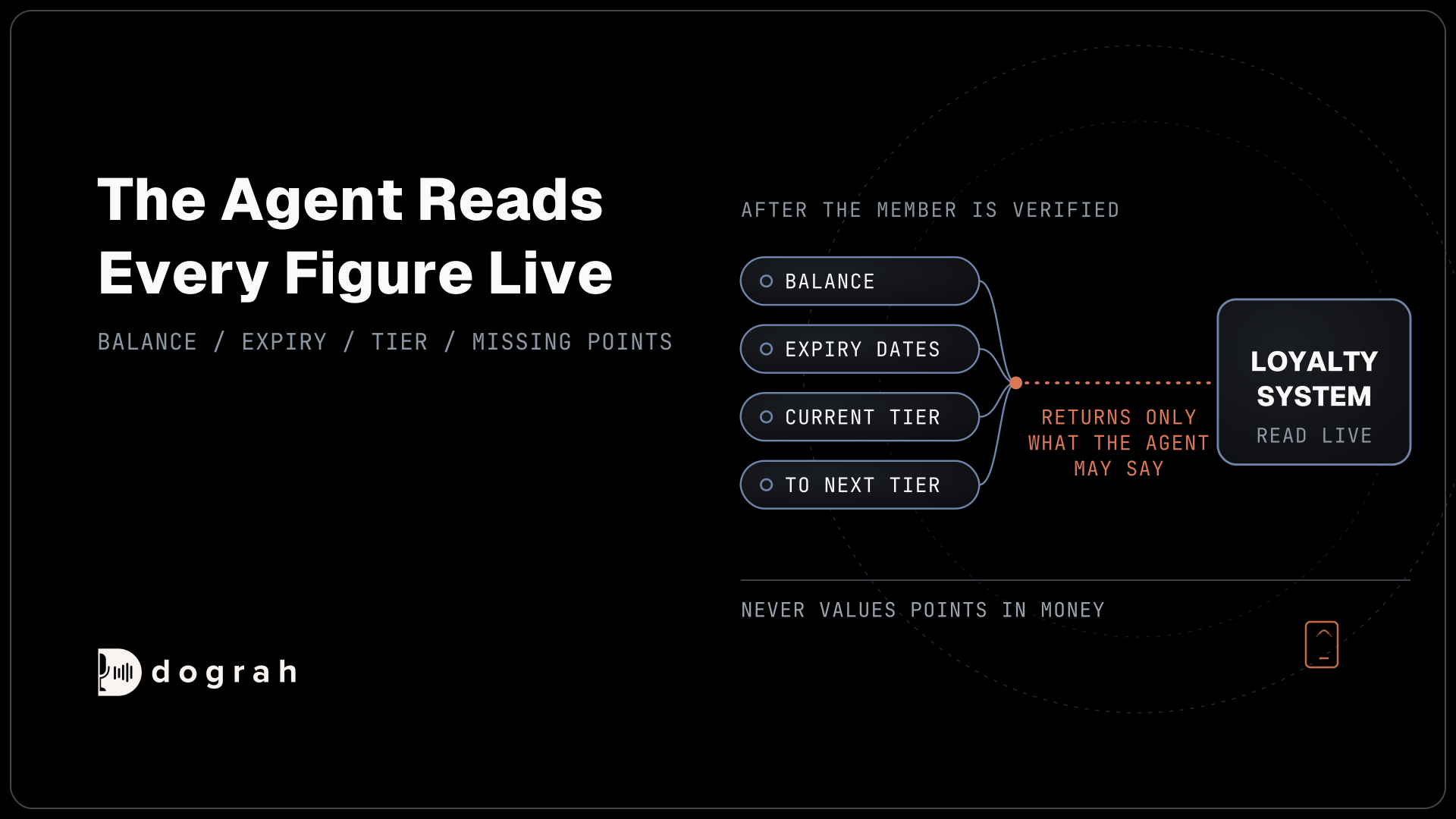

AI voice agents for loyalty program support in travel answer members' points questions right away: balance, expiry dates, tier status and missing points. After the member passes the program's identity check, the agent reads every figure live from the loyalty system and files claims with a reference number. Contact-detail changes and point transfers never complete on the call.
Key Takeaways
- The agent reads balances and tiers live, only after the member passes verification.
- Missing-points claims are filed during the call, with a reference number.
- Contact changes and point transfers go to a person or a secure link.
This post is part of our guide to AI voice agents for airlines and travel, where every call verifies the traveller first. Below, we cover members' points questions and riskier account changes. Each section also shows how the loyalty line runs in Dograh, the open-source AI voice agent platform we build.
What loyalty members phone about
Most loyalty calls ask the system something the member cannot see for themselves. They want their points balance, the date the points expire, how far they are from the next tier, or why a flight or hotel stay never posted. Frequent-flyer programs and hotel programs run on those numbers, and every one of them already sits in the loyalty system.
That makes these calls reads, which a voice agent can answer the moment the member is verified, with no queue for a person. The agent says what the system returns and nothing more.
Spending points is a different job. An award seat or a free night changes the account, and its price comes from the program's award rules at that moment. Some vendors fold redemptions into the same quick chat. Here they get their own verified path, and the agent never quotes an award price the system has not returned.
Verify the member before any balance
A points balance is money to a fraudster, so verification comes before any figure. In November 2025, The Seattle Times reported members whose airline miles were drained. In one case, the intruder changed the email on her account, then spent 7,500 miles on a flight.
Every call runs greet, verify, then disclose. On an inbound call, Pre-Call Data Fetch can load the member record that matches the calling number as the call connects. A phone number finds the account. It does not prove who is calling, and neither does a name. So the agent asks for the member number plus the check your program sets, such as the date of birth or the postcode on file, and reads nothing back until it passes.
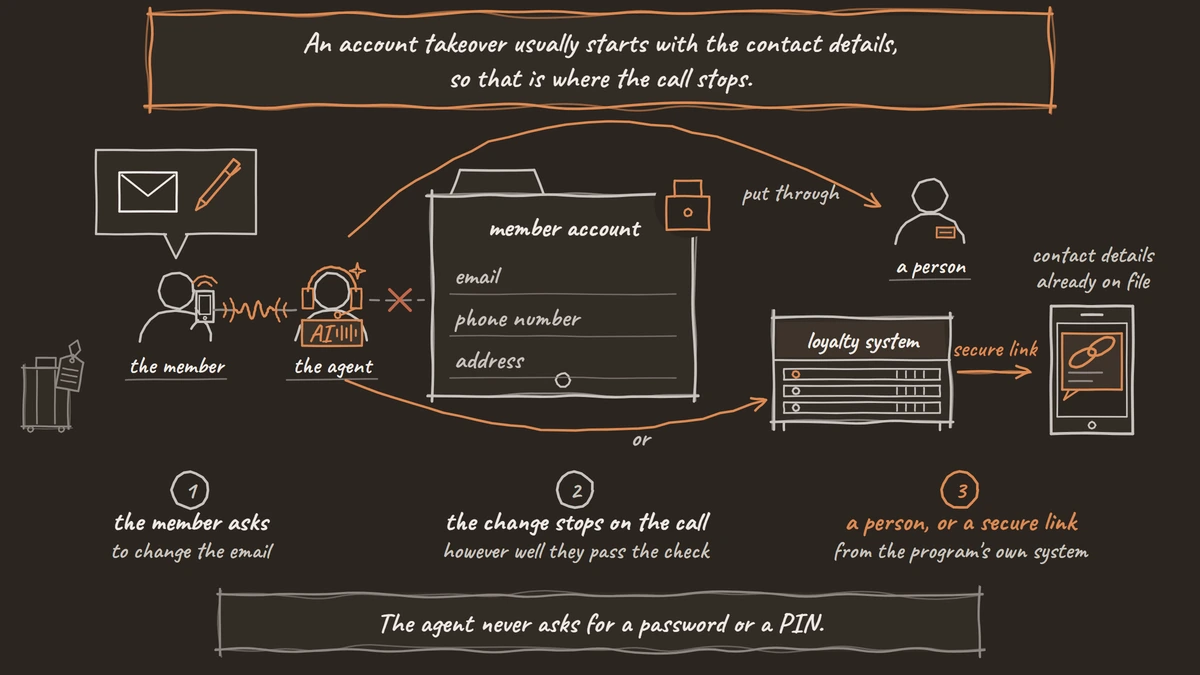
The agent never asks for a password or a PIN. Transcripts keep everything said, so a secret spoken on a call stops being a secret.

Open Source Alternative to Vapi / Retell
Self-hosted voice agent platform — no per-minute fees
dograh-hq/dograh
Star on GitHub
Balances, expiry and tier questions
Once the member is verified, an HTTP API tool reads the account from the loyalty system: balance, expiry dates, current tier, and the qualifying activity still needed for the next one. The tool hands the whole response to the language model, so build the endpoint to return only what the agent may say. A field the agent never receives is one it cannot read out.
While the request runs, the tool's "When the tool starts" message plays a short line, such as "Let me pull up your account." If the system is slow, a "While the tool is running" update follows after the delay you set.
General questions about what a tier includes go to the program's published terms. Upload them to the Knowledge Base as PDF or Word files. Account figures always come from the live system. The agent never values points in money and never guesses how many points a future award will cost. Add program, partner and tier names to the agent's Dictionary so speech-to-text hears them correctly.
Missing-points claims, filed on the call
A missing-points claim is paperwork the agent can finish while the member is still on the line. It collects what your claim form needs: the date, the flight number or hotel, the booking reference, the ticket number or folio, and the partner if there was one.
An HTTP API tool checks the claim window your system returns. If the activity is inside it, a second tool files the claim and the agent reads the claim reference back before the call ends. Add a Preset Parameter carrying workflow_run_id, so a retried request files one claim, not two. The agent never promises the points will post. Your system decides, and the member hears what it decided when it decides.
Hotel programs work the same way, with the stay dates and the folio in place of the ticket. Our guide to AI voice agents for hotels and hospitality covers the rest of the guest's calls. A member who disputes a denied claim goes to a person, with the details written to your system first.
Account changes stay off the call
Some requests never complete on a voice call, however well the caller passes the check. These are changes to the email, phone number or address, password resets, point transfers, pooling and adding a nominee. An account takeover usually starts with the contact details, so that is where the call stops.
For these, the agent does one of two things. It puts the member through to a person, or an HTTP API tool asks the program's own system to send a secure link by text or email to the contact details already on file, so the message comes from the program's own provider. Our post on fraud-alert callbacks follows the same rule: tell, and never ask for anything a criminal would want.
Elite members often have their own desk. A Transfer Call tool set to that number puts them through, on Twilio, Telnyx, Plivo, Cloudonix or Asterisk ARI. Redemptions can go to a separate agent through Transfer to Agent, which passes the conversation so far to that agent, so the member does not have to repeat anything.
Join the Dograh Community
Dograh is an OSS alternative to Vapi. Join our Slack community for queries, releases, best practices & community interactions.
Running the loyalty line
Run the line on a QA sample from day one. Write the QA System Prompt to flag any call where a balance or tier figure was read before verification passed, or where the agent named a value for points. Each step gets its own score, so you can see which step slipped. View Trace shows each tool request and how long the loyalty system took to answer.
For members who call in other languages, set speech-to-text to Multilingual (Auto-detect). The Greeting Text plays before Dograh can hear the caller's language, so write it in both, for example "Hola, hello".
Member data can stay with the program. You can self-host the platform or run it on Dograh Cloud, and pick the speech and language models separately: your own keys for any provider, or open models on your own servers.
Self-hosted Dograh has no per-minute platform fee, but servers, model keys and phone minutes still cost money. Dograh Cloud charges a 1¢-a-minute platform fee. Start with balance and expiry questions, then add claims once the first week of transcripts reads clean.
Glossary
- Account takeover
- A criminal getting into a member's loyalty account, usually by changing its contact details first, then spending or moving the points.
- Missing-points claim
- A request to add points for a flight or stay that did not post. The program's system checks it against its claim window and decides.
- Qualifying activity
- The travel and spend that count toward the next tier. The agent reads what is left from the loyalty system and never estimates it.
- Secure link
- A one-time link the program's own system sends by text or email to contact details already on file, used for changes too risky to finish on a call.