
AI voice agents for timeshare companies answer owner calls about stays, points, fees and bookings on the first ring, after checking who is calling. They book resort stays and tours through your own reservation systems. Sales calls, such as tour invitations or upgrade offers, run on a separate agent that only calls owners who gave written consent.
Key Takeaways
- Verify the owner before the agent reads any balance, points or booking.
- Keep owner service and sales on two agents with different rules.
- Sales calls in an AI voice need the owner's prior written consent.
Timeshare phone lines carry two kinds of call: owners asking about their own stay, and sales calls about tours or upgrades. This post covers the owner calls an AI voice agent takes, why the two stay apart, the US rules for sales calls and the settings that carry them.
What owners call a timeshare company about
Owners call about the week they already own. They want to know whether the resort has their dates, how many points are left this year, why the maintenance fee went up and whether a booking can move by two days.
The volume behind those questions is large. The American Resort Development Association (ARDA), the industry's trade group, counts 1,434 timeshare resorts in the US, running at 79.9% occupancy. The average maintenance fee it reports is $1,550 per weekly interval, up 4.7% on the year before, so fee questions are a steady share of the calls. Sales reached $10.7 billion, which means a steady flow of new owners learning how their points work.
Most of these calls follow a pattern. The owner wants a fact from their own account, a booking or a change to one. An AI voice agent can answer them at any hour, in the same calm way each time, and hand the rest to your team. The settings below are from Dograh, the open-source AI voice agent platform we build.
Verify the owner before reading the account
Every owner call starts with a check. The agent greets the caller, asks for the details your owner services team already uses, such as the member number and date of birth, and compares them with your records. Only after a match does it read anything from the account.
The account details come from your own owner or reservation system. An HTTP API tool asks that system for the points balance, the fee due or the next stay, and the agent reads back what it returns. If the check fails twice, the agent stops and offers a call back from a person.
Payments stay off the call. When an owner wants to pay the maintenance fee, the agent explains where to do it: the owner portal, or a person on your team. If you want a payment link sent by text, the HTTP API tool asks your own messaging provider to send it.
Resort bookings from live inventory
A booking call needs the live picture. The agent asks for the resort, the dates and the unit size, checks availability through an HTTP API tool against your reservation system, and offers what is open. Before it books, it reads back the resort, the check-in and check-out dates and the points or fee involved.
A booking is real only when the reservation system returns a confirmation number. The agent says that number aloud, so the owner hears a booking that exists. If the system times out, the agent says so and offers a call back, and your team sees the request.
The mechanics are the same as a hotel booking line. Our post on AI voice agents for hotel reservations covers the read-back, retry-safe bookings and changes in more detail.
Tour scheduling without a sales pitch
Tours come in two kinds. A guest who asked about the resort and wants to see it calls in, and the agent books the slot like any other appointment, through your scheduling system. That is a service call the guest started.
The other kind is the outbound tour invitation. Calling owners or past guests to suggest a tour is selling, and it falls under the rules in the section below. Keep it out of the inbound line, so a guest who called to book a tour hears no sales talk on the way.

Open Source Alternative to Vapi / Retell
Self-hosted voice agent platform — no per-minute fees
dograh-hq/dograh
Star on GitHub
Keep owner service and sales on two agents
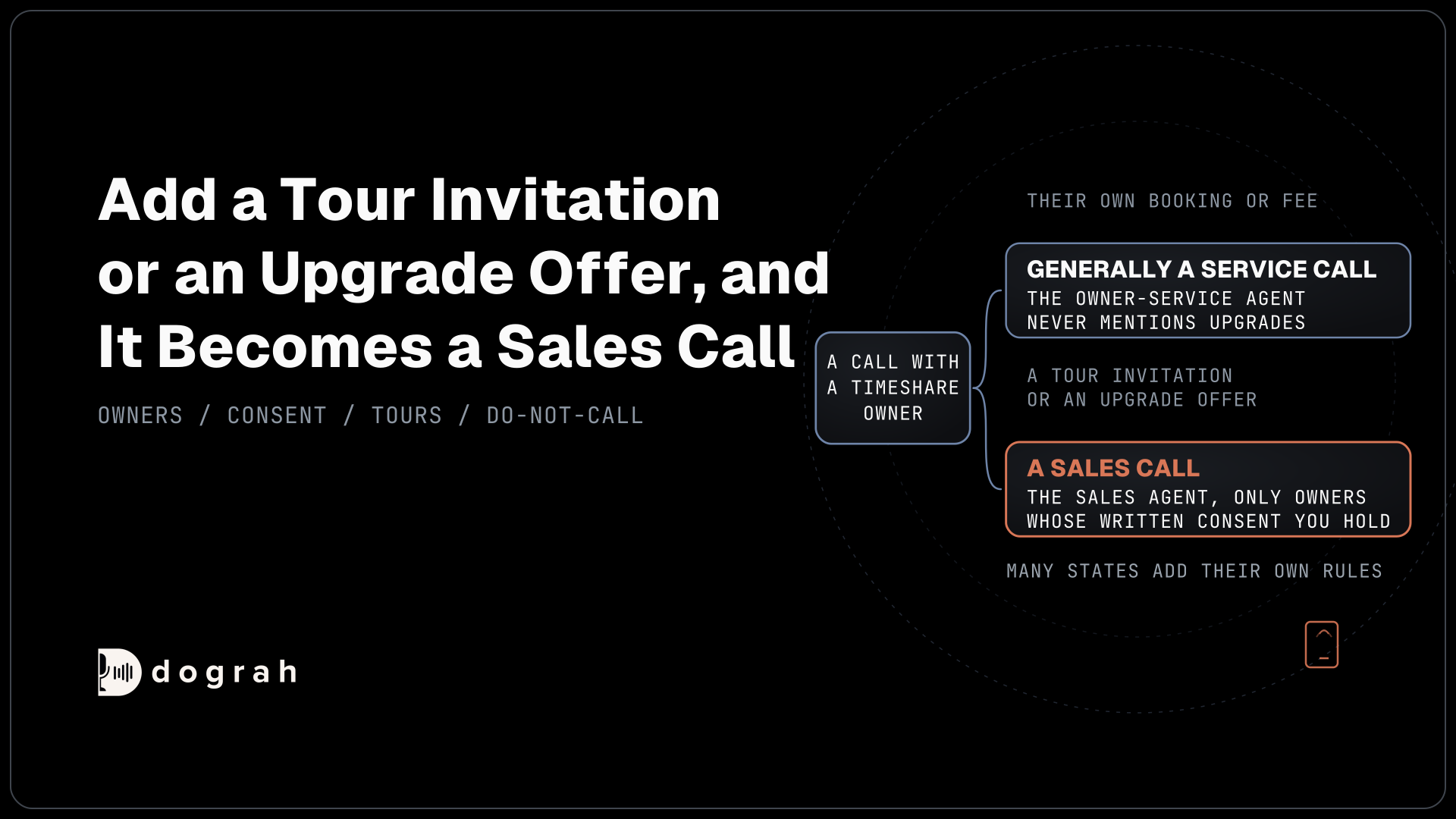
Owner service and sales are two different calls under the law, so build them as two agents. The owner-service agent answers the calls owners place and makes service calls about their own stays and fees. It never mentions upgrades, new points or tours.
The sales agent makes the calls that need consent. It only dials owners and prospects whose written consent you hold, on its own campaign, with its own greeting and its own checks.
The split protects you from drift. A friendly owner call that ends with "would you like to hear about our new resort?" has become a sales call, and the consent you needed was never collected. Our guide to AI voice agents for outbound sales covers how sales agents are built and measured.
The rules for timeshare sales calls
The Federal Communications Commission ruled that an AI-generated voice is an artificial voice under the Telephone Consumer Protection Act (TCPA). The TCPA rules then set the bar for sales calls. A telemarketing call in an artificial voice to a mobile or a home line needs the person's prior express written consent. That is a signed agreement, e-signatures included, that names the number, clearly allows such calls and is not a condition of buying anything. Every artificial-voice call names the business at the start and gives a number to call back. Telemarketing calls also offer an automated way to opt out, and run only between 8 a.m. and 9 p.m. in the called person's local time.
The Telemarketing Sales Rule from the Federal Trade Commission adds more. A sales call promptly says who the seller is, that the call is about selling and what is being sold. Numbers on the National Do Not Call Registry can be called only with the person's written agreement or an existing business relationship, and owners usually have one. Many states add their own timeshare and telemarketing rules, so confirm the full set for your states with counsel before the first sales campaign.
A call about the owner's own booking or fee is generally a service call. Add a tour invitation or an upgrade offer, and it becomes a sales call with all of the rules above.
Setting the sales agent up to follow them
Start with the greeting. In the Start Call node's Greeting Text, name the company and give a callback number before anything else, for example "This is Lakeview Vacation Club calling. You can reach us at +1407555XXXX." Then say what the call is about. If you want owners to know they are speaking with an automated assistant, or a law where they live requires it, add that line here too.
Allow Greeting Interruption is on by default. Switch it off on the Start Call node, so the whole required opening plays even when the owner starts talking.
Calling hours come next. Campaigns run their calling hours in one time zone each, so split your owner list by time zone and run one campaign per zone, each set inside 8 a.m. to 9 p.m. local. You set the retries (0 to 10), and each owner gets one answered call per campaign, so how often an owner hears from you across campaigns is set by the lists you upload.
Opt-outs are taken by voice, and the agent writes them to your do-not-call list through an HTTP API tool. Remove those numbers from every list before the next campaign runs.
Handing owners to your team
Some calls need a person: a dispute about a fee, a hardship request or an owner who simply asks. On Twilio, Telnyx, Plivo, Cloudonix and Asterisk ARI, the Transfer Call tool handles those calls. It calls your owner services desk first and connects the owner only when someone answers. On Twilio it can also play a short spoken introduction that both sides hear, which is off by default.
If no one answers within the timeout, 30 seconds by default, the owner stays with the agent. The agent then writes a callback request to your system through an HTTP API tool, so the desk sees who to call and why.
Join the Dograh Community
Dograh is an OSS alternative to Vapi. Join our Slack community for queries, releases, best practices & community interactions.
Checking calls and where the agent runs
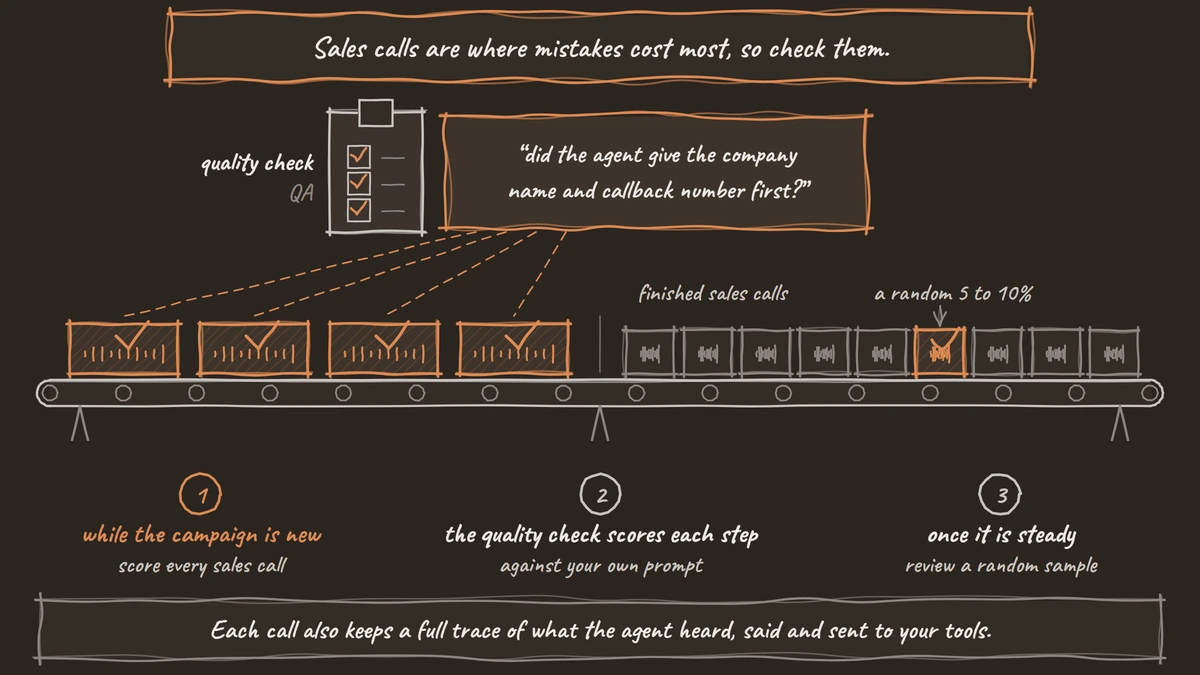
Sales calls are where mistakes cost most, so check them. Dograh's QA scores each step of a finished call against your own prompt, such as "did the agent give the company name and callback number first?" A sample rate below 100% picks calls at random. Score every sales call while the campaign is new, then review a random 5 to 10% once it is steady. Each call also keeps a full trace of what the agent heard, said and sent to your tools.
Owner records hold names, addresses and payment history, so where the agent runs matters. The platform is open source and runs on your own servers or in the cloud, with your own keys for the speech and language models. Self-hosted Dograh has no per-minute platform fee, but servers, model keys and phone minutes still cost money. Dograh Cloud charges a 1¢-a-minute platform fee.
Resorts that also run hotel-style front desks can see the wider picture in our guide to AI voice agents for hotels and hospitality.
Glossary
- Prior express written consent
- A signed agreement, e-signatures included, in which a person allows sales calls in an artificial voice to a named number. It cannot be a condition of buying anything.
- Artificial voice
- A voice that is not a live person on the line. The FCC treats AI-generated voices as artificial voices, so AI voice agent calls follow the same TCPA rules.
- Established business relationship
- A recent purchase or transaction between a business and a customer. Under the Telemarketing Sales Rule it can allow calls to numbers on the National Do Not Call Registry, but it does not replace written consent for artificial-voice sales calls.
- Internal do-not-call list
- A company's own list of people who asked not to be called. Opt-outs taken on a call go onto it, and the numbers come off every list before the next campaign.