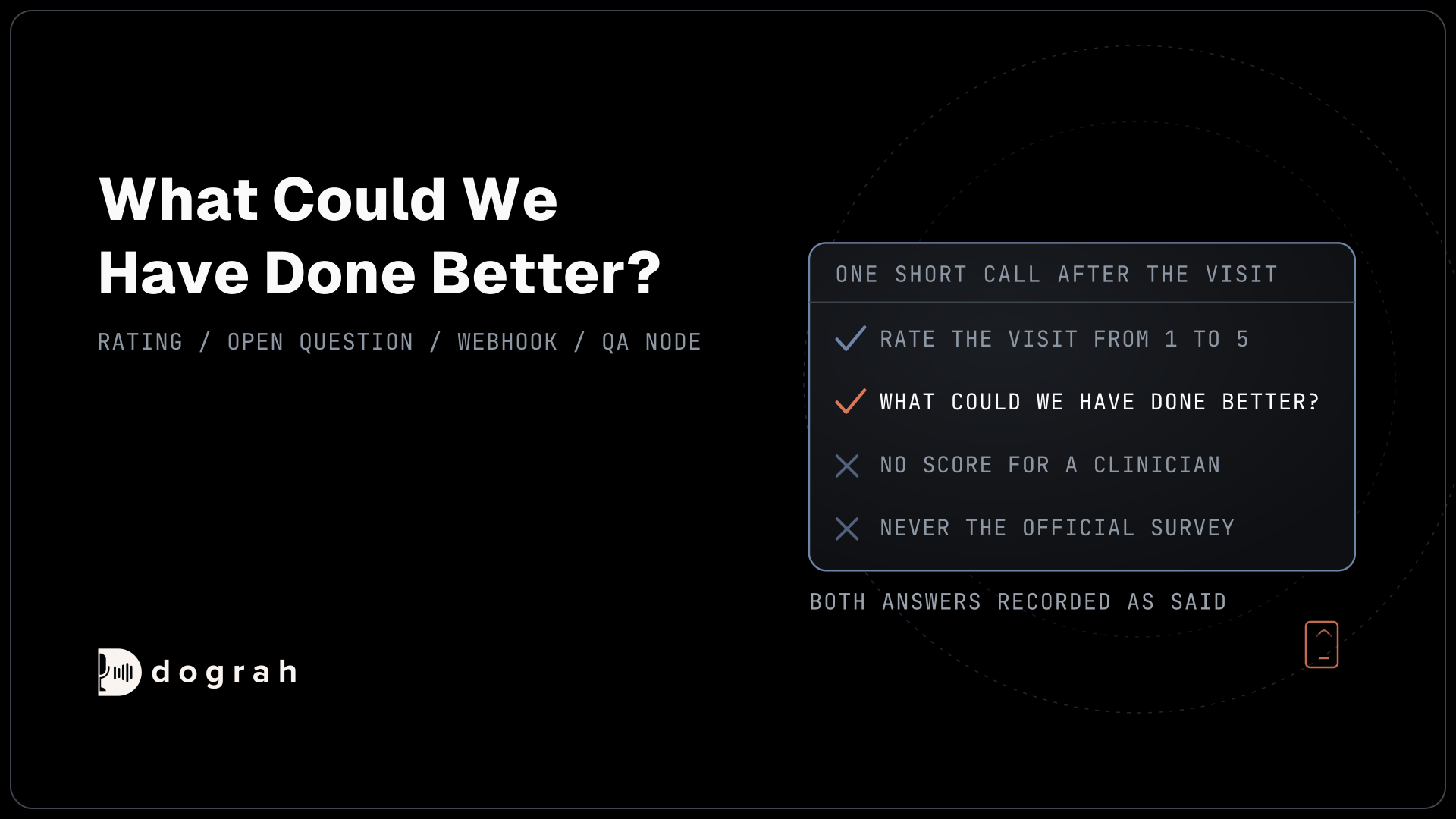

AI voice agents for patient surveys in telehealth call a patient after a virtual visit and ask one rating and one open question. The agent records both answers as the patient said them and sends them to your survey system by webhook. It never scores a clinician, and it never stands in for the official patient experience surveys.
Key Takeaways
- Keep the call to one rating and one open question.
- Record answers as the patient said them. Never score a clinician.
- Your own survey call never replaces or mimics the official patient surveys.
This post is part of our guide to AI voice agents for hospitals and health systems. The guide's section on patient calls after a visit ends with the survey: one rating and one open question, recorded and never scored. This post builds that call in Dograh, an open-source, self-hostable voice agent platform, with both answers extracted after the call and a quality assurance (QA) node checking a sample of calls.
Some patients do not want this call, so keep it short
Not every patient welcomes an automated survey call, and the design should start from that. In a June 2026 OnePoll survey of 6,000 adults reported by WellReceived, 90% said they prefer to speak to a real person over an AI when contacting a healthcare practice, and 55% would not trust an automated AI service to relay accurate information. WellReceived sells live medical receptionist services, so it has a stake in that finding. The question was also about contacting a practice, and a short survey call is a different moment.
The lesson still holds. Say who is calling in the first sentence, keep the call to a minute or two, offer a person at any point and accept that some patients will let it ring. A survey that annoys patients ends up measuring their annoyance.
Text and email surveys cost less and suit the patients who prefer them. A call earns its place with patients who never open those, and with the open question, where a spoken answer carries far more than a comment box left empty.
One rating and one open question
The whole script fits on an index card. The agent says who is calling and why, checks it has the right person, asks for a rating from 1 to 5 for how the visit went, asks one open question and says thank you. The open question should invite a story. "What could we have done better?" works better than "Any comments?". Then the agent lets the patient talk.
Even a survey runs greet, verify, disclose, because naming the visit discloses that the patient was seen. Write the Greeting Text to name the clinic, with a fallback such as {{clinic_name | your care team}}, and to say the patient is speaking with an automated assistant, but nothing about the visit. Dograh plays exactly what you write, before verification. The agent then checks the date of birth plus one reference, such as the visit date. A phone number finds the record. It does not prove who answered.
Call a day or two after the visit, while it is still fresh. Your telehealth platform starts the call through Dograh's API Trigger once the visit closes, passing the visit reference into the call. Never place it while a clinical check-in for the same visit is still open. The post-visit follow-up call comes first, and a request for a rating on top of a worrying symptom reads badly.
A survey is not among the purposes the Federal Communications Commission (FCC) healthcare exemption lists, so an automated survey call to a mobile number generally needs the patient's prior consent, and the guide's consent section sets out the rule.

Open Source Alternative to Vapi / Retell
Self-hosted voice agent platform — no per-minute fees
dograh-hq/dograh
Star on GitHub
Your own survey never stands in for the official one
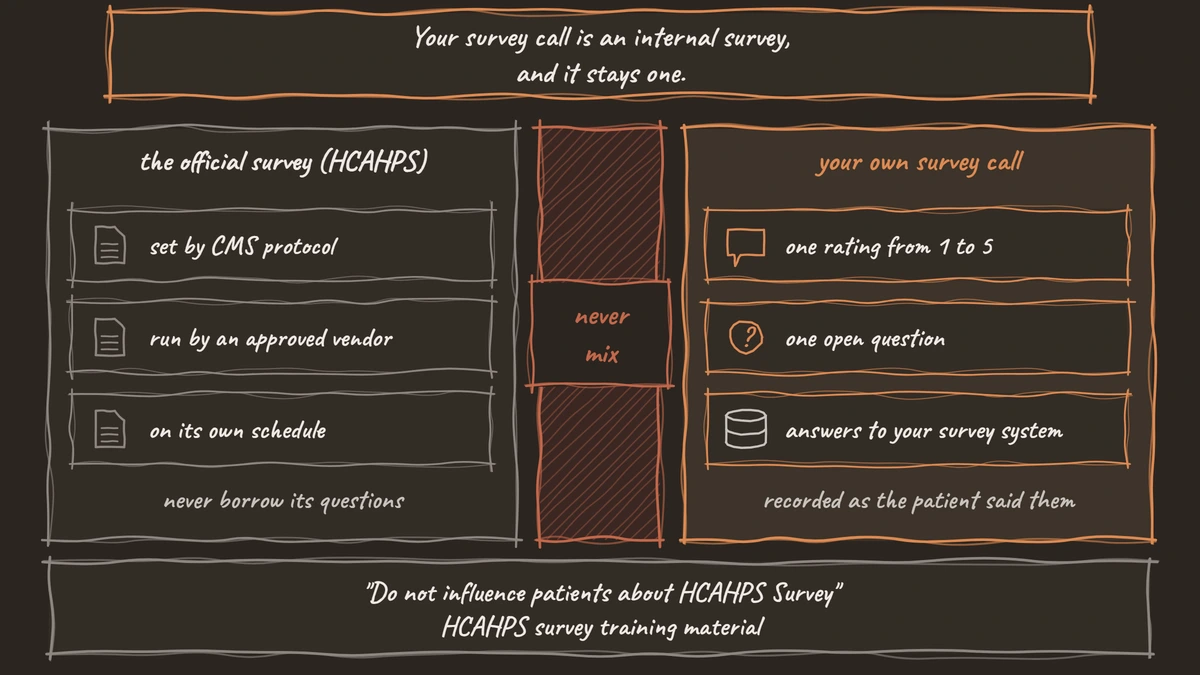
One rule protects you from the most expensive mistake a survey call can make. The official surveys, such as the Hospital Consumer Assessment of Healthcare Providers and Systems (HCAHPS), run on strict protocols set by the Centers for Medicare and Medicaid Services (CMS), through approved survey vendors or approved self-administering hospitals. The HCAHPS survey training material tells hospitals: "Do not influence patients about HCAHPS Survey". It also bars any "communication to patients that is intended to influence survey results".
So your AI survey call is an internal survey, and it stays one. It never borrows the official questions or claims to be the official survey. It never hints at how a patient should rate a visit when the official survey arrives. HCAHPS covers hospital stays, and the outpatient surveys in the same family have their own vendor rules, but the principle carries across: keep your own feedback call clearly separate from anything a patient might be sampled for. The protocol detail is in the FAQ below.
Record what the patient said, and never score the clinician
The agent's job is to capture the two answers faithfully. In Dograh, variable extraction records the rating and the open answer as extracted variables after the call, as the patient stated them. Extraction is an AI step, so the transcript and the recording stay the exact record. The agent never turns the comment into a sentiment score, and it never rates or comments on a named clinician. The same rule runs through our post on claims satisfaction surveys in insurance: record it, never score it.
After the call, a webhook node sends both answers, the visit reference and a link to the recording to your survey system or customer relationship management (CRM) system. A temporary failure is retried automatically, up to five attempts.
Two kinds of answer leave the survey. A complaint about a named clinician goes to your patient experience team, recorded as said. A clinical remark in the open answer, such as a rash that is getting worse, goes to a nurse. The agent does not discuss either one. It says someone will call back and writes the request to your system through an HTTP API tool.
Join the Dograh Community
Dograh is an OSS alternative to Vapi. Join our Slack community for queries, releases, best practices & community interactions.
Check a sample of calls with the QA node
QA grades the agent, never the patient. Dograh's QA node reviews calls after they end and scores each step of the agent separately, with its own tags, a score from 1 to 10 and a summary. There is no single score for the call. Its Sample Rate, the share of calls it checks, can be set below 100% to review a random sample, so a team can review one call in ten instead of all of them. Summaries come out in English by default.
Look for the moments that hurt a survey: the agent talking over a patient, or pressing for a rating after the patient has said no. Our post on automated QA for voice agents covers how to set those checks up.
Keep survey answers on your own servers
An open answer about a visit is protected health information (PHI), even when it sounds like small talk. Self-hosting Dograh runs the platform on your own servers, so the recordings and transcripts stay there too. No business associate agreement (BAA) with Dograh is needed then, because Dograh never receives the PHI. Each model provider you use through an API key still hears the audio, so each needs its own BAA. The phone carrier may need one too, depending on what it stores. A BAA delegates duties and never transfers your liability. The audio stays inside your infrastructure only when the speech and language models run on your servers too.
There is no retention setting and no automatic deletion, so your own policy decides how long survey recordings and transcripts are kept. On a self-hosted server, recording can be switched off for the whole server, and transcripts are still saved. Self-hosted Dograh has no per-minute platform fee, though servers, any paid model keys and phone minutes still cost money. Dograh Cloud has a 1¢-a-minute platform fee.
Measure one thing first: how many patients who gave a 1 or a 2 also said why. That number tells you whether the call is doing the job a comment box never did.
Glossary
- Hospital Consumer Assessment of Healthcare Providers and Systems (HCAHPS)
- The official national survey of patients' hospital experience, run on a fixed protocol through approved survey vendors or approved self-administering hospitals. A provider's own survey call must never influence it.
- extracted variables
- The fields Dograh fills from the conversation after the call, such as the rating and the open answer, recorded as the patient stated them, with the transcript as the exact record.
- QA node
- The Dograh step that reviews calls after they end and scores each step of the agent separately, with tags, a score and a summary. It grades the agent, never the patient.
- Sample Rate
- The QA node setting that decides what share of calls is reviewed. Below 100%, calls are picked at random.