
AI voice agents for real estate in the UK answer viewing and valuation enquiries and book viewings for estate and letting agents. Start with inbound calls. Treat any outbound AI marketing call as an automated call that needs specific consent under PECR, and keep data in the UK by self-hosting with the models there too.
Key Takeaways
- Start with inbound enquiries, which PECR's marketing call rules generally do not cover.
- Treat an outbound AI marketing call as automated and get specific consent.
- Call data stays in the UK only if the models run there too.
This post is part of our guide to AI voice agents for real estate. The guide's section on Spanish-speaking buyers and UK agencies points out that the Telephone Consumer Protection Act (TCPA) and the Fair Housing Act are US law, and that UK marketing calls fall under the Privacy and Electronic Communications Regulations (PECR). This post sets out what that means for estate and letting agents running calls on Dograh, an open-source, self-hostable voice agent platform. It is general information, not legal advice.
Evening calls are where UK agencies miss enquiries
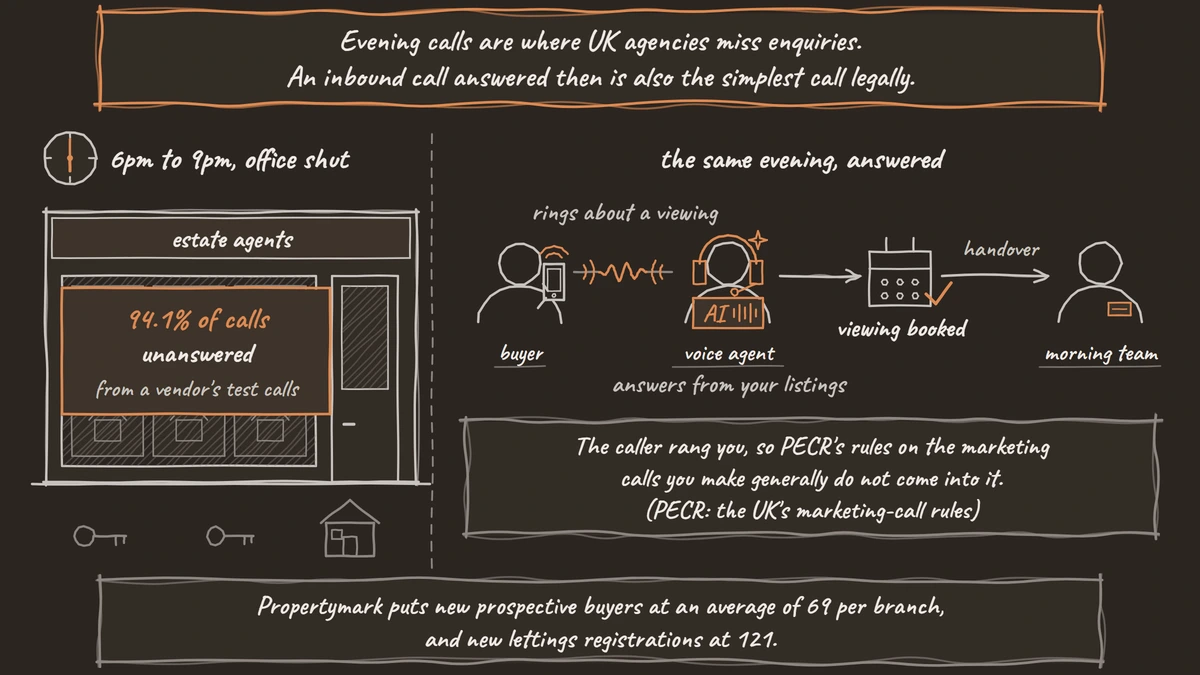
A large gap opens after the office shuts. InStep AI, which sells an AI assistant to agents, made test calls on weekday evenings from May to July 2026 to 3,047 UK property business numbers, and Property Industry Eye reported that 94.1% of calls between 6pm and 9pm went unanswered. Across the study, only 0.7% of calls were answered by a voice AI system. That is vendor data, as is InStep's figure that 27% of the leads its own clients captured arrived outside office hours.
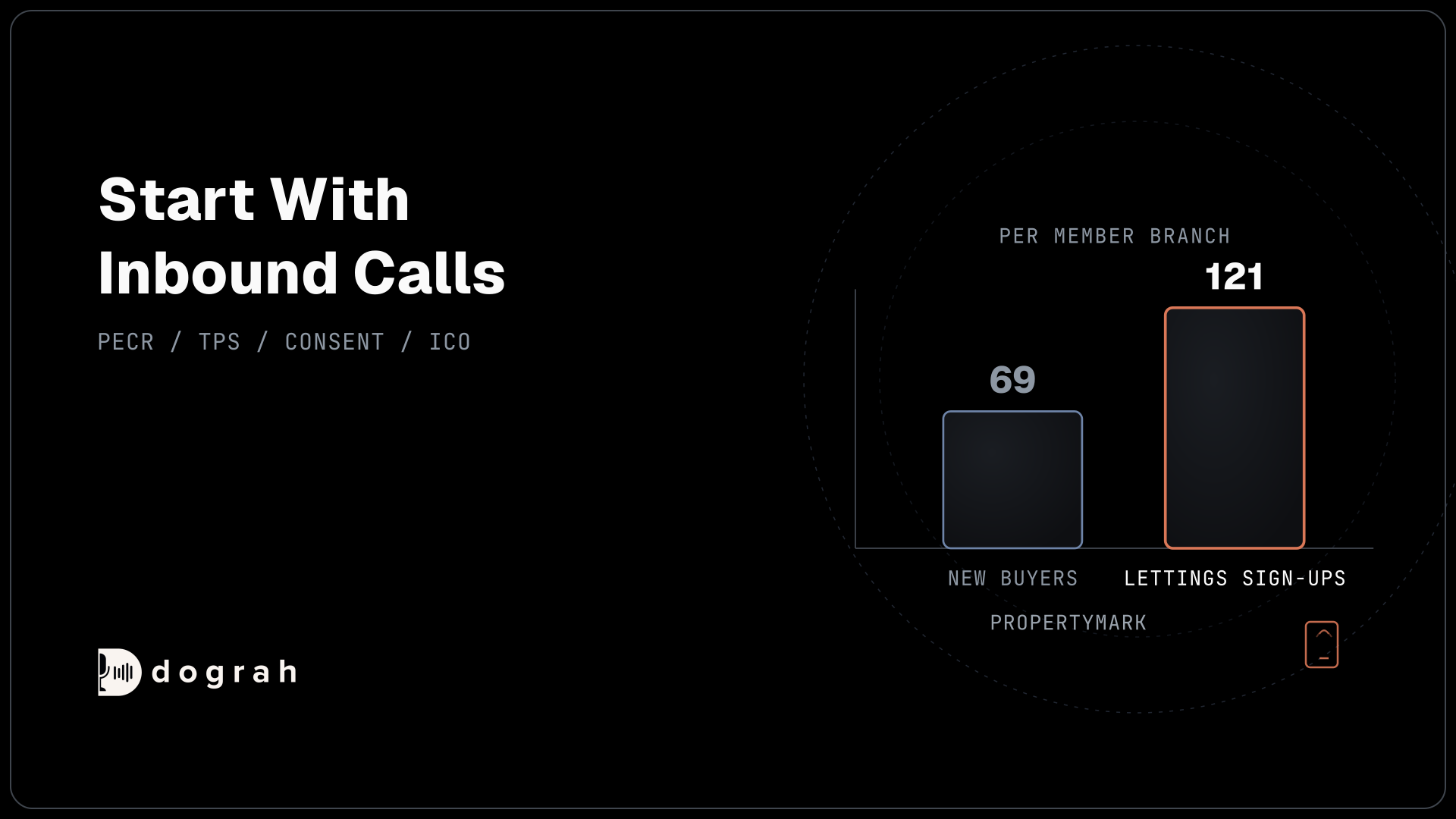
The demand behind those calls is steady. Propertymark's Housing Insight Report for August 2026 puts new prospective buyers at an average of 69 per member branch and new lettings registrations at 121 per branch. Each of those people may ring about a viewing or a valuation at a time that suits them, which is often the evening.
An inbound call is also the simplest call legally. The caller rang you, so PECR's rules on the marketing calls you make generally do not come into it, although the UK General Data Protection Regulation (UK GDPR) still covers the recording and the details the agent takes. The agent answers from your listings and books viewings. The overnight handover to the morning team is covered in AI Voice Agents for After-Hours Coverage.
Service calls and marketing calls follow different rules
Before an agency makes any outbound call, it should know which kind of call it is making. The Information Commissioner's Office (ICO) guidance on identifying direct marketing describes service messages as messages "that aren't promotional but are for administrative or customer services purposes", including messages to "confirm or remind them about appointments". A call confirming a viewing the person booked is generally a service call.
The line moves fast. The same guidance says that if a service message "has elements that are direct marketing, even if that is not the main purpose of your message, then it will count as direct marketing". A viewing confirmation that ends with "and would you like a free valuation of your own home?" has become a marketing call. Valuation canvassing to people who never asked is marketing from the first word.
So write service calls to stay service calls. The prompt confirms or moves the viewing and stops there, and any offer lives in a separate campaign with its own consent. The call is about the person's own booking, so the agent checks their name plus the property address or email on file before it names the viewing.

Open Source Alternative to Vapi / Retell
Self-hosted voice agent platform — no per-minute fees
dograh-hq/dograh
Star on GitHub
Treat an outbound AI marketing call as automated
PECR has two sets of rules for marketing calls, and an AI voice agent sits between them. Live calls fall under regulation 21. The ICO's telephone marketing guidance says that "In general, you must not make marketing calls to any number listed on the Telephone Preference Service (TPS) or Corporate TPS (CTPS), unless that person has specifically consented to your calls". Automated calls fall under regulation 19, which is stricter: "You must not make an automated marketing call" unless the person has specifically consented, and "General consent for marketing, or even consent for live calls, is not enough".
The ICO describes an automated call as "a call made by an automated dialling system that plays a recorded message", and its guidance does not name AI voices. The Data & Marketing Association (DMA), the UK marketing trade body, takes the cautious view that "Automated calls and AI call handling should be treated the same". That is a trade body's position, not a ruling, and it is still the safer reading. Generally, treat an AI marketing call as automated, and get consent that specifically covers automated calls before the first dial.
The ICO also says its guidance "is under review and may be subject to change" after the Data (Use and Access) Act, so check it before each new campaign and confirm your consent wording with a data protection adviser.
In Dograh, consent stays in your customer relationship management (CRM) system, and only numbers with an automated-call consent record reach Campaigns (a CSV upload) or the API Trigger. Screen the list against both TPS registers and your own suppression file as well, as the DMA recommends. Campaigns lets you set calling hours by weekday, but it has no per-person call cap, so your list decides how often anyone is called, or you set retries to zero.
Say who is calling, and that it is an AI
The opening line carries the identity rules, so write it before anything else. The ICO says automated calls "must include your name and a contact address or freephone number", and that you must allow your number to be displayed. The DMA adds that "you should disclose if AI is speaking", which it ties to UK GDPR's fairness and transparency requirements.
Dograh's Greeting Text plays word for word, so put the agency's name and, as the DMA advises, the automated-assistant line there, with a freephone or contact number on marketing calls. Greeting Text plays before any verification, so it never names the property or the vendor.
Opt-outs come by voice, because Dograh has no keypad tool. When someone says "stop calling me" or "take me off your list", the agent confirms it and writes the request to your CRM through an HTTP API tool during the call, so the number joins your suppression file before the next campaign runs. A person who wants to speak to someone can be transferred through Transfer Call, which works on Twilio only, with the details written to your system first.
Keep call data in the UK
A UK data promise holds only when every part that touches the audio sits in the UK. Self-hosting Dograh in a UK data centre keeps the call platform and its recordings and transcripts there. Dograh is the orchestration layer: it runs the call flow, tools and telephony, and the speech and language models are a separate layer you choose.
That layer decides where the audio goes. Call data stays in the UK only when the speech and language models also run on your UK servers. Using your own API key with a hosted model changes who you contract with, and the provider still receives the audio wherever it processes it. The phone carrier carries the call too. Dograh Cloud does not name a UK data region, so a UK-only promise rests on self-hosting.
The processor contracts each hosted provider needs are covered in AI Voice Agents for Hospitals and Health Systems (UK): Keep Data in the UK, and sizing open-weight models for your own servers is in Running Voice AI on Local, Self-Hosted Models.
Plan retention yourself. Dograh has no retention setting and deletes nothing automatically, so your own retention schedule decides how long recordings and transcripts are kept. On a self-hosted server, recording can be switched off only for the whole server, and transcripts are still saved. Self-hosted Dograh has no per-minute platform fee (servers, model keys and phone minutes still cost); Dograh Cloud has a 1¢-a-minute platform fee.
Join the Dograh Community
Dograh is an OSS alternative to Vapi. Join our Slack community for queries, releases, best practices & community interactions.
Where a UK agency should start
Start with the inbound line in the evenings and at weekends. It answers from your listings and books viewings, and nobody on it needs TPS screening. Next come service calls that confirm or move viewings, written so they never turn into marketing; the booking rules and read-back are in AI voice agents for property-visit scheduling. Outbound valuation canvassing and portal-lead calls come last, and only to numbers whose consent specifically covers automated calls.
Test with real regional accents and local road names over a real phone line. Most phone calls still reach the agent as 8 kHz audio, while a browser demo runs at 16 kHz, and a village or development name is easy to mishear. Add those names to the agent's Dictionary (it works with Deepgram and Dograh speech-to-text), then read the transcripts of the first week's calls before you widen what the agent does.
Glossary
- PECR
- The Privacy and Electronic Communications Regulations, the UK rules on marketing calls and electronic messages. They sit alongside UK GDPR, and the ICO enforces both.
- Telephone Preference Service (TPS)
- The UK register of people who have opted out of unsolicited live marketing calls. The Corporate TPS (CTPS) does the same for business numbers.
- Automated call
- Under PECR regulation 19, a marketing call made by an automated system that plays a recorded message. It needs consent that specifically covers automated calls, and the cautious reading treats an AI voice the same way.
- Service message
- A call or message for administrative or customer service purposes, such as confirming a viewing. It falls outside PECR's marketing rules unless it carries any direct marketing.