
AI voice agents for branch appointment booking book a visit at the branch the caller named or dialled, asking only who they are and why they're coming, and answer opening hours and what to bring from the bank's own files. Questions about an account wait until the caller passes the bank's own verification. Reminder calls carry no product offer.
Key Takeaways
- A branch booking needs the reason for the visit, never account data.
- Account questions wait for the bank's own verification, and the agent hears pass or fail.
- Reminders never ask for a PIN or password and never carry an offer.
Someone booking a branch visit wants time with a person, and the booking needs none of their account details. We cover checking identity before account questions, booking the right staff at the right branch, reminders without offers and handover in Dograh. For the wider field, see our guide to appointment and demo booking.
A branch booking needs no account data
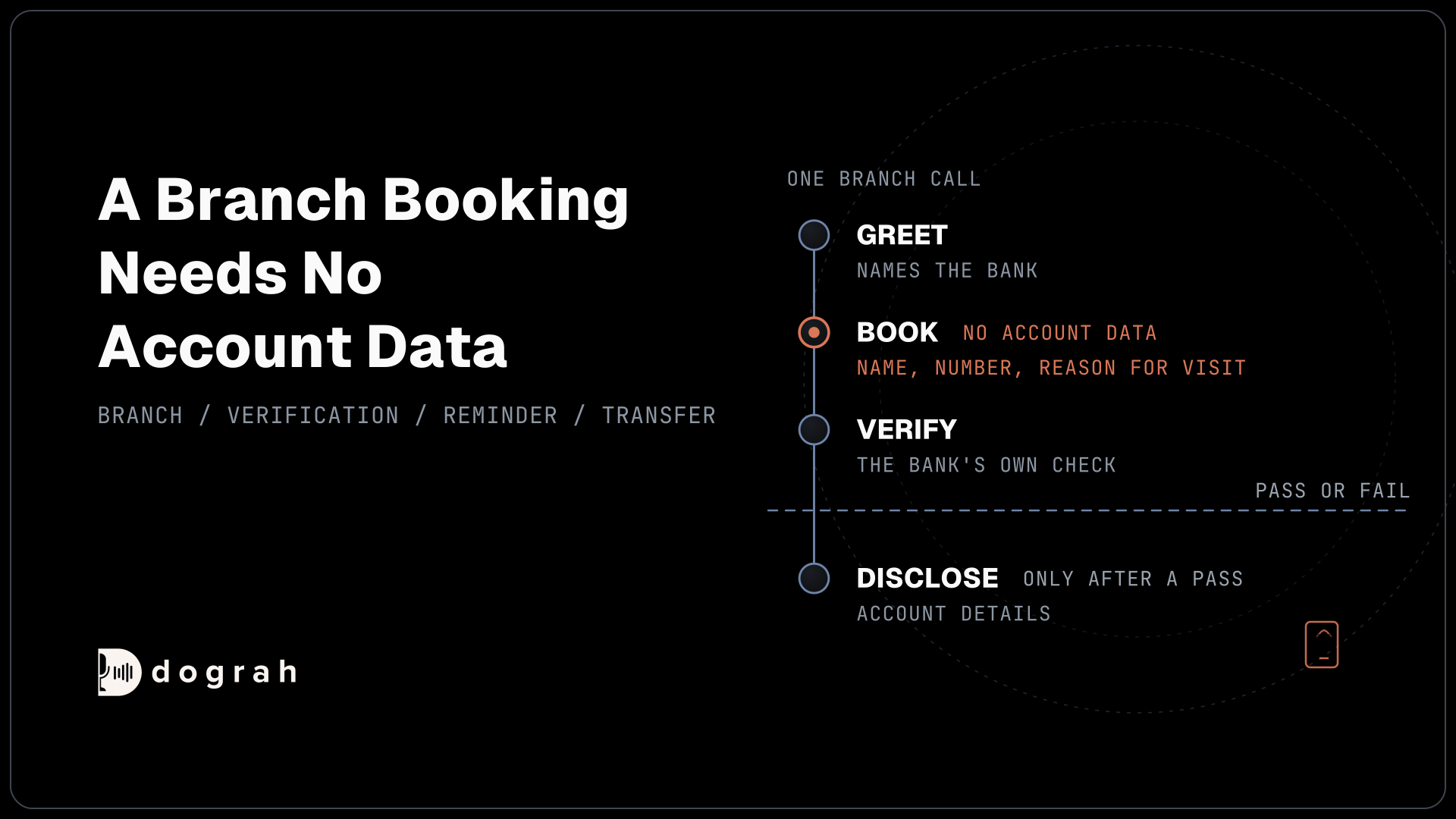
A customer booking a branch visit is asking for time with a person, so the agent books with the caller's contact details and the reason for the visit. Opening an account and a loan conversation need different people and different slot lengths. Neither needs the agent to look at an account.
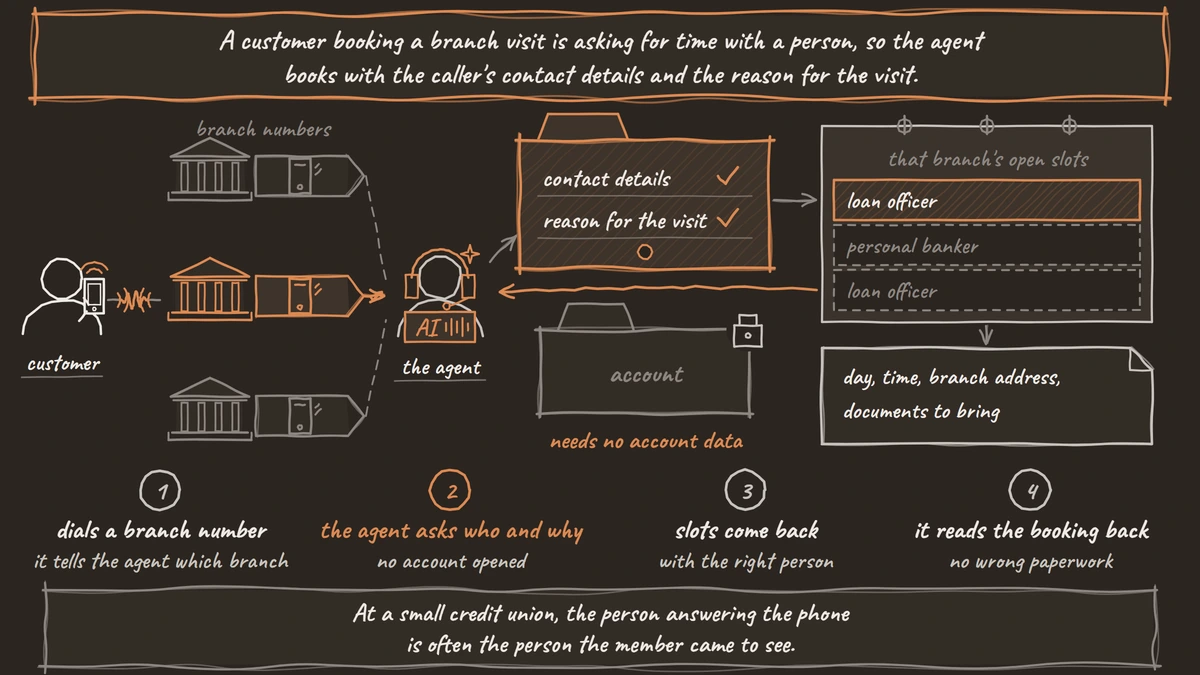
Many of the institutions taking these calls are small. The NCUA's quarterly data summary counted 4,214 federally insured credit unions with 146.1 million members at the end of June 2026, and only 748 of them hold more than $500 million in assets. At a small credit union, the person answering the phone is often the person the member came to see.
Several branch numbers can point at one agent, each through its own inbound workflow setting. Pre-Call Data Fetch receives the dialled number as the call connects, so your endpoint can tell the agent which branch the customer called. The agent offers that branch's slots first.
Opening hours, holiday closures and what to bring to a loan meeting come from the bank's own files. Upload them to the Knowledge Base as PDF, Word, text or JSON files of up to 5 MB each. A short branch FAQ works well in Full Document mode, which needs no embedding key.
Verify before anything about an account
Every call runs greet, verify, then disclose, and the booking itself sits before the verify step. Once a caller asks about a deposit or an existing appointment's details, the bank's own check comes first. A matching number tells the agent which customer to expect, while anyone could be the one who phoned.
Phone lines are where attackers try first. The FFIEC guidance on authentication says reliable verification methods "generally do not depend solely on knowledge-based questions." It lists call-backs to a pre-established phone number and one-time codes sent to a pre-established device among stronger options.
The agent collects the answers and the bank decides. An HTTP API tool sends them to your system, or asks it to send a one-time code to the number on file, and the agent hears only pass or fail. Attach account tools only to the step after the check, so a caller who fails never reaches one. AI voice agents for banking and credit unions covers that order of checks.
Some requests stay with staff whatever the check says, such as changing a phone number or resetting an online banking login. AI voice agents for inbound support in banking covers what the agent answers after the check and what it hands over.

Open Source Alternative to Vapi / Retell
Self-hosted voice agent platform — no per-minute fees
dograh-hq/dograh
Star on GitHub
Book with the right person at the right branch
The booking runs against the branch's own scheduling system, where appointment types already set the length and the staff who take them. An HTTP API tool sends the branch and the reason for the visit, and the system returns open slots with a loan officer, a personal banker or whoever that type needs. The agent offers two or three of them.
A lookup across several staff calendars can take a few seconds. A message on the tool's Messages card, such as "Let me check the branch calendar", plays when the tool starts, while the request runs. Add a Preset Parameter named workflow_run_id with the value {{initial_context.workflow_run_id}} to the booking tool, so your system ignores a repeated request and never books the same slot twice.
Before the call ends, the agent reads back the day, the time, the branch address and the documents to bring. A customer who arrives with the wrong paperwork costs the branch a second appointment.
Reminder calls carry no offer
A reminder is a service call about a visit the customer booked, and it stays that way. Even so, the FCC's 2024 ruling on AI-generated voices counts an AI voice as an artificial voice under the Telephone Consumer Protection Act (TCPA), which means a reminder to a customer's mobile needs their prior express consent.
Banks have a narrow financial-institution exemption in the FCC's calling rules, and it covers calls about fraud, data breaches and pending money transfers. Appointment reminders fall outside it. Mention a new product or a better rate on the reminder, and it becomes a telemarketing call that needs prior express written consent. AI voice agents for payment reminders in banking covers the consent records.
Customers also have good reason to doubt the call. The FTC reported that people lost nearly $1 billion to business impersonators in 2025, with the highest reported losses to bank impersonators. So the reminder never asks for a PIN, a password, a full card number or a security code, and it tells the customer they can call back on the number on their card.
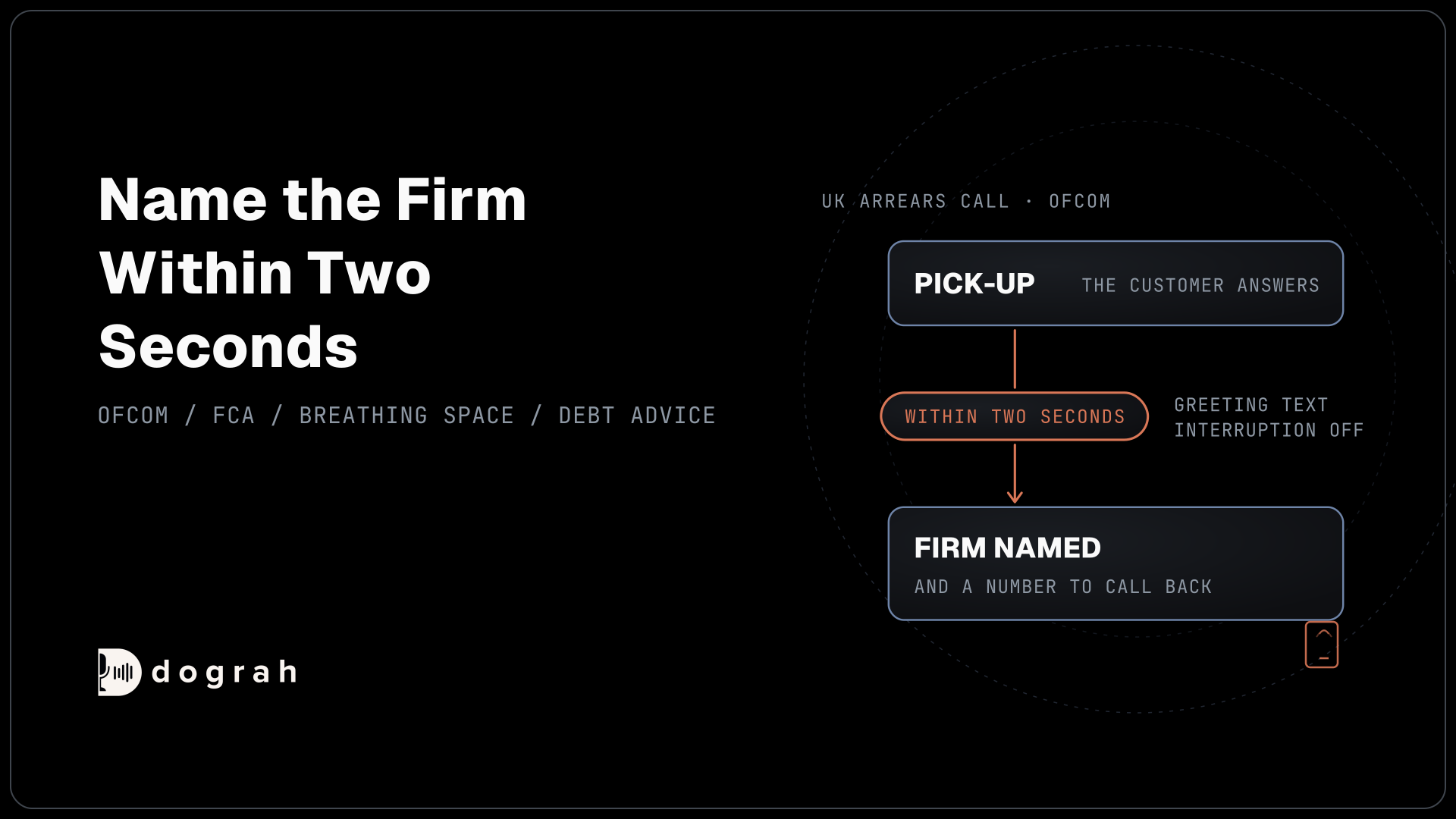
The Greeting Text names the bank. A notice that the customer is hearing an automated assistant, whether the bank chooses it or local law requires it, sits in that same text, and switching off Allow Greeting Interruption on the Start Call node lets the full notice play. If voicemail handling is on, the message names the bank and the appointment day, and nothing about the account. Confirm your consent records and reminder script with counsel.
Join the Dograh Community
Dograh is an OSS alternative to Vapi. Join our Slack community for queries, releases, best practices & community interactions.
Handing over and keeping call data in the bank
Some callers need a person, and Transfer Call can send them to the right branch or team. It is available on Twilio, Telnyx, Plivo, Cloudonix and Asterisk ARI, and it rings the branch first, joining the customer only after a staff member picks up.
Context Mapping picks the destination from what the agent learned, such as the branch or the topic. No summary travels with the call by default, so the agent writes the request to your system first. If nobody answers within 30 seconds, the default, the caller stays with the agent, which records a callback request.
Recordings keep whatever is said, which is one more reason the call never asks for full account or card numbers. Recordings and transcripts stay until your own retention schedule removes them. Self-hosted with open-weight models, the whole call runs on the bank's own servers. Before the first customer call, switch off the anonymous usage telemetry a self-hosted install sends by default, by setting ENABLE_TELEMETRY=false and removing POSTHOG_API_KEY.
Glossary
- Knowledge-based questions
- Questions that check identity with facts the caller should know, such as date of birth. Banking guidance says reliable methods do not rely on these questions alone, so the bank's own process adds a stronger step.
- Pre-established phone number
- A phone number the bank already holds on file for the customer. A one-time code or a call-back to that number is stronger proof than anything the caller says.
- Financial-institution exemption
- A narrow TCPA exemption for bank calls about fraud, data breaches and pending money transfers. Appointment reminders fall outside it and need the customer's prior express consent.
- Inbound workflow
- The setting on each phone number that points it at an agent. Several branch numbers can point at one agent, and the dialled number tells it which branch was called.