
AI voice agents for alarm monitoring companies make the routine calls operators would otherwise make. When an alarm comes in, the agent calls the owner and the call list, checks the passcode and records what each person says. It also answers customer service calls. The operator and the center's own procedure still decide every dispatch.
Key Takeaways
- The agent calls the owner and call list, and the operator decides on dispatch.
- Anyone in danger hears "get to safety and call 911", then reaches an operator.
- Florida law asks for two confirmation attempts before a police dispatch request.
This guide covers the calls a monitoring center can hand to an AI voice agent, from alarm events to the customer line, and shows how each part works in Dograh, the open-source AI voice agent platform we build. You can self-host it or run it on Dograh Cloud.
What a false alarm costs a monitoring center
Many alarm signals that bring police out turn out to be false, and each one takes an officer away from other work. One Illinois village shows the size of it. The Burr Ridge Police Department's 2025 report puts its false alarm rate at 66%, down from 74% in 2023, with 864 false alarms in the year.
The cause is often ordinary. In that same report, 358 false alarms came from owner or employee errors, down from 468 two years earlier. Someone forgets the code, or a cleaner arrives before the system is disarmed. A short call to the person at the property can clear these before anyone is sent.
That call is where the center's time goes. Operators dial owners and keyholders one by one while new signals keep arriving, and a storm or a power cut can bring in many signals at once. The calls are routine and scripted, yet each one still needs a person to make it. That is the work an AI voice agent can take on.
Why the agent never makes the dispatch decision
An AI voice agent in a monitoring center makes calls and records answers, and the operator decides what happens next. The Electronic Security Association describes the same split from inside the industry: voice assistants take the first calls with property owners, ask the follow-up questions and escalate to a live operator.
Some products go further and sell an agent that sorts false alarms from real threats and sends guards on its own, with accuracy figures to match. We would not set it up that way. A model that hears "it's fine, I set it off" cannot see who is saying it. If it gets that wrong, nobody goes to a real break-in.
So the agent's job stays narrow. It reaches a person on the call list, checks the passcode through the center's own system, records what they say and passes it on. The operator and the center's written procedure decide every dispatch, and the agent never cancels one either. It supports the monitoring center and never replaces its emergency process.
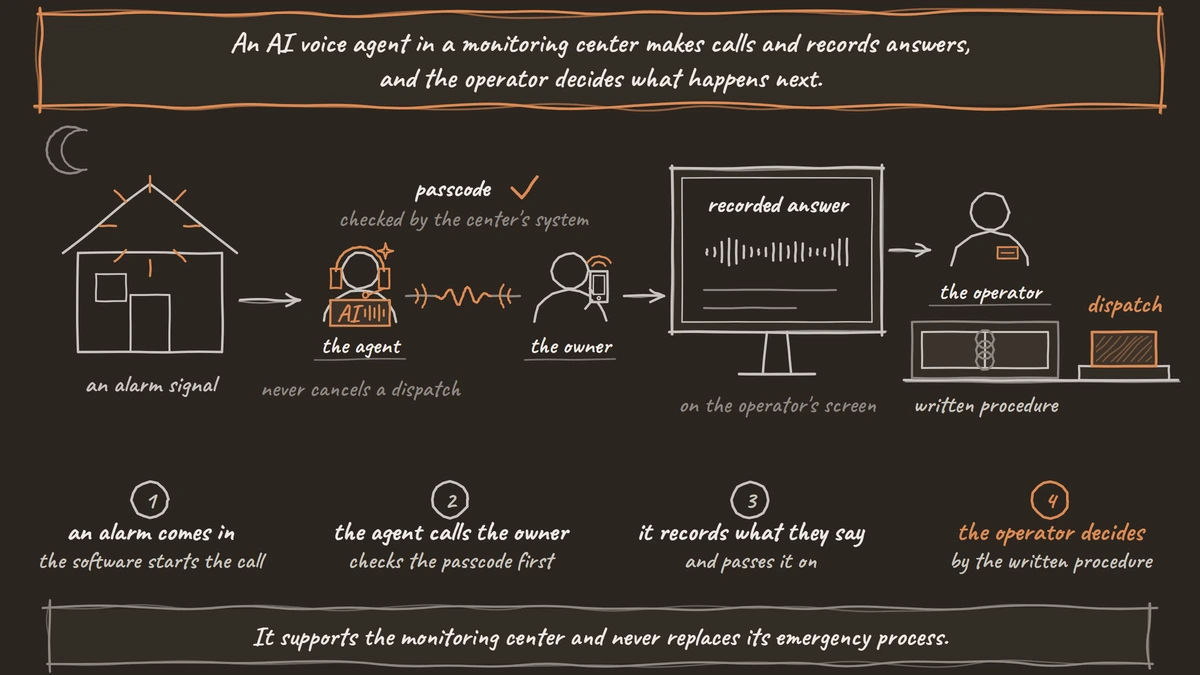
The same holds when the operator does call 911. ANSI/TMA-AVS-01, The Monitoring Association's alarm validation standard, gives each alarm an alarm validation score from Level 0 (no call for service) to Level 4 (confirmed threat to life) for the 911 center. The agent's recorded answers feed the operator's view of the event. The score itself comes from the center's process.
Alarm-event calls: owner first, then the call list
When an alarm comes in, the agent calls the premises or the owner first, then the next contact, and then the event goes to an operator. Each attempt is one call. The center's automation software starts it by sending the alarm details to the agent, which we cover in the section on connecting your software.
The call opens with the Greeting Text on the Start Call node. It names the monitoring company and asks for the passcode, and it says nothing about the zone or the address yet: "Hello, this is Northgate Monitoring calling about your security system. Can I have your passcode, please?" Switch off Allow Greeting Interruption, which is on by default, so the company name and the request play in full.
The passcode is checked by the center's own system. An HTTP API tool sends what the person said to that system, which answers match or no match, and the agent never reads a passcode back. Only after a match does the agent describe the alarm and ask whether everything is all right. Whatever the person says, the agent records it as they said it, with the recording as the exact record.
If nobody answers, or voicemail picks up, the outcome is "not reached". The center's software then starts the call to the next contact on the list. Campaign retries call the same number again, so moving down the list is the software's job. The Monitoring Association calls this enhanced confirmation: two or more investigative calls before any dispatch request. The full sequence, with the no-code and wrong-code cases and local rules, is in our post on AI alarm verification and escalation calls.

Open Source Alternative to Vapi / Retell
Self-hosted voice agent platform — no per-minute fees
dograh-hq/dograh
Star on GitHub
When a caller is in danger
Any sign of real danger ends the routine script at once. The prompt lists the signs in plain words: the person says someone is inside, they smell smoke or see fire, or someone needs medical help. When any of them comes up, the agent stops asking questions and uses the Transfer Call tool.
The safety line goes in the tool's Pre-Transfer Message, set to Custom Message or Pre-recorded Audio, so it plays as fixed words: "If you're in danger, get to safety and call 911." Then Dograh calls the operator queue and connects the caller only when someone answers. The destination can be a phone number or a SIP endpoint. With Context Mapping, the alarm type in the call details picks the queue, so a fire alarm can reach a different desk from a burglary.
If the queue does not answer within the Transfer Timeout, 30 seconds by default and settable from 5 to 120, the caller stays with the agent. The prompt has it repeat the safety line, and an HTTP API tool writes an urgent flag to the center's software so an operator calls back.
Transfers run on Twilio, Telnyx, Plivo, Cloudonix and Asterisk ARI. Deciding to transfer is the model following the prompt, and transfers run on phone calls, not browser tests. So test every danger sign over a real phone line before going live.
Customer service calls after the passcode check
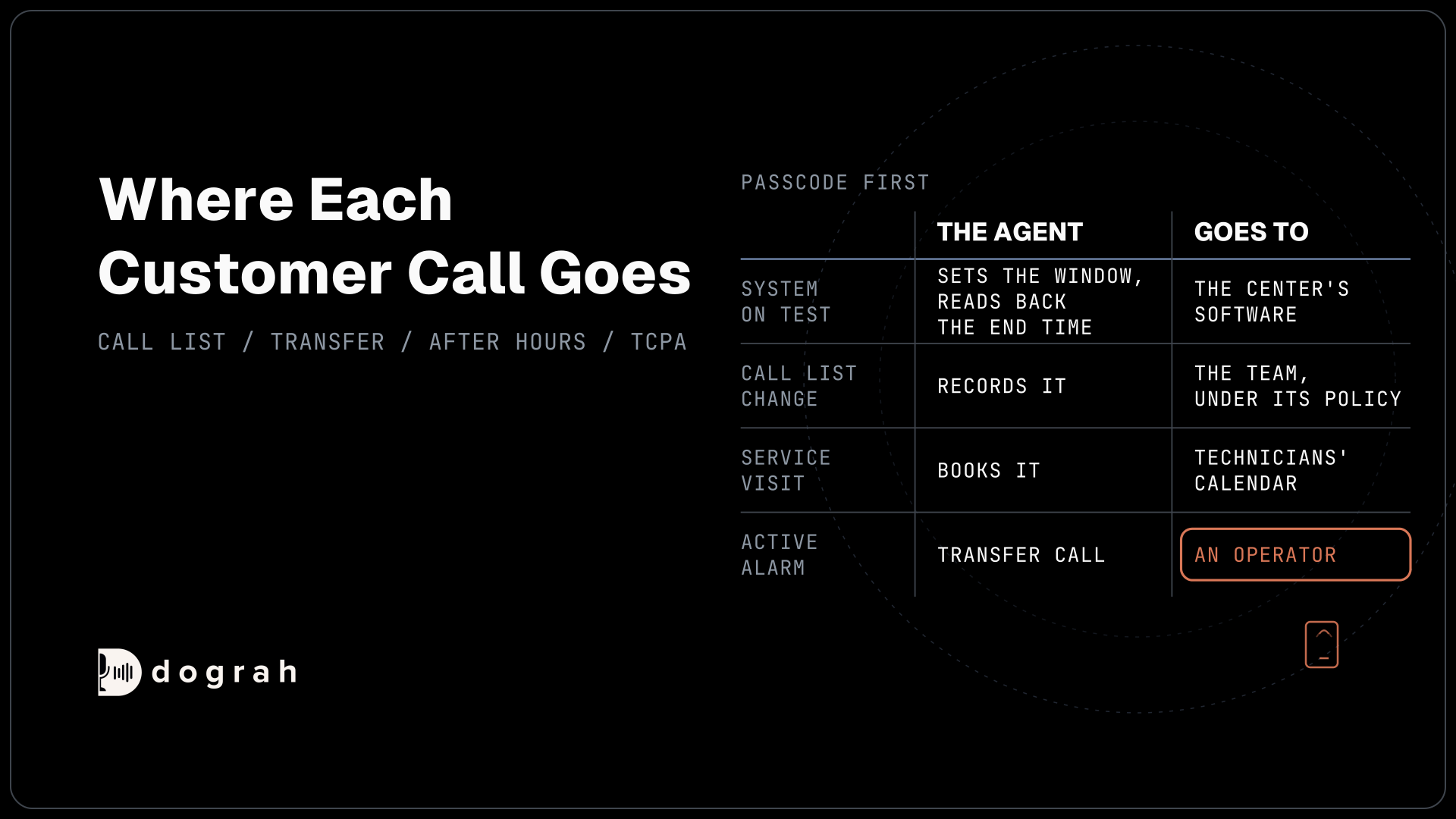
The customer line carries the same identity rule as an alarm call: passcode first, account details after. When a customer calls in, Pre-Call Data Fetch on the Start Call node, set to Inbound calls only, can load the account by the caller's number. The caller hears ringing while it runs. A phone number finds the account, but it does not prove who is calling, so the agent still asks for the passcode before it says anything about the account.
After the check, most service calls are short. A customer putting the system on test for a few hours gives the time window, and an HTTP API tool asks the center's software to set it, then the agent reads back the end time. Changes to the call list are recorded and written to the same software for the team to apply under its own policy. Service visits are booked against the technicians' calendar through an HTTP API tool, and billing questions are answered from the account data.
Anything about an alarm that is active right now goes to an operator through Transfer Call. The agent does not discuss it or cancel it.
After hours, when operators work alarm traffic
At night and during storms, operators belong on alarm signals, and the customer line still rings. The agent answers it, handles the routine requests above and writes anything that needs a person to the center's software for the morning team. Our post on AI voice agents for after-hours coverage covers the on-call side of night work in more detail.
A storm is also when call volume spikes, so plan capacity before you need it. Self-hosted Dograh runs 10 concurrent calls by default, which you can raise with the DEFAULT_ORG_CONCURRENCY_LIMIT setting, and your servers and phone provider set the practical ceiling. Dograh Cloud pay as you go includes 10 concurrent calls, and you can ask for more.
Join the Dograh Community
Dograh is an OSS alternative to Vapi. Join our Slack community for queries, releases, best practices & community interactions.
Connecting the agent to your automation software
Alarm-event calls start from the center's automation software, one request per event. You add an API Trigger node to the agent, and the software posts to its URL with the number to call in phone_number and the alarm details in initial_context:
curl -X POST https://your-dograh-instance/api/v1/public/agent/{uuid} \
  -H "Content-Type: application/json" \
  -H "X-API-Key: dgr_your_api_key" \
  -d '{
    "phone_number": "+1415555XXXX",
    "initial_context": {
      "account_name": "Lakeview Dental",
      "alarm_type": "burglary",
      "zone": "rear door",
      "attempt": 1
    }
  }'
What this does: It starts the first call for this alarm. The agent knows the zone and alarm type from the start, but the prompt keeps "rear door" back until the passcode matches, and
alarm_typeis what Context Mapping reads if the call needs an operator.
The moment your monitoring software sends the request, the call goes out. The reply carries a workflow_run_id, which your software stores beside the alarm event so the result can be matched to it later. Our post on API triggers covers keys, test URLs and error codes.
The result travels back the other way. Variables to Extract on the agent's nodes record fields such as reached, passcode_result and caller_statement, and a Webhook node posts them to the center's software when the call ends. A temporary failure on that post is retried automatically, up to five attempts. HTTP API tools used during the call make a single attempt, so the receiving endpoint should answer fast.
The rules on verification and calling
Some states set the order of calls in law. Florida's alarm confirmation law requires a monitoring company to try to confirm a centrally monitored burglary or intrusion alarm with the owner, occupant or a designee before asking police to dispatch, and to try a second time if the first attempt fails. Each attempt can be a call, a text message or another electronic means.
Florida's rule does not apply when a working camera or audio sensor lets monitoring staff verify the signal. It also does not apply to premises where a federally licensed firearms maker, importer or dealer stores firearms or ammunition, if the customer asks to skip the two attempts. Other states and cities set their own verification rules, so check your own state and city rules before you fix the sequence.
The calls themselves fall under the Telephone Consumer Protection Act (TCPA). The FCC's calling rules define emergency-purpose calls as calls needed because of a situation that affects people's health and safety, and an artificial-voice call made for an emergency purpose needs no consent to a mobile or a home line. An alarm verification call may count as one. Customer service calls you place to a mobile need prior express consent, any call that sells needs prior express written consent, and every call names the business at the start. Confirm with counsel how these rules apply to your alarm-event and service calls before you go live.
Where recordings and passcodes live
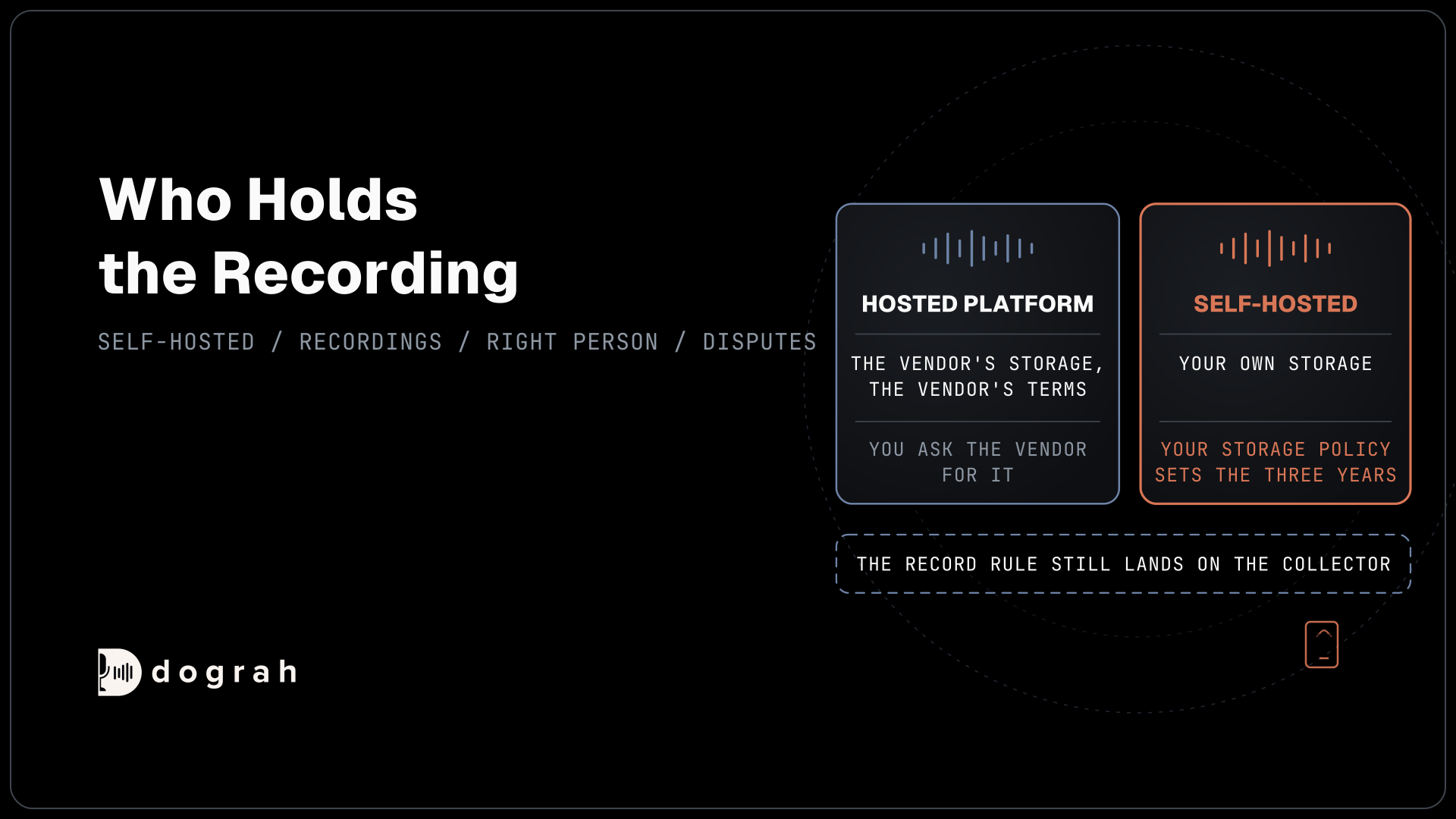
Every alarm call holds a passcode exchange and a description of someone's property, so where the audio goes matters. Self-hosting Dograh with open-weight speech and language models on the center's own servers keeps calls, recordings and transcripts inside its infrastructure. Using your own keys for hosted models moves the contract to you, but the audio still reaches those providers. Monitoring centers can see the setup in self-hosted voice agents for alarm monitoring, with alarm calls, passcode checks and the customer line on their servers.
Recordings and transcripts stay in storage until the team deletes them under its own policy. That same archive is useful on the other side: when a city or a customer questions a dispatch, the center has both attempts on record.
A QA Analysis node scores finished calls step by step, and a Sample Rate below 100 picks calls at random. Give it checks that matter here, such as whether the zone was named before the passcode matched, or whether a danger sign was heard without a transfer. View Trace opens a call's trace for the turn-by-turn timing. Self-hosted Dograh has no per-minute platform fee, but servers, model keys and phone minutes still cost money. Dograh Cloud charges a 1¢-a-minute platform fee.
Where to start
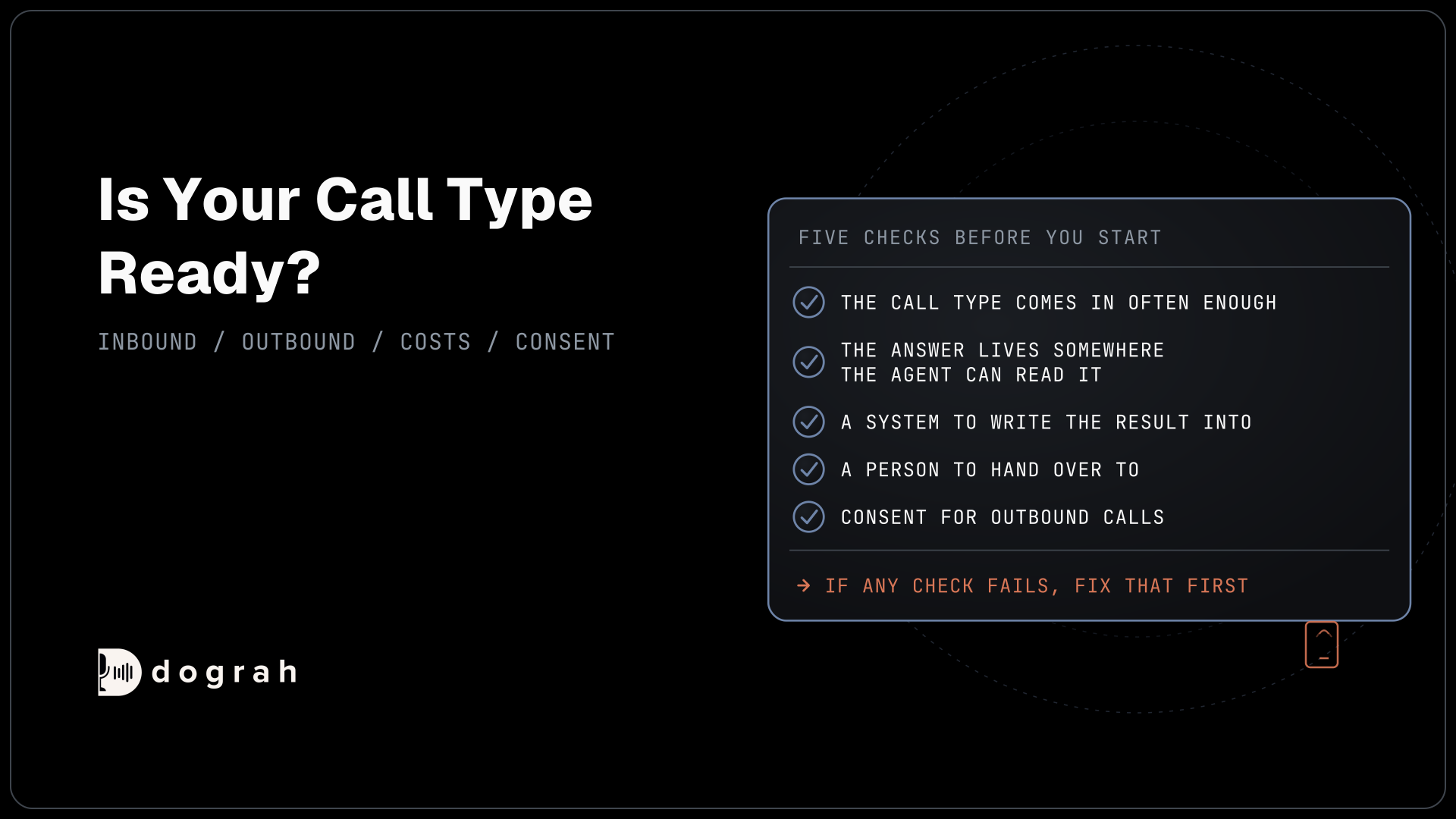
Start with the calls that carry the least risk. The customer line, and after-hours cover for it, let the team see how the agent handles real callers before it touches an alarm. Alarm-event calls come next, once the center's written procedure is mapped call by call and every danger sign has been tested over a real phone line.
Keep the operator in the loop from day one. Every outcome lands on an operator's screen, and every dispatch decision stays there.
The alarm-event call above has its own deep dive:
Glossary
- Enhanced confirmation
- The Monitoring Association's name for confirming an alarm with two or more investigative calls or other means before any dispatch request. It was formerly called ECV.
- Call list
- The ordered contacts a monitoring center may reach for an account: usually the premises, then the owner, then keyholders. The center's software moves the agent down it one call at a time.
- Alarm validation score
- The Level 0 to Level 4 score in ANSI/TMA-AVS-01 that a monitoring center passes to the 911 center with a call for service. It comes from the center's process, not from the agent.
- Pre-Transfer Message
- The fixed line or recorded clip that plays before the Transfer Call tool dials the destination. The safety line for a caller in danger goes here.