
AI voice agents for abandoned loan application recovery call applicants who started an application and stopped. After verifying the person, the agent names the step that stalled and says why the lender needs it, then asks the lender's portal to send a link to resume. It adds no offer and never says how likely approval is.
Key Takeaways
- Helping someone finish what they started is a help call, with nothing offered.
- The agent names the stalled step, and the lender's portal sends the resume link.
- Questions about approval or loan terms always go to a loan officer.
An applicant who stopped at the pay stub step needs a nudge and a link. We cover keeping it a help call, starting from the step that stalled, sending the resume link, saying nothing on approval and handling a changed mind in Dograh. It is part of our guide to dormant customer reactivation.
Finishing an application is a help call
A call that only helps an applicant finish what they asked for is a service call, and keeping it that way keeps the consent simple. With nothing new offered, it is generally an informational call that needs prior express consent, such as the phone number the person gave on the application.
Offer a bigger loan or a lower rate on the same call, and it becomes a sales call. That pulls in the Telephone Consumer Protection Act (TCPA). The Federal Communications Commission's calling rules want prior express written consent before an artificial voice pitches a borrower anything, and since the FCC's 2024 ruling on AI-generated voices, an AI voice is one of those.
So the prompt carries one firm rule: the agent offers nothing new. If the applicant asks about a larger amount, the agent records the question for a loan officer. For industries outside lending, win-back and drop-off recovery draws the same line between help and selling. Confirm your consent wording with counsel before the first campaign.
Start the call from the step that stalled
The lender's own system knows where each applicant stopped, so it starts the call and passes that step to the agent. When an application has sat unfinished for the time you set, such as a day, your loan origination system (LOS) starts the call through the API Trigger and passes the stalled step, such as "income documents" or "identity check". A daily list uploaded to a campaign works too.
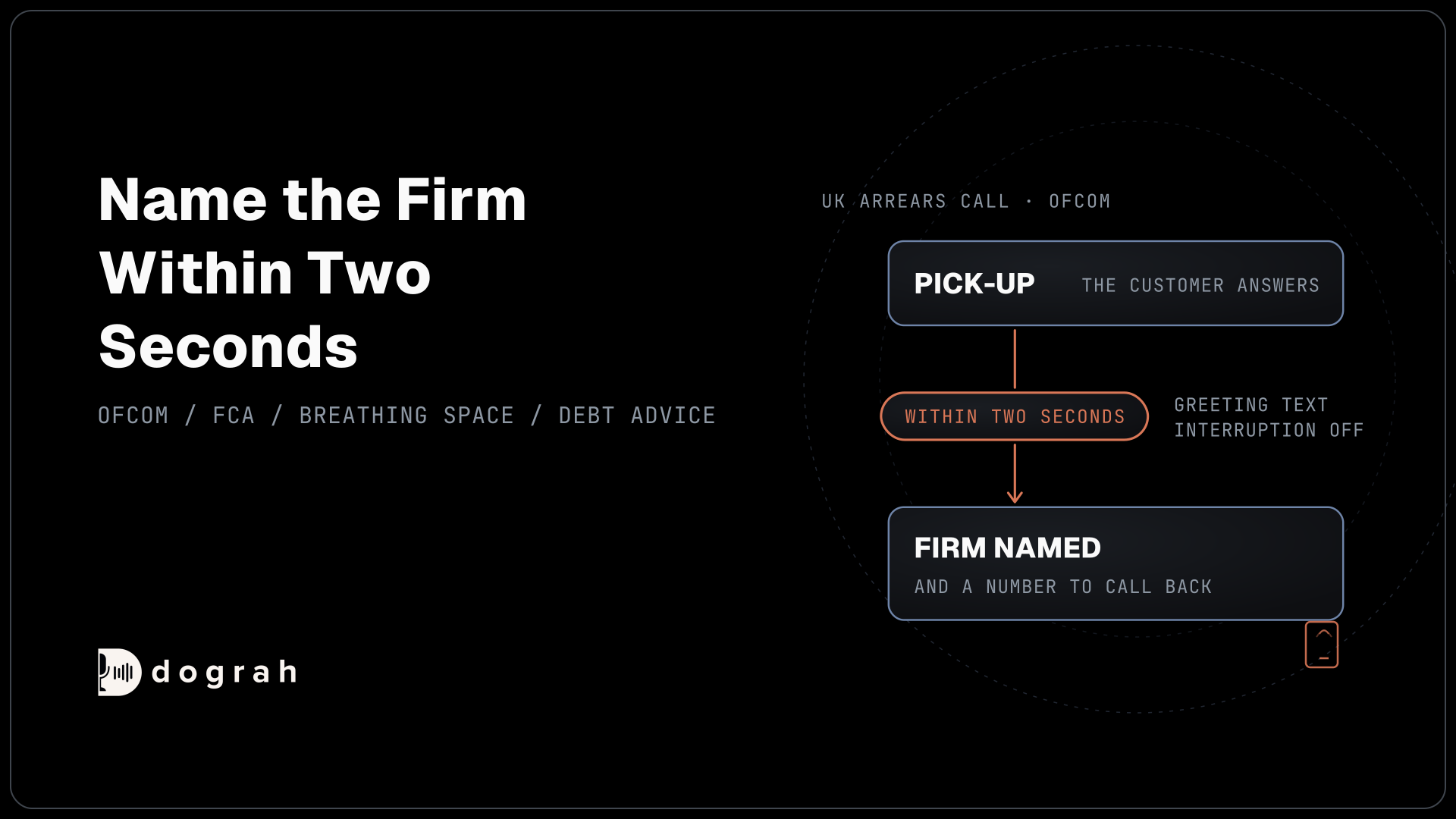
An unexpected call about a loan can sound like a scam. One in five adults, 20%, told the Federal Reserve's survey of household finances that they experienced financial fraud or scams in 2025. Put the lender's name in the Greeting Text, the fixed line Dograh speaks word for word as the call connects. When applicants should hear that an automated assistant is on the line, by your choice or because local law requires it, that disclosure belongs in the same greeting. For that greeting, turn off the Start Call node's Allow Greeting Interruption setting, as it arrives switched on and an applicant who speaks over the opening would otherwise miss the disclosure.
The agent then asks for the applicant by name, which only finds the right person. Before it mentions the application, it asks for an approved check, such as date of birth or the last digits of the application reference. It never asks for a one-time code, and bank account and card numbers stay off the call too. If the application stalled at the identity step, that step has its own call, covered in AI voice agents for KYC and identity verification in fintech.
Name the step, then send the link
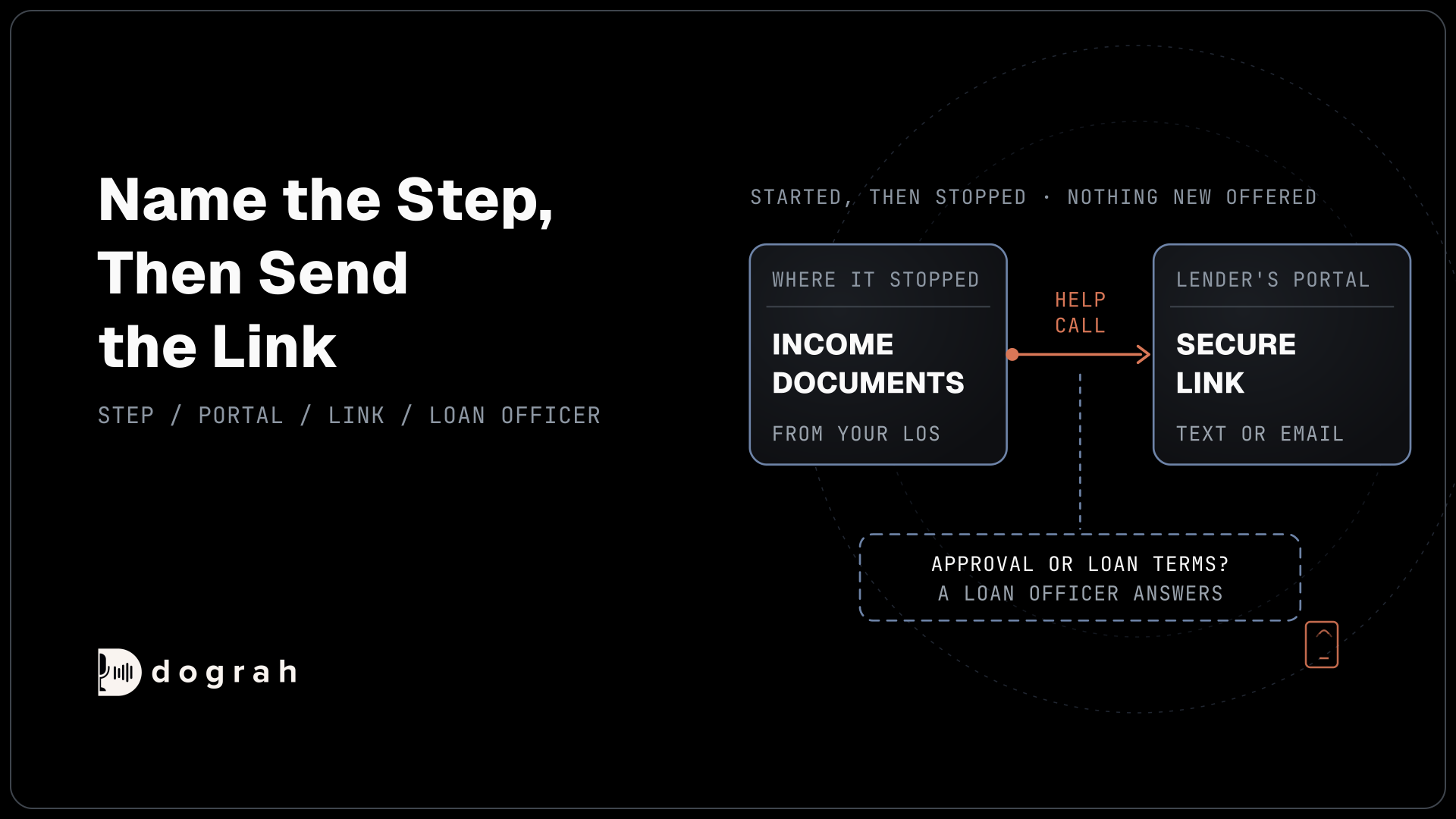
Once the applicant is verified, the agent names exactly what is missing and why the lender needs it, read from the LOS and never guessed. "We still need your second pay stub, because the lender checks two months of income" helps far more than "your application is incomplete".
Next, an HTTP API tool asks the lender's portal to send the applicant a secure link to resume, by text or email. The applicant finishes in the portal. Nothing is collected on the call, and the agent never asks anyone to read out a document number, because the recording keeps whatever is said.
Regulation B, the rule that carries out the Equal Credit Opportunity Act (ECOA), allows this kind of call. Under Regulation B's notice rule, a lender may tell an applicant by phone what information is missing, and sends the written notice if the application stays incomplete. Whether a half-filled online form already counts as an application depends on the lender's own procedures, so the lender's compliance team decides that. The call works the same way either way. The 30-day notice clock for submitted applications is covered in AI voice agents for loan application screening.

Open Source Alternative to Vapi / Retell
Self-hosted voice agent platform — no per-minute fees
dograh-hq/dograh
Star on GitHub
Nothing about approval, ever
The agent never says how likely approval is, and never hints at it. A refusal of credit, or credit on worse terms than the applicant asked for, is an adverse action under Regulation B's definitions, and the lender's system decides it and explains it in a written notice. A voice agent that says "you'll probably qualify" or "that might be a problem" has given an answer nobody can stand behind.
The prompt sets the limits. The agent never comments on the applicant's chances or discourages anyone from finishing. It explains rates or fees only as the LOS returns them, and questions about approval or loan terms go to a loan officer through Transfer Call, which works on Twilio, Telnyx, Plivo, Cloudonix and Asterisk ARI. The officer's line rings first, and the applicant is joined only once someone picks up, after the agent has written the question to the LOS.
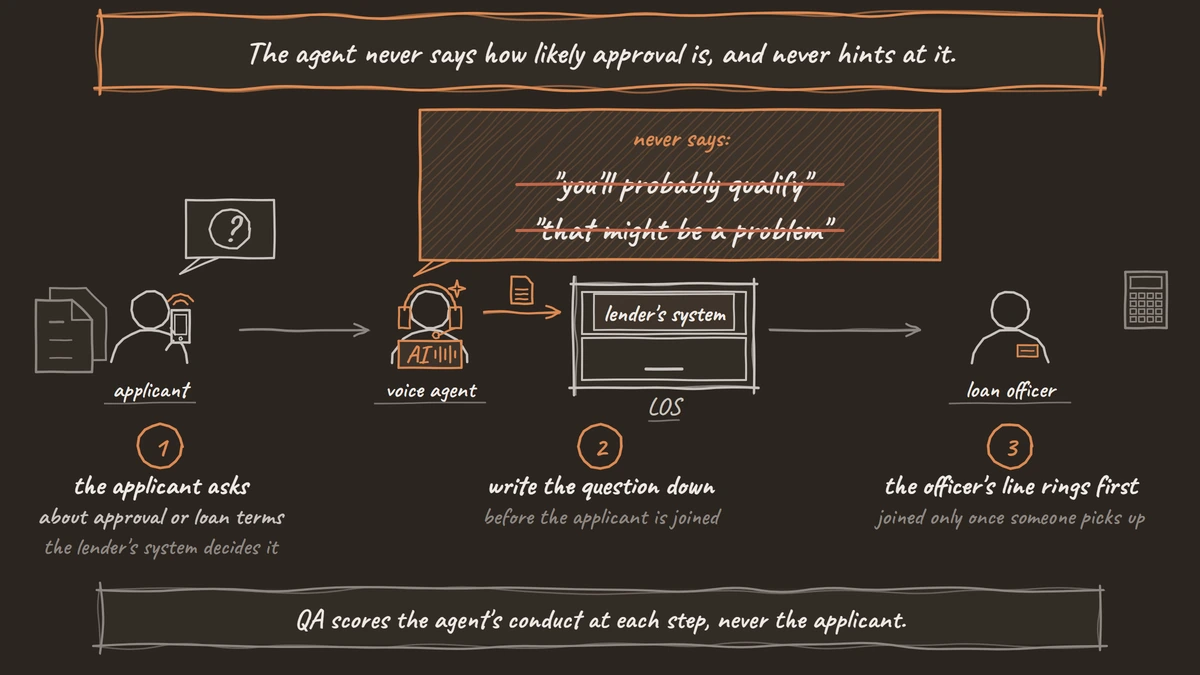
If nobody answers within the 30-second default, the applicant stays with the agent, and the prompt tells it to record a callback request in your system. QA scores the agent's conduct at each step, never the applicant. Write its instructions to flag any call where the agent spoke about approval or quoted a figure the LOS did not return.
Join the Dograh Community
Dograh is an OSS alternative to Vapi. Join our Slack community for queries, releases, best practices & community interactions.
When the applicant has changed their mind
Some applicants stopped on purpose, and the call records that and moves on. If the applicant says they no longer want the loan, the agent thanks them, records the answer as stated and writes it to the LOS. The lender's system withdraws or closes the file. The agent never argues and never tries a new offer.
A spoken request to stop calling is written to your system during the call, and your system keeps the number off the next list. A Webhook node sends the outcome after every call, so the loan file shows what happened.
You can self-host Dograh or run it on Dograh Cloud, and self-hosted, applicants' answers and recordings stay on the lender's own servers. Start with one stalled step, such as income documents. Test the agent on a real phone line, then read the early transcripts for any word about approval.
Glossary
- Help call
- A call that only helps a person finish something they asked for, such as a loan application, with nothing new offered. It is generally informational, and adding an offer turns it into a sales call.
- Notice of incompleteness
- The written notice a lender sends naming the information an application still needs and a reasonable time to provide it. Regulation B lets the lender say this by phone first, with the written notice to follow if the file stays incomplete.
- Adverse action
- Under Regulation B, a refusal of credit or an offer on worse terms than the applicant asked for. The lender's system decides it and gives the reasons, so the voice agent never hints at it.
- Loan origination system (LOS)
- The lender's system that holds each application and its status. It starts the recovery call with the stalled step and receives every answer and outcome afterwards.