
AI voice agents for KYC and identity verification in fintech call customers who stopped partway through onboarding. After a check, the agent names the step still open, confirms details the customer already typed and sends documents through the app with a secure upload link. Your onboarding system and your partner bank's program decide whether the customer passes.
Key Takeaways
- Verify the customer before the agent names any part of their application.
- Documents, selfies and ID numbers go through the app, never read aloud.
- In a bank partnership, the partner bank's program sets which questions the agent asks.
The longer a stalled applicant waits for a call, the less they recall why they stopped. We cover who gets the call, the check before naming the open step, confirming details without documents, whose program sets the questions and the flow in Dograh. It builds on our guide to KYC and identity calls.
Which customers get the onboarding call
The onboarding call goes to people who started opening an account and stopped before KYC was done. Your app already knows who they are and which step is open, such as a missing proof of address or a name that did not match. The sooner the call comes after the stall, the more the customer remembers about why they stopped.
Your app starts each call itself. When a step stays open past the time you set, it calls the API Trigger with the customer's number and a reference to the application in the context. Our post on API triggers covers what to send.
Many of these customers are new to formal banking. The Federal Reserve's household survey found that 94% of adults had a bank account in 2025, but only 77% of adults with incomes under $25,000 did. A patient call that explains one step can matter more to them than another email.
This is a service call, and the script keeps it that way. Under the Telephone Consumer Protection Act (TCPA), the FCC's 2024 ruling on AI-generated voices treats an AI voice as an artificial voice, so a call to a mobile needs the customer's prior express consent. Help to finish an application with nothing offered is generally a service call. Add a sign-up bonus or a card offer, and it becomes a sales call that needs prior express written consent.
Verify before naming the open step
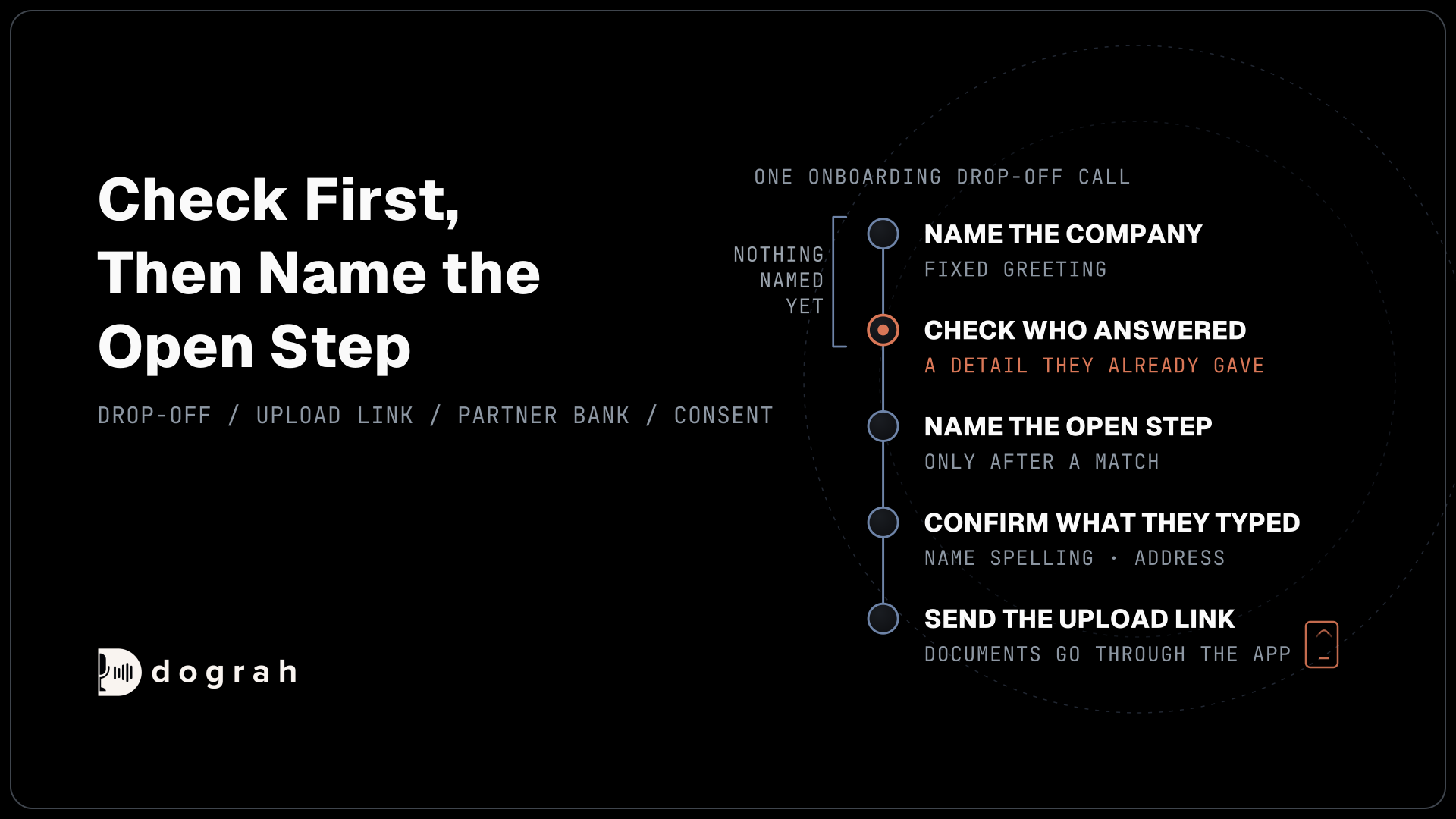
A phone number finds the application, but it does not prove who answered. The Greeting Text names your company in fixed words, and the agent then asks for a check before it says anything about the account. Nothing about the application is named until the check passes, not even which step is open.
The check uses details the customer already gave you, such as the date of birth they entered. The agent sends the answer to your onboarding system, which replies match or no match. If it fails, the agent says it can't discuss the application on this call and points the customer to the app. If someone else answered, the agent asks when the customer is free and ends the call politely.
Getting this order right matters because these calls look like scams from the outside. The FTC recorded $15.9 billion in reported fraud losses in 2025. A real onboarding call names the company, asks only what the customer already shared and never asks for a password or code.

Open Source Alternative to Vapi / Retell
Self-hosted voice agent platform — no per-minute fees
dograh-hq/dograh
Star on GitHub
Confirm details, never collect documents
Most of the call goes on checking what the customer already gave you. The agent reads back what the customer typed, such as the spelling of a legal name or an apartment number, and asks whether it is right. An HTTP API tool sends each confirmed or corrected detail to your onboarding system. The agent records the correction as the customer said it, and the transcript and recording stay the exact record.
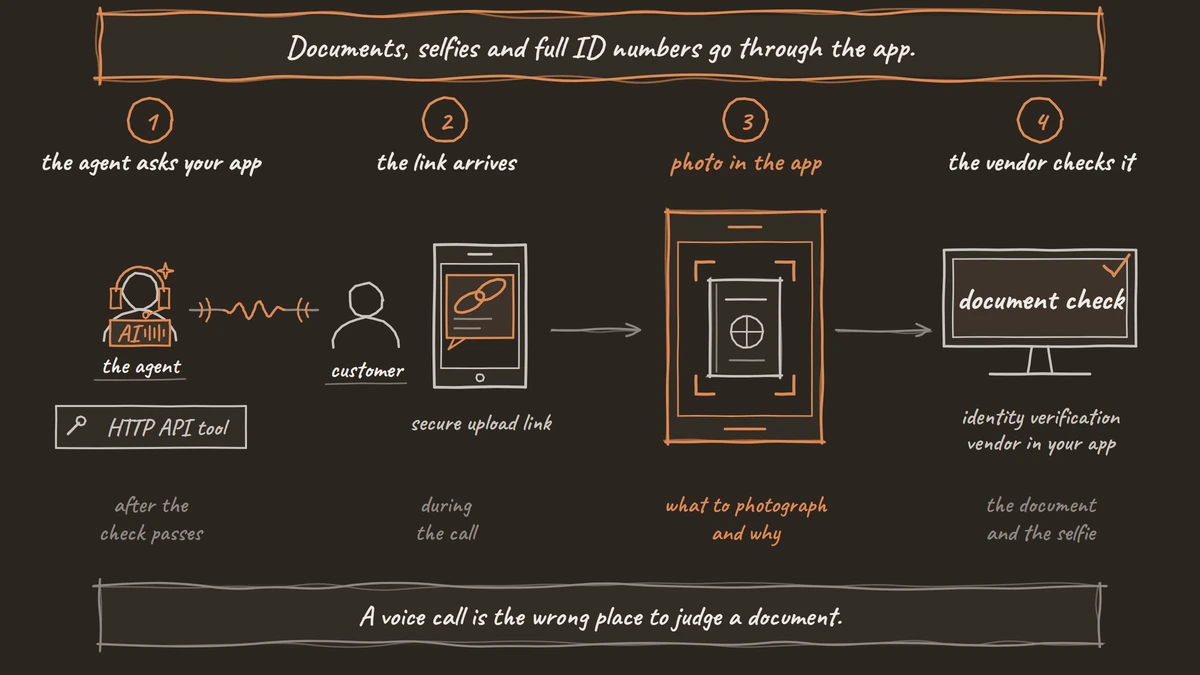
Documents, selfies and full ID numbers go through the app. If the open step is a document, an HTTP API tool asks your app or messaging provider to send a secure upload link during the call, and the agent explains what to photograph and why. The identity verification vendor in your app checks the document and the selfie. That split matters more now that fakes are easy to make. FinCEN's alert on deepfake media describes fraudsters using AI-made identity documents to get past verification. A voice call is the wrong place to judge a document.
Income and credit stay out of this call. The agent never asks about salary, debts or spending, because those questions start a credit decision. A loan application that stalls is a different call, covered in abandoned loan application recovery.
Whose program sets the questions
The questions on the call come from your identification program, or your partner bank's. The US Customer Identification Program rule asks a bank to collect at least a name, date of birth, address and identification number before opening an account, and to form a reasonable belief that it knows who the customer is. Contacting the customer is one of the listed ways to verify without documents, so the call can be one input to that belief.
Many fintechs are not banks. In a bank partnership, the bank's identification program usually sets the questions, and your contract says who owns which step. The rule lets a bank rely on another institution's program only in narrow cases, so do not assume the bank will accept the fintech's checks as its own. Confirm with counsel which step your call covers before the first campaign.
Join the Dograh Community
Dograh is an OSS alternative to Vapi. Join our Slack community for queries, releases, best practices & community interactions.
Setting up the drop-off call in Dograh
The agent follows a short flow that greets, checks, names the open step, confirms the details, sends the link and closes. Each step is a node with its own prompt, and the tools that read the application attach only to the steps after the check.
The verify tool and the update tool both point at your onboarding API. Add a Preset Parameter named workflow_run_id with the value {{initial_context.workflow_run_id}}, so your system can ignore a duplicate write if a request repeats. A tool message such as "Let me pull that up" plays while the request runs. If your API returns an error, the agent gets one error result, so tell it in the prompt to say the system is busy and that the team will follow up.
Some customers want a person. Transfer Call works on Twilio, Telnyx, Plivo, Cloudonix and Asterisk ARI, and Dograh calls the onboarding team first, connecting the customer only when someone answers. An HTTP API tool writes the open step and the confirmed details to your system before the transfer, so the person starts with the context.
Add your product and partner bank names to the Dictionary in the agent's Settings, then test on a real phone line, because phone audio is harder on speech-to-text than a browser test. Applicants' names and addresses pass through every model on the call, so a self-hosted install with open-weight models keeps that audio on your own servers. Such an install sends anonymous usage telemetry by default, which you switch off by setting ENABLE_TELEMETRY=false and removing POSTHOG_API_KEY.
Glossary
- KYC drop-off
- An application that stops before the identity steps are finished, such as a missing document or a name mismatch. The onboarding call goes to these customers and names the open step after a check.
- Partner bank program
- The identification program of the bank that holds the accounts a fintech offers. It usually sets which questions a KYC call asks, and the contract says which step each side owns.
- Identity verification (IDV) vendor
- The service inside a fintech's app that checks ID documents and selfies. It judges the document, so the voice call never needs to hear or see one.
- Prior express consent
- The customer's permission, usually given with their number at sign-up, to be called with an artificial or AI voice. A help call with no offer generally rests on it.