
Australian AI phone calls follow the Do Not Call Register Act and an industry standard that covers synthetic voices. Sales calls run 9 am to 8 pm weekdays and 9 am to 5 pm Saturdays, after a Register wash within 30 days. On Dograh, the open-source AI voice agent platform, self-hosted or on Dograh Cloud, campaigns hold those hours.
Key Takeaways
- The industry standard already covers calls made with a synthetic voice.
- No telemarketing calls on Sundays or the seven national public holidays.
- The number you show must take return calls for at least 30 days.
Australia's calling rules already name synthetic voices, which helps AI agents. We cover the two instruments behind them, calling hours and holidays, what a synthetic-voice call must offer, the Register and calls you answer. Then we close with a launch checklist and talk about Dograh's settings.
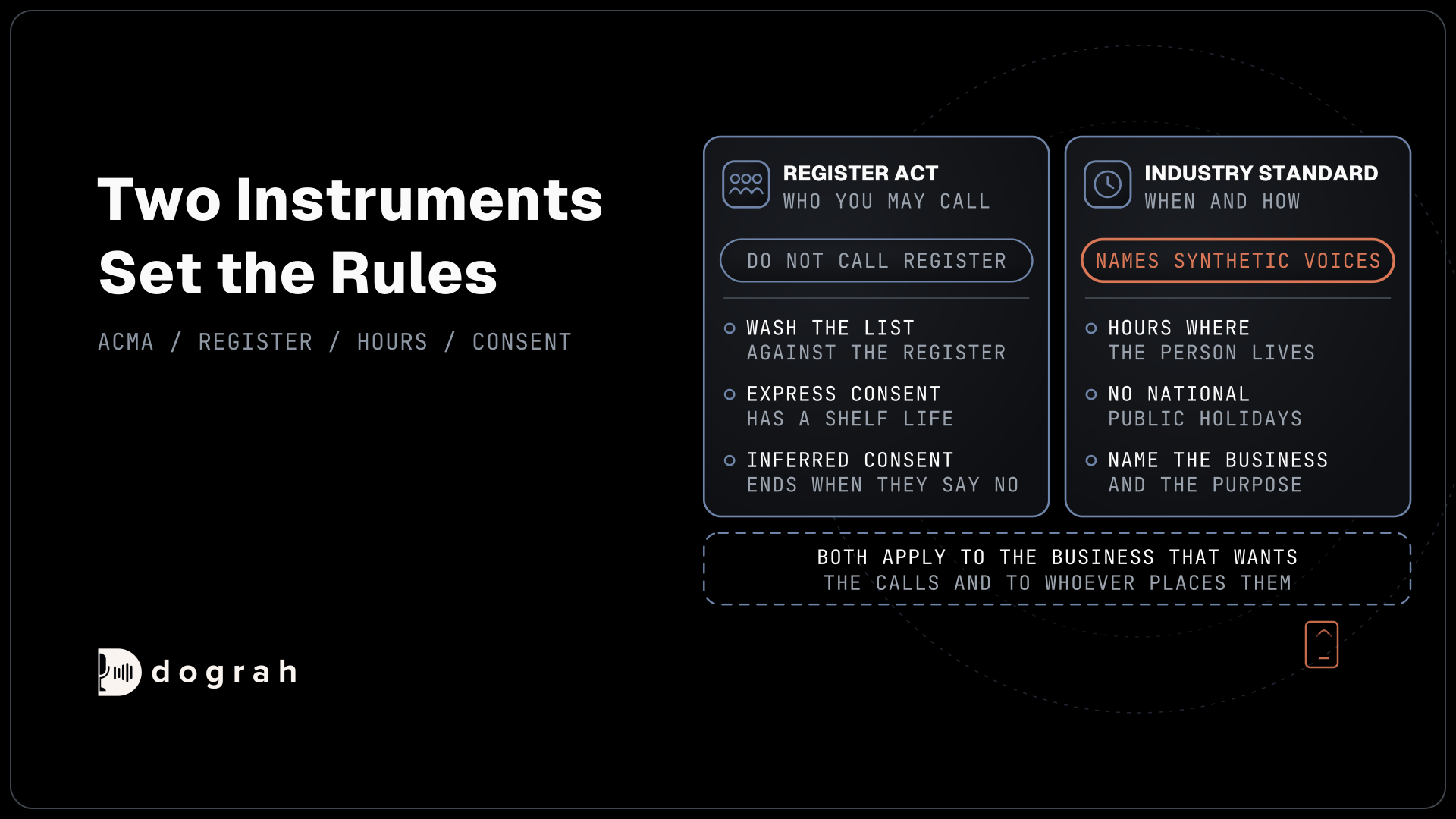
Two instruments set the rules
Two pieces of law decide almost every outbound AI call in Australia. The Do Not Call Register Act 2006 decides who you may call, and the Telecommunications (Telemarketing and Research Calls) Industry Standard 2017 decides when and how. The Australian Communications and Media Authority (ACMA) runs the Register and enforces both.
The standard applies to telemarketing calls and research calls, whether a person or a machine makes them. It names recorded and synthetic voices directly, so an AI agent is not a gray area here. The Spam Act 2003 is about electronic messages, so it governs the text your agent might send after a call, while the call itself sits under these two.
Both apply to the business that wants the calls and to whoever places them. Outsourcing the dialing to an agency, or to an AI agent, does not move the duty off your business. For the US, UK and EU rules, see our post on whether AI phone calls are legal.
Calling hours and public holidays
The clock that counts is the one where the person lives. Telemarketing calls are allowed from 9 am to 8 pm on weekdays and from 9 am to 5 pm on Saturdays, with no calls on Sundays. Research calls get a little more room, from 9 am to 8.30 pm on weekdays and from 9 am to 5 pm on both Saturday and Sunday.
Neither kind of call may go out on a national public holiday. The standard lists seven, which are New Year's Day, Australia Day, Good Friday, Easter Monday, Anzac Day, Christmas Day and Boxing Day, plus any weekday that stands in for one of them. State-only holidays such as the Melbourne Cup are not on the list, though many teams skip them anyway.
Time is set by the person's usual home address where you know it. Australia runs several time zones, and daylight saving moves some of them and not others. In summer, 8 pm in Sydney is still 7 pm in Brisbane, because Queensland keeps standard time, so a single national schedule calls some people too late and others too early.

Open Source Alternative to Vapi / Retell
Self-hosted voice agent platform — no per-minute fees
dograh-hq/dograh
Star on GitHub
What a synthetic voice must say and do
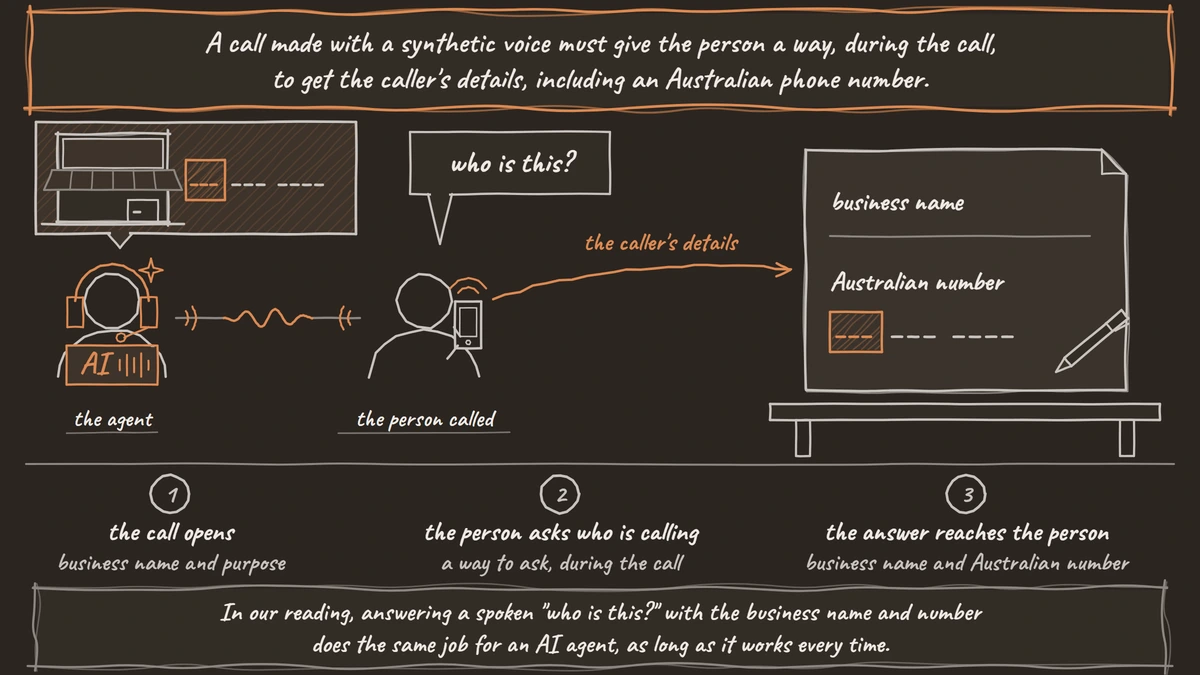
The opening has to tell the person who is calling and why. At the start of a telemarketing call, the caller gives the name of the business, the business that caused the call if it is a different one, and the purpose of the call. A person calling also gives their given name, but that part falls away when the call is made only with a recorded or synthetic voice.
What replaces it is a way to ask. A call made with a synthetic voice must give the person a way, during the call, to get the caller's details, including an Australian phone number. The standard's own example is pressing a button. In our reading, answering a spoken "who is this?" with the business name and number does the same job for an AI agent, as long as it works every time. Write the callback number into the agent's instructions digit by digit, so it is never left to the model to work out.
Two more duties follow. Calling line identification has to be switched on, and the number shown must be able to take return calls for at least 30 days after the call. And when the person asks to end the call, or makes clear they don't want it to go on, the caller must end it at once.
The Do Not Call Register and consent
The Register decides who you may ring for sales. You may not make a telemarketing call to a registered number without consent, unless you washed your list against the Register within the 30 days before the call and the number was not on it. The Register's guide for businesses explains washing a list and the consent rules.
Consent has a shelf life. Express consent given with no end date expires three months after it was given. Consent can also be inferred from an existing relationship, such as a bank calling its card holder about its home loans, but it ends as soon as the person says they don't want the calls. Keep the date and the way each person agreed with your list, since the three-month clock starts on that date. Charities, schools, government bodies, political parties and researchers are exempt from the Register for calls with no commercial purpose, yet they still follow the standard. Our post on AI voice agents for insurance in Australia applies these rules to renewals and offers.
Calls that sell nothing sit apart. An appointment reminder, a payment reminder or a reply to the person's own inquiry is generally not a telemarketing call under the Register Act, and calls people place to an AI receptionist are not calls you make at all. The Privacy Act 1988 still covers the recording and the transcript. Those points are our reading of the law, and the rest is the rules as we read them, so confirm with counsel how they apply to your calls before launch.
Checklist before any outbound AI call in Australia
Run every campaign through this list before the first number is dialed. Each check comes from the ACMA rules above, and the section after it shows the agent setting behind it.
- Decide whether each call is telemarketing, research or a service call.
- Wash the list against the Register within the 30 days before the campaign.
- Check that express consent with no end date is less than three months old.
- Split the list by time zone, keeping Queensland apart from New South Wales, Victoria and Tasmania.
- Set weekday, Saturday and research hours separately, with no telemarketing on Sundays.
- Pause campaigns on the seven national public holidays and their substitute days.
- Name the business and the purpose in the opening line.
- Let the person ask who is calling at any point and get an Australian number.
- Show a number that takes return calls for at least 30 days.
Join the Dograh Community
Dograh is an OSS alternative to Vapi. Join our Slack community for queries, releases, best practices & community interactions.
Setting up Australian calls in Dograh
The opening line should be fixed, so it never drifts. In Dograh, the Greeting Text on the Start Call node plays word for word the moment the call connects, so put the business name and the purpose there. Then tell the agent in its prompt to answer "who is calling?" at any point with the business name and your Australian callback number. If you want to tell callers they're speaking with an automated assistant, write it in the Greeting Text along with the business's name.
Hours and holidays live on the campaign. A campaign's Call Schedule runs in one Timezone with Time Slots by weekday, so run one campaign per zone, such as Australia/Sydney, Australia/Brisbane and Australia/Perth. A named zone follows its own daylight saving, which is why Brisbane gets its own campaign. Leave Sunday out of telemarketing schedules, and pause the campaign on each national holiday, since the schedule has no holiday calendar. Research calls get campaigns of their own, because their evening and Sunday hours differ.
A stop request has to end the call and reach your list. Give the agent a path to an End Call node when the person asks to stop, and the call disposition do_not_call marks the outcome. A Webhook node then sends it to your own list before the next upload. Should someone ask to speak to a person, Dograh calls the destination first and connects the caller only when someone answers, on Twilio, Telnyx, Plivo, Cloudonix and Asterisk ARI. Our post on AI receptionists for tradies in Australia covers the inbound side.
Recordings live on the servers that run the calls. To keep call data in Australia, self-host in an Australian data center, with the speech and language models hosted there as well. Running Dograh yourself means no per-minute platform fee. You still pay for servers, model keys and phone minutes, and your team looks after the database and upgrades. Support comes from the open-source community, and Enterprise adds custom SLAs. If you would rather not host it, Dograh Cloud runs it for a 1 cent a minute platform fee.
Glossary
- Telemarketing call
- A call that offers or advertises goods or services, or seeks donations. Reminders and replies to a person's own inquiry generally fall outside the Register Act.
- Washing a list
- Checking your call list against the Do Not Call Register. A wash protects calls made within 30 days of it to numbers that were not registered.
- Synthetic voice
- A computer-generated voice, which includes an AI agent's voice. The industry standard requires such calls to offer a way to get the caller's details during the call.
- Calling line identification (CLI)
- The number shown to the person you call. In Australia it must be switched on and take return calls for at least 30 days.