
AI dental treatment plan follow-up calls reach patients who accepted a treatment plan but never booked it. The agent verifies the patient, says a plan from their last visit is still open and offers to book the appointment. Every cost, insurance, financing or "do I really need this" question goes to the practice's treatment coordinator.
Key Takeaways
- The call offers the appointment the dentist recommended and nothing else.
- Cost and insurance questions go to the treatment coordinator, written down first.
- The procedure is never named before verification or on voicemail.
This post is part of our guide to AI voice agents for hospitals and health systems, and expands the last call in AI voice agents for dental clinics, treatment-plan follow-up. Here we design that call and show how it runs in Dograh, the open-source AI voice agent platform we build.
Treatment patients accept but never book
A treatment plan the patient said yes to but never booked is care the dentist already recommended, still waiting. Cost is part of why plans stall. CareQuest Institute's 2025 oral health equity survey, based on 9,450 adults, puts the number of US adults who travelled abroad for dental care in 2025 at about 10 million, a choice the report ties to care that is no longer affordable.
Dentists also want treatment decisions kept with people. In the ADA Health Policy Institute's Q2 2026 report, four out of five dentists said they have no interest in using AI for patient treatment recommendations.
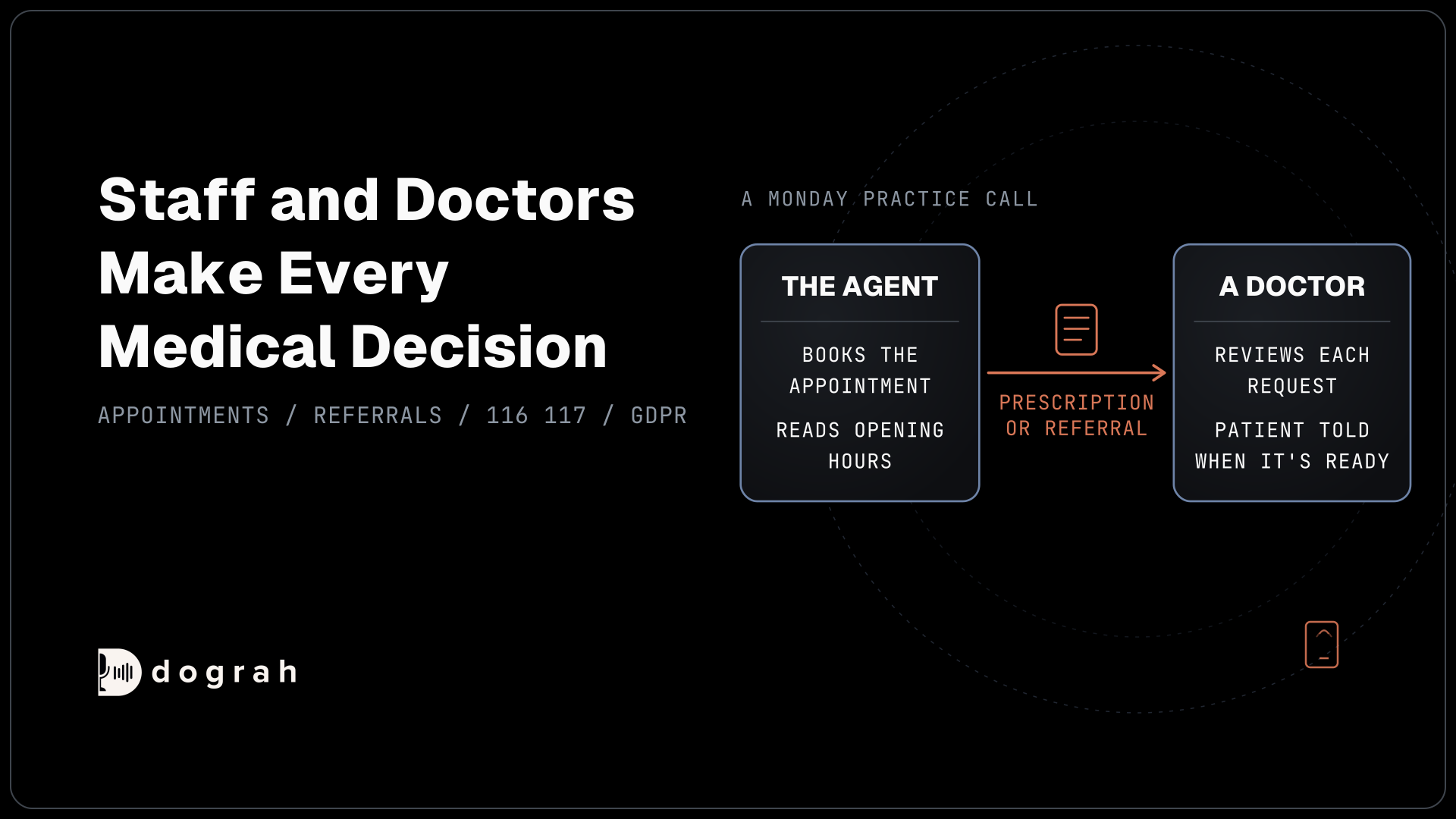
That sets the job. The agent offers the appointment the dentist already recommended and books it. It never explains the treatment, argues for it or talks about price. Those conversations belong to the dentist and the treatment coordinator.
The call list comes from the PMS
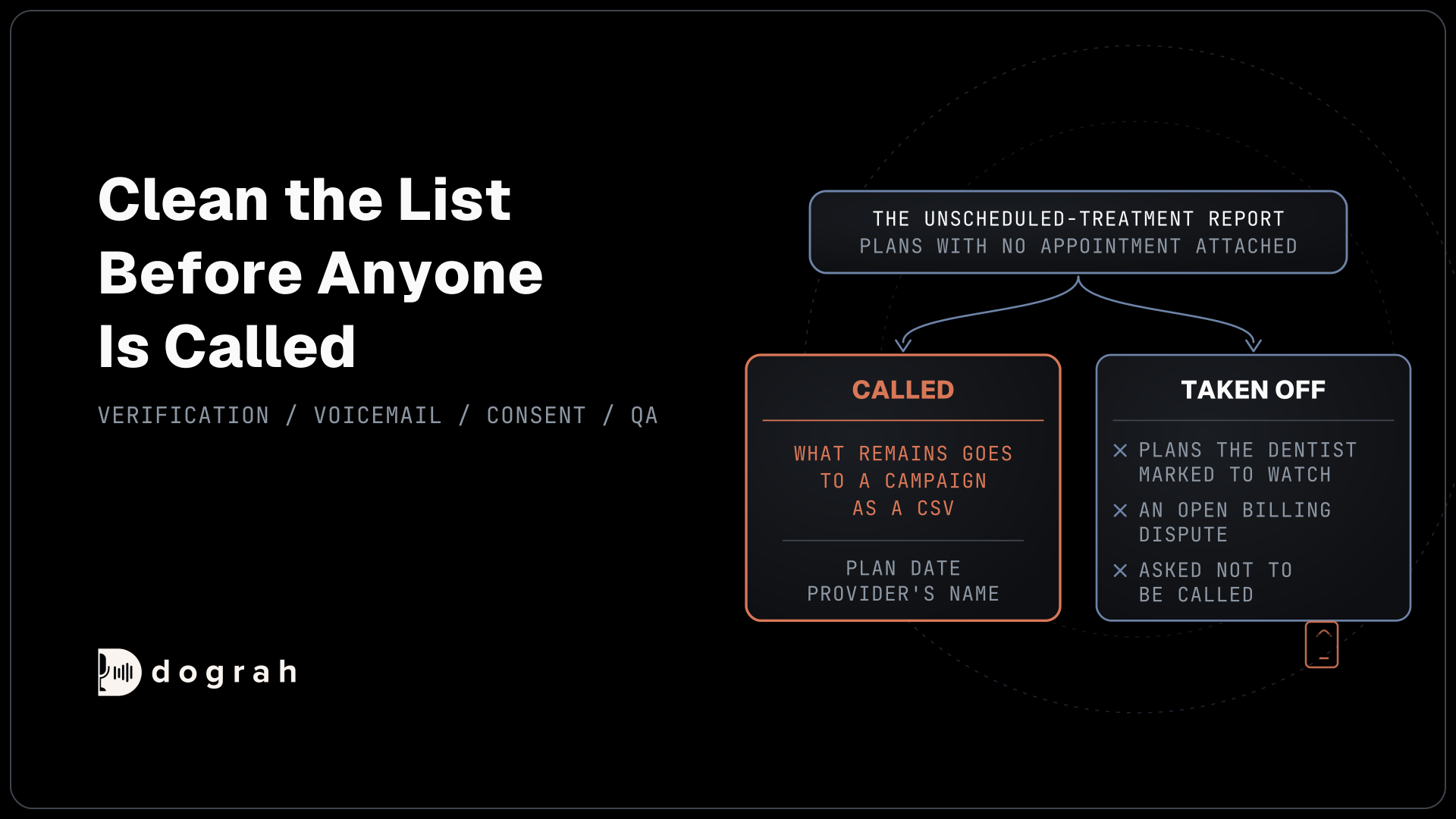
The practice management system (PMS) already knows which plans were accepted and never scheduled. Most systems can produce an unscheduled-treatment report: plans presented or accepted, with no appointment attached. That report is the call list.
Clean it before anyone is called. Plans the dentist marked to watch rather than treat come off. So do patients with an open billing dispute, and anyone who asked not to be called. What remains goes to a campaign as a CSV, with columns such as the plan date and the provider's name. Each column becomes a variable the agent can use once the patient is verified.
The practice's own list decides how often a patient hears from you. Retries count within one campaign, and you set them from 0 to 10, so a patient who declined comes off the next list in your own system. Calling hours run in one time zone per campaign, so a group spread across time zones runs one campaign per zone.

Open Source Alternative to Vapi / Retell
Self-hosted voice agent platform — no per-minute fees
dograh-hq/dograh
Star on GitHub
What the agent says, and when
The call opens with fixed words and gets to the plan only after verification. The Greeting Text on the Start Call node names the practice and asks for the patient, such as Hi {{initial_context.first_name | there}}, this is Lakeside Dental. Allow Greeting Interruption is on by default, so switch it off and the practice name always plays in full.
Then the agent confirms the patient with an approved check, such as a date of birth. Only after that does it say there is an open treatment plan from their visit on the plan date, with the dentist's name if it helps. It still doesn't name the procedure unless the patient asks, and it offers to book the next step, reading openings from the PMS through an HTTP API tool.
If the patient says not now, the agent records that and ends politely. It does not push, offer a discount or warn about what happens if they wait. A voicemail carries the practice name and a callback number only, never the plan or the procedure. Our post on front-desk privacy in dental clinics sets out what the agent may say on each dental call.
Cost and insurance go to the coordinator
Every question about cost, insurance, financing or whether the treatment is really needed goes to the treatment coordinator. The agent never quotes a fee or guesses what insurance will cover, and it never takes a payment on the call.
Before handing over, the agent writes the patient's question to the PMS through an HTTP API tool, in the patient's own words. Then Transfer Call rings the coordinator, on Twilio, Telnyx, Plivo, Cloudonix or Asterisk ARI. Dograh calls the coordinator first and connects the patient only when someone answers. On Twilio, it can also play a short spoken introduction to both people before connecting them.
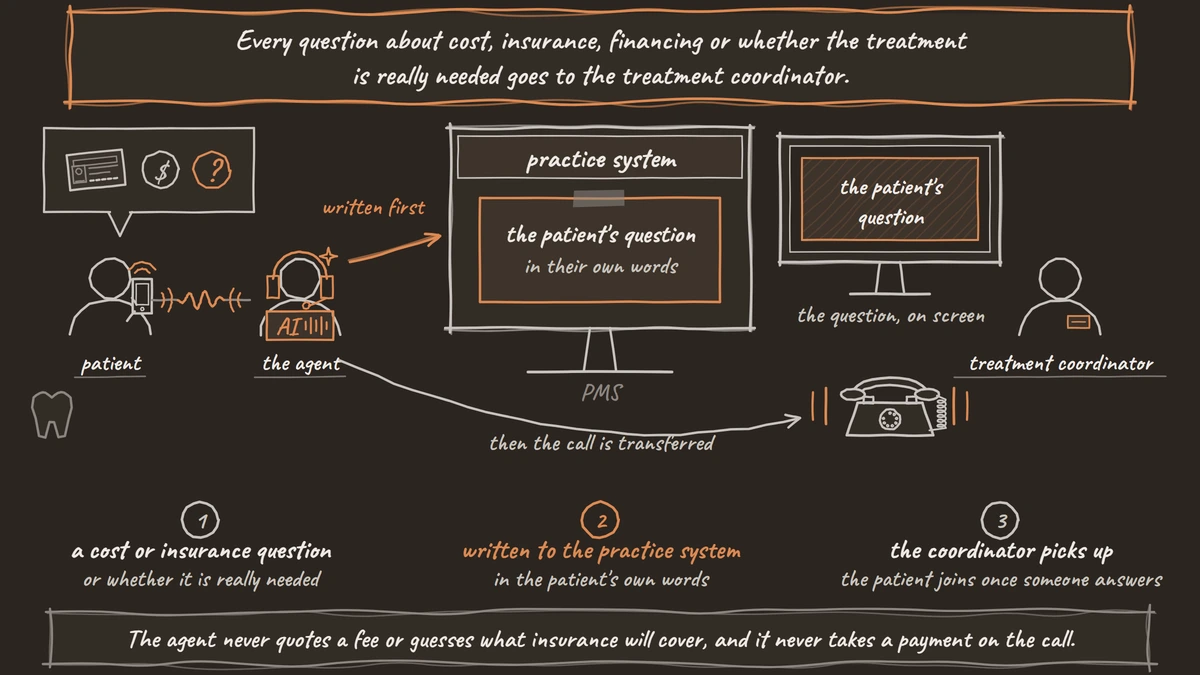
No summary passes with the transfer by default, which is why the note goes in first. If nobody picks up within 30 seconds, the default timeout, the patient stays with the agent. The agent offers a callback and writes that request to the PMS, so the coordinator has the question in front of them when they call back.
Treatment, not marketing
A call about the patient's own treatment, from their own practice, sits outside the definition of marketing in the Health Insurance Portability and Accountability Act (HIPAA) Privacy Rule. That changes if the practice is paid by a third party whose product or service the call describes. A follow-up about a crown the dentist recommended stays a treatment communication. Add a sponsored product or a cosmetic offer and it can become marketing.
The Federal Communications Commission's calling rules are tighter. A call about an open plan can read as promoting a service, so it generally relies on consent the patient gave, collected at registration, rather than on the healthcare exemption alone. AI voice agents for dental recall and recare outreach works through that exemption and opt-outs by voice. Treat this as informed commentary on the rules and confirm your own setup with counsel.
Join the Dograh Community
Dograh is an OSS alternative to Vapi. Join our Slack community for queries, releases, best practices & community interactions.
Checking calls and keeping the data
The fixed lines are the same on every call, so checks focus on the parts the model words. Once calls end, Dograh's built-in QA reads a sample and scores each step on its own. Write its prompt to flag any call where the agent described the treatment, mentioned a price or pressed after a no.
Treatment plans are protected health information. When the practice self-hosts Dograh on its own servers, recordings and transcripts stay there, and no business associate agreement (BAA) with Dograh is needed. Model providers that hear the call may need their own BAA when they handle that information, unless the models run on your servers as well. A phone carrier may need one too, depending on what it keeps, and many, Twilio for example, provide one. Servers in a cloud account such as AWS, Google Cloud or Azure need a BAA with that cloud provider, and the practice's own data centre does not.
Self-hosted Dograh has no per-minute platform fee, but servers, model keys and phone minutes still cost money. Dograh Cloud charges a 1¢-a-minute platform fee. Each call keeps a full trace of what the agent heard and said.
Start with plans from the last three months and one coordinator on the transfer line. Read the first week's transcripts before widening the list.
Glossary
- Unscheduled-treatment report
- A practice management system report listing treatment plans that were presented or accepted but have no appointment attached. Cleaned of exclusions, it becomes the follow-up call list.
- Treatment coordinator
- The staff member who explains costs, insurance and financing for a treatment plan. In this call design, every money or need question goes to them, never to the agent.
- Definition of marketing
- The HIPAA Privacy Rule's test for marketing. It leaves out a provider's communications about the patient's own treatment, unless a third party pays the provider to describe its product or service.
- Transfer Call
- Dograh's tool for handing a live call to a person. Dograh calls the destination first and connects the caller only when someone answers. It passes no summary by default, so notes are written to the PMS first.