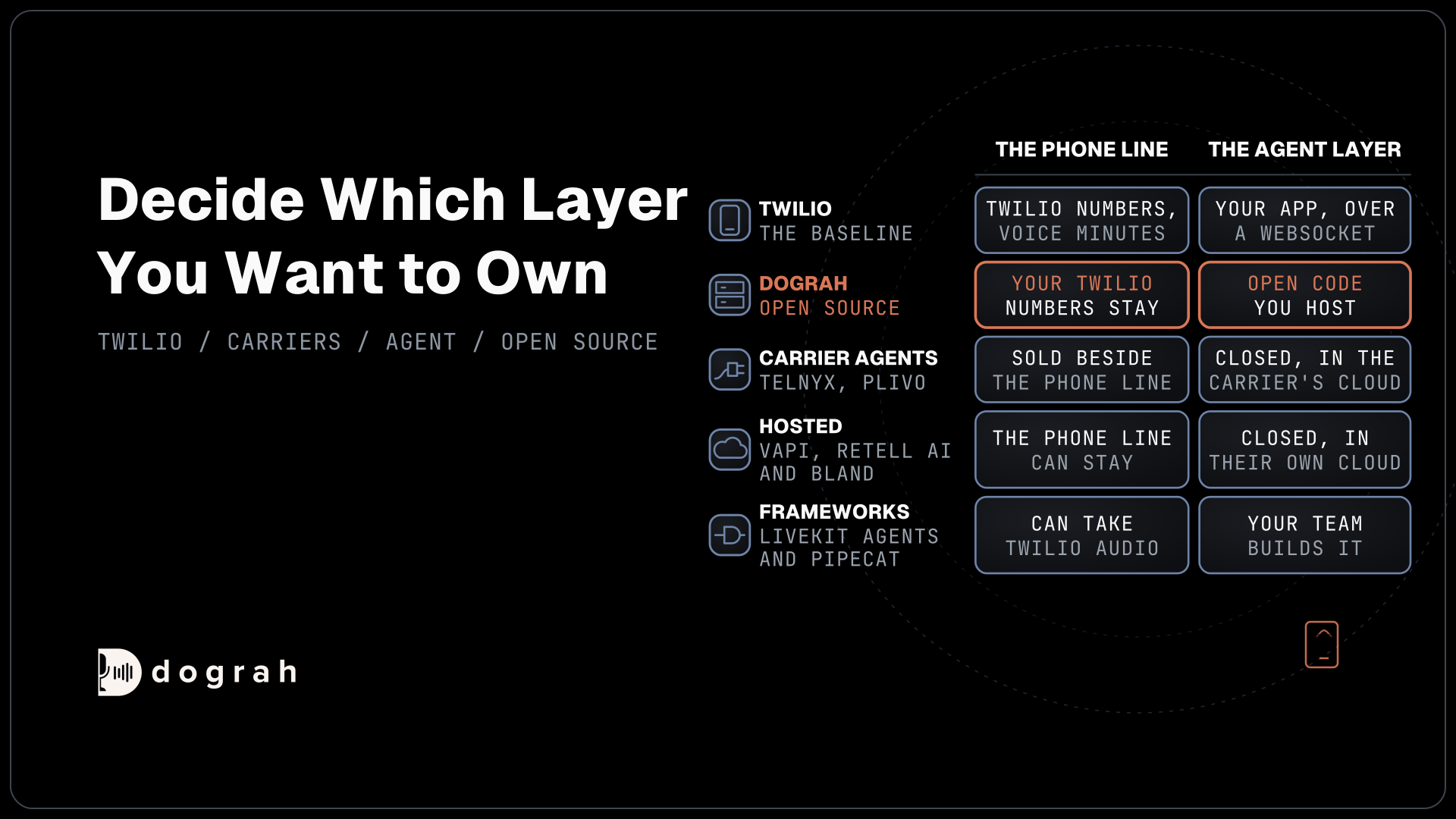

Twilio voice AI alternatives are divided into carriers with their own agents, hosted platforms and open-source platforms. For teams that want to own the agent layer, Dograh is the open-source AI voice agent platform, self-hosted or on Dograh Cloud, and it runs on Twilio. Telnyx and Plivo are the carriers, and Vapi, Retell AI and Bland the hosted platforms.
Key Takeaways
- ConversationRelay costs $0.07 a minute, and Twilio bills voice minutes on top.
- Telnyx and Plivo now sell carrier agents at $0.05 and $0.03 a minute.
- Dograh is open source and runs on Twilio, so your numbers can stay put.
Twilio sells the phone line plus ConversationRelay, a speech layer your own app drives over a WebSocket. Below we compare the routes in one table, start with open-source Dograh on your existing Twilio numbers, then cover carrier agents, hosted platforms, a priced month, staying and moving.
Twilio voice AI alternatives in one table
Twilio is the baseline row, and each alternative replaces a different layer of it. Twilio's conversational AI prices list ConversationRelay at $0.07 a minute and say voice costs are calculated separately, so a US local inbound call adds $0.0085 a minute for the line.
| Option | Open source | Where it runs | How it bills | What you get |
|---|---|---|---|---|
| Twilio ConversationRelay (baseline) | No | Twilio's cloud, with your app running the model and logic over a WebSocket | $0.07/min plus voice minutes ($0.0085/min US local inbound) | Speech-to-text from Deepgram or Google and voices from ElevenLabs, Google or Amazon. You build the agent |
| Dograh | Yes, BSD 2-Clause | Your own servers with Docker Compose, on-prem on Enterprise, or Dograh Cloud. Runs on Twilio and other carriers | Self-hosted, no per-minute platform fee. Dograh Cloud, 1¢/min platform fee. Models and phone extra | A full platform with the Agent Builder, a visual call-flow canvas, Campaigns, call transfer, QA and call traces |
| Telnyx Voice AI | No | Telnyx's cloud, with dedicated Telnyx-hosted infrastructure on Enterprise | $0.05/min voice engine, LLM per token, telephony extra. Growth has a $2,000/mo minimum | Orchestration, speech-to-text and text-to-speech in one rate, on Telnyx numbers |
| Plivo AI Agents | No | Plivo's cloud | $0.03/min, excluding telephony | Vibe Agent builder, simulation testing, transfer to a person and a knowledge base included |
| Vapi | No | Vapi's cloud | $0.05/min hosting plus models and phone. Core $29/mo for 10 calls at once | A developer platform set up in code or the dashboard |
| Retell AI | No | Retell's cloud, with on-prem through Enterprise sales | $0.055/min voice infrastructure plus $0.015/min telephony and the model. $0.07 to $0.31/min all in | Hosted agents with 20 calls at once included |
| Bland | No | Bland's cloud, with on-prem or VPC on Enterprise | Start $0.14/min. Build $0.12/min plus $299/mo | One rate that includes Bland's own models |
| LiveKit Agents and Pipecat | Yes, Apache-2.0 and BSD-2-Clause | Your own servers | Free to self-host | Frameworks. Your team builds the phone wiring, call history and QA |
Twilio's row bills for a speech layer and leaves the agent to your app, while the carrier agents bundle orchestration with speech and the hosted rows add hosting on top of the models. Only Dograh, LiveKit Agents and Pipecat hand you the code, and Dograh is the one that arrives as a working product with the builder, phone connections and QA in place.
Dograh: open code you host, on Twilio or other carriers
Dograh keeps the whole agent layer in its GitHub repository under the BSD 2-Clause license, and it joins Twilio the way your own code would. You add a Twilio configuration under Telephony with your Account SID and Auth Token, and the call audio reaches the agent through Media Streams. The numbers stay in your Twilio account, and saving an inbound workflow on a number points it at Dograh straight away. The same agent also runs on Telnyx, Plivo, Vonage, Exotel, Vobiz and Cloudonix numbers, or on your own Asterisk PBX through ARI when you self-host. Our post on the open-source alternative to Twilio voice AI walks through that route call by call.
Dograh runs the call flow, the tools and the telephony as the orchestration layer, and you pick the speech-to-text, LLM and voice provider for each agent as a separate layer. That can be the platform's own models, your keys with a provider you already pay, or open-weight models on your own machines. Bring your own key (BYOK) moves the contract to you, while the call audio still reaches that provider. If a caller wants a person, Transfer Call hands them over on Twilio, Telnyx, Plivo, Cloudonix and Asterisk ARI. Dograh calls the destination first and connects the caller only when someone answers, and on Twilio it can play a short spoken introduction to both people. A no-answer, busy or failed attempt goes back to the agent, and the call continues. On Exotel, Vobiz and Vonage numbers, the agent books a callback request in your system through an HTTP API tool.
Where the platform runs is your choice, which is the gap the other closed rows cannot close. Every carrier agent and hosted platform in the table processes your calls in its provider's cloud under code you cannot read. Dograh can run on your own servers with Docker Compose on a machine with at least 8 GB of RAM and 4 vCPUs, on Dograh Cloud, or on-prem inside your own data perimeter on the Enterprise plan.
The cost follows from that choice. Self-hosted Dograh has no per-minute platform fee, but servers, model keys and phone minutes still cost money. Dograh Cloud charges a 1¢-a-minute platform fee. Twilio keeps billing its minutes and Media Streams either way. A self-hosted install runs 10 calls at once by default, a setting you can raise, and the Cloud pay as you go plan includes 10. Running it yourself means the server, the database and every upgrade belong to your team, with community support on the open-source edition and custom SLAs on Enterprise.

Open Source Alternative to Vapi / Retell
Self-hosted voice agent platform — no per-minute fees
dograh-hq/dograh
Star on GitHub
Carriers that sell their own AI agents
Two carriers now sell an agent beside the phone line, which makes them the closest swap for ConversationRelay. Telnyx's Voice AI pricing puts the voice engine at $0.05 a minute for orchestration, speech-to-text and text-to-speech in one rate. The language model is billed per token, and SIP trunking starts at $0.0032 a minute inbound plus a $0.002 Voice API fee. Telnyx says a production agent lands near $0.06 a minute, each call is billed in 60-second increments, and the Growth and Enterprise plans carry $2,000 and $5,000 monthly minimums.
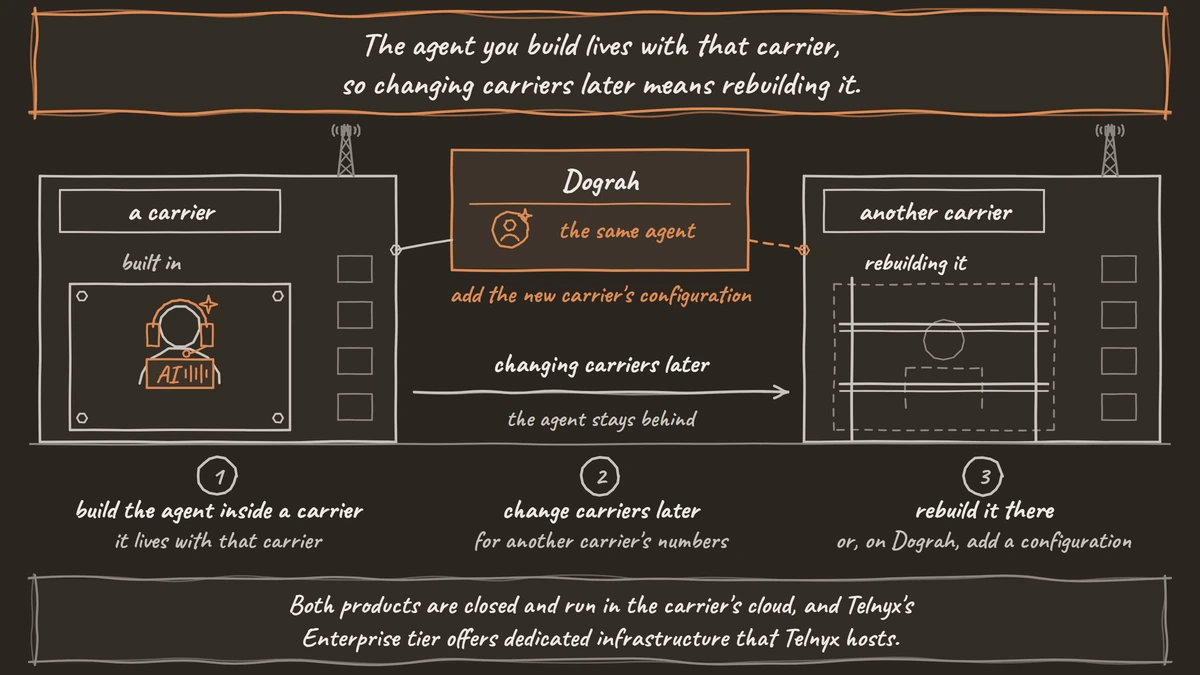
Plivo's pricing page lists its AI Agents at $0.03 a minute, excluding telephony, with concurrent calls, the Vibe Agent builder, simulation testing, transfer to a person and a knowledge base included. You build in code or in its no-code AI Agent Studio and can bring your own language model. Both products are closed and run in the carrier's cloud, and Telnyx's Enterprise tier offers dedicated infrastructure that Telnyx hosts. The agent you build lives with that carrier, so changing carriers later means rebuilding it. Our post on Plivo alternatives compares the carriers themselves.
Hosted platforms that sit on top of a carrier
Vapi, Retell AI and Bland run the agent in their own cloud and reach callers through a carrier, so they replace the agent layer while the phone line can stay. Vapi's pricing page lists $0.05 a minute for hosting, with speech, the model, the voice and the phone line billed on top. Without a package, Vapi allows 4 calls at once, Core lifts that to 10 for $29 a month, and HIPAA handling costs $2,000 a month as an add-on.
Retell AI charges $0.055 a minute for voice infrastructure and $0.015 for its telephony, with no charge when you bring your own SIP trunk, and puts the all-in range at $0.07 to $0.31 a minute. Every account gets 20 calls at once, then $8 a month for each extra. Bland's Start plan costs $0.14 a minute with its own models included, 10 calls at once and 100 calls a day, and Build costs $0.12 a minute plus $299 a month for 50 at once.
All three are closed source. Bland lists on-prem or VPC deployment on Enterprise, and Retell sells on-prem through Enterprise sales, so the self-hosted version is a closed product under a contract. On every other plan, your calls are processed in the provider's cloud.
Open-source frameworks: LiveKit Agents and Pipecat
LiveKit Agents and Pipecat are strong building blocks for a team that wants to write the product itself. LiveKit Agents is Apache-2.0, with its turn-detection models under a separate LiveKit Model License, and Pipecat is a BSD-2-Clause Python framework that Dograh is built on. Either one can take Twilio audio, but your team writes the call history, the transfer logic and the QA before the first caller hears the agent.
What 3,000 inbound minutes cost
A worked example shows how differently these rows bill. Take 3,000 minutes a month of inbound calls to US local numbers and price the platform and phone lines each option charges.
| Option | Platform and phone line for 3,000 minutes | Still to add |
|---|---|---|
| Twilio ConversationRelay | 3,000 x $0.07 = $210, plus 3,000 x $0.0085 = $25.50 voice, so $235.50 | Your language model and the server for your WebSocket app |
| Telnyx Voice AI | 3,000 x $0.05 = $150, plus 3,000 x ($0.0032 + $0.002) = $15.60, so $165.60 | Language model tokens, with each call rounded up to the minute |
| Plivo AI Agents | 3,000 x $0.03 = $90, plus 3,000 x $0.0055 = $16.50 inbound, so $106.50 | Your language model if you bring one |
| Vapi | 3,000 x $0.05 = $150 | Speech, language model, voice and phone |
| Retell AI | 3,000 x $0.055 = $165, plus 3,000 x $0.015 = $45, so $210 | The language model |
| Bland Start | 3,000 x $0.14 = $420 | Its own models are in the rate |
| Dograh Cloud on Twilio | 3,000 x $0.01 = $30, plus 3,000 x ($0.0085 + $0.0044) = $38.70 Twilio, so $68.70 | Your speech, language model and voice keys |
| Dograh self-hosted on Twilio | No platform fee, $38.70 Twilio | Servers and your model keys |
The rows price different layers. Twilio, Telnyx and Plivo fold speech into their rate, the hosted platforms add hosting on top of the models, and the Dograh rows carry only the platform and the line, with every model billed by its provider on your key. Compare like with like by adding your real model costs to each row.
Join the Dograh Community
Dograh is an OSS alternative to Vapi. Join our Slack community for queries, releases, best practices & community interactions.
When staying on Twilio makes sense
ConversationRelay is a sensible home for a team that already has a strong backend and wants Twilio to handle the speech. It picks Deepgram for speech-to-text and ElevenLabs for the voice by default, with Google and Amazon as other choices, and callers can interrupt on any input out of the box. Our explainer on Twilio ConversationRelay covers its settings and what you still build.
Twilio also keeps numbers, Media Streams, recording and SIP in one account and one bill, and new accounts get $15 in credit to test with. Teams rarely leave because the API lets them down. They move when the per-minute speech line grows with volume, or when they want to own the agent, its prompts and its call data.
What moving off Twilio takes
If Twilio stays your carrier, moving means rebuilding only the agent. Your ConversationRelay app already holds the prompt, the tool calls and the handoff rules, so treat that code as the spec for the new agent.
On Dograh Cloud you describe the agent on the Agent Builder's "Create an agent" page, approve the "Your agent requirements" card and let it build. On a self-hosted install, the builder works with a Dograh Service Key, or you can lay out the flow on the canvas yourself. Then add your Twilio account under Telephony and assign the agent as one number's Inbound workflow.
Plan the cutover number by number. Saving the workflow switches that number at once, and removing it later leaves the number blank instead of restoring your old webhook, so note the old voice URL first. Test every transfer over a real phone call, because a browser test call cannot run one. If you also leave Twilio as a carrier, add the new carrier's configuration and port the numbers before the agent moves.
Picking your Twilio voice AI alternative
Decide first which layer you want to own. If you want open source, your own servers or on-prem inside your network, start with Dograh, on your current Twilio numbers or another carrier, with an Enterprise contract when you need on-prem. If one carrier bill matters most, price Telnyx Voice AI and Plivo AI Agents with your model costs added. If a hosted rate suits you, price Vapi, Retell AI and Bland at your own minutes. And if your team wants to write the product, LiveKit Agents and Pipecat are good bases. Whichever way you lean, move one number first and listen to real calls before the rest follow.
Glossary
- ConversationRelay
- Twilio's speech layer for AI agents. It turns the caller's speech into text for your app over a WebSocket and speaks the replies, for $0.07 a minute plus voice minutes.
- Media Streams
- Twilio's raw audio feed for a call, sent to your server over a WebSocket for $0.0044 a minute. It is how Dograh receives Twilio calls.
- Voice engine
- Telnyx's name for its agent runtime, priced at $0.05 a minute for orchestration, speech-to-text and text-to-speech together, with the language model billed per token.
- Bring your own key (BYOK)
- Connecting your own model provider account to the platform. You own the contract and pay the bill, and the call audio still travels to that provider.